
Kyler Olson Ripleys Believe it or Not Reptiles
* Kyler Olson
*Ripley’s Believe it or Not! Reptiles, Lizards, and Prehistoric Beasts *Reptile by Eye. Witness Books *What is a Reptile? by Feana Tu’akoi *True or False: Reptiles by Scholastic *Alligators and Crocodiles by Gail Gibbons *Magic Tree House: Snakes and Other Reptiles by Mary Pope Osborne *Remarkable Reptiles by Extreme Animals *Slither and Crawl: Eye to Eye with Reptiles by Jim Arnosky
* See You Later, Alligator! by Annie Kubler * Old Bumpy Alligator by Patricia Blanchard * Yertle the Turtle by Dr. Seuss * Verdi (snake) by Janell Cannon * Franklin the Turtle book series by Paulette Bourgeois * Cold-Blooded: Reptiles by Magic School Bus * Miles and Miles of Reptiles by Dr. Seuss * The Legend of Lizard Lick: A North Carolina Folktale by Josh Taylor * A Girl and Her Gator by Sean Bryan * How to Hide a Reptile by Ruth Heller
*Students will take part in a thematic unit on reptiles. This unit will integrate reading and writing with social studies, science, mathematics, art, music, and physical education. *Students will develop an understanding of where reptiles live around the world and the reasons why they live there. *Students will analyze how a reptile’s physical features allow them to adapt to their natural environment. *Students will become more knowledgeable about a variety of reptiles.
* Students will read various fiction and non-fiction books about different reptiles and their unique characteristics and environments in reading circles. * Students will infer why certain books with reptiles as characters may be fiction and non-fiction. * Students will share their books and other readings with the class and explain what makes the animals or characteristics specific to that of a reptile. * Read Ripley’s Believe it or Not! Reptiles, Lizards, and Prehistoric Beasts and discuss extraordinary reptile facts. * Read Alligators and Crocodiles and have a grand conversation about the differences between the two.
* Students will write a descriptive story about reptiles from the ideas they currently have from previous knowledge. * Students will write personal journal entries on their thoughts and opinions towards reptiles after reading nonfiction selections. * Students will write vocab from “What is a Reptile? ” on the word wall. * Students will identify why reptiles cannot live in semi-cold temperatures year-round. * Students will compare and contrast reptiles. * Students will write a story containing a main character that is a particular reptile. * Students will write from the story in the perspective of the reptile and how they feel about how some people are afraid or grossed out by them, while some are interested and curious.
**The classroom will have a designated area for learning about reptiles called “the swamp”** *The class will go to “the swamp” and perform actions and sounds that some reptiles make. * Slither and “Ssssss” like a snake * Chomp your hands like an alligator * Move in slow motion like a turtle or tortoise *Students will use alligator, crocodile, snake, and lizard in order to tell about their reptile characters. *Students will present a “daily fact” about reptiles that they find on their own.
* Students will watch and listen to “Cold-Blooded: Reptiles” by Magic School Bus. * Students will listen to audio recordings online of several different reptiles. * The class will create, record, and listen to their reptile noises. * Students will listen to classmates share personal poems, stories, and group projects about reptiles. * Students will listen to the teacher read aloud from a reptile book every day after lunch. * The class will have a zoologist come in to talk about reptiles to the class. * The zoologist can explain and demonstrate to the class how to safely handle reptiles when encountered with one.
* National Geographic * Video gallery: http: //video. nationalgeographic. com/video/player/kids/anim als-pets-kids/reptiles-kids * Planet Earth * Life: Reptiles and Amphibians Photo Gallery * http: //www. bbcamerica. com/earth-night/photos/life-episode -2 -reptiles-amphibians/#255 * Magic School Bus: Cold Feet (Season 2, Episode 12) * Visit Reptile Gardens website: http: //www. reptilegardens. com/ * Watch What is a Reptile produced by Visual Learning Company * Students will take a closer look at why reptiles are the color that they are and their body surfaces. * Introduce Steve Irwin the Crocodile Hunter online and why he was a big name in the reptile industry. * “Reptiles of North Dakota” poster from the ND Game and Fish Department
*Teacher will create a classroom KWL chart to display their growing knowledge of reptiles. *Students will experiment with alligator, crocodile, turtle, and lizard puppet in order to display a class puppet show later on. *Students will illustrate their researched materials on poster boards. *Venn diagrams comparing reptiles with other species. *Students will display their Reptile drawings. *Create a Reptile word wall.
* Students will learn about the different kinds of reptiles and what sets them apart from one another. * Introduce and have students write letters to Steve Irwin: The Crocodile Hunter (now deceased). * Students will gain an understanding of the different life cycles that each reptile experiences throughout their lifespan. * Students will learn about overall characteristics that the entire reptile family shares. * Students will discover through research the differences between crocodiles and alligators. * Students will develop a checklist of why venomous snakes and other reptiles can be so dangerous and life threatening. * Touch and feel the snakeskin from the traveling kit. * The class will fundraise for a Corn Snake as a class pet and see how they live.
*Look up the endangered species list of reptiles. *How many are left from each group? *Solve birth rate numbers for projected years. *Talk about the less than and greater than signs: >, <, = *The alligator eats the bigger number. *Graph numbers least to greatest. *Play a dice game where two students roll a die and they decide whose number is greater than the other. *Students will solve word problems written by other students that contain facts involving reptiles.
* Students will identify where most reptiles live and why they must live there in order to survive. * Students will gain an understanding to why reptiles cannot survive in cold climates. * Display “Reptiles of North Dakota” poster from the ND Game and Fish Department in order to give students an idea of what types of reptiles actually can survive in North Dakota. * Watch and discuss: Backyard Habitat: Alligators and Green Anoles by Discovery Education * Research how many different types of reptiles live at certain locations of the world. * What does this tell us about reptiles? * Have a grand conversation about how reptiles impact human life in where they live.
* Read and sing songs in “the swamp” * Use crocodile, alligator, and snake puppets to assist with music and art and to also give some students a better idea of detail. * Create plays using the reptile puppets. * Discuss the ways can we create the texture of real reptiles through our art. * Create dioramas of reptile habitats. * Students will draw or create the reptile that they researched.
* Try to cross the swamp * Row your boat across the swamp before the alligators can get to you. * Try to cross the water * With teamwork, the class will use a limited amount of orange dots. They are to work together to find a strategy to cross the water with their dots or “lily pads”. However, both of someone’s feet touch the water at the same time, that person’s group starts over at the beginning. * Relate the ways that reptiles’ bodies and muscles work compared to our own. * Alligators and wildebeests * Same concept as “Sharks and Minnows”
* Pebblego. com * www. nationalgeographic. com * www. reptilegardens. com * Reptile Word Search, Word-o-rama, and jigsaw puzzles. * http: //www. learninggamesforkids. com/animalgames-reptile. html * Discovery Channel Planet Earth: Filming Reptiles and Amphibians. * http: //www. discovery. com/tvshows/life/videos/filming-reptiles-andamphibians/ * Snake shedding its skin * https: //www. youtube. com/watch? v=h. WXn 1 l. EKsu 0 * http: //www. reptilesmagazine. com/
*Large group: *KWL Chart, reading in “the swamp”, book sharing, PE activities, research sharing, compare and contrast alligators and crocodiles, class discussions, sharing personal poems, stories, and group projects, reptile word wall, visit Reptile Gardens online.
*Small group: *Research preparation, writing descriptive stories, math activities and dice game with >, <, =. *Individual: *Writing stories, writing poems, partial research on reptile, write letters to Steve Irwin.
* Connect. Students will make connections between how they are different from reptiles. * Connect. Students will make connections based on how alligators are structured for their specific environment just like how giraffes are for theirs. * Elaborate. Students will add details and examples to why the physical features and specific environments reptiles live in are so crucial. * Organize. Students prepare structures for their ideas in order to present them orally and visual to their peers. * Take Notes. Students will analyze the main idea of reptiles and highlight key familiarities between the different types.
*Students collaborate with one another to gain an understanding of how different reptile’s physical features helps and protects them in their surroundings. *Students will brainstorm the main differences between humans and reptiles, both anatomically and environmentally.
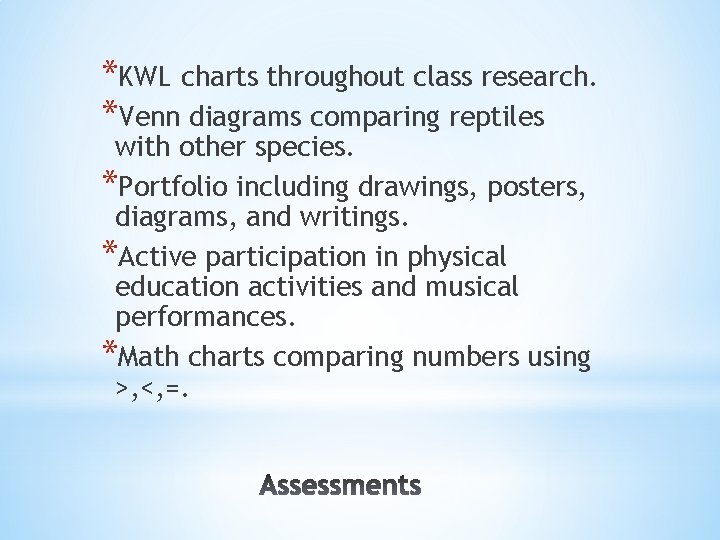
*KWL charts throughout class research. *Venn diagrams comparing reptiles with other species. *Portfolio including drawings, posters, diagrams, and writings. *Active participation in physical education activities and musical performances. *Math charts comparing numbers using >, <, =.
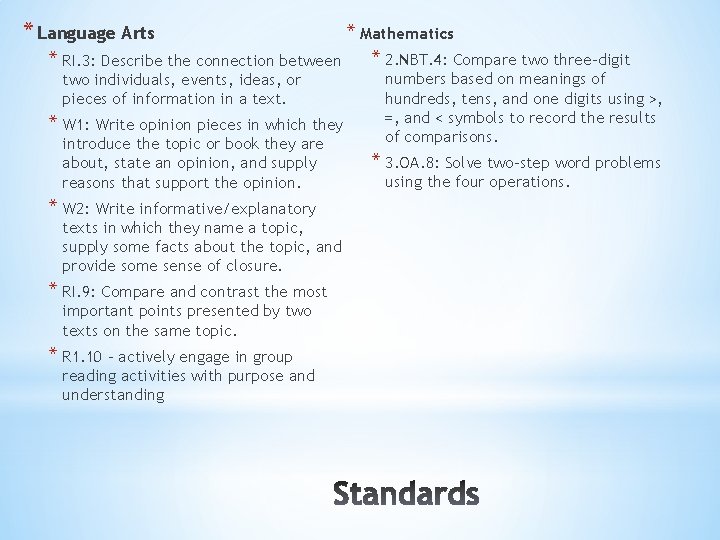
* Language Arts * Mathematics * RI. 3: Describe the connection between * 2. NBT. 4: Compare two three-digit two individuals, events, ideas, or pieces of information in a text. * W 1: Write opinion pieces in which they introduce the topic or book they are about, state an opinion, and supply reasons that support the opinion. * W 2: Write informative/explanatory texts in which they name a topic, supply some facts about the topic, and provide some sense of closure. * RI. 9: Compare and contrast the most important points presented by two texts on the same topic. * R 1. 10 – actively engage in group reading activities with purpose and understanding numbers based on meanings of hundreds, tens, and one digits using >, =, and < symbols to record the results of comparisons. * 3. OA. 8: Solve two-step word problems using the four operations.
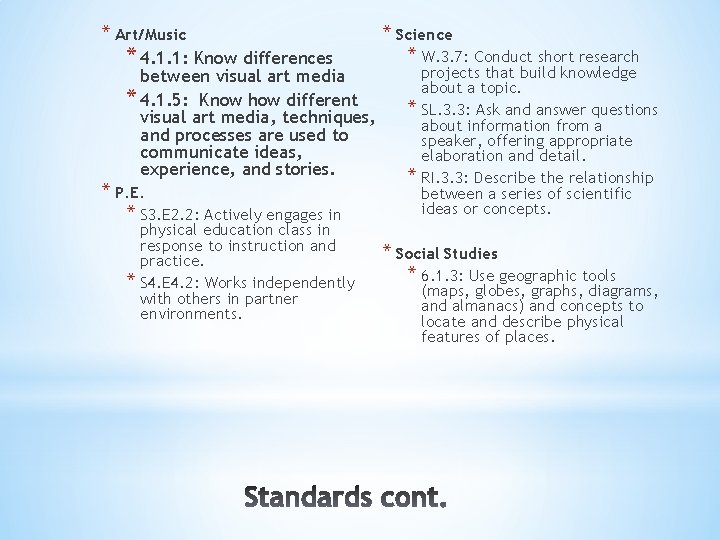
* Art/Music * 4. 1. 1: Know differences between visual art media * 4. 1. 5: Know how different visual art media, techniques, and processes are used to communicate ideas, experience, and stories. * P. E. * S 3. E 2. 2: Actively engages in physical education class in response to instruction and practice. * S 4. E 4. 2: Works independently with others in partner environments. * Science * W. 3. 7: Conduct short research projects that build knowledge about a topic. * SL. 3. 3: Ask and answer questions about information from a speaker, offering appropriate elaboration and detail. * RI. 3. 3: Describe the relationship between a series of scientific ideas or concepts. * Social Studies * 6. 1. 3: Use geographic tools (maps, globes, graphs, diagrams, and almanacs) and concepts to locate and describe physical features of places.
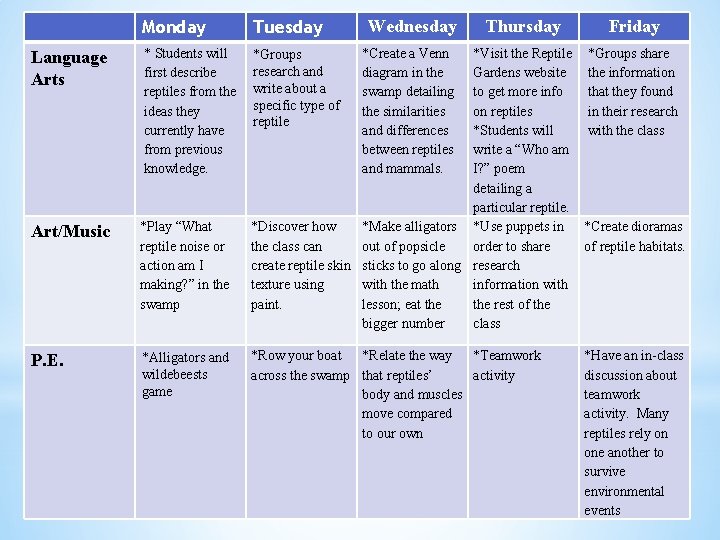
Wednesday Thursday Friday Monday Tuesday Language Arts * Students will first describe reptiles from the ideas they currently have from previous knowledge. Art/Music *Play “What reptile noise or action am I making? ” in the swamp *Visit the Reptile *Groups share Gardens website the information to get more info that they found on reptiles in their research *Students will with the class write a “Who am I? ” poem detailing a particular reptile. *Discover how *Make alligators *Use puppets in *Create dioramas the class can out of popsicle order to share of reptile habitats. create reptile skin sticks to go along research texture using with the math information with paint. lesson; eat the rest of the bigger number class P. E. *Alligators and wildebeests game *Groups research and write about a specific type of reptile *Create a Venn diagram in the swamp detailing the similarities and differences between reptiles and mammals. *Row your boat *Relate the way *Teamwork across the swamp that reptiles’ activity body and muscles move compared to our own *Have an in-class discussion about teamwork activity. Many reptiles rely on one another to survive environmental events
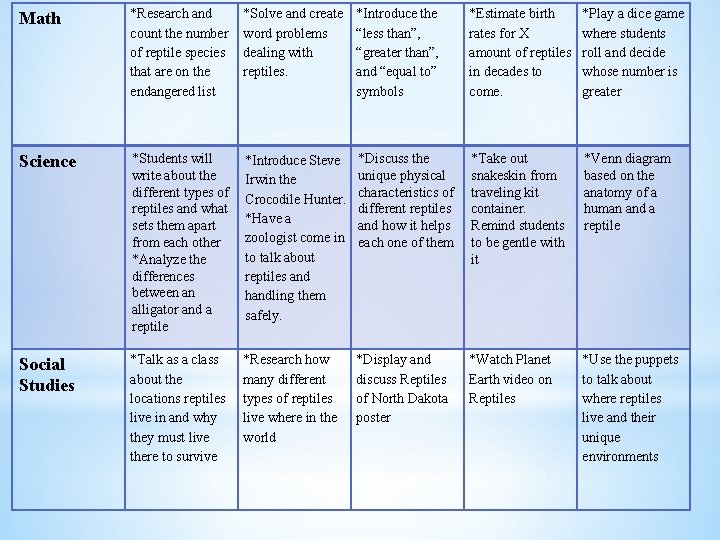
Math *Research and count the number of reptile species that are on the endangered list *Solve and create word problems dealing with reptiles. *Introduce the “less than”, “greater than”, and “equal to” symbols *Estimate birth rates for X amount of reptiles in decades to come. *Play a dice game where students roll and decide whose number is greater Science *Students will write about the different types of reptiles and what sets them apart from each other *Analyze the differences between an alligator and a reptile *Introduce Steve Irwin the Crocodile Hunter. *Have a zoologist come in to talk about reptiles and handling them safely. *Discuss the unique physical characteristics of different reptiles and how it helps each one of them *Take out snakeskin from traveling kit container. Remind students to be gentle with it *Venn diagram based on the anatomy of a human and a reptile Social Studies *Talk as a class about the locations reptiles live in and why they must live there to survive *Research how many different types of reptiles live where in the world *Display and discuss Reptiles of North Dakota poster *Watch Planet Earth video on Reptiles *Use the puppets to talk about where reptiles live and their unique environments
- Slides: 25