
Kwame Nkrumah University of Science Technology Kumasi Ghana
- Slides: 6
Kwame Nkrumah University of Science & Technology, Kumasi, Ghana LOGIC & CRITICAL THINKING COURSE OUTLINE
LOGIC & CRITICAL THINKING 1. Basic concepts: critical thinking, reasoning, logic and language, issues, claims, arguments, explanations, premises, conclusions, fact and opinion. 2. Understanding two kinds of reasoning: Deductive reasoning (the logic of demonstration), and Inductive reasoning (the logic of support). Identifying unstated assumptions. www. knust. edu. gh
LOGIC & CRITICAL THINKING 3. Deductive Reasoning: Categorical logic. Assessing categorical syllogisms and onepremise arguments for validity. Categorical Reasoning in natural languages. Formal Fallacies. 4. Deductive Reasoning continued: Sentential deductive reasoning: Common valid and invalid argument forms. Necessary and sufficient conditions. Sentential Reasoning in natural languages. www. knust. edu. gh Formal Fallacies.
LOGIC & CRITICAL THINKING 5. Inductive Reasoning: Statistical syllogisms, generalizations, reasoning from analogies. Fallacies. 6. Inductive Reasoning continued: Evaluating arguments that lead to a cause and-effect conclusion. Fallacies. www. knust. edu. gh
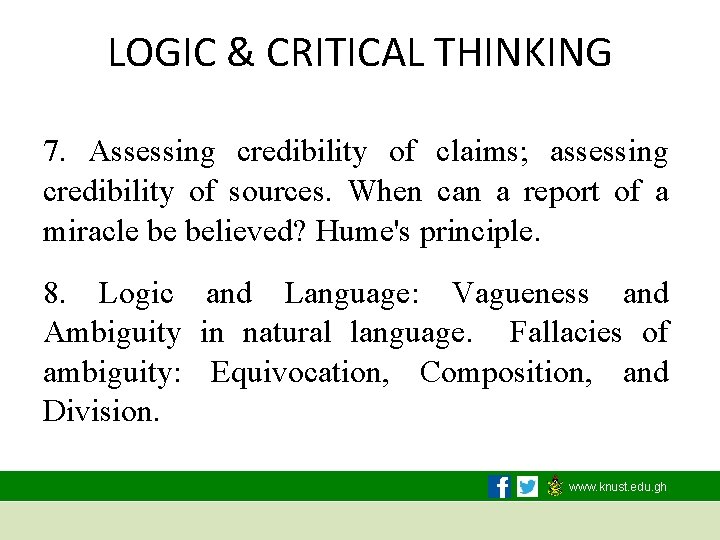
LOGIC & CRITICAL THINKING 7. Assessing credibility of claims; assessing credibility of sources. When can a report of a miracle be believed? Hume's principle. 8. Logic and Language: Vagueness and Ambiguity in natural language. Fallacies of ambiguity: Equivocation, Composition, and Division. www. knust. edu. gh
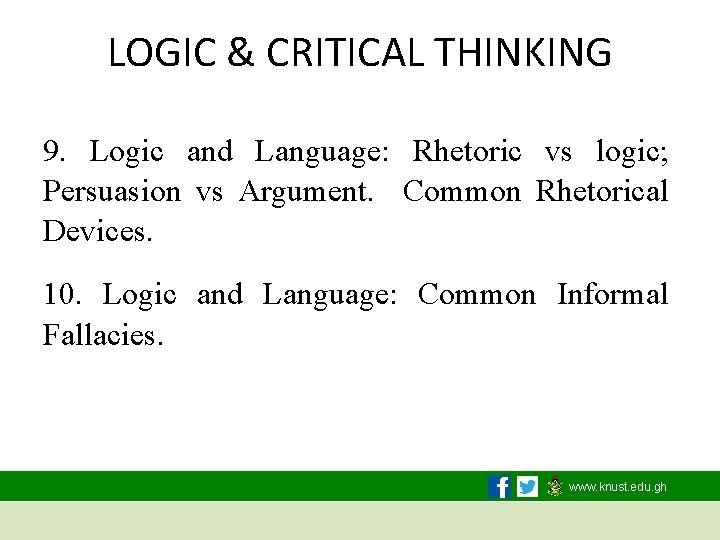
LOGIC & CRITICAL THINKING 9. Logic and Language: Rhetoric vs logic; Persuasion vs Argument. Common Rhetorical Devices. 10. Logic and Language: Common Informal Fallacies. www. knust. edu. gh