
KUVAN A CASE PRESENTATION Stefanie L Drahuschak Pharm


- Slides: 27
® KUVAN A CASE PRESENTATION Stefanie L. Drahuschak Pharm. D Candidate Class of 2014 University of Pittsburgh School of Pharmacy Walgreens Specialty Pharmacy March 5, 2014
Objectives • 1) Understand the basics of phenylketonuria • 2) Understand the dosing, administration, and counseling points of Kuvan® • 3) Apply the understanding of PKU and Kuvan® to a patient case.
Patient Case: RS • 29 yo male • No known drug allergies • Diagnosis: Phenylketonuria – PKU • ICD 9 code: 270. 1 • Current medications and PMHx unknown
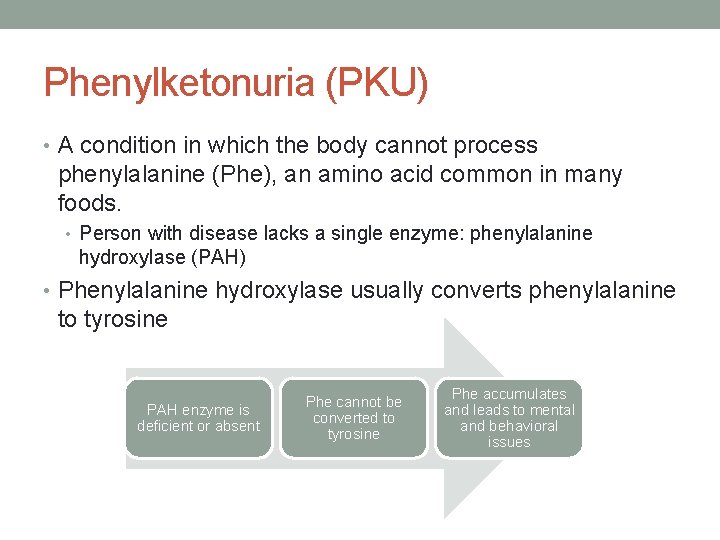
Phenylketonuria (PKU) • A condition in which the body cannot process phenylalanine (Phe), an amino acid common in many foods. • Person with disease lacks a single enzyme: phenylalanine hydroxylase (PAH) • Phenylalanine hydroxylase usually converts phenylalanine to tyrosine PAH enzyme is deficient or absent Phe cannot be converted to tyrosine Phe accumulates and leads to mental and behavioral issues
Diagnosing PKU • All 50 states and US territories require newborns to be screened for PKU • Many other countries also routinely screen • After birth, a few drops of blood are taken from the newborn’s heel to determine if Phe levels are already elevated • Some mothers who have already given birth to a child with PKU can have future children screened for PKU before birth
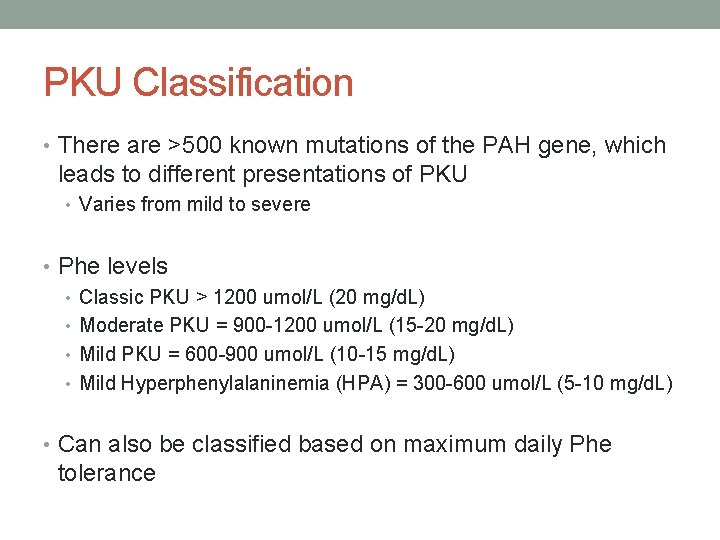
PKU Classification • There are >500 known mutations of the PAH gene, which leads to different presentations of PKU • Varies from mild to severe • Phe levels • Classic PKU > 1200 umol/L (20 mg/d. L) • Moderate PKU = 900 -1200 umol/L (15 -20 mg/d. L) • Mild PKU = 600 -900 umol/L (10 -15 mg/d. L) • Mild Hyperphenylalaninemia (HPA) = 300 -600 umol/L (5 -10 mg/d. L) • Can also be classified based on maximum daily Phe tolerance
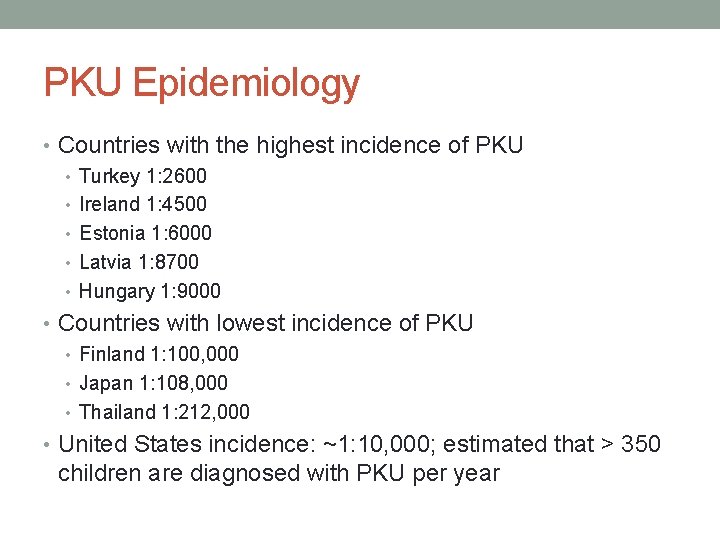
PKU Epidemiology • Countries with the highest incidence of PKU • Turkey 1: 2600 • Ireland 1: 4500 • Estonia 1: 6000 • Latvia 1: 8700 • Hungary 1: 9000 • Countries with lowest incidence of PKU • Finland 1: 100, 000 • Japan 1: 108, 000 • Thailand 1: 212, 000 • United States incidence: ~1: 10, 000; estimated that > 350 children are diagnosed with PKU per year
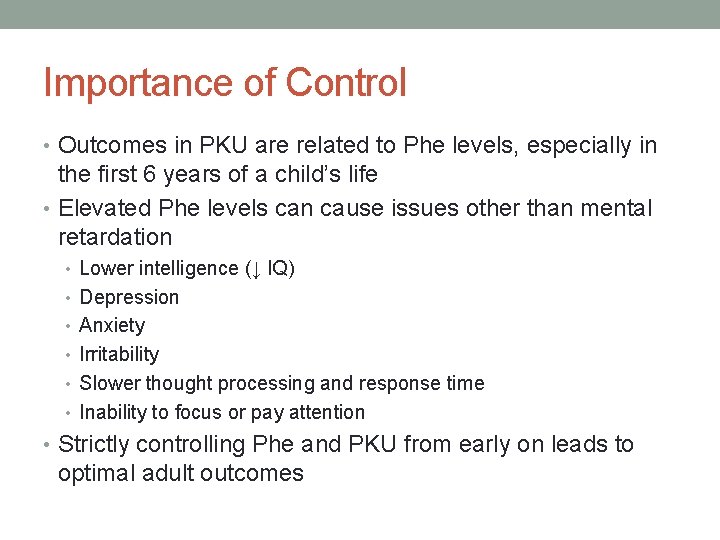
Importance of Control • Outcomes in PKU are related to Phe levels, especially in the first 6 years of a child’s life • Elevated Phe levels can cause issues other than mental retardation • Lower intelligence (↓ IQ) • Depression • Anxiety • Irritability • Slower thought processing and response time • Inability to focus or pay attention • Strictly controlling Phe and PKU from early on leads to optimal adult outcomes
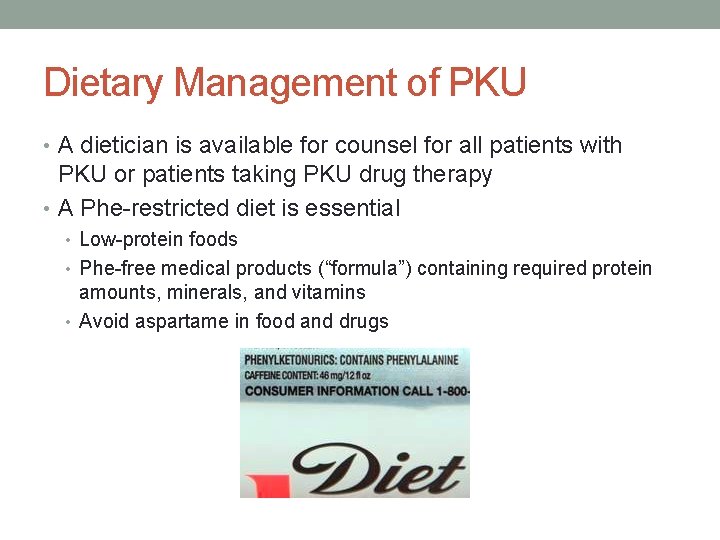
Dietary Management of PKU • A dietician is available for counsel for all patients with PKU or patients taking PKU drug therapy • A Phe-restricted diet is essential • Low-protein foods • Phe-free medical products (“formula”) containing required protein amounts, minerals, and vitamins • Avoid aspartame in food and drugs
Kuvan ® • Sapropterin dihydrochloride • A biologically active synthetic form of tetrahydrobiopterin (BH 4) • Indication • Kuvan® is indicated in conjunction with a Phe-restricted diet to reduce blood phenylalanine (Phe) levels in PKU patients with BH 4 responsive disease
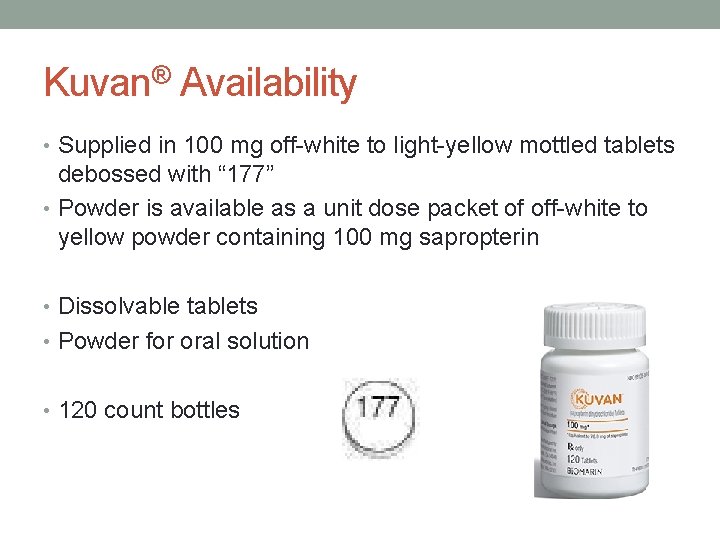
Kuvan® Availability • Supplied in 100 mg off-white to light-yellow mottled tablets debossed with “ 177” • Powder is available as a unit dose packet of off-white to yellow powder containing 100 mg sapropterin • Dissolvable tablets • Powder for oral solution • 120 count bottles
Mechanism of Action • Reduces blood Phe levels by activating residual phenylalanine hydroxylase (the deficient enzyme) and improving the normal oxidative metabolism of phenylalanine tyrosine • Treatment with sapropterin can therefore promote the normal metabolism of Phe and lower blood levels in some patients
Kuvan® Dosing • Initial dose: • 10 mg/kg PO once daily with food • Increase dose to 20 mg/kg/day if Phe levels do not decrease after one month • Medication should be discontinued if Phe levels do not decrease after one month of treatment with maximum dose of 20 mg/kg/day • Maintenance dose: • 5 to 20 mg/kg PO once daily depending on response
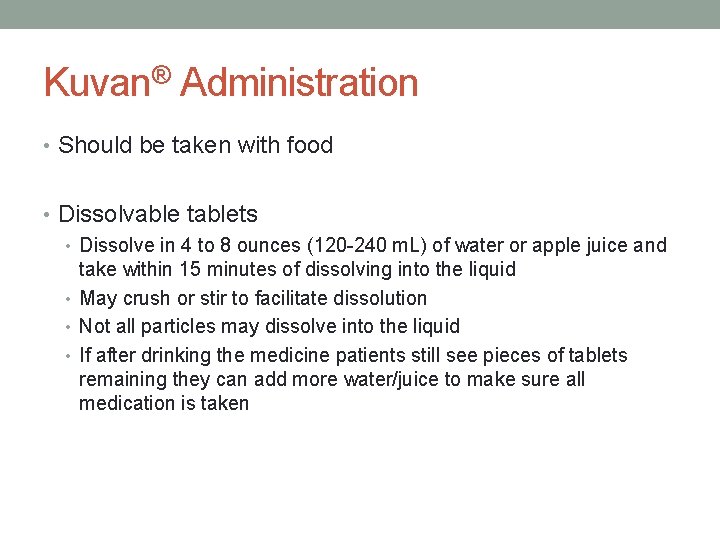
Kuvan® Administration • Should be taken with food • Dissolvable tablets • Dissolve in 4 to 8 ounces (120 -240 m. L) of water or apple juice and take within 15 minutes of dissolving into the liquid • May crush or stir to facilitate dissolution • Not all particles may dissolve into the liquid • If after drinking the medicine patients still see pieces of tablets remaining they can add more water/juice to make sure all medication is taken
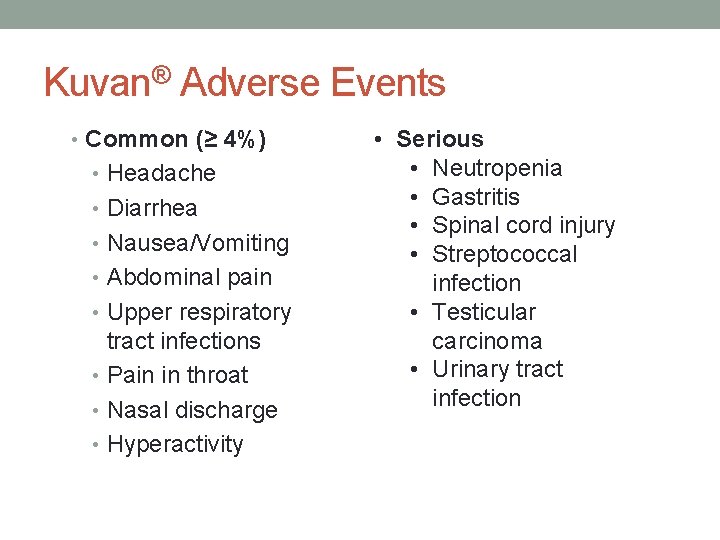
Kuvan® Adverse Events • Common (≥ 4%) • Headache • Diarrhea • Nausea/Vomiting • Abdominal pain • Upper respiratory tract infections • Pain in throat • Nasal discharge • Hyperactivity • Serious • Neutropenia • Gastritis • Spinal cord injury • Streptococcal infection • Testicular carcinoma • Urinary tract infection
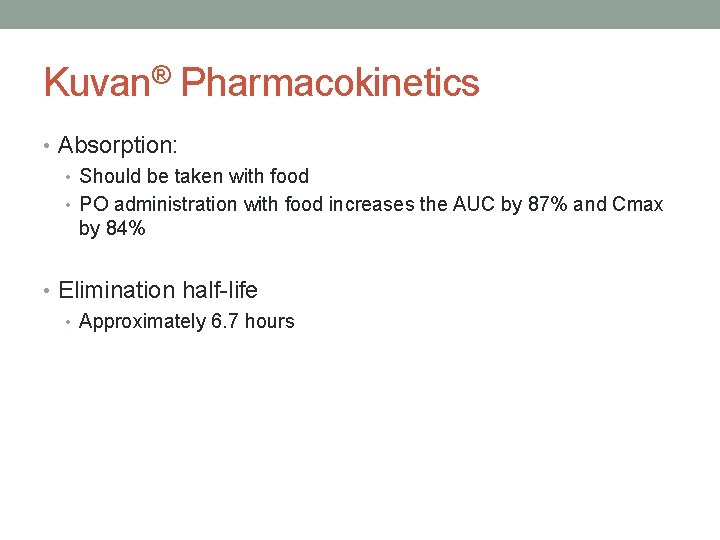
Kuvan® Pharmacokinetics • Absorption: • Should be taken with food • PO administration with food increases the AUC by 87% and Cmax by 84% • Elimination half-life • Approximately 6. 7 hours
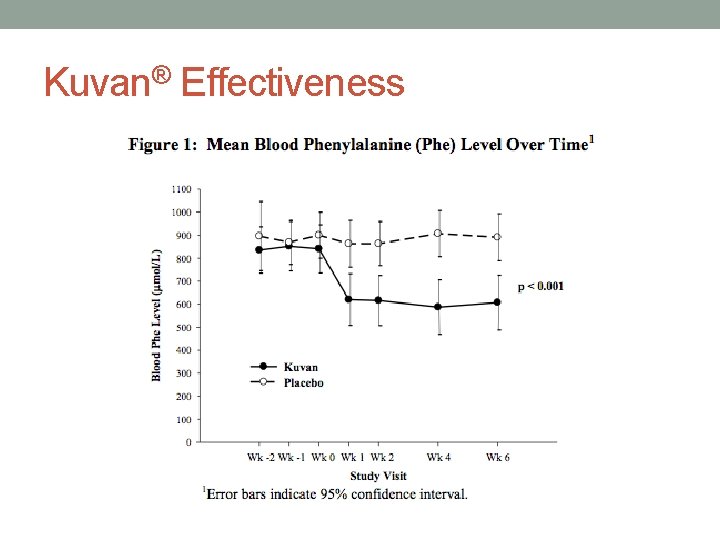
Kuvan® Effectiveness
Drug-Drug Interactions • Monitoring or modification of treatment should be implemented if concomitantly taking folate antagonists • Combination of Kuvan® and folate antagonists may decrease the efficacy of sapropterin • Folate antagonists: • Methotrexate • Premetrexed • Pyrimethamine • Sulfadoxine/pyrimethamine • Trimethoprim/sulfamethoxazole
Drug-Drug Interactions • Monitor for hypotension when co-administering drugs known to affect NO-mediated vasodilation • Sildenafil • Vardenafil • Tadalafil • Monitor for patients taking Kuvan® with levodopa • In a post-marketing study, 3 patients with underlying neurologic disorders experienced convulsions, exacerbation of convulsions, over-stimulation, or irritability during co-administration • Monitor for changes in mental status
Pregnancy Considerations • Pregnancy Category C • No adequate or well-controlled studies with Kuvan® in pregnant women • A patient registry exists to collect data from pregnant women who take Kuvan® • Nursing mothers • It is not known whether Kuvan® is present in human milk
Special Populations • Pediatric use • Use in pediatric patients less than 4 yo has not been studied • Geriatric use • Clinical studies of Kuvan® in patients with PKU did not include patients aged 65 years and older – unknown how elderly patients respond • Renal impairment • Patients with renal impairment have not been evaluated – extra monitoring should be implemented in patients taking Kuvan®
Kuvan® Non-Responders • Not all patients with PKU respond to treatment with Kuvan® • In clinical trials, approximately 20% to 56% of PKU patients responded to treatment • Response to treatment cannot be pre-determined with laboratory testing • Can only be determined via therapeutic trial of Kuvan® • If patient does not respond after one month at maximum dose of Kuvan®, medication should be d/c’ed
Patient Case: RS • Patient was started on Kuvan® to lower Phe levels • First fill with WSP in July 2012, but unknown if on medication prior to 2012 • Dose • Dissolve 18 – 100 mg tablets in water or orange juice once daily • Patient’s weight unknown; ~20 mg/kg dosing • Patient has been continuing on same medication at the same dose through last fill at WSP on 2/14/2014 • No adverse reactions or changes in medical conditions were reported
RS: Assessment and Plan • Assessment • Patient appears to be well managed on current Kuvan® dose • Plan • Continue on Kuvan® 100 mg – 18 tablets daily for Phe level control • Continue on a restricted phenylalanine diet • Continue with regular MD visits and obtain regular blood Phe levels
References • 1) Pey AL, Martinez A. The Phenylalanine Hydroxylase System. In: Blau N. PKU and BH 4–Advances in Phenylketonuria and Tetrahydrobiopterin. 1 st ed. SPS Publications; 2006: 67 -91. • 2) Singh R, Jurecki E, Rohr, F. Recommendations for personalized dietary adjustments based on patient response to tetrahydrobiopterin (BH 4) in phenylketonuria. Top Clin Nutr. 2008: 149 -157. • 3) Mitchell J, Scriver C. Phenylalanine hydroxylase deficiency. In: Gene. Reviews at Gene. Tests: Medical Genetics Information Resource. Copyright, University of Washington, Seattle. 19972009. Available at http: //www. genetests. org. Accessed February 3, 2009. • 4) Waisbren SE, Noel K, Fahrbach K, et al. Phenylalanine blood levels and clinical outcomes in phenylketonuria: a systematic literature review and meta-analysis. Mol Genet Metab. 2007; 92(1 -2): 63 -70
References • 5) Levy H, Burton B, Cederbaum S, Scriver C. Recommendations for evaluation of responsiveness to tetrahydrobiopterin (BH 4) in phenylketonuria and its use in treatment. Mol Genet Metab. 2007; 92: 287 -291 • 6) Kuvan® [package insert]. Novato, CA: Bio. Marin Pharmaceuticals, Inc; 2013.
QUESTIONS?