
KULIAH KE 10 MULTICULTURAL EDUCATION SCHOOL TRANSFORMATION CULTURAL
- Slides: 20
KULIAH KE 10 MULTICULTURAL EDUCATION SCHOOL TRANSFORMATION
CULTURAL COMPETENCE A developmental process. A set of congruent behaviors, attitudes and policies that come together in a system, agency or among professionals to work effectively in cross-cultural situations. Having the capacity to function effectively in cultural contexts that differ from your own. Contoh: kultur kelas, kultur sekolah 09/01/2022 KULIAH KE 10 ME, SCHOOL TRANSFORMATION, 2018 2
DIVERSITY & CULTURAL COMPETENCY Valuing Diversity is a necessary step along the continuum of cultural competency and culturally responsive pedagogy, but it is not enough. Cultural Competency requires knowledge, skills and experience and the ability to transform these into practice which results in improved services and outcomes. 09/01/2022 KULIAH KE 10 ME, SCHOOL TRANSFORMATION, 2018 3
THE IMPORTANCE OF CULTURAL COMPETENCY • Beyond simply having a diverse school staff, it is important that the teachers, administrators, and other school officials are culturally competent. • A lack of cultural competency (as well as a lack of diversity) in teaching staff has been linked to: – Tracking students of color into lower ability classes/ special ed. – Unequal rates of discipline/ suspension for students of color (particularly black males) 09/01/2022 KULIAH KE 10 ME, SCHOOL TRANSFORMATION, 2018 4
COMPONENTS OF CULTURAL COMPETENCY • Awareness – An individual’s own sense of their “emotional, psychological, and behavioral responses to diversity” • Attitudes – “Our personal biases, moral positions, and openness to differences” • Knowledge – “The concepts, skill requirements, and ethics associated with diversity training” • Skills – The ability to act in ways that are culturally competent 09/01/2022 KULIAH KE 10 ME, SCHOOL TRANSFORMATION, 2018 5
CHARACTERISTICS OF CULTURALLY COMPETENT EDUCATORS AND SCHOOLS • Foster a climate of inclusion and respect • Bridge academic material with students’ “prior understanding, knowledge, native language, and values. ” – Consider culture a valued asset rather than a detriment to overcome 09/01/2022 KULIAH KE 10 ME, SCHOOL TRANSFORMATION, 2018 6
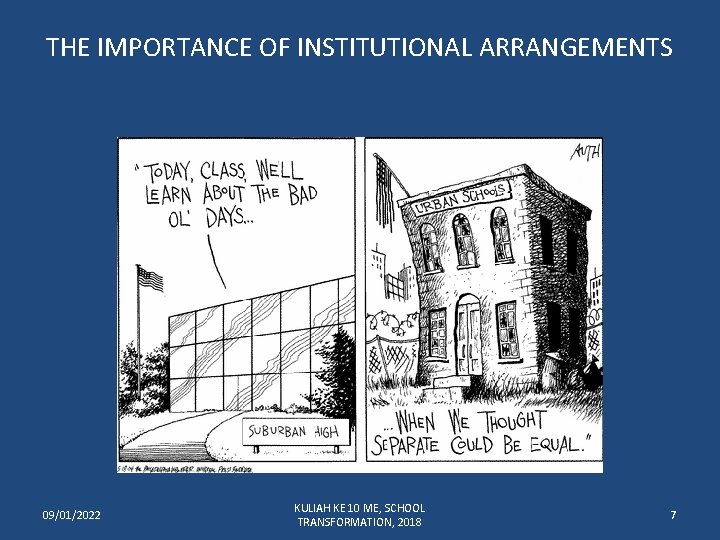
THE IMPORTANCE OF INSTITUTIONAL ARRANGEMENTS 09/01/2022 KULIAH KE 10 ME, SCHOOL TRANSFORMATION, 2018 7
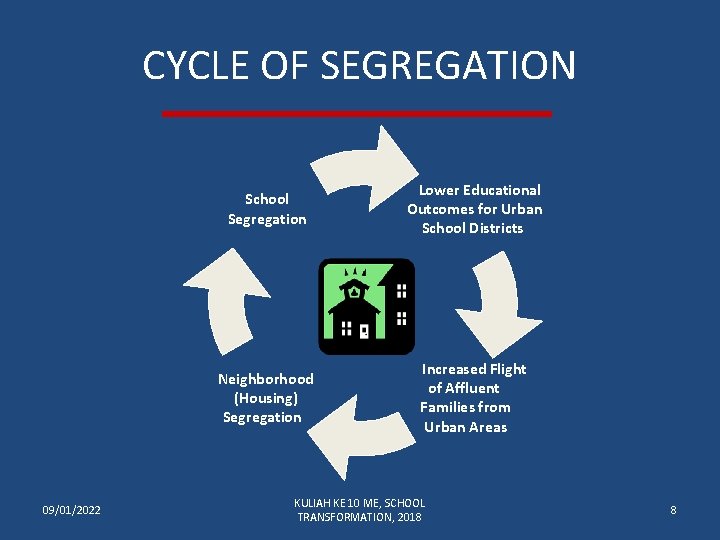
CYCLE OF SEGREGATION 09/01/2022 School Segregation Lower Educational Outcomes for Urban School Districts Neighborhood (Housing) Segregation Increased Flight of Affluent Families from Urban Areas KULIAH KE 10 ME, SCHOOL TRANSFORMATION, 2018 8
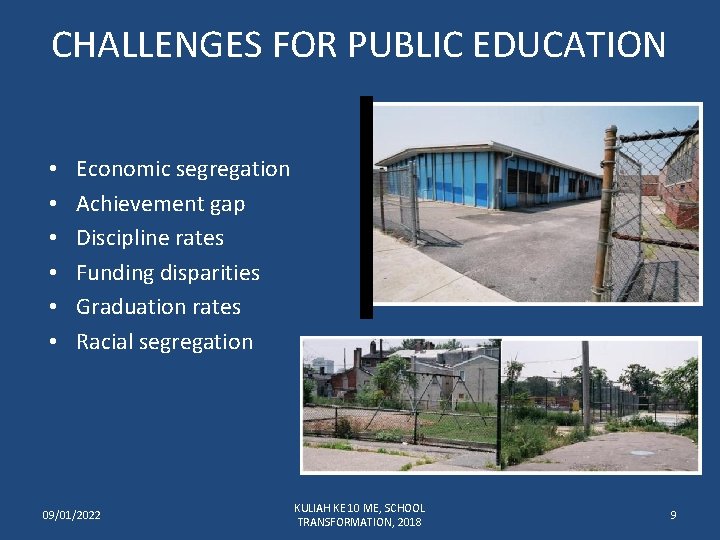
CHALLENGES FOR PUBLIC EDUCATION • • • Economic segregation Achievement gap Discipline rates Funding disparities Graduation rates Racial segregation 09/01/2022 KULIAH KE 10 ME, SCHOOL TRANSFORMATION, 2018 9
THE ARRANGEMENT OF STRUCTURES • How we arrange structures matters – The order of the structures – The timing of the interaction between them – The relationships that exist between them – We must be aware of how structures are arranged in order to fully understand social phenomena 09/01/2022 KULIAH KE 10 ME, SCHOOL TRANSFORMATION, 2018 10
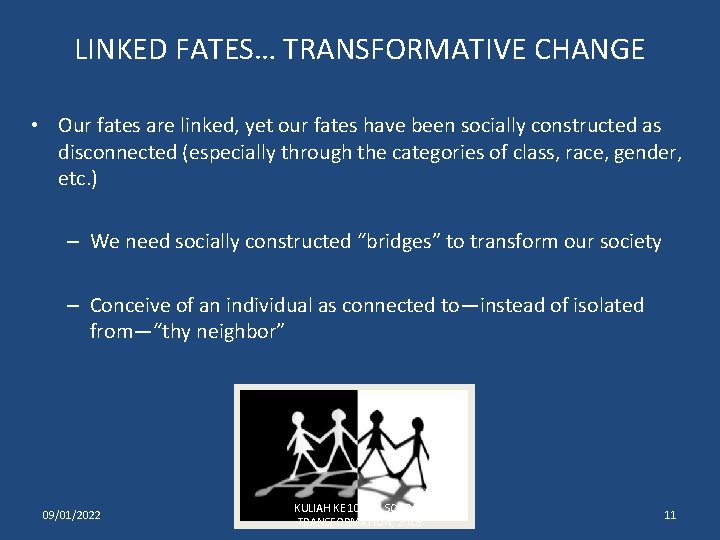
LINKED FATES… TRANSFORMATIVE CHANGE • Our fates are linked, yet our fates have been socially constructed as disconnected (especially through the categories of class, race, gender, etc. ) – We need socially constructed “bridges” to transform our society – Conceive of an individual as connected to—instead of isolated from—“thy neighbor” 09/01/2022 KULIAH KE 10 ME, SCHOOL TRANSFORMATION, 2018 11
INSTRUCTIONAL • Acknowledge students’ differences as well as their commonalities • Validate students’ cultural identity in classroom practices and instructional materials • Educate students about the diversity of the world around them • Promote equity and mutual respect • Assess students’ ability and achievement validly • Encourage students to think critically • Challenge students to strive for excellence as defined by their potential 09/01/2022 KULIAH KE 10 ME, SCHOOL TRANSFORMATION, 2018 12
SHIFTS OF CONSCIOUSNESS Shift #1 I must be willing to think critically about the things about which I’ve been discouraged from thinking critically • Capitalism, Consumer Culture, Globalization • Two-party political system v. “democracy” • Etc. 09/01/2022 KULIAH KE 10 ME, SCHOOL TRANSFORMATION, 2018 13
SHIFTS OF CONSCIOUSNESS Shift #2 I must acknowledge that multicultural education is about creating equitable learning environments for all students, so I must be against all inequity 09/01/2022 KULIAH KE 10 ME, SCHOOL TRANSFORMATION, 2018 14
SHIFTS OF CONSCIOUSNESS Shift #3 I must understand inequities as systemic and not just individual acts (and what this means in the context of my classroom) 09/01/2022 KULIAH KE 10 ME, SCHOOL TRANSFORMATION, 2018 15
SHIFTS OF CONSCIOUSNESS Shift #4 I must transcend the idea of multicultural education as “learning about other cultures” and “celebrating diversity” 09/01/2022 KULIAH KE 10 ME, SCHOOL TRANSFORMATION, 2018 16
SHIFTS OF CONSCIOUSNESS Shift #5 I must be willing to discomfort and unsettle myself and my students • Institutional likeability 09/01/2022 KULIAH KE 10 ME, SCHOOL TRANSFORMATION, 2018 17
SHIFTS OF CONSCIOUSNESS Shift #6 I must shift from an equality orientation toward multiculturalism to an equity orientation 09/01/2022 KULIAH KE 10 ME, SCHOOL TRANSFORMATION, 2018 18
SHIFTS OF CONSCIOUSNESS Shift #7 I must move beyond the “objective facilitator” role and actively advocate for equity and justice • Multicultural education is not about validating all perspectives 09/01/2022 KULIAH KE 10 ME, SCHOOL TRANSFORMATION, 2018 19
SHIFTS OF CONSCIOUSNESS Shift #8 I must understand multicultural education as a comprehensive approach, not additional activities or slight shifts in an otherwise monocultural curriculum 09/01/2022 KULIAH KE 10 ME, SCHOOL TRANSFORMATION, 2018 20