
KSU Math Department Colloquium Graphical Models of Probability
KSU Math Department Colloquium Graphical Models of Probability for Causal Reasoning Thursday 07 November 2002 (revised 09 December 2003) William H. Hsu Laboratory for Knowledge Discovery in Databases Department of Computing and Information Sciences Kansas State University http: //www. kddresearch. org This presentation is: http: //www. kddresearch. org/KSU/CIS/BN-Math-20021107. ppt Kansas State University KDD Lab (www. kddresearch. org) Kansas State University Department of Computing and Information Sciences
Overview • Graphical Models of Probability – – Markov graphs Bayesian (belief) networks Causal semantics Direction-dependent separation (d-separation) property • Learning and Reasoning: Problems, Algorithms – Inference: exact and approximate • Junction tree – Lauritzen and Spiegelhalter (1988) • (Bounded) loop cutset conditioning – Horvitz and Cooper (1989) • Variable elimination – Dechter (1996) – Structure learning • K 2 algorithm – Cooper and Herskovits (1992) • Variable ordering problem – Larannaga (1996), Hsu et al. (2002) • Probabilistic Reasoning in Machine Learning, Data Mining • Current Research and Open Problems Kansas State University KDD Lab (www. kddresearch. org) Kansas State University Department of Computing and Information Sciences

Stages of Data Mining and Knowledge Discovery in Databases Adapted from Fayyad, Piatetsky-Shapiro, and Smyth (1996) Kansas State University KDD Lab (www. kddresearch. org) Kansas State University Department of Computing and Information Sciences
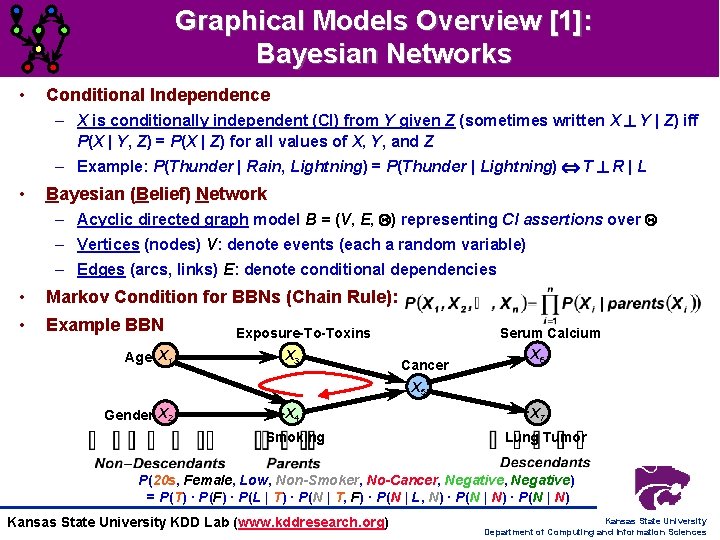
Graphical Models Overview [1]: Bayesian Networks • Conditional Independence – X is conditionally independent (CI) from Y given Z (sometimes written X Y | Z) iff P(X | Y, Z) = P(X | Z) for all values of X, Y, and Z – Example: P(Thunder | Rain, Lightning) = P(Thunder | Lightning) T R | L • Bayesian (Belief) Network – Acyclic directed graph model B = (V, E, ) representing CI assertions over – Vertices (nodes) V: denote events (each a random variable) – Edges (arcs, links) E: denote conditional dependencies • Markov Condition for BBNs (Chain Rule): • Example BBN Age X 1 Exposure-To-Toxins X 3 Cancer Serum Calcium X 6 X 5 Gender X 2 X 4 Smoking X 7 Lung Tumor P(20 s, Female, Low, Non-Smoker, No-Cancer, Negative) = P(T) · P(F) · P(L | T) · P(N | T, F) · P(N | L, N) · P(N | N) Kansas State University KDD Lab (www. kddresearch. org) Kansas State University Department of Computing and Information Sciences

Graphical Models Overview [2]: Markov Blankets and d-Separation Property Motivation: The conditional independence status of nodes within a BBN might change as the availability of evidence E changes. Direction-dependent separation (d -separation) is a technique used to determine conditional independence of nodes as evidence changes. Definition: A set of evidence nodes E d-separates two sets of nodes X and Y if every undirected path from a node in X to a node in Y is blocked given E. From S. Russell & P. Norvig (1995) A path is blocked if one of three conditions holds: X E (1) Z (2) Z (3) Z Y Adapted from J. Schlabach (1996) Kansas State University KDD Lab (www. kddresearch. org) Kansas State University Department of Computing and Information Sciences

Graphical Models Overview [3]: Inference Problem Multiply-connected case: exact, approximate inference are #P-complete Adapted from slides by S. Russell, UC Berkeley Kansas State University KDD Lab (www. kddresearch. org) http: //aima. cs. berkeley. edu/ Kansas State University Department of Computing and Information Sciences

Other Topics in Graphical Models [1]: Temporal Probabilistic Reasoning • Goal: Estimate • Filtering: r = t Adapted from Murphy (2001), Guo (2002) – Intuition: infer current state from observations – Applications: signal identification – Variation: Viterbi algorithm • Prediction: r < t – Intuition: infer future state – Applications: prognostics • Smoothing: r > t – Intuition: infer past hidden state – Applications: signal enhancement • CF Tasks – Plan recognition by smoothing – Prediction cf. Web. CANVAS – Cadez et al. (2000) Kansas State University KDD Lab (www. kddresearch. org) Kansas State University Department of Computing and Information Sciences
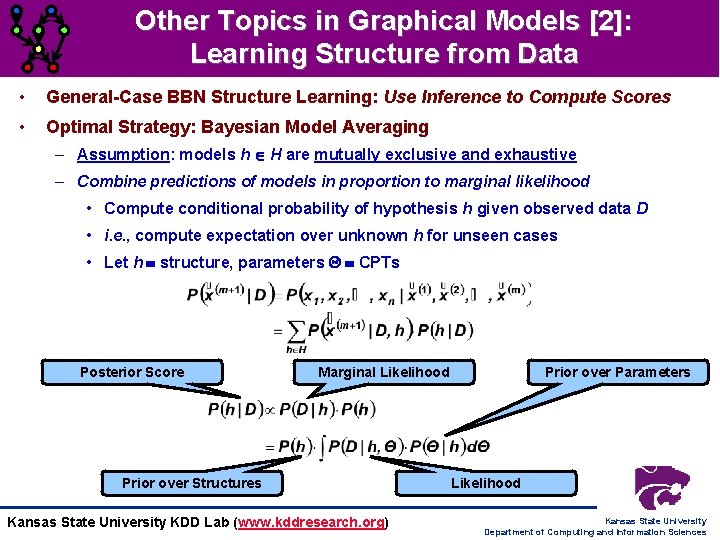
Other Topics in Graphical Models [2]: Learning Structure from Data • General-Case BBN Structure Learning: Use Inference to Compute Scores • Optimal Strategy: Bayesian Model Averaging – Assumption: models h H are mutually exclusive and exhaustive – Combine predictions of models in proportion to marginal likelihood • Compute conditional probability of hypothesis h given observed data D • i. e. , compute expectation over unknown h for unseen cases • Let h structure, parameters CPTs Posterior Score Marginal Likelihood Prior over Structures Kansas State University KDD Lab (www. kddresearch. org) Prior over Parameters Likelihood Kansas State University Department of Computing and Information Sciences
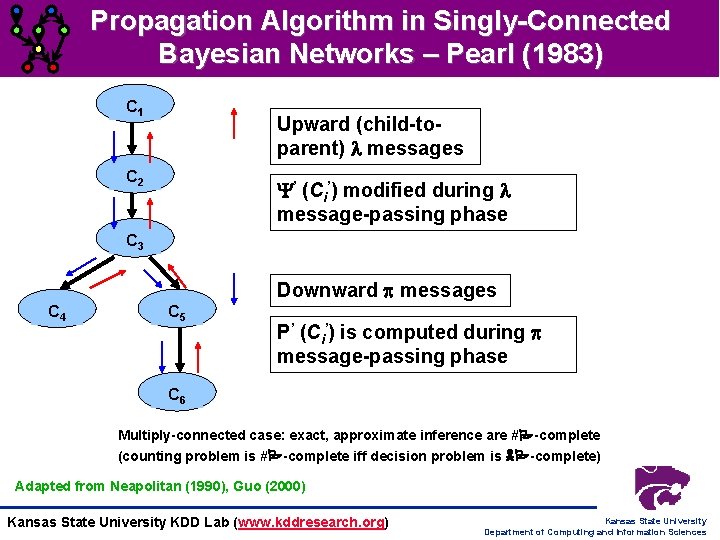
Propagation Algorithm in Singly-Connected Bayesian Networks – Pearl (1983) C 1 Upward (child-toparent) messages C 2 ’ (Ci’) modified during message-passing phase C 3 Downward messages C 4 C 5 P’ (Ci’) is computed during message-passing phase C 6 Multiply-connected case: exact, approximate inference are #P-complete (counting problem is #P-complete iff decision problem is NP-complete) Adapted from Neapolitan (1990), Guo (2000) Kansas State University KDD Lab (www. kddresearch. org) Kansas State University Department of Computing and Information Sciences
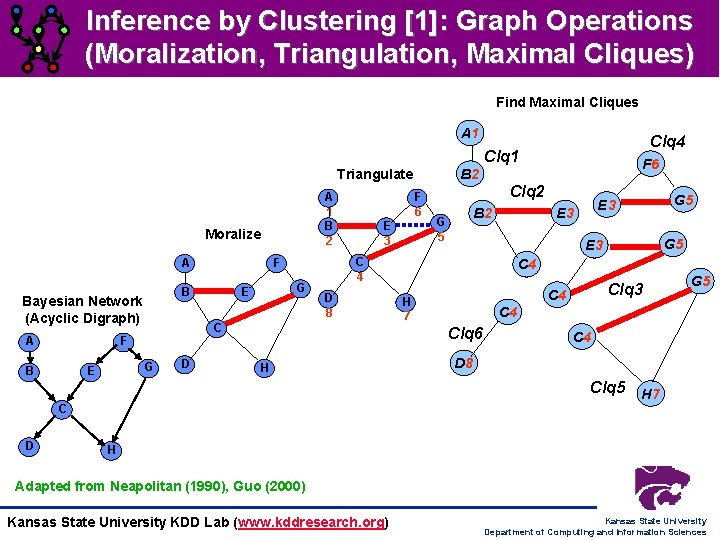
Inference by Clustering [1]: Graph Operations (Moralization, Triangulation, Maximal Cliques) Find Maximal Cliques A 1 Clq 4 Clq 1 A 1 B 2 Moralize B Bayesian Network (Acyclic Digraph) A G E D 8 C G E D B 2 G 5 H G 5 E 3 C 4 Clq 3 C 4 H 7 G 5 C 4 Clq 6 F B Clq 2 C 4 F A F 6 E 3 F 6 B 2 Triangulate C 4 D 8 Clq 5 H 7 C D H Adapted from Neapolitan (1990), Guo (2000) Kansas State University KDD Lab (www. kddresearch. org) Kansas State University Department of Computing and Information Sciences

Inference by Clustering [2]: Junction Tree – Lauritzen & Spiegelhalter (1988) Input: list of cliques of triangulated, moralized graph Gu Output: Tree of cliques Separators nodes Si, Residual nodes Ri and potential probability (Clqi) for all cliques Algorithm: 1. Si = Clqi (Clq 1 Clq 2 … Clqi-1) 2. Ri = Clqi - Si 3. If i >1 then identify a j < i such that Clqj is a parent of Clqi 4. Assign each node v to a unique clique Clqi that v c(v) Clqi 5. Compute (Clqi) = f(v) Clqi = P(v | c(v)) {1 if no v is assigned to Clqi} 6. Store Clqi , Ri , Si, and (Clqi) at each vertex in the tree of cliques Adapted from Neapolitan (1990), Guo (2000) Kansas State University KDD Lab (www. kddresearch. org) Kansas State University Department of Computing and Information Sciences
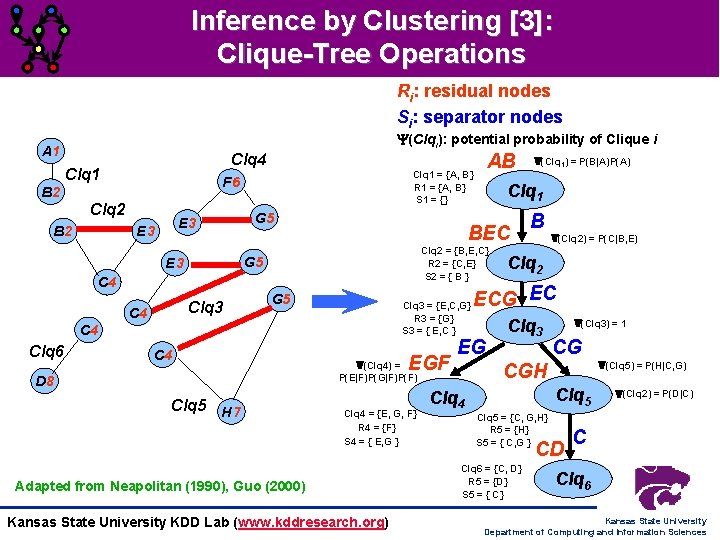
Inference by Clustering [3]: Clique-Tree Operations Ri: residual nodes Si: separator nodes (Clqi): potential probability of Clique i A 1 Clq 1 = {A, B} R 1 = {A, B} S 1 = {} F 6 B 2 Clq 2 B 2 G 5 E 3 Clq 2 = {B, E, C} R 2 = {C, E} S 2 = { B } C 4 Clq 3 C 4 G 5 Clq 3 = {E, C, G} R 3 = {G} S 3 = { E, C } C 4 EGF D 8 Clq 5 H 7 Clq 4 = {E, G, F} R 4 = {F} S 4 = { E, G } Adapted from Neapolitan (1990), Guo (2000) Kansas State University KDD Lab (www. kddresearch. org) B (Clq 2) = P(C|B, E) Clq 2 ECG EC EG (Clq 4) = P(E|F)P(G|F)P(F) (Clq 1) = P(B|A)P(A) Clq 1 BEC G 5 E 3 Clq 6 AB Clq 4 Clq 3 (Clq 3) = 1 CG (Clq 5) = P(H|C, G) CGH Clq 5 Clq 4 Clq 5 = {C, G, H} R 5 = {H} S 5 = { C, G } CD Clq 6 = {C, D} R 5 = {D} S 5 = { C} (Clq 2) = P(D|C) C Clq 6 Kansas State University Department of Computing and Information Sciences
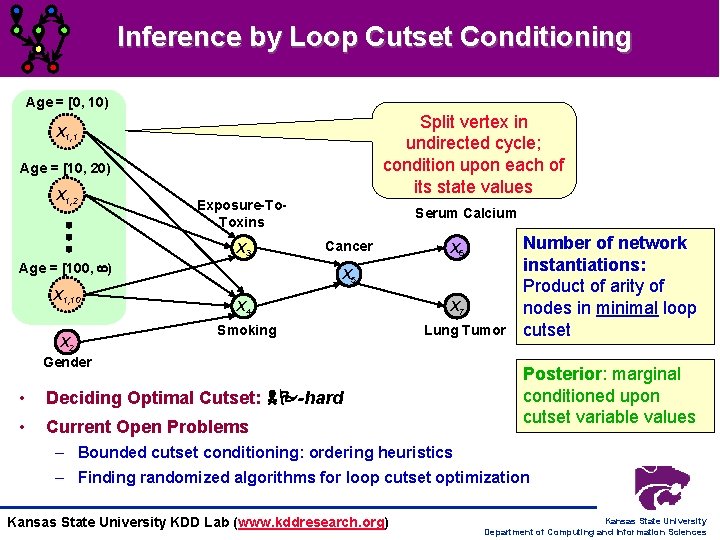
Inference by Loop Cutset Conditioning Age = [0, 10) Split vertex in undirected cycle; condition upon each of its state values X 1, 1 Age = [10, 20) X 1, 2 Exposure-To. Toxins X 3 Age = [100, ) X 1, 10 X 2 Gender Serum Calcium Cancer X 6 X 5 X 4 Smoking • Deciding Optimal Cutset: NP-hard • Current Open Problems X 7 Lung Tumor Number of network instantiations: Product of arity of nodes in minimal loop cutset Posterior: marginal conditioned upon cutset variable values – Bounded cutset conditioning: ordering heuristics – Finding randomized algorithms for loop cutset optimization Kansas State University KDD Lab (www. kddresearch. org) Kansas State University Department of Computing and Information Sciences
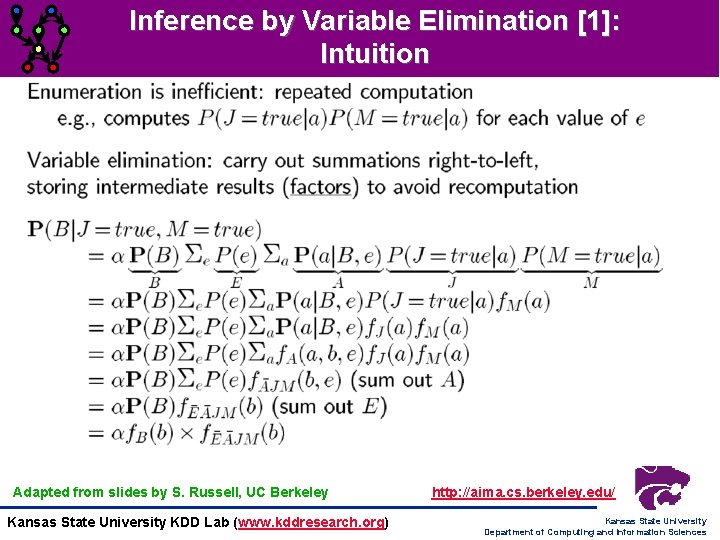
Inference by Variable Elimination [1]: Intuition Adapted from slides by S. Russell, UC Berkeley Kansas State University KDD Lab (www. kddresearch. org) http: //aima. cs. berkeley. edu/ Kansas State University Department of Computing and Information Sciences
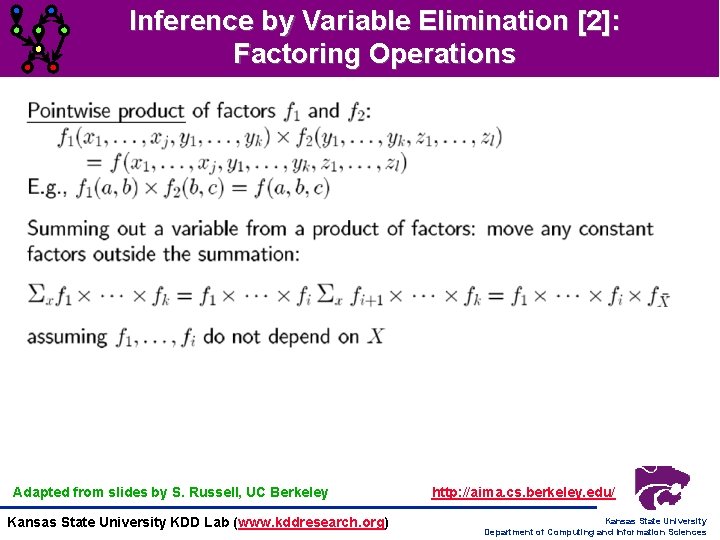
Inference by Variable Elimination [2]: Factoring Operations Adapted from slides by S. Russell, UC Berkeley Kansas State University KDD Lab (www. kddresearch. org) http: //aima. cs. berkeley. edu/ Kansas State University Department of Computing and Information Sciences
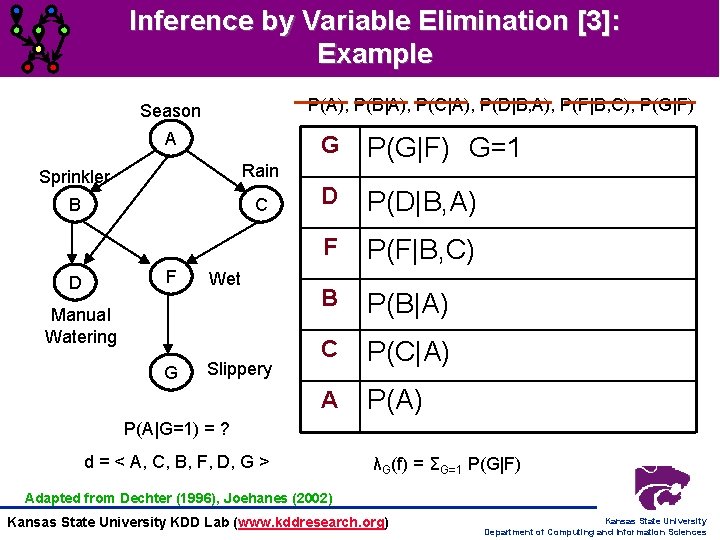
Inference by Variable Elimination [3]: Example P(A), P(B|A), P(C|A), P(D|B, A), P(F|B, C), P(G|F) Season A Sprinkler Rain B C F D Wet Manual Watering G Slippery G P(G|F) G=1 D P(D|B, A) F P(F|B, C) B P(B|A) C P(C|A) A P(A) P(A|G=1) = ? d = < A, C, B, F, D, G > λG(f) = ΣG=1 P(G|F) Adapted from Dechter (1996), Joehanes (2002) Kansas State University KDD Lab (www. kddresearch. org) Kansas State University Department of Computing and Information Sciences
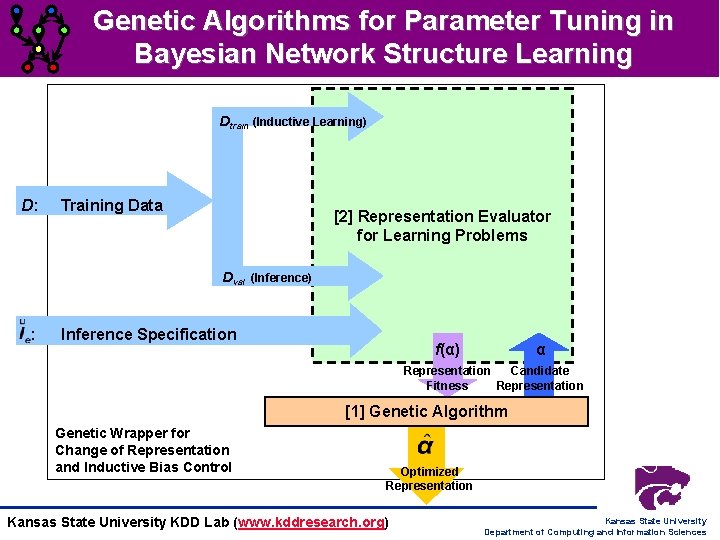
Genetic Algorithms for Parameter Tuning in Bayesian Network Structure Learning Dtrain (Inductive Learning) D: Training Data [2] Representation Evaluator for Learning Problems Dval (Inference) : Inference Specification f(α) α Representation Candidate Fitness Representation [1] Genetic Algorithm Genetic Wrapper for Change of Representation and Inductive Bias Control Optimized Representation Kansas State University KDD Lab (www. kddresearch. org) Kansas State University Department of Computing and Information Sciences
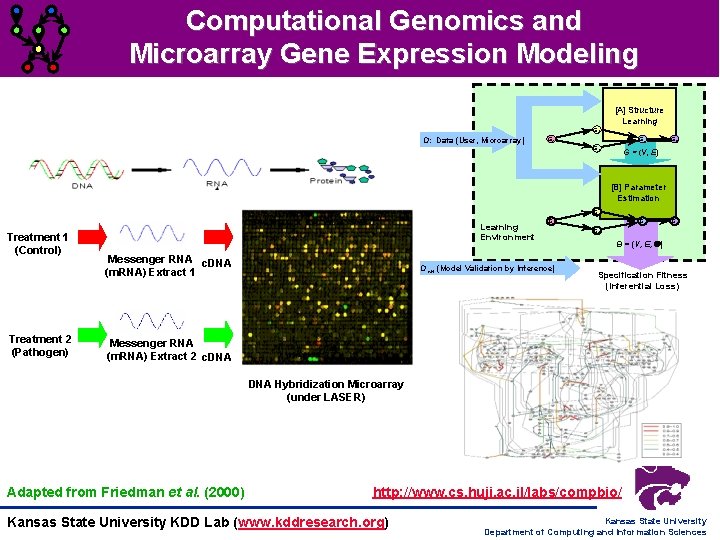
Computational Genomics and Microarray Gene Expression Modeling [A] Structure Learning G 2 D: Data (User, Microarray) G 1 G 4 G 3 G 5 G = (V, E) [B] Parameter Estimation G 2 Treatment 1 (Control) Treatment 2 (Pathogen) Learning Environment Messenger RNA c. DNA (m. RNA) Extract 1 G 1 Dval (Model Validation by Inference) G 4 G 5 G 3 B = (V, E, ) Specification Fitness (Inferential Loss) Messenger RNA (m. RNA) Extract 2 c. DNA Hybridization Microarray (under LASER) Adapted from Friedman et al. (2000) http: //www. cs. huji. ac. il/labs/compbio/ Kansas State University KDD Lab (www. kddresearch. org) Kansas State University Department of Computing and Information Sciences
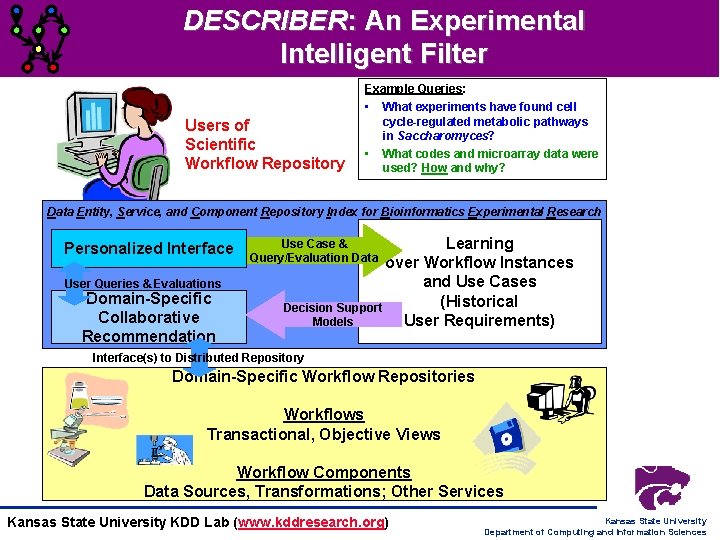
DESCRIBER: An Experimental Intelligent Filter Users of Scientific Workflow Repository Example Queries: • What experiments have found cell cycle-regulated metabolic pathways in Saccharomyces? • What codes and microarray data were used? How and why? Data Entity, Service, and Component Repository Index for Bioinformatics Experimental Research Personalized Interface User Queries & Evaluations Domain-Specific Collaborative Recommendation Learning over Workflow Instances and Use Cases (Historical Decision Support User Requirements) Models Use Case & Query/Evaluation Data Interface(s) to Distributed Repository Domain-Specific Workflow Repositories Workflows Transactional, Objective Views Workflow Components Data Sources, Transformations; Other Services Kansas State University KDD Lab (www. kddresearch. org) Kansas State University Department of Computing and Information Sciences
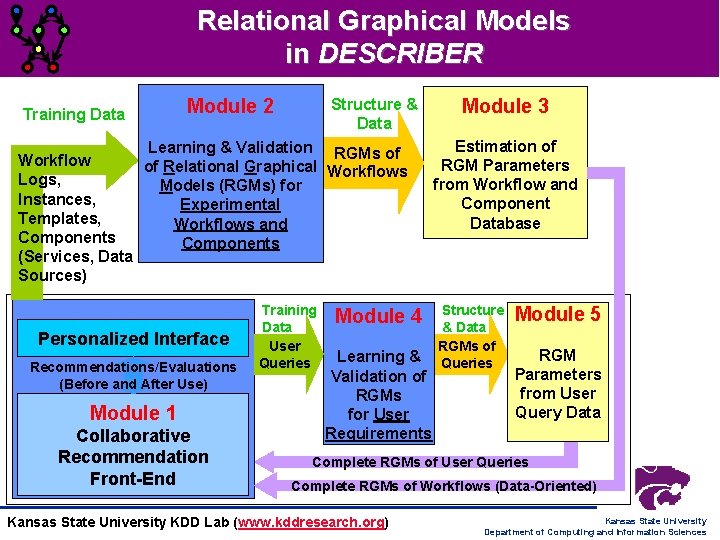
Relational Graphical Models in DESCRIBER Module 2 Training Data Workflow Logs, Instances, Templates, Components (Services, Data Sources) Structure & Data Learning & Validation RGMs of of Relational Graphical Workflows Models (RGMs) for Experimental Workflows and Components Personalized Interface Recommendations/Evaluations (Before and After Use) Module 1 Collaborative Recommendation Front-End Training Data User Queries Module 4 Learning & Validation of RGMs for User Requirements Module 3 Estimation of RGM Parameters from Workflow and Component Database Structure & Data RGMs of Queries Module 5 RGM Parameters from User Query Data Complete RGMs of User Queries Complete RGMs of Workflows (Data-Oriented) Kansas State University KDD Lab (www. kddresearch. org) Kansas State University Department of Computing and Information Sciences
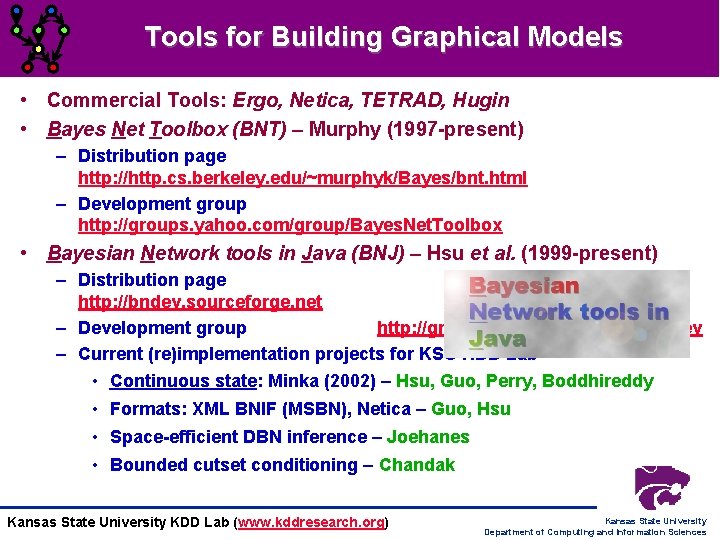
Tools for Building Graphical Models • Commercial Tools: Ergo, Netica, TETRAD, Hugin • Bayes Net Toolbox (BNT) – Murphy (1997 -present) – Distribution page http: //http. cs. berkeley. edu/~murphyk/Bayes/bnt. html – Development group http: //groups. yahoo. com/group/Bayes. Net. Toolbox • Bayesian Network tools in Java (BNJ) – Hsu et al. (1999 -present) – Distribution page http: //bndev. sourceforge. net – Development group http: //groups. yahoo. com/group/bndev – Current (re)implementation projects for KSU KDD Lab • Continuous state: Minka (2002) – Hsu, Guo, Perry, Boddhireddy • Formats: XML BNIF (MSBN), Netica – Guo, Hsu • Space-efficient DBN inference – Joehanes • Bounded cutset conditioning – Chandak Kansas State University KDD Lab (www. kddresearch. org) Kansas State University Department of Computing and Information Sciences
References [1]: Graphical Models and Inference Algorithms • Graphical Models – Bayesian (Belief) Networks tutorial – Murphy (2001) http: //www. cs. berkeley. edu/~murphyk/Bayes/bayes. html – Learning Bayesian Networks – Heckerman (1996, 1999) http: //research. microsoft. com/~heckerman • Inference Algorithms – Junction Tree (Join Tree, L-S, Hugin): Lauritzen & Spiegelhalter (1988) http: //citeseer. nj. nec. com/huang 94 inference. html – (Bounded) Loop Cutset Conditioning: Horvitz & Cooper (1989) http: //citeseer. nj. nec. com/shachter 94 global. html – Variable Elimination (Bucket Elimination, Elim. Bel): Dechter (1986) http: //citeseer. nj. nec. com/dechter 96 bucket. html – Recommended Books • Neapolitan (1990) – out of print; see Pearl (1988), Jensen (2001) • Castillo, Gutierrez, Hadi (1997) • Cowell, Dawid, Lauritzen, Spiegelhalter (1999) – Stochastic Approximation http: //citeseer. nj. nec. com/cheng 00 aisbn. html Kansas State University KDD Lab (www. kddresearch. org) Kansas State University Department of Computing and Information Sciences
References [2]: Machine Learning, KDD, and Bioinformatics • Machine Learning, Data Mining, and Knowledge Discovery – K-State KDD Lab: literature survey and resource catalog (2002) http: //www. kddresearch. org/Resources – Bayesian Network tools in Java (BNJ): Hsu, Guo, Joehanes, Perry, Thornton (2002) http: //bndev. sourceforge. net – Machine Learning in Java (BNJ): Hsu, Louis, Plummer (2002) http: //mldev. sourceforge. net – NCSA Data to Knowledge (D 2 K): Welge, Redman, Auvil, Tcheng, Hsu http: //alg. ncsa. uiuc. edu • Bioinformatics – European Bioinformatics Institute Tutorial: Brazma et al. (2001) http: //www. ebi. ac. uk/microarray/biology_intro. htm – Hebrew University: Friedman, Pe’er, et al. (1999, 2000, 2002) http: //www. cs. huji. ac. il/labs/compbio/ – K-State BMI Group: literature survey and resource catalog (2002) http: //www. kddresearch. org/Groups/Bioinformatics Kansas State University KDD Lab (www. kddresearch. org) Kansas State University Department of Computing and Information Sciences
Acknowledgements • Kansas State University Lab for Knowledge Discovery in Databases – Graduate research assistants: Haipeng Guo (hpguo@cis. ksu. edu), Roby Joehanes (robbyjo@cis. ksu. edu) – Other grad students: Prashanth Boddhireddy, Siddharth Chandak, Ben B. Perry, Rengakrishnan Subramanian – Undergraduate programmers: James W. Plummer, Julie A. Thornton • Joint Work with – KSU Bioinformatics and Medical Informatics (BMI) group: Sanjoy Das (EECE), Judith L. Roe (Biology), Stephen M. Welch (Agronomy) – KSU Microarray group: Scot Hulbert (Plant Pathology), J. Clare Nelson (Plant Pathology), Jan Leach (Plant Pathology) – Kansas Geological Survey, Kansas Biological Survey, KU EECS • Other Research Partners – NCSA Automated Learning Group (Michael Welge, Tom Redman, David Clutter, Lisa Gatzke) – The Institute for Genomic Research (John Quackenbush, Alex Saeed) – University of Manchester (Carole Goble, Robert Stevens) – International Rice Research Institute (Richard Bruskiewich) Kansas State University KDD Lab (www. kddresearch. org) Kansas State University Department of Computing and Information Sciences
- Slides: 24