
KS 4 Waves Total Internal Reflection and Communication
![Total Internal Reflection This angle is called the critical angle [ c] i< c](https://slidetodoc.com/presentation_image_h/86d223511799ad54c7aac0c0348c71f4/image-4.jpg "Total Internal Reflection This angle is called the critical angle [ c] i< c")

- Slides: 31
KS 4 Waves: Total Internal Reflection and Communication LEARNING OUTCOMES: • Describe what happens to light incident on a perspex/glass-air surface both above and below the critical angle of incidence and describe how light is reflected at the inner face of a right-angled prism. • Explain how optical fibres are used in endoscopy. Explain how optical fibres allow the rapid transmission of data using digital signals. © Boardworks Ltd 2003
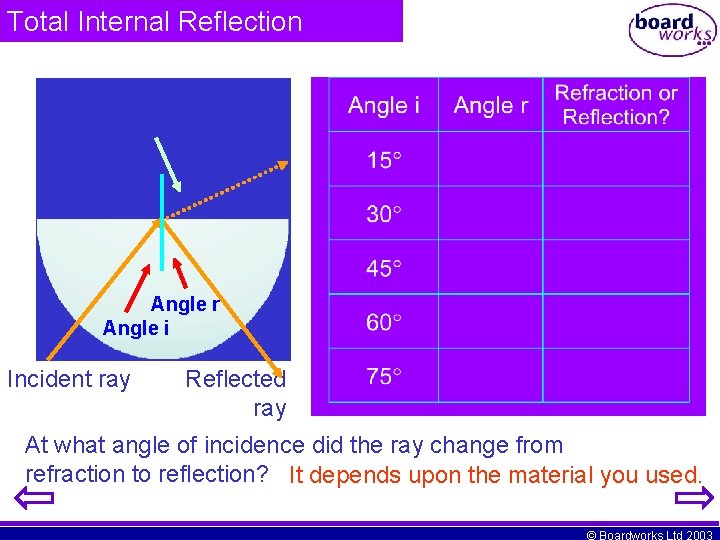
Total Internal Reflection Angle r Refracted ray Angle r Angle i Incident ray Reflected ray At what angle of incidence did the ray change from refraction to reflection? It depends upon the material you used. © Boardworks Ltd 2003
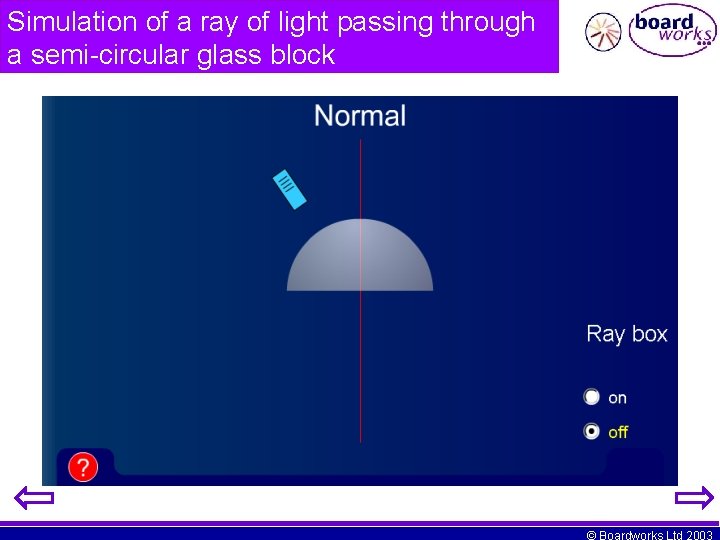
Simulation of a ray of light passing through a semi-circular glass block © Boardworks Ltd 2003
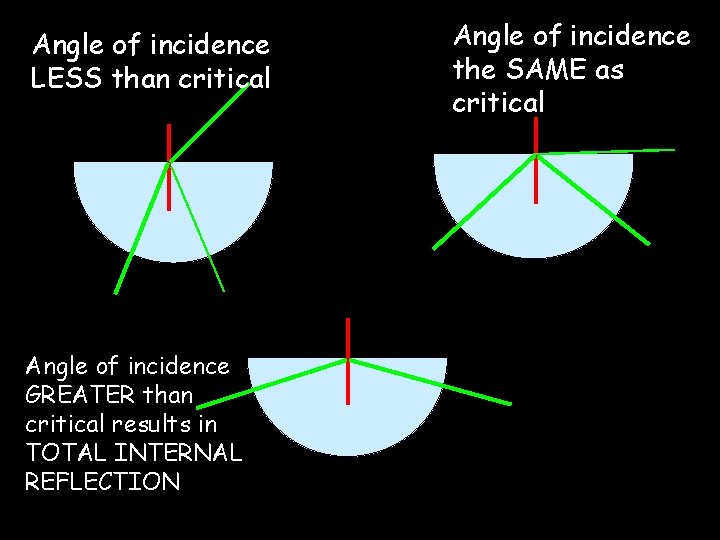
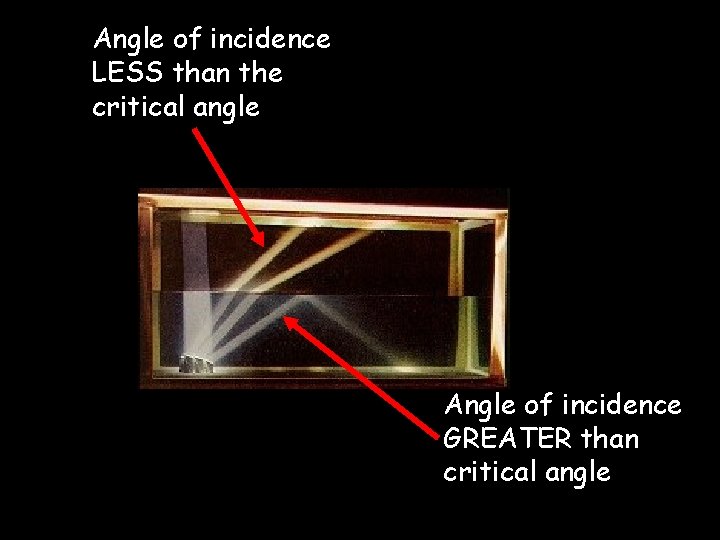
Total Internal Reflection This angle is called the critical angle [ c] i< c i= c Refraction Critical case i> c Total Internal Different materials have different critical angles. Reflection Diamond has the lowest at 24º which is why it [TIR] reflects so much light. © Boardworks Ltd 2003
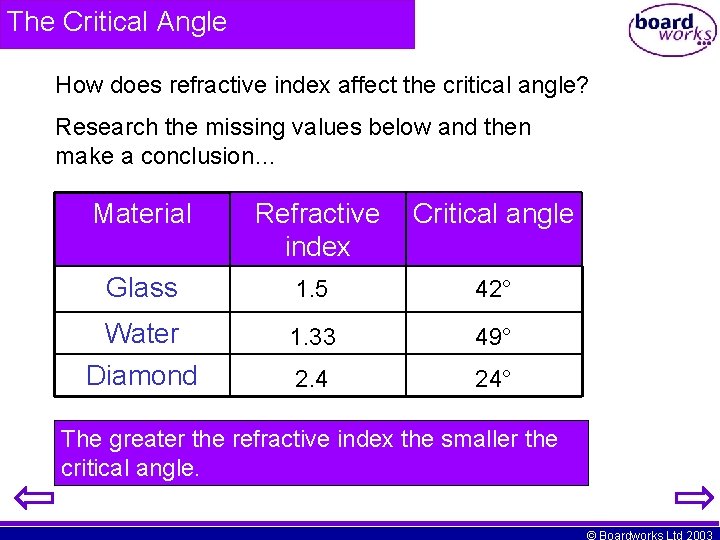
The Critical Angle How does refractive index affect the critical angle? Research the missing values below and then make a conclusion… Material Refractive index Critical angle Glass 1. 5 42° Water Diamond 1. 33 49° 2. 4 24° The greater the refractive index the smaller the critical angle. © Boardworks Ltd 2003
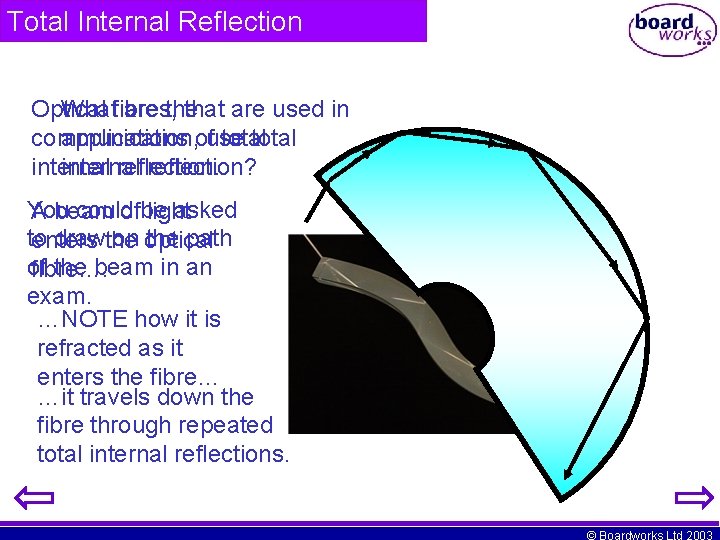
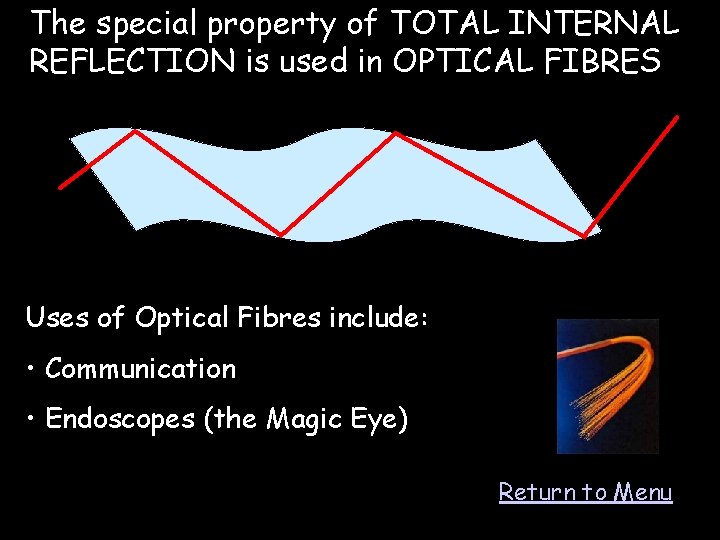
Total Internal Reflection Optical Whatfibres, are that are used in communication, applications ofuse total internal reflection? You could asked A beam ofbe light to drawthe on optical the path enters of the beam in an fibre…. exam. …NOTE how it is refracted as it enters the fibre… …it travels down the fibre through repeated total internal reflections. © Boardworks Ltd 2003
Angle of incidence LESS than critical Angle of incidence GREATER than critical results in TOTAL INTERNAL REFLECTION Angle of incidence the SAME as critical
Angle of incidence LESS than the critical angle Angle of incidence GREATER than critical angle
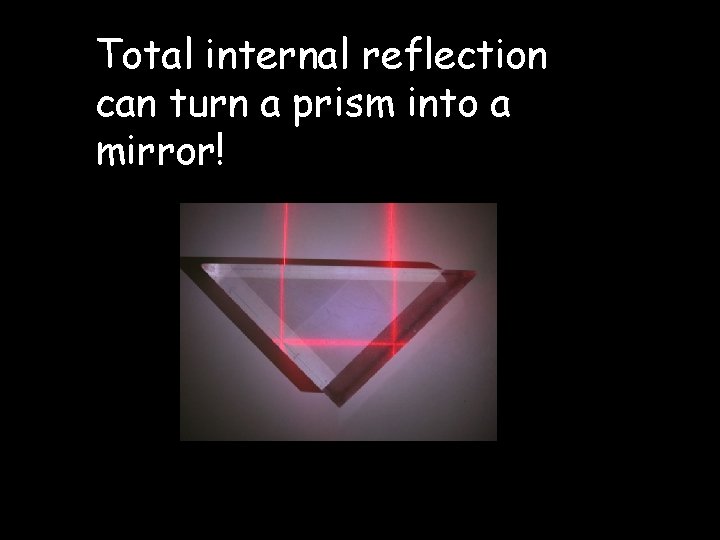
Total internal reflection can turn a prism into a mirror!
The special property of TOTAL INTERNAL REFLECTION is used in OPTICAL FIBRES Uses of Optical Fibres include: • Communication • Endoscopes (the Magic Eye) Return to Menu
WEB LINK: http: //sol. sci. uop. edu/~jfalward/physics 17/chapter 12/c hapter 12. html © Boardworks Ltd 2003
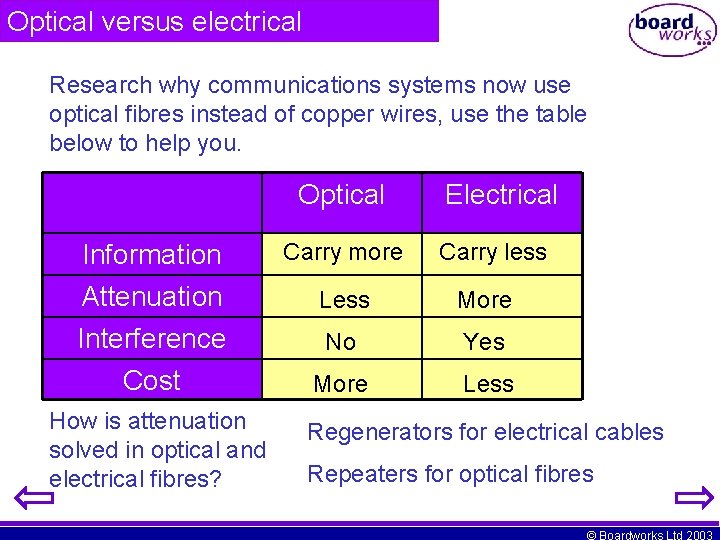
Optical versus electrical Research why communications systems now use optical fibres instead of copper wires, use the table below to help you. Optical Electrical Information Attenuation Carry more Less More Interference Cost No Yes More Less How is attenuation solved in optical and electrical fibres? Carry less Regenerators for electrical cables Repeaters for optical fibres © Boardworks Ltd 2003
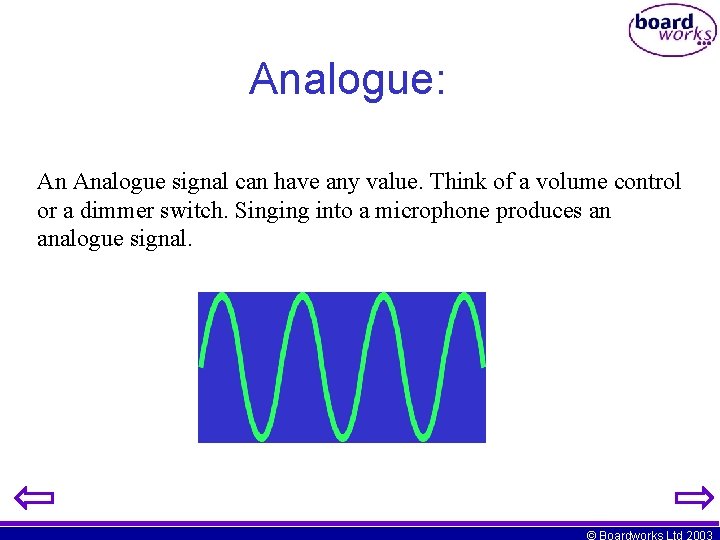
Analogue: An Analogue signal can have any value. Think of a volume control or a dimmer switch. Singing into a microphone produces an analogue signal. © Boardworks Ltd 2003
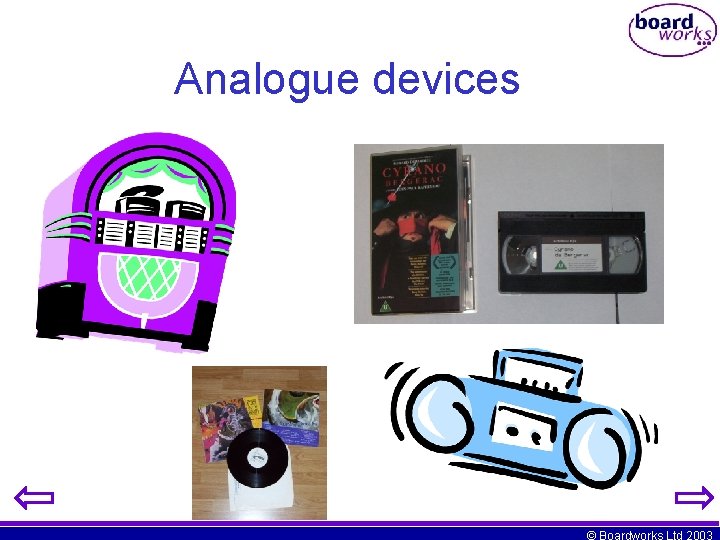
Analogue devices © Boardworks Ltd 2003
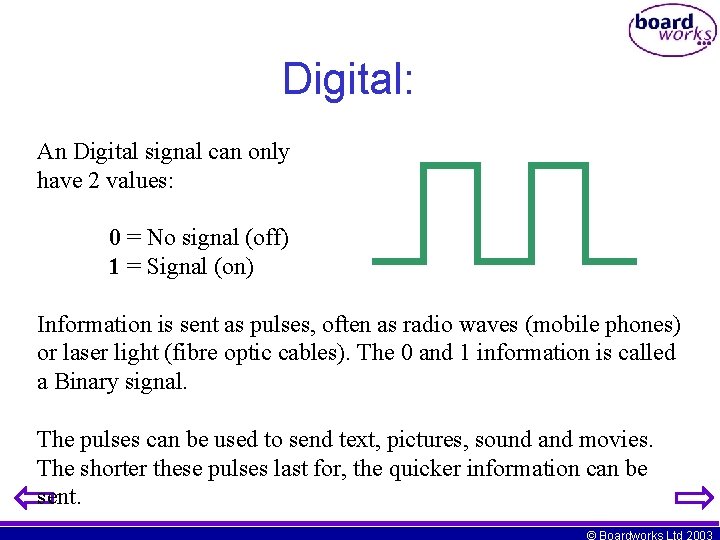
Digital: An Digital signal can only have 2 values: 0 = No signal (off) 1 = Signal (on) Information is sent as pulses, often as radio waves (mobile phones) or laser light (fibre optic cables). The 0 and 1 information is called a Binary signal. The pulses can be used to send text, pictures, sound and movies. The shorter these pulses last for, the quicker information can be sent. © Boardworks Ltd 2003
digital devices © Boardworks Ltd 2003
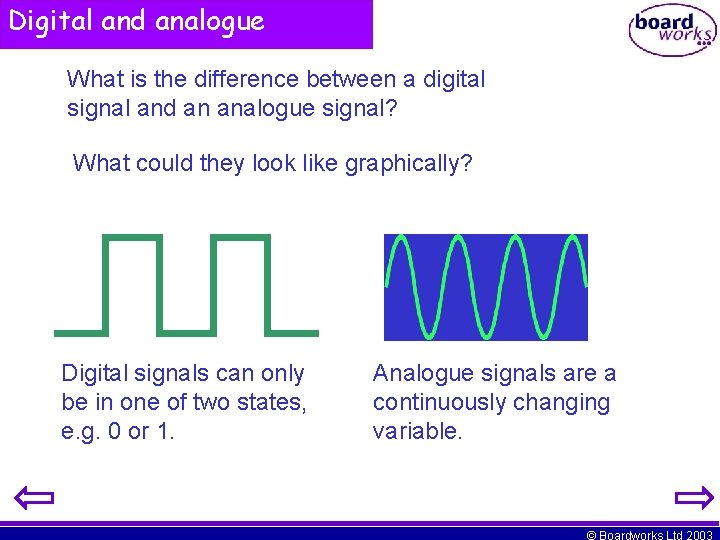
Digital and analogue What is the difference between a digital signal and an analogue signal? What could they look like graphically? Digital signals can only be in one of two states, e. g. 0 or 1. Analogue signals are a continuously changing variable. © Boardworks Ltd 2003
Analogue VS Digital Advantages of Analogue: • Cheap, • Easy (not much technology needed) Disadvantages of Analogue: • Noise & loss of signal • Quality is poor • Cannot be copied more than a few times © Boardworks Ltd 2003
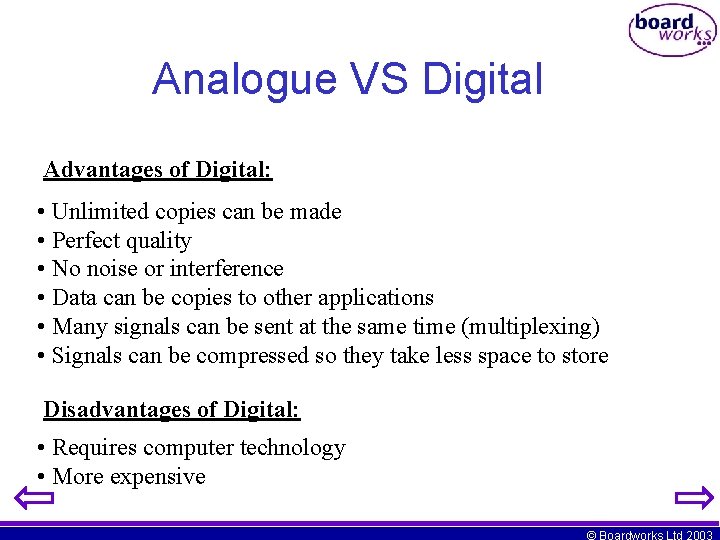
Analogue VS Digital Advantages of Digital: • Unlimited copies can be made • Perfect quality • No noise or interference • Data can be copies to other applications • Many signals can be sent at the same time (multiplexing) • Signals can be compressed so they take less space to store Disadvantages of Digital: • Requires computer technology • More expensive © Boardworks Ltd 2003
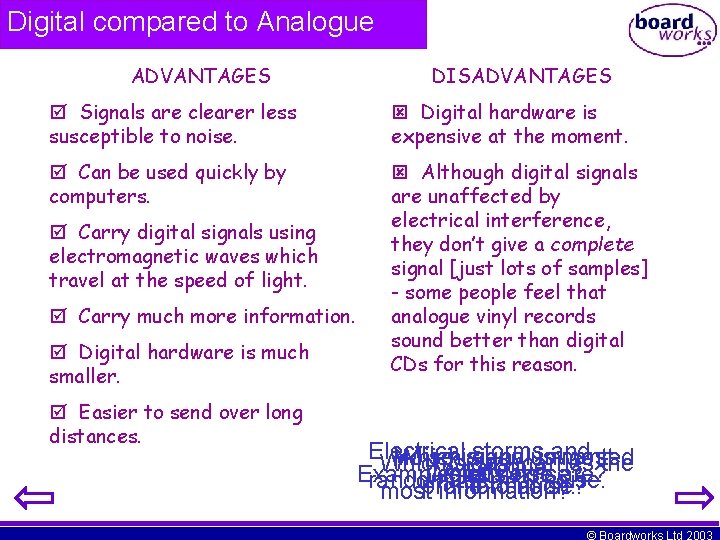
Digital compared to Analogue ADVANTAGES DISADVANTAGES Signals are clearer less susceptible to noise. Digital hardware is expensive at the moment. Can be used quickly by computers. Although digital signals are unaffected by electrical interference, they don’t give a complete signal [just lots of samples] - some people feel that analogue vinyl records sound better than digital CDs for this reason. Carry digital signals using electromagnetic waves which travel at the speed of light. Carry much more information. Digital hardware is much smaller. Easier to send over long distances. Electrical storms and Noise Which is signal any unwanted is most Which signal carries the Analogue Examples Digital What of is noise? are? random thermal noise. information. to noise? mostprone information? © Boardworks Ltd 2003
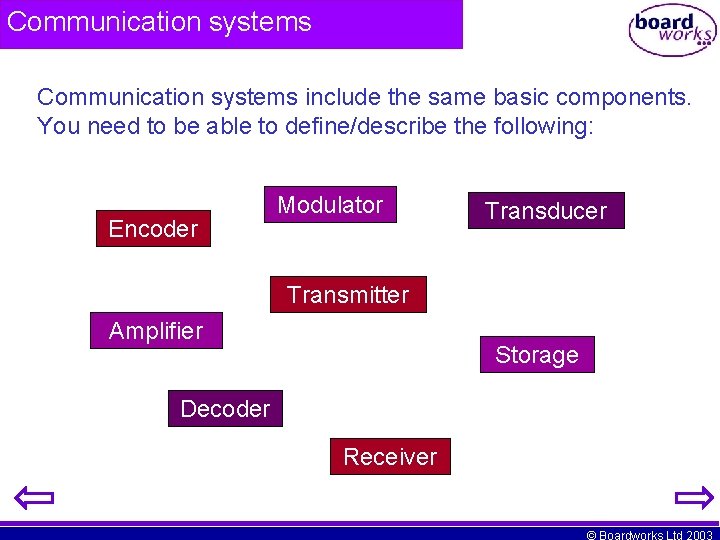
Communication systems include the same basic components. You need to be able to define/describe the following: Encoder Modulator Transducer Transmitter Amplifier Storage Decoder Receiver © Boardworks Ltd 2003
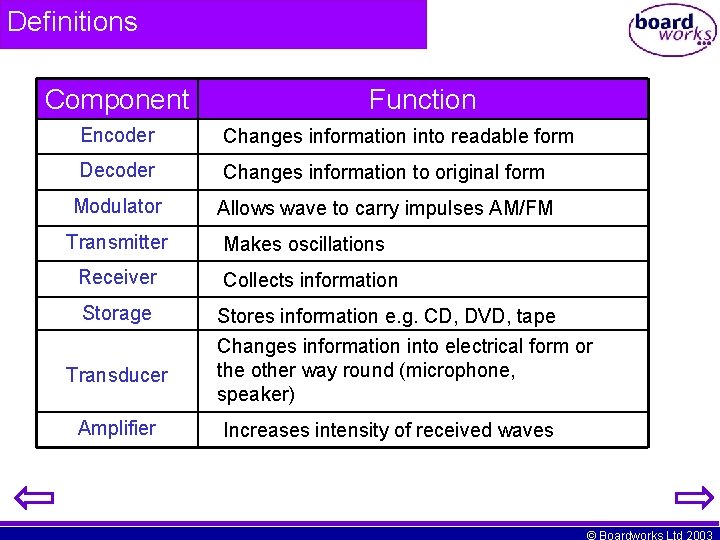
Definitions Component Function Encoder Changes information into readable form Decoder Changes information to original form Modulator Allows wave to carry impulses AM/FM Transmitter Makes oscillations Receiver Collects information Storage Stores information e. g. CD, DVD, tape Changes information into electrical form or the other way round (microphone, speaker) Transducer Amplifier Increases intensity of received waves © Boardworks Ltd 2003
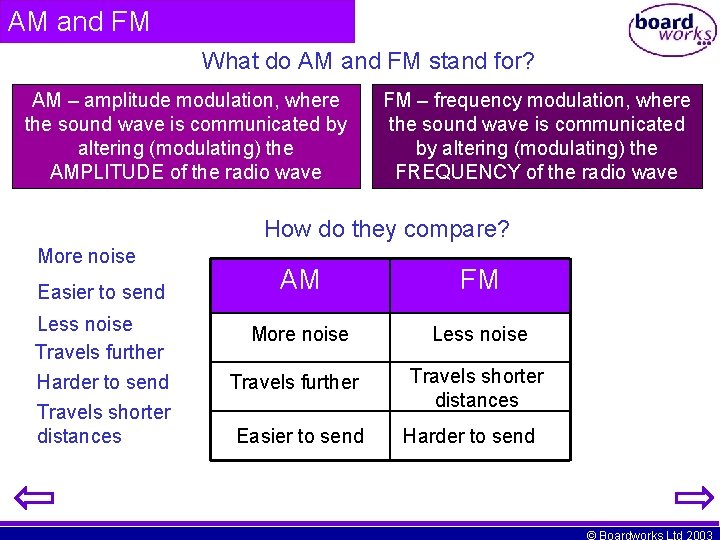
AM and FM What do AM and FM stand for? AM – amplitude modulation, where the sound wave is communicated by altering (modulating) the AMPLITUDE of the radio wave FM – frequency modulation, where the sound wave is communicated by altering (modulating) the FREQUENCY of the radio wave How do they compare? More noise Easier to send Less noise Travels further Harder to send Travels shorter distances AM FM More noise Less noise Travels further Easier to send Travels shorter distances Harder to send © Boardworks Ltd 2003
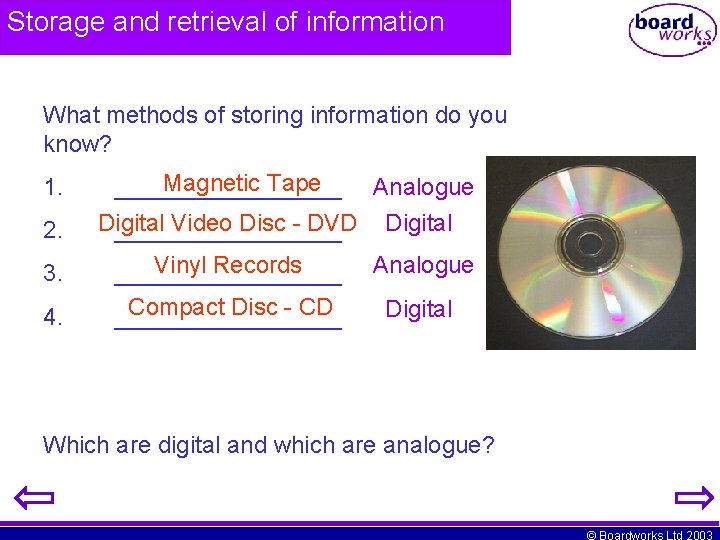
Storage and retrieval of information What methods of storing information do you know? 1. 2. 3. 4. Magnetic Tape _________ Analogue Digital Video Disc - DVD Digital _________ Vinyl Records Analogue _________ Compact Disc - CD _________ Digital Which are digital and which are analogue? © Boardworks Ltd 2003
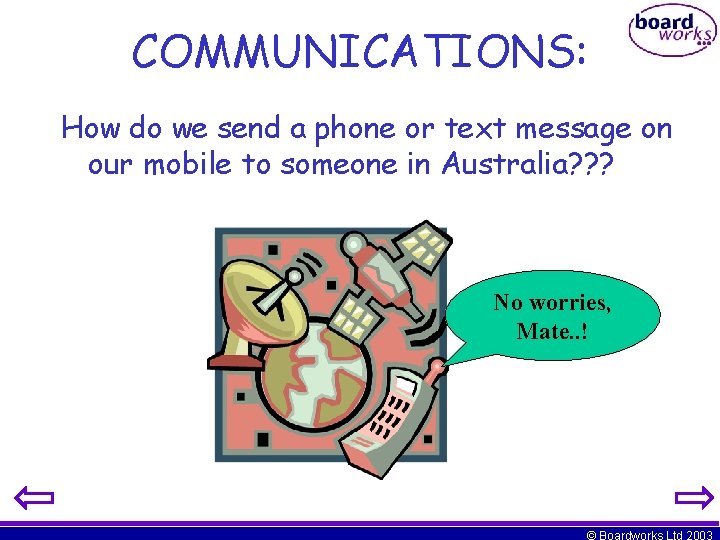
COMMUNICATIONS: How do we send a phone or text message on our mobile to someone in Australia? ? ? No worries, Mate. . ! © Boardworks Ltd 2003
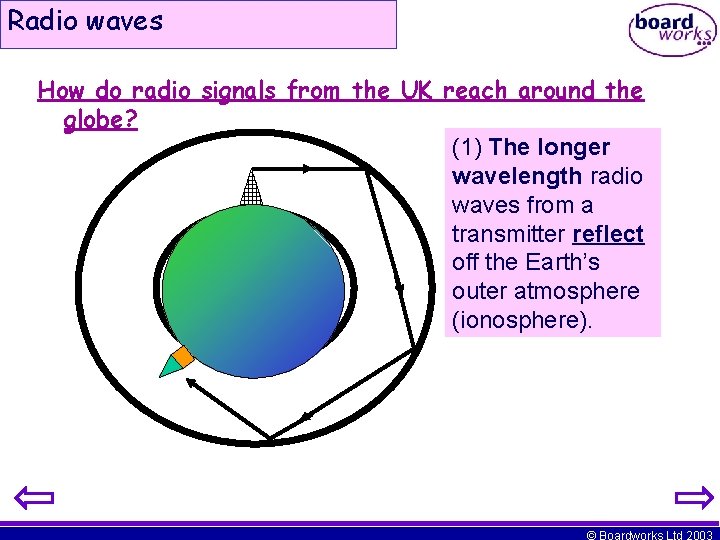
Radio waves How do radio signals from the UK reach around the globe? (1) The longer wavelength radio waves from a transmitter reflect off the Earth’s outer atmosphere (ionosphere). © Boardworks Ltd 2003
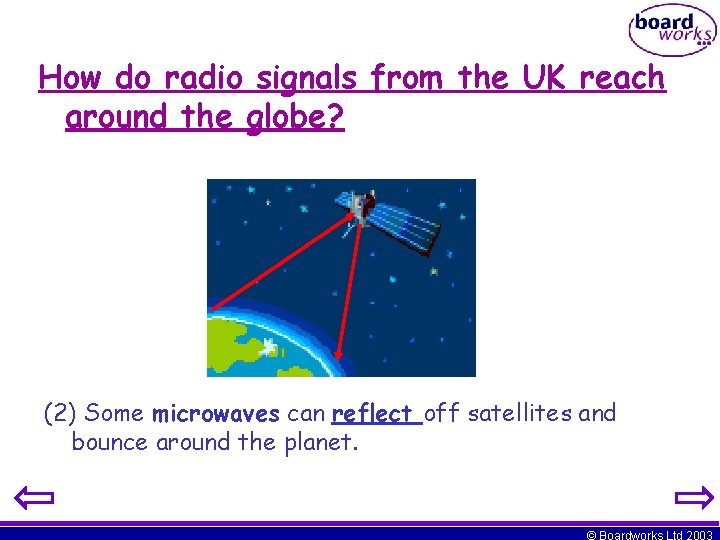
How do radio signals from the UK reach around the globe? (2) Some microwaves can reflect off satellites and bounce around the planet. © Boardworks Ltd 2003
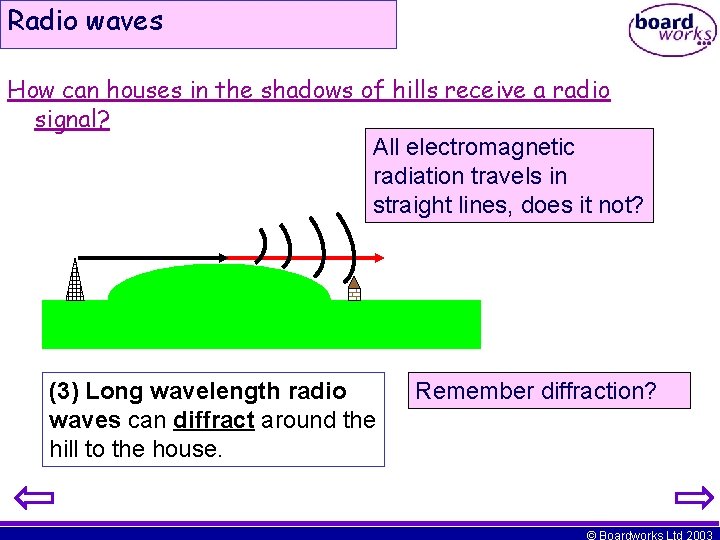
Radio waves How can houses in the shadows of hills receive a radio signal? All electromagnetic radiation travels in straight lines, does it not? (3) Long wavelength radio waves can diffract around the hill to the house. Remember diffraction? © Boardworks Ltd 2003
Which of the following is not a use of total internal reflection? A. Periscopes B. Endoscopes C. Fibre optic communication D. Mirrors © Boardworks Ltd 2003
What does attenuation mean? A. Strengthening B. Increasing C. Larger D. Weakening © Boardworks Ltd 2003
Which of the following is not a a digital storage method? A. DVD B. CD C. CD-ROM D. Vinyl record © Boardworks Ltd 2003