
KS 4 Biology Digestion Part Two 1 of
KS 4 Biology • Digestion - Part Two 1 of 55 © Boardworks Ltd 2004
Contents Digestion – Part Two Mouth to gullet Gastric processes The small intestine Lipid digestion Absorption Summary 2 of 55 © Boardworks Ltd 2004

Digestive action of the mouth – reminder Carbohydrates Fats Proteins physical digestion chemical digestion The food could now pass down either the trachea (windpipe) or the gullet/oesophagus. chemically and physically digested sugars 3 of 55 © Boardworks Ltd 2004
Mouth to the gullet: The semi-digested food has been formed into a ball by the tongue and is now swallowed. The ball firstly moves to the pharynx, the region at the back of the mouth where there is a junction between two pipes. It needs to pass down through the gullet. To ensure that it does not fall into the trachea and thus block our breathing, a small flap moves to cover the tube. 4 of 55 © Boardworks Ltd 2004
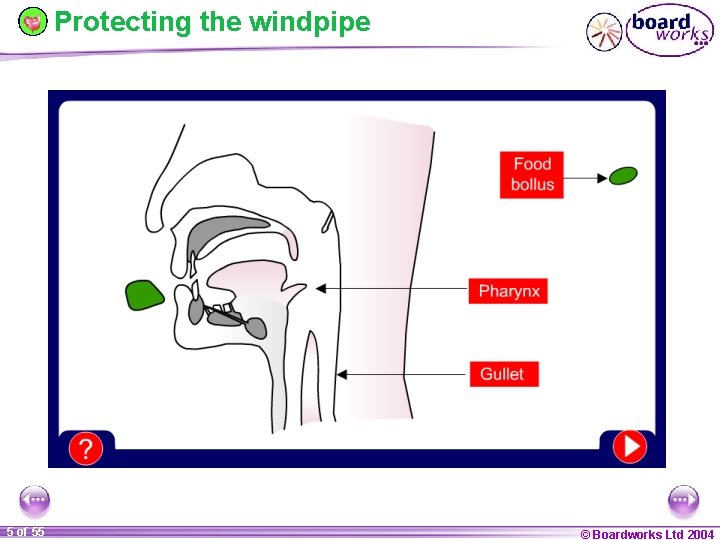
Protecting the windpipe 5 of 55 © Boardworks Ltd 2004
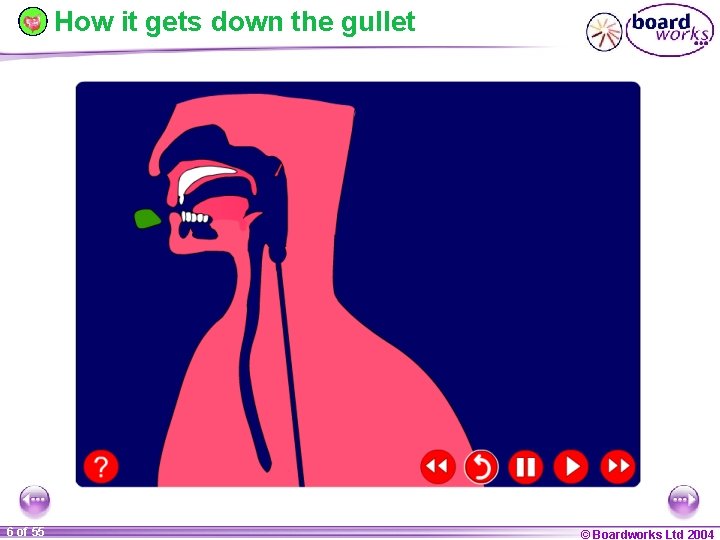
How it gets down the gullet 6 of 55 © Boardworks Ltd 2004
Epiglottis The flap is known as the epiglottis. If ever food accidentally got into the trachea, we would choke and try to cough it back out. How do we swallow? Once the ball of food has passed through the top of the gullet, it is forced downwards by waves of muscular contraction. 7 of 55 © Boardworks Ltd 2004
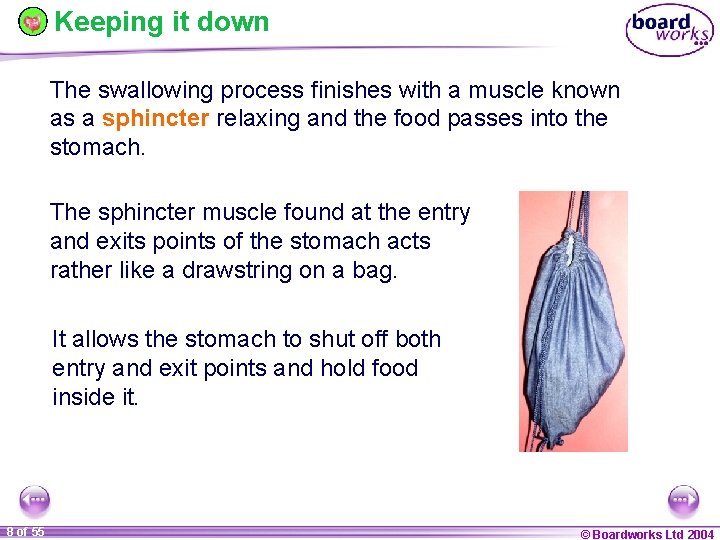
Keeping it down The swallowing process finishes with a muscle known as a sphincter relaxing and the food passes into the stomach. The sphincter muscle found at the entry and exits points of the stomach acts rather like a drawstring on a bag. It allows the stomach to shut off both entry and exit points and hold food inside it. 8 of 55 © Boardworks Ltd 2004
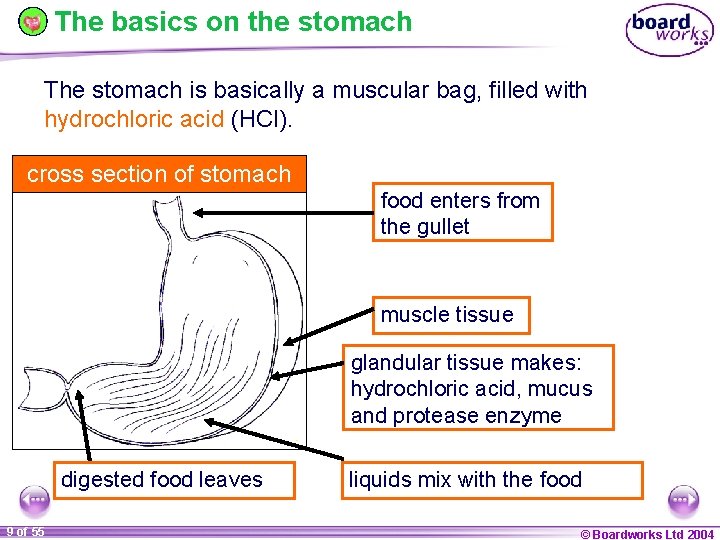
The basics on the stomach The stomach is basically a muscular bag, filled with hydrochloric acid (HCl). cross section of stomach food enters from the gullet muscle tissue glandular tissue makes: hydrochloric acid, mucus and protease enzyme digested food leaves 9 of 55 liquids mix with the food © Boardworks Ltd 2004
Contents Digestion – Part Two Mouth to gullet Gastric processes The small intestine Lipid digestion Absorption Summary 10 of 55 © Boardworks Ltd 2004
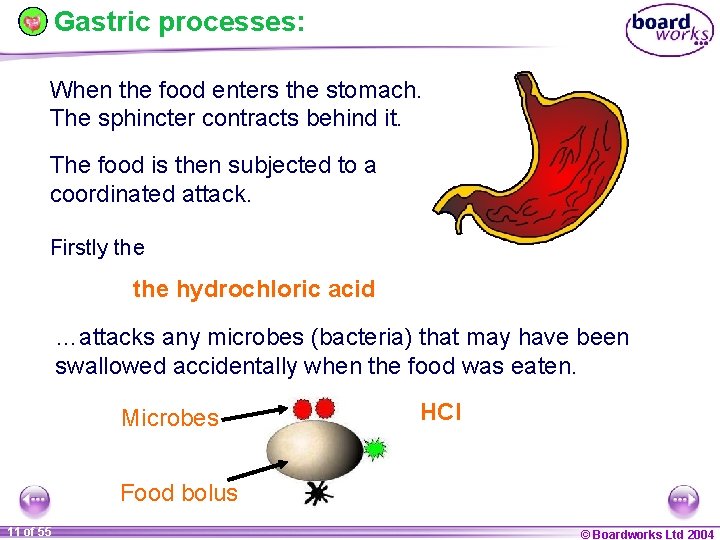
Gastric processes: When the food enters the stomach. The sphincter contracts behind it. The food is then subjected to a coordinated attack. Firstly the hydrochloric acid …attacks any microbes (bacteria) that may have been swallowed accidentally when the food was eaten. Microbes HCl Food bolus 11 of 55 © Boardworks Ltd 2004
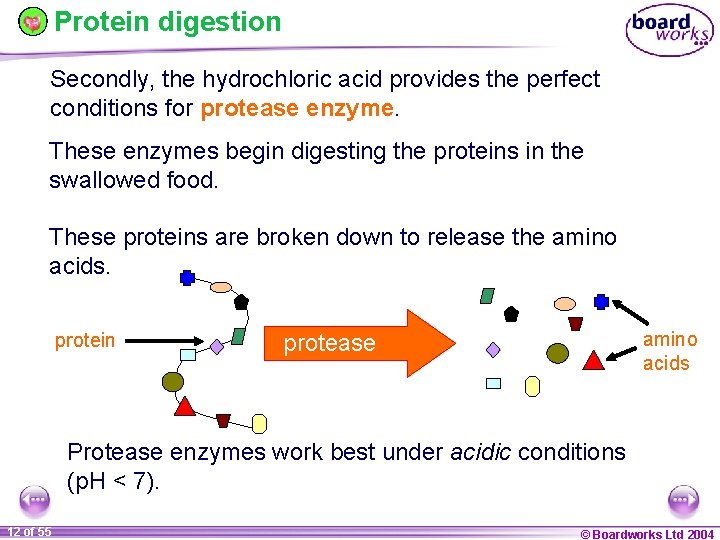
Protein digestion Secondly, the hydrochloric acid provides the perfect conditions for protease enzyme. These enzymes begin digesting the proteins in the swallowed food. These proteins are broken down to release the amino acids. protein amino acids protease Protease enzymes work best under acidic conditions (p. H < 7). 12 of 55 © Boardworks Ltd 2004

Mucus and muscles Thirdly, the muscular tissue of the stomach has the ability to contract and relax and in doing so, physically grinds the food inside it. Mucus is produced to protect the lining of the stomach from the acid. If the mucus were not present, the hydrochloric acid would actually digest the tissue that had made it! 13 of 55 © Boardworks Ltd 2004

Making gastric juice presence of HCl wall of stomach is protected muscle and glandular tissue layer of mucus The hydrochloric acid, mucus, food and enzyme solution is given the name - gastric juice. 14 of 55 © Boardworks Ltd 2004
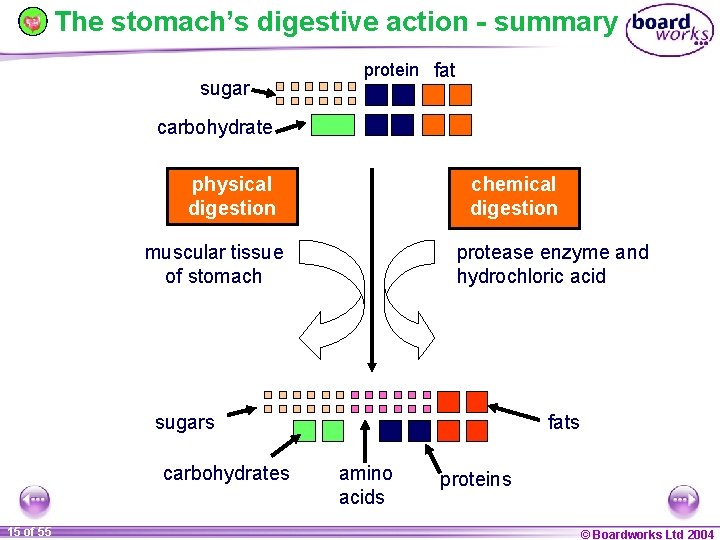
The stomach’s digestive action - summary sugar protein fat carbohydrate physical digestion chemical digestion muscular tissue of stomach protease enzyme and hydrochloric acid sugars carbohydrates 15 of 55 fats amino acids proteins © Boardworks Ltd 2004
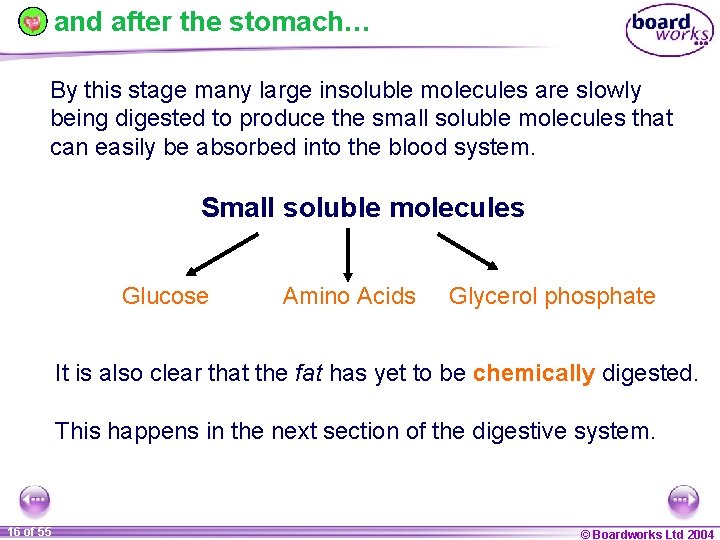
and after the stomach… By this stage many large insoluble molecules are slowly being digested to produce the small soluble molecules that can easily be absorbed into the blood system. Small soluble molecules Glucose Amino Acids Glycerol phosphate It is also clear that the fat has yet to be chemically digested. This happens in the next section of the digestive system. 16 of 55 © Boardworks Ltd 2004
Contents Digestion – Part Two Mouth to gullet Gastric processes The small intestine Lipid digestion Absorption Summary 17 of 55 © Boardworks Ltd 2004
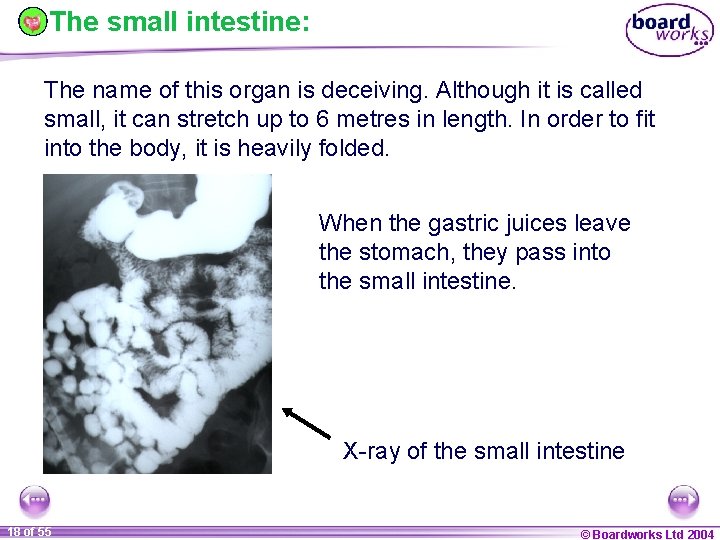
The small intestine: The name of this organ is deceiving. Although it is called small, it can stretch up to 6 metres in length. In order to fit into the body, it is heavily folded. When the gastric juices leave the stomach, they pass into the small intestine. X-ray of the small intestine 18 of 55 © Boardworks Ltd 2004
Dealing with the acid A nasty problem! The gastric juices are very acidic. There could be a danger of the lining of the small intestine being digested. Luckily two substances are produced to stop this happening. The first is mucus and we have seen how this works. The second is bile. Bile is made in the liver. It is a yellow/green liquid that is naturally alkaline (p. H > 7). 19 of 55 © Boardworks Ltd 2004
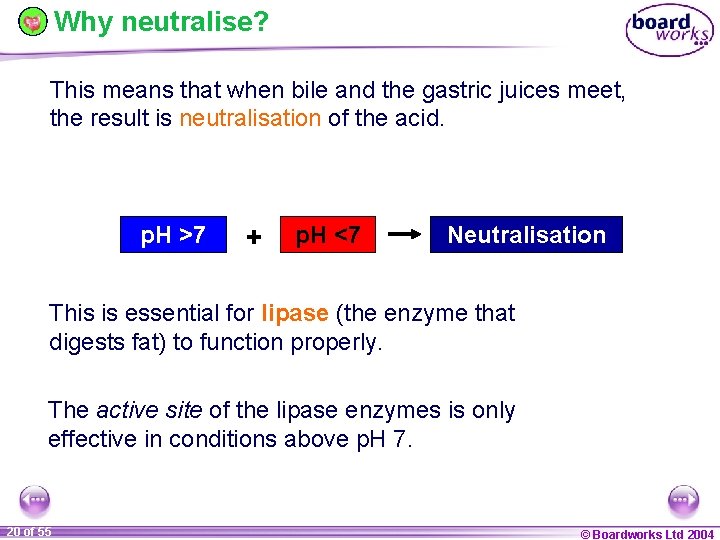
Why neutralise? This means that when bile and the gastric juices meet, the result is neutralisation of the acid. p. H >7 + p. H <7 Neutralisation This is essential for lipase (the enzyme that digests fat) to function properly. The active site of the lipase enzymes is only effective in conditions above p. H 7. 20 of 55 © Boardworks Ltd 2004
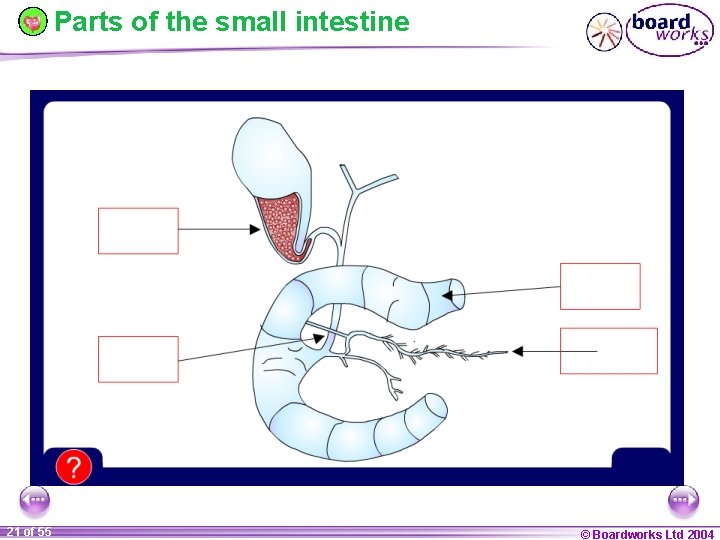
Parts of the small intestine 21 of 55 © Boardworks Ltd 2004
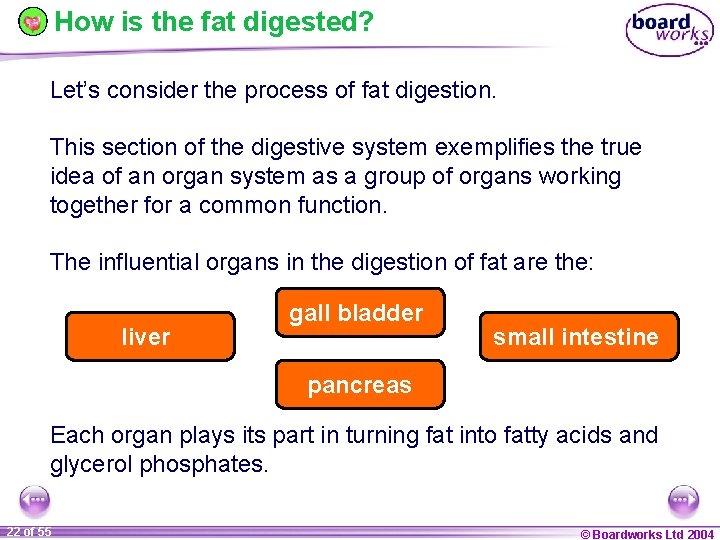
How is the fat digested? Let’s consider the process of fat digestion. This section of the digestive system exemplifies the true idea of an organ system as a group of organs working together for a common function. The influential organs in the digestion of fat are the: liver gall bladder small intestine pancreas Each organ plays its part in turning fat into fatty acids and glycerol phosphates. 22 of 55 © Boardworks Ltd 2004
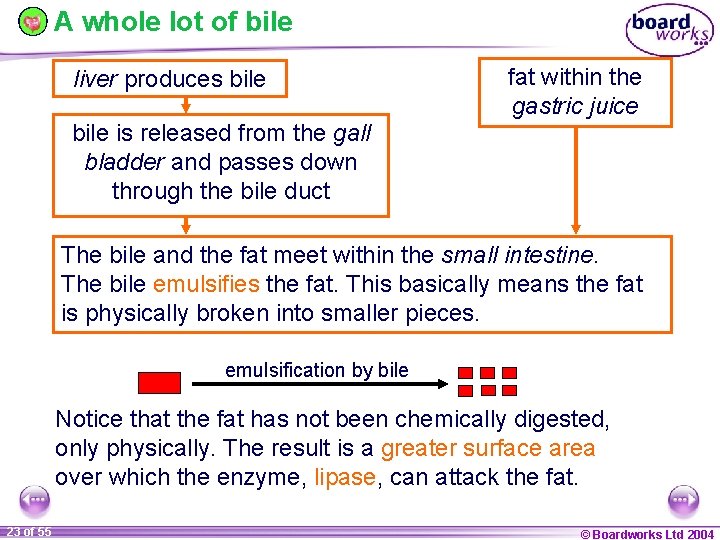
A whole lot of bile liver produces bile fat within the gastric juice bile is released from the gall bladder and passes down through the bile duct The bile and the fat meet within the small intestine. The bile emulsifies the fat. This basically means the fat is physically broken into smaller pieces. emulsification by bile Notice that the fat has not been chemically digested, only physically. The result is a greater surface area over which the enzyme, lipase, can attack the fat. 23 of 55 © Boardworks Ltd 2004
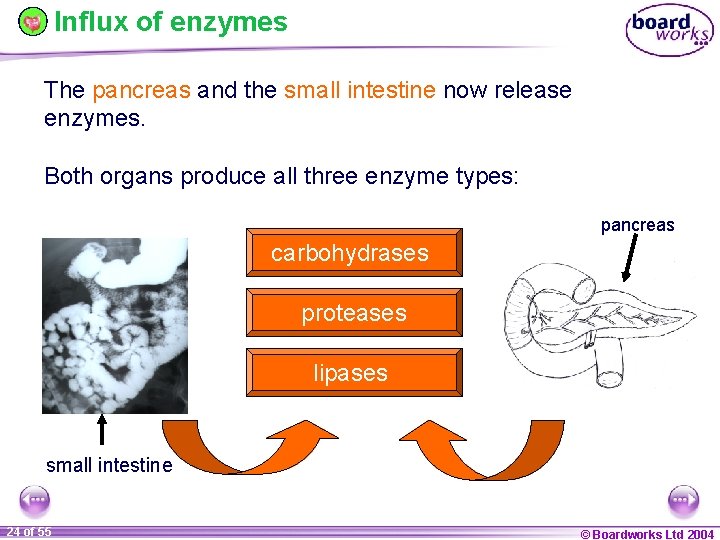
Influx of enzymes The pancreas and the small intestine now release enzymes. Both organs produce all three enzyme types: pancreas carbohydrases proteases lipases small intestine 24 of 55 © Boardworks Ltd 2004
Contents Digestion – Part Two Mouth to gullet Gastric processes The small intestine Lipid digestion Absorption Summary 25 of 55 © Boardworks Ltd 2004
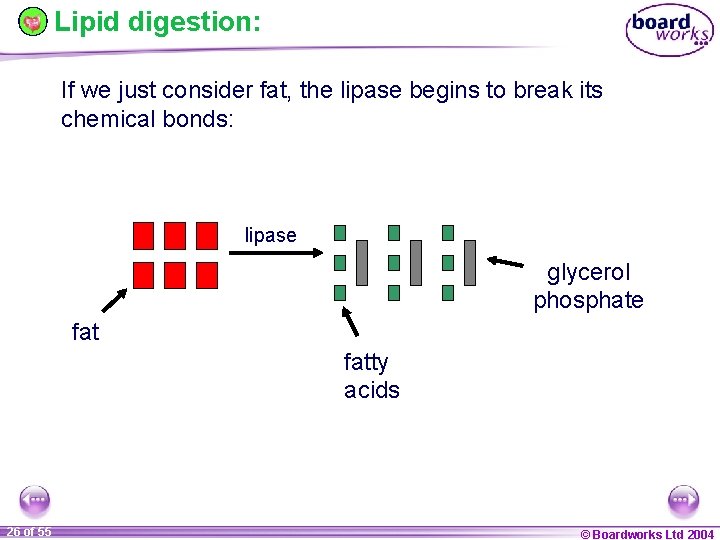
Lipid digestion: If we just consider fat, the lipase begins to break its chemical bonds: lipase glycerol phosphate fatty acids 26 of 55 © Boardworks Ltd 2004
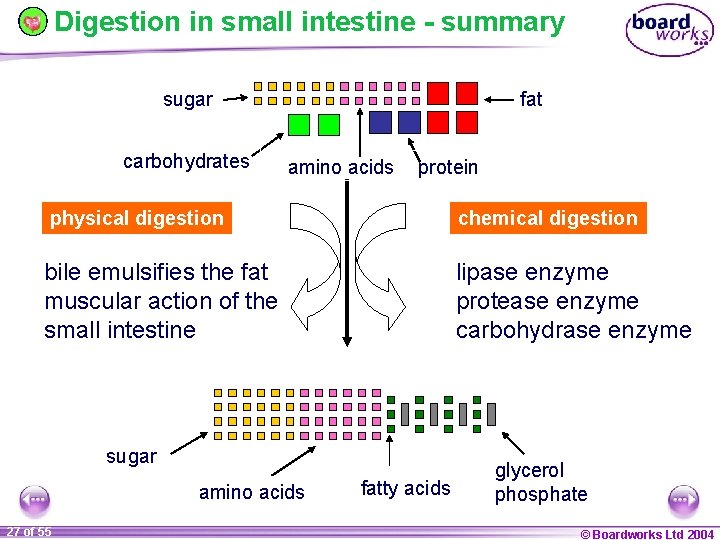
Digestion in small intestine - summary sugar carbohydrates fat amino acids protein physical digestion chemical digestion bile emulsifies the fat muscular action of the small intestine lipase enzyme protease enzyme carbohydrase enzyme sugar amino acids 27 of 55 fatty acids glycerol phosphate © Boardworks Ltd 2004
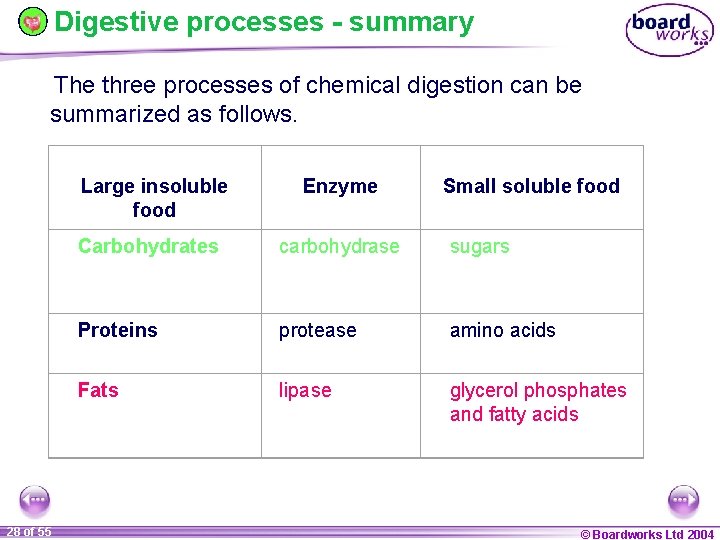
Digestive processes - summary The three processes of chemical digestion can be summarized as follows. Large insoluble food 28 of 55 Enzyme Small soluble food Carbohydrates carbohydrase sugars Proteins protease amino acids Fats lipase glycerol phosphates and fatty acids © Boardworks Ltd 2004
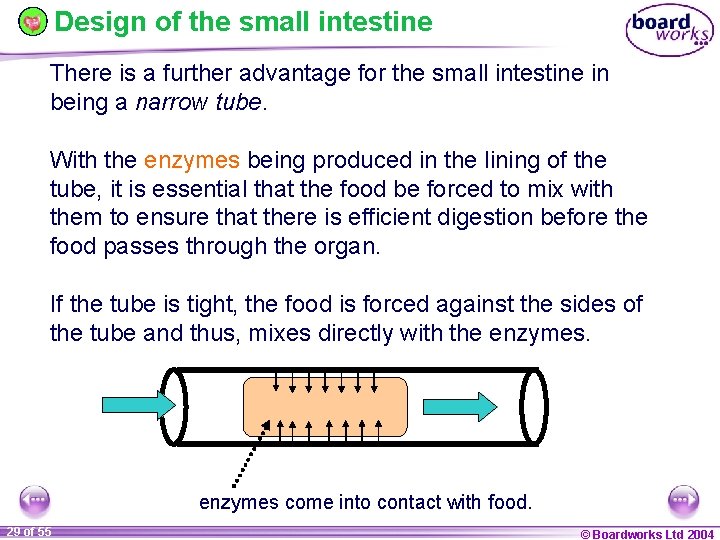
Design of the small intestine There is a further advantage for the small intestine in being a narrow tube. With the enzymes being produced in the lining of the tube, it is essential that the food be forced to mix with them to ensure that there is efficient digestion before the food passes through the organ. If the tube is tight, the food is forced against the sides of the tube and thus, mixes directly with the enzymes come into contact with food. 29 of 55 © Boardworks Ltd 2004
What about the waste? Now that the large insoluble molecules have been digested down into the small soluble molecules, the body must separate them from the waste food that has not been digested. No food is 100% useful and so there will always be some waste that needs excreting. In order to understand how the body carries out this selection procedure, we need to take a closer look at the lining of the small intestine. 30 of 55 © Boardworks Ltd 2004
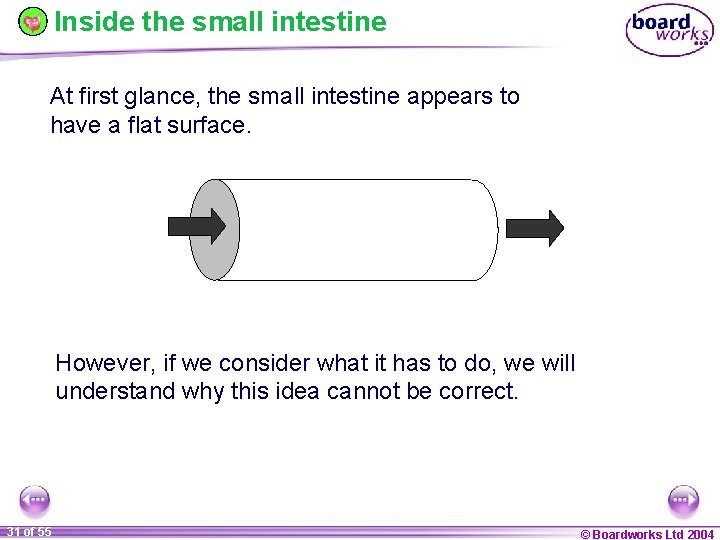
Inside the small intestine At first glance, the small intestine appears to have a flat surface. However, if we consider what it has to do, we will understand why this idea cannot be correct. 31 of 55 © Boardworks Ltd 2004
Contents Digestion – Part Two Mouth to gullet Gastric processes The small intestine Lipid digestion Absorption Summary 32 of 55 © Boardworks Ltd 2004
Absorption: The small intestine is the site of absorption of useful molecules of digested food. These molecules must pass across the lining of the small intestine and enter the blood stream. Their destinations are the cells of the body. Our body cells constantly need these chemicals and therefore the absorption process must be very efficient to keep up with the high demand. 33 of 55 © Boardworks Ltd 2004
Surface area and absorption If absorption were to occur across a flat lining, then not enough molecules would pass across the lining in the desired time. The only way to improve this situation would be to create a larger surface area over which absorption could occur. That is exactly what is present in the small intestine. Its lining is in fact a highly folded lining, which creates an enormous surface area in a small space. 34 of 55 © Boardworks Ltd 2004
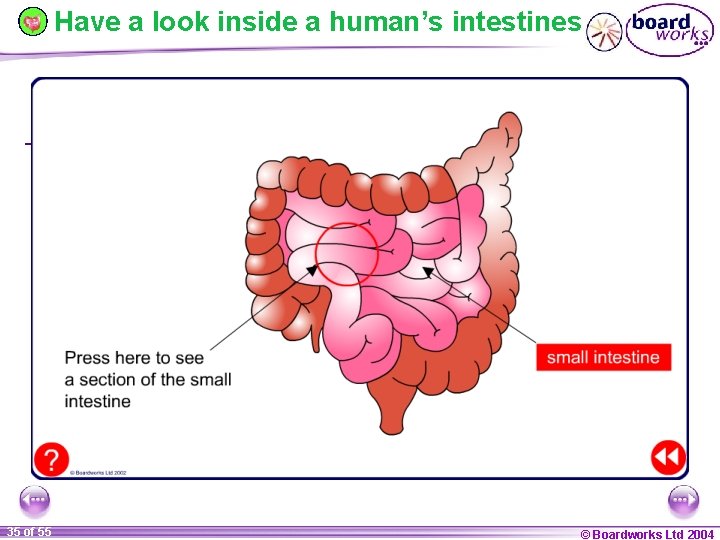
Have a look inside a human’s intestines The small intestine 35 of 55 © Boardworks Ltd 2004
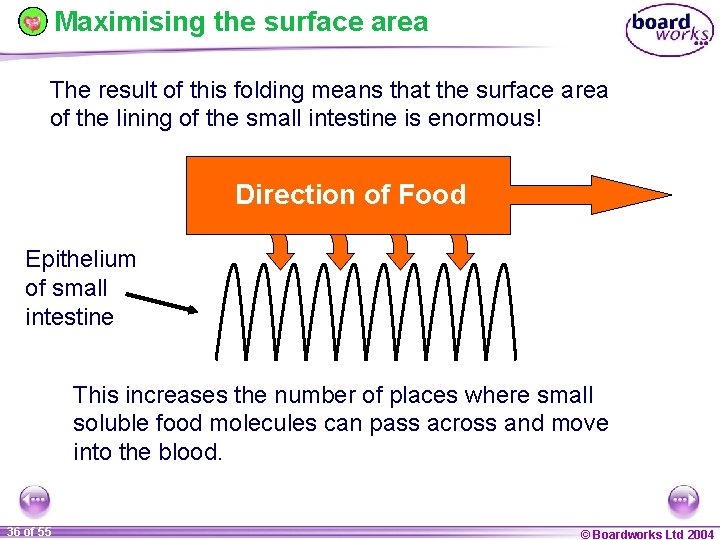
Maximising the surface area The result of this folding means that the surface area of the lining of the small intestine is enormous! Direction of Food Epithelium of small intestine This increases the number of places where small soluble food molecules can pass across and move into the blood. 36 of 55 © Boardworks Ltd 2004
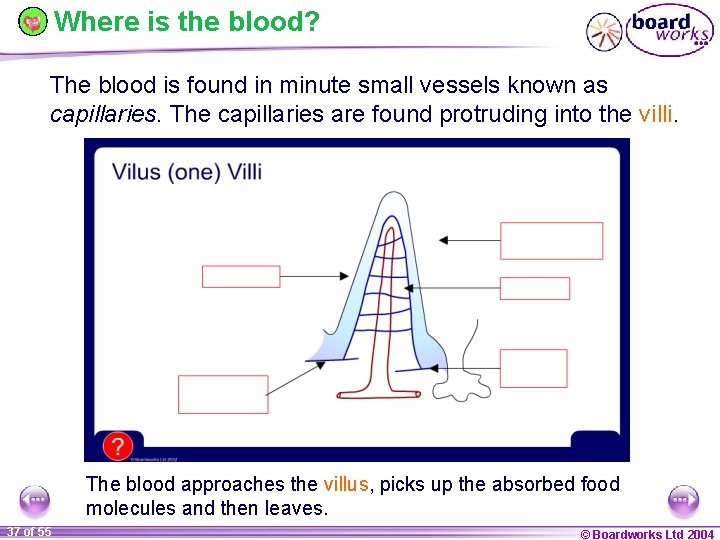
Where is the blood? The blood is found in minute small vessels known as capillaries. The capillaries are found protruding into the villi. The blood approaches the villus, picks up the absorbed food molecules and then leaves. 37 of 55 © Boardworks Ltd 2004
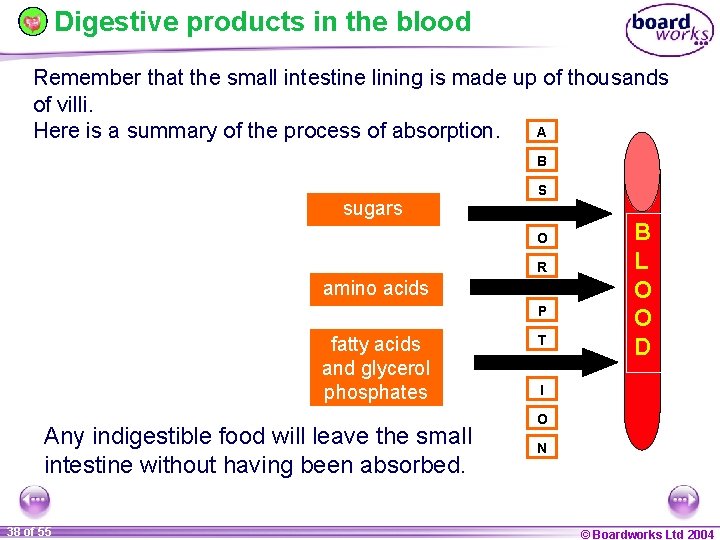
Digestive products in the blood Remember that the small intestine lining is made up of thousands of villi. A Here is a summary of the process of absorption. B sugars S O R amino acids P fatty acids and glycerol phosphates Any indigestible food will leave the small intestine without having been absorbed. 38 of 55 T B L O O D I O N © Boardworks Ltd 2004
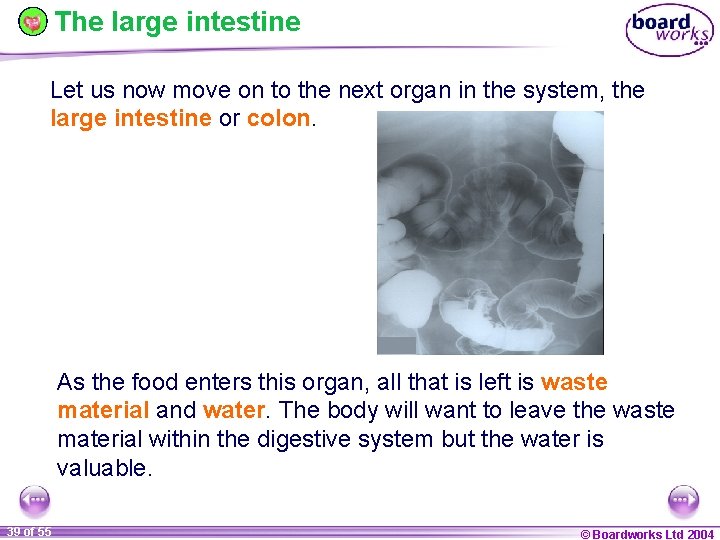
The large intestine Let us now move on to the next organ in the system, the large intestine or colon. As the food enters this organ, all that is left is waste material and water. The body will want to leave the waste material within the digestive system but the water is valuable. 39 of 55 © Boardworks Ltd 2004
Water regulation This water will need to be retained by the body in order to prevent dehydration. Remember that all the liquids you drink provide the largest source of water for the body. The blood reabsorbs the excess water that is mixed with the waste food. Again, if something is going to be absorbed, it must have somewhere to go. 40 of 55 © Boardworks Ltd 2004
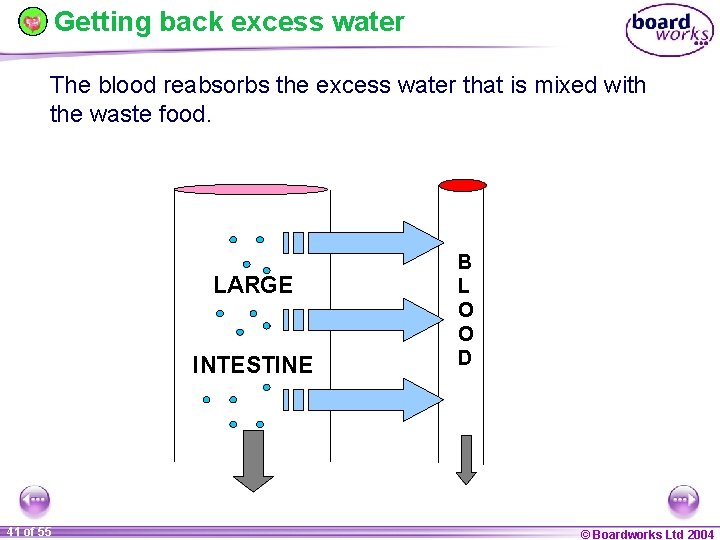
Getting back excess water The blood reabsorbs the excess water that is mixed with the waste food. LARGE INTESTINE 41 of 55 B L O O D © Boardworks Ltd 2004
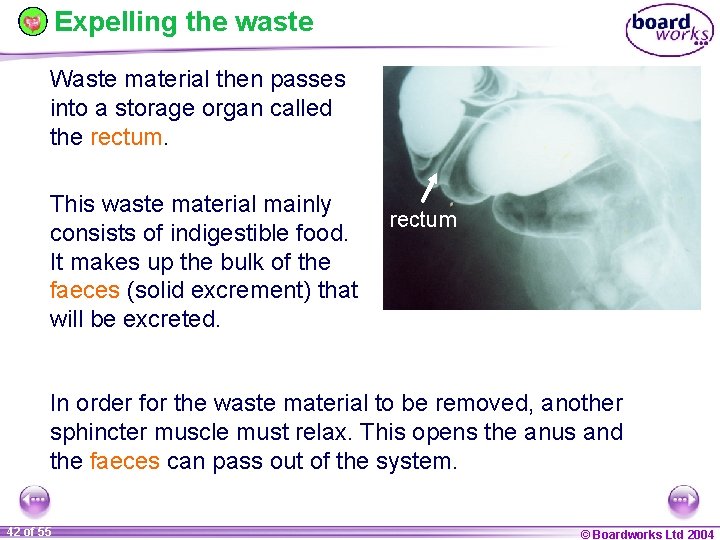
Expelling the waste Waste material then passes into a storage organ called the rectum. This waste material mainly consists of indigestible food. It makes up the bulk of the faeces (solid excrement) that will be excreted. rectum In order for the waste material to be removed, another sphincter muscle must relax. This opens the anus and the faeces can pass out of the system. 42 of 55 © Boardworks Ltd 2004
Important body tissues in digestion We have now finished our journey through the digestive system. We have seen the chemical and physical digestion of large & insoluble into small & soluble food. It is important to remember that the digestive system relies heavily on the presence of two important types of body tissue. 1. Glandular tissue This is responsible for the production of the digestive enzymes. 2. Muscular tissue Through constant contraction and relaxation, the food is kept moving through the system, from the mouth to the anus. 43 of 55 © Boardworks Ltd 2004
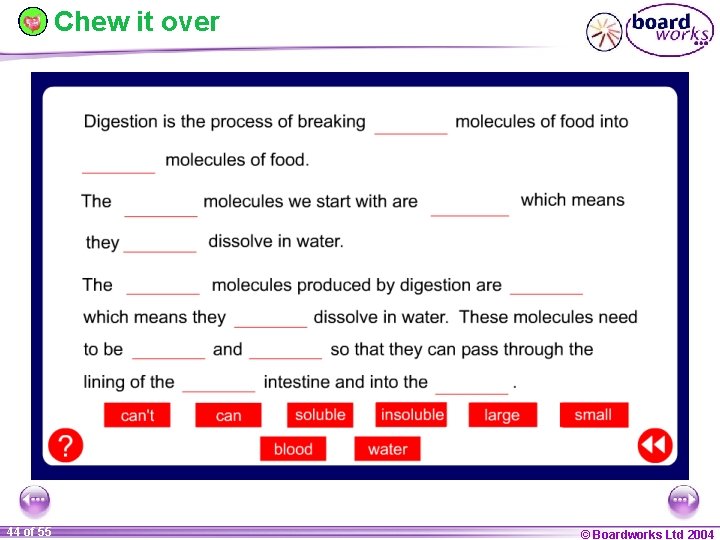
Chew it over Chew it all over 44 of 55 © Boardworks Ltd 2004
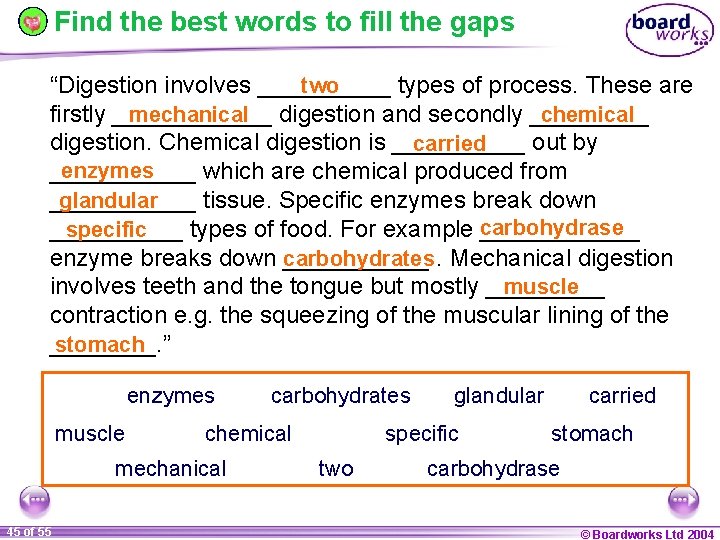
Find the best words to fill the gaps “Digestion involves _____ types of process. These are two firstly ______ mechanical digestion and secondly _____ chemical digestion. Chemical digestion is _____ out by carried enzymes ______ which are chemical produced from ______ tissue. Specific enzymes break down glandular _____ types of food. For example carbohydrase ______ specific enzyme breaks down ______ carbohydrates. Mechanical digestion involves teeth and the tongue but mostly _____ muscle contraction e. g. the squeezing of the muscular lining of the ____. ” stomach enzymes muscle chemical mechanical 45 of 55 carbohydrates glandular specific two carried stomach carbohydrase © Boardworks Ltd 2004
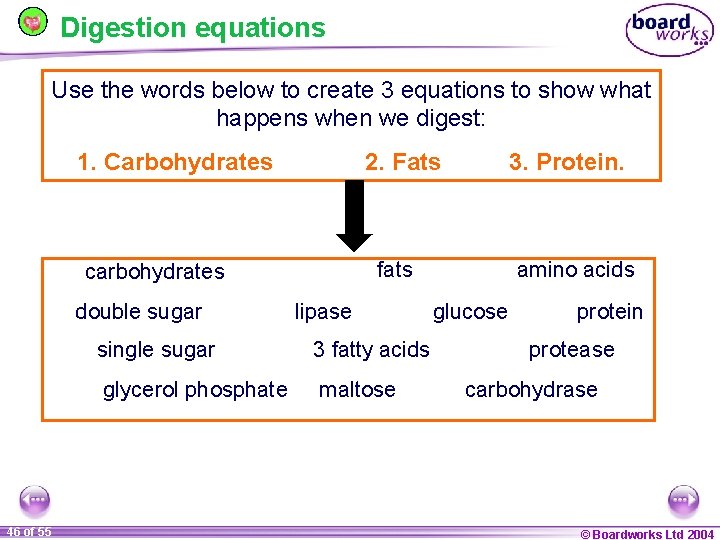
Digestion equations Use the words below to create 3 equations to show what happens when we digest: 1. Carbohydrates 2. Fats fats carbohydrates double sugar 46 of 55 3. Protein. lipase single sugar 3 fatty acids glycerol phosphate maltose amino acids glucose protein protease carbohydrase © Boardworks Ltd 2004
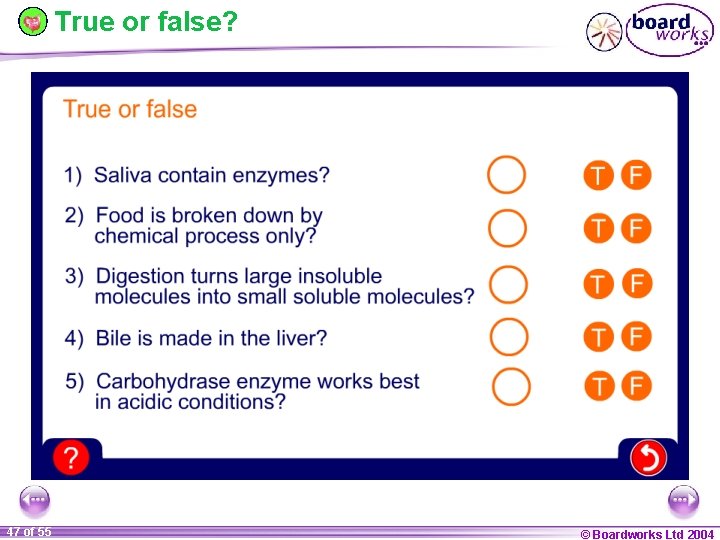
True or false? 47 of 55 © Boardworks Ltd 2004
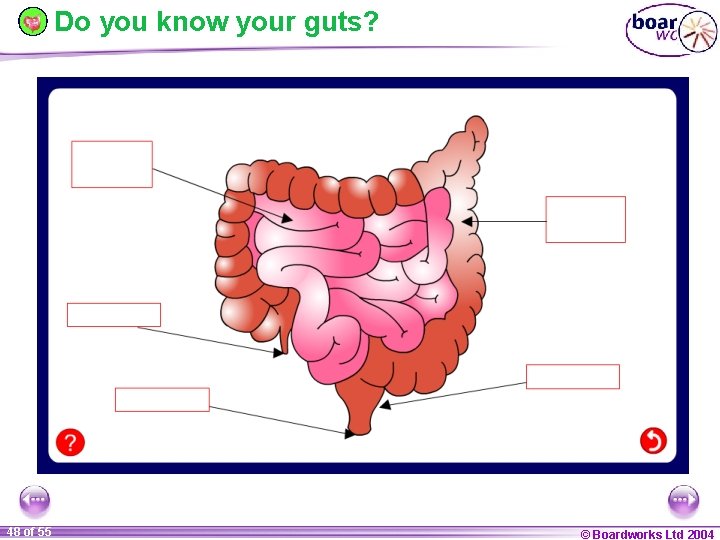
Do you know your guts? 48 of 55 © Boardworks Ltd 2004
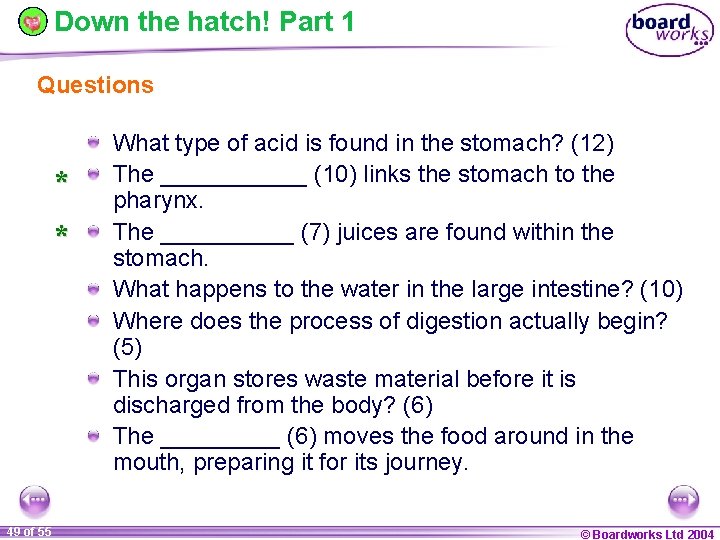
Down the hatch! Part 1 Questions * * 49 of 55 What type of acid is found in the stomach? (12) The ______ (10) links the stomach to the pharynx. The _____ (7) juices are found within the stomach. What happens to the water in the large intestine? (10) Where does the process of digestion actually begin? (5) This organ stores waste material before it is discharged from the body? (6) The _____ (6) moves the food around in the mouth, preparing it for its journey. © Boardworks Ltd 2004
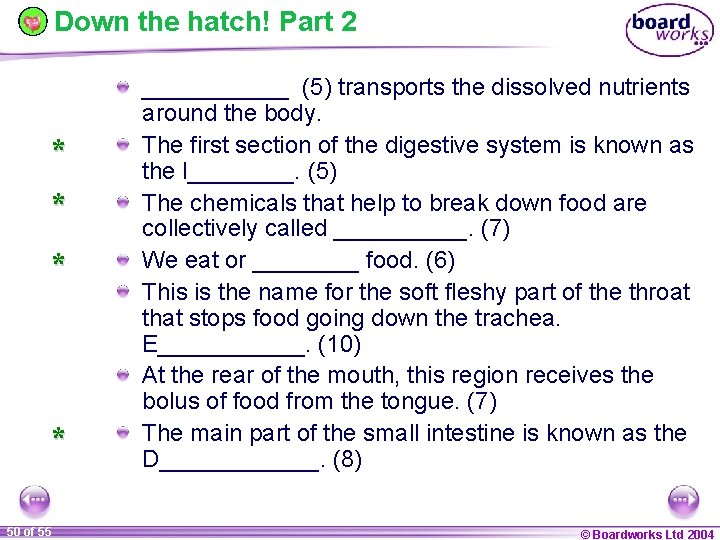
Down the hatch! Part 2 * * 50 of 55 ______ (5) transports the dissolved nutrients around the body. The first section of the digestive system is known as the l____. (5) The chemicals that help to break down food are collectively called _____. (7) We eat or ____ food. (6) This is the name for the soft fleshy part of the throat that stops food going down the trachea. E______. (10) At the rear of the mouth, this region receives the bolus of food from the tongue. (7) The main part of the small intestine is known as the D______. (8) © Boardworks Ltd 2004
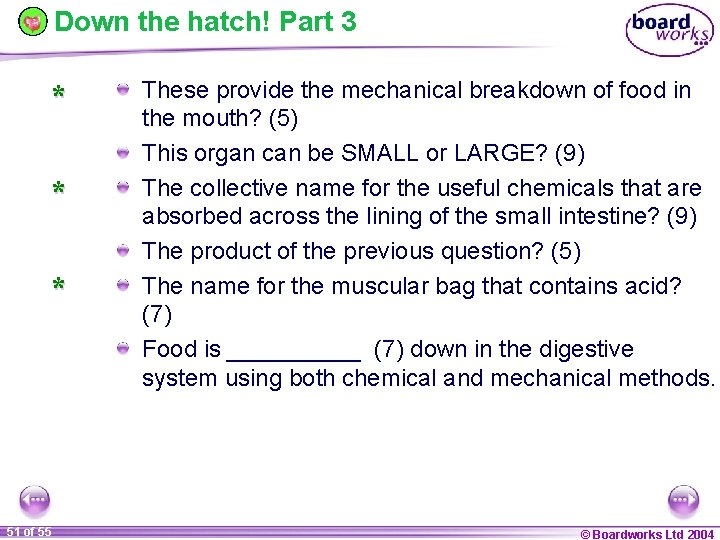
Down the hatch! Part 3 * * * 51 of 55 These provide the mechanical breakdown of food in the mouth? (5) This organ can be SMALL or LARGE? (9) The collective name for the useful chemicals that are absorbed across the lining of the small intestine? (9) The product of the previous question? (5) The name for the muscular bag that contains acid? (7) Food is _____ (7) down in the digestive system using both chemical and mechanical methods. © Boardworks Ltd 2004
Down the hatch! Final Part You will notice that 9 of the questions have a small green asterisk beside them. Take the first letter of each of the answers to these questions. Put these letters in the box below. Now rearrange them to find the mystery word! 52 of 55 © Boardworks Ltd 2004
Contents Digestion – Part Two Mouth to gullet Gastric processes The small intestine Lipid digestion Absorption Summary 53 of 55 © Boardworks Ltd 2004
20 questions 54 of 55 © Boardworks Ltd 2004
Digestion wordsearch 55 of 55 © Boardworks Ltd 2004
- Slides: 55