
KS 3KS 4 Angles Skipton Girls High School

- Slides: 83
KS 3/KS 4: Angles Skipton Girls’ High School Objectives: Understand notation for angles. Know basic rules of angles (angles in triangle, on straight line). Recognise alternate, corresponding and vertically opposite angles. Find angles in isosceles triangles. Deal with and introduce algebraic angles. Construct diagrams from written information and form angle proofs.
For Teacher Use: Recommended lesson structure: Lesson 1: Angle notation. Angle basics. Lesson 2: Z/F/C/v. opposite angles. Angle properties of quadrilaterals. Lesson 3: Isosceles Triangles Lesson 4: Algebraic Angles Lesson 5/6: Constructing diagrams from information. Proof Lesson 7: Consolidation/Mini-assessment
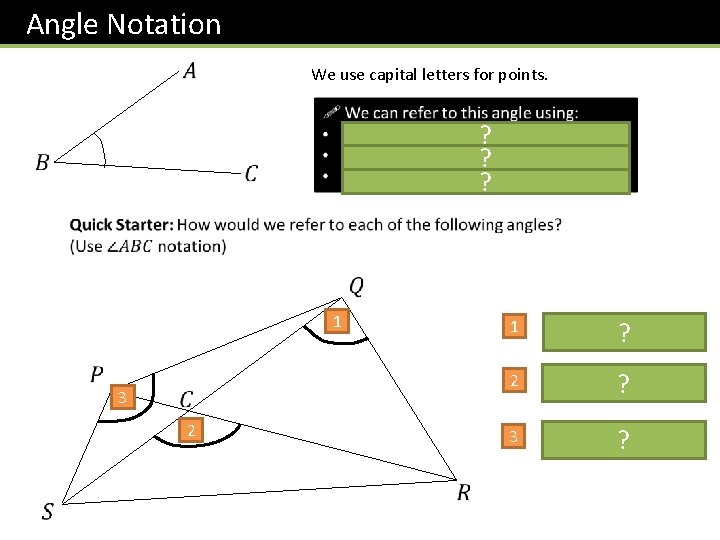
Angle Notation We use capital letters for points. ? ? ? 1 1 3 2 ? 3 ?
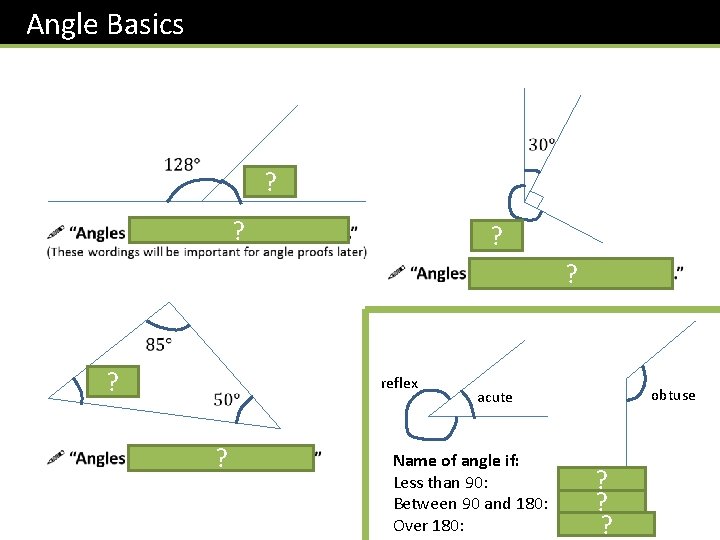
Angle Basics ? ? ? reflex acute obtuse Name of angle if: Less than 90: Acute ? Between 90 and 180: Obtuse ? Over 180: Reflex? angle
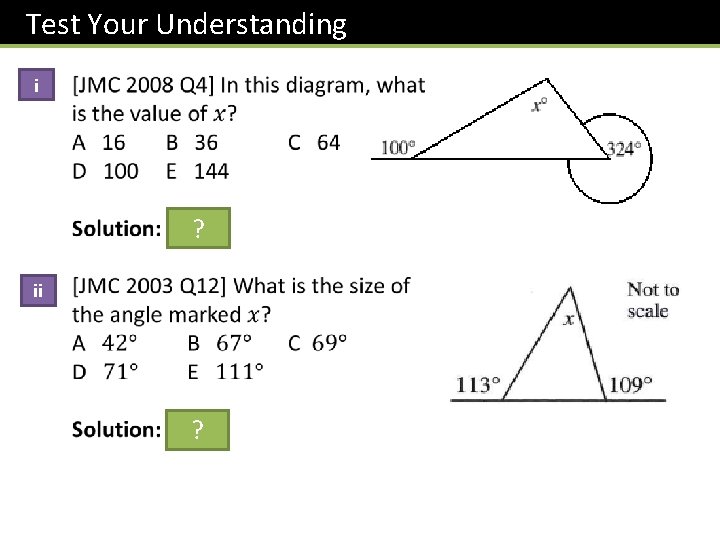
Test Your Understanding i ? ii ?
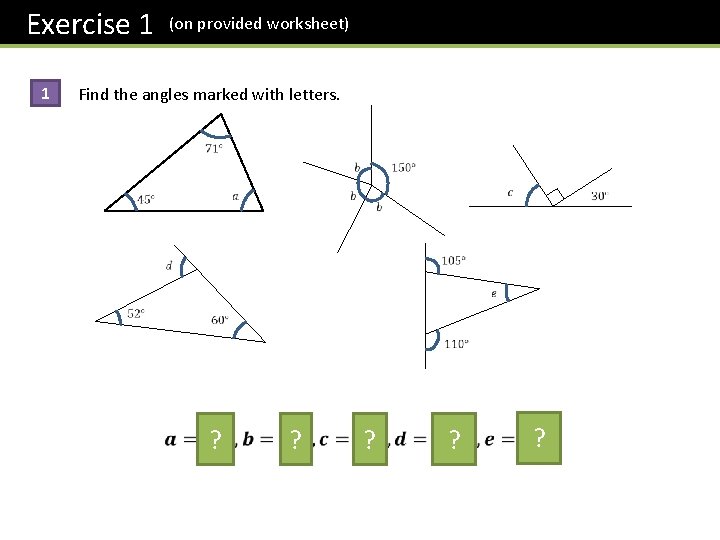
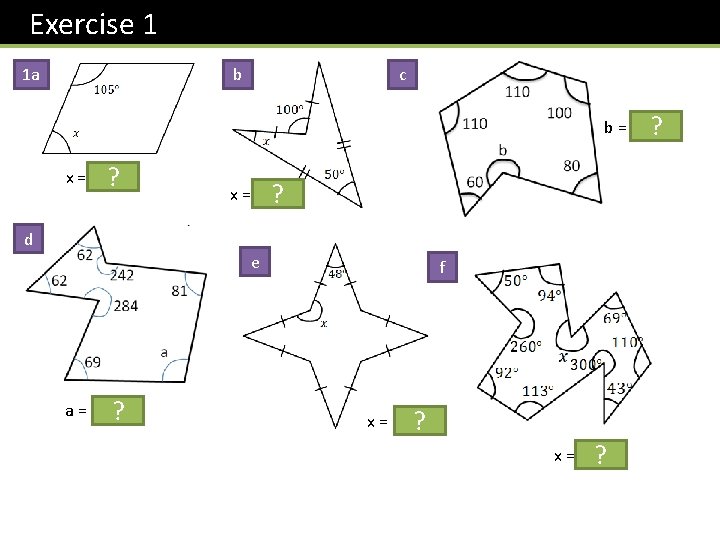
Exercise 1 (on provided worksheet) 1 Find the angles marked with letters. ? ? ?
Exercise 1 (on provided worksheet) 2 ? 3 ? 4 ? 5 ? 6 ? 7 ?
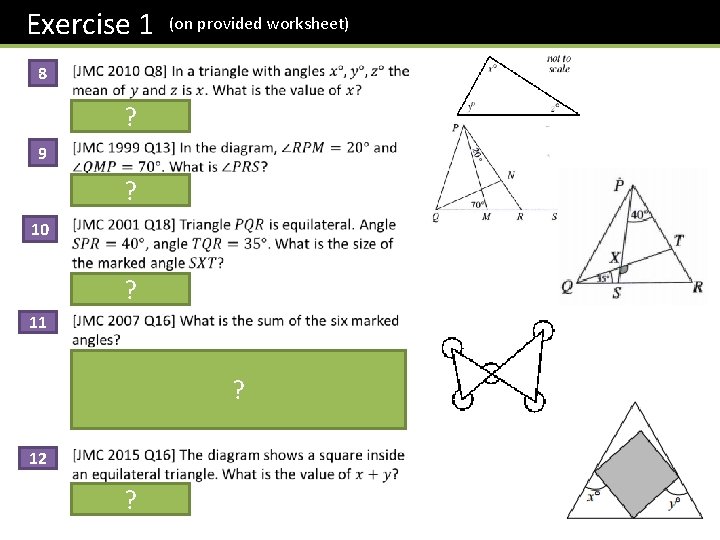
Exercise 1 (on provided worksheet) 8 ? 9 ? 10 ? 11 ? 12 ?
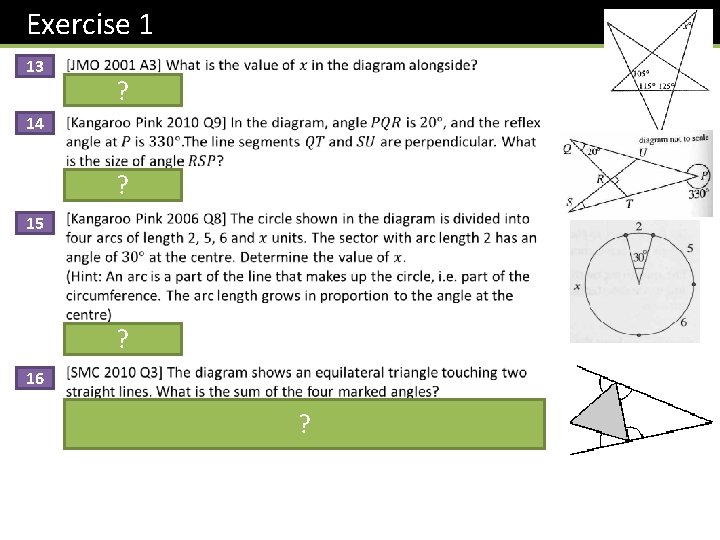
Exercise 1 13 ? 14 ? 15 ? 16 ?
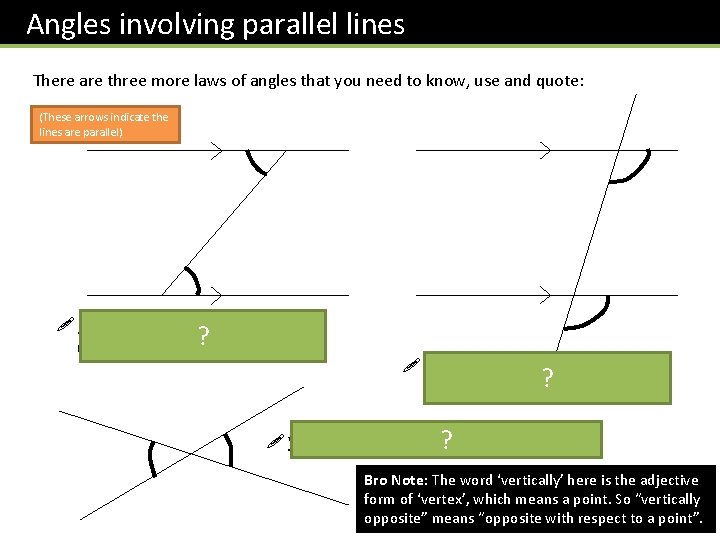
Angles involving parallel lines There are three more laws of angles that you need to know, use and quote: (These arrows indicate the lines are parallel) ! Alternate angles are equal. ? (Sometimes known as ‘Z’ angles) ! Corresponding angles are equal. ? (Sometimes known as ‘F’ angles) ! Vertically opposite angles ? are equal. Bro Note: The word ‘vertically’ here is the adjective form of ‘vertex’, which means a point. So “vertically opposite” means “opposite with respect to a point”.
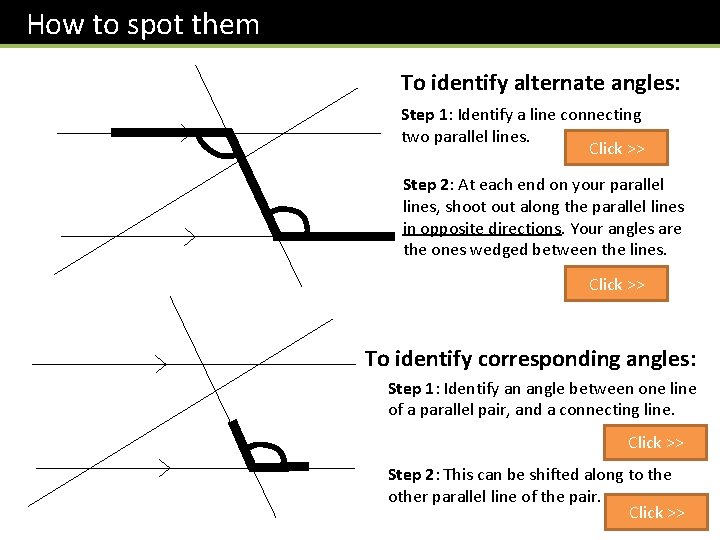
How to spot them To identify alternate angles: Step 1: Identify a line connecting two parallel lines. Click >> Step 2: At each end on your parallel lines, shoot out along the parallel lines in opposite directions. Your angles are the ones wedged between the lines. Click >> To identify corresponding angles: Step 1: Identify an angle between one line of a parallel pair, and a connecting line. Click >> Step 2: This can be shifted along to the other parallel line of the pair. Click >>
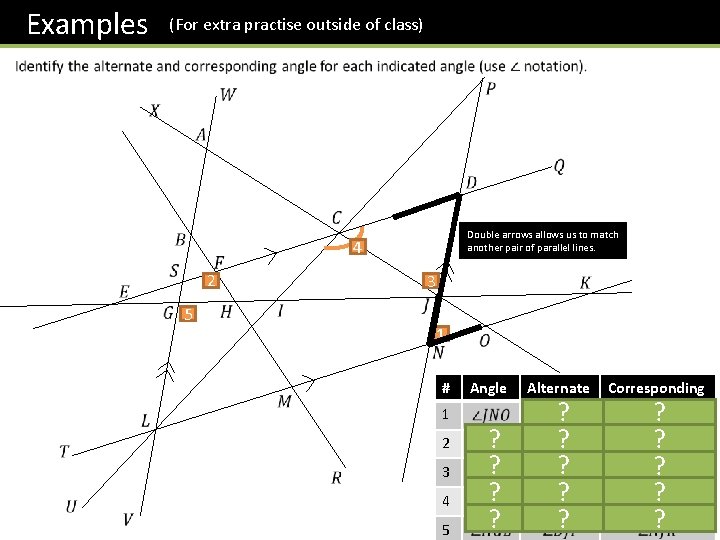
Examples (For extra practise outside of class) 4 2 5 Double arrows allows us to match another pair of parallel lines. 3 1 # 1 2 3 4 5 Angle ? ? Alternate ? ? ? Corresponding ? ? ?
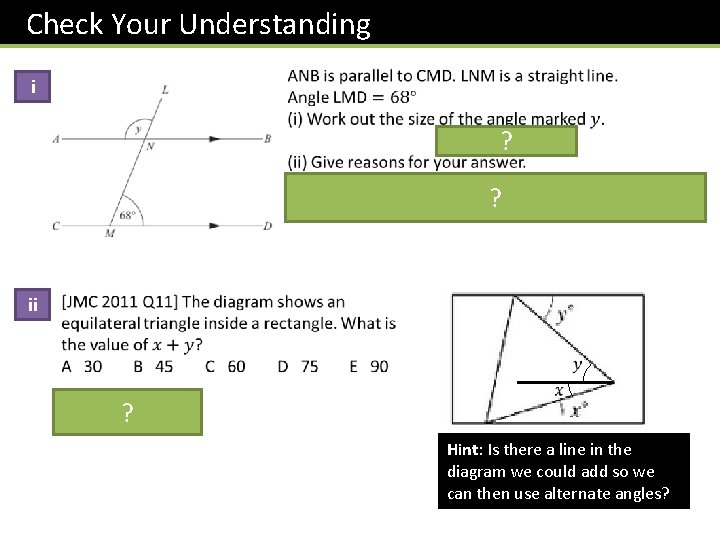
Check Your Understanding i ? ? ii ? Hint: Is there a line in the diagram we could add so we can then use alternate angles?
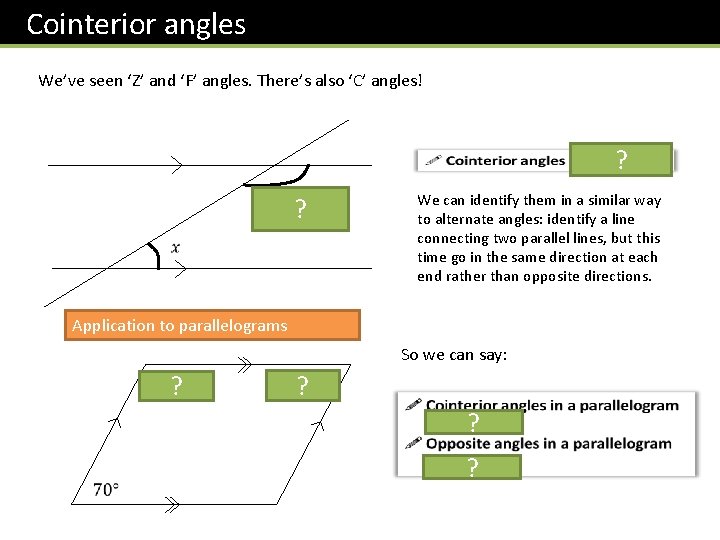
Cointerior angles We’ve seen ‘Z’ and ‘F’ angles. There’s also ‘C’ angles! ? We can identify them in a similar way to alternate angles: identify a line connecting two parallel lines, but this time go in the same direction at each end rather than opposite directions. ? Application to parallelograms So we can say: ? ? ? ?
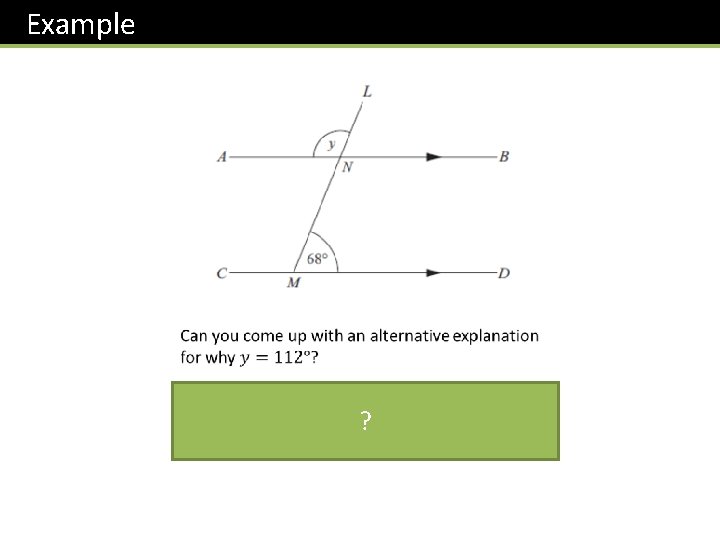
Example ?
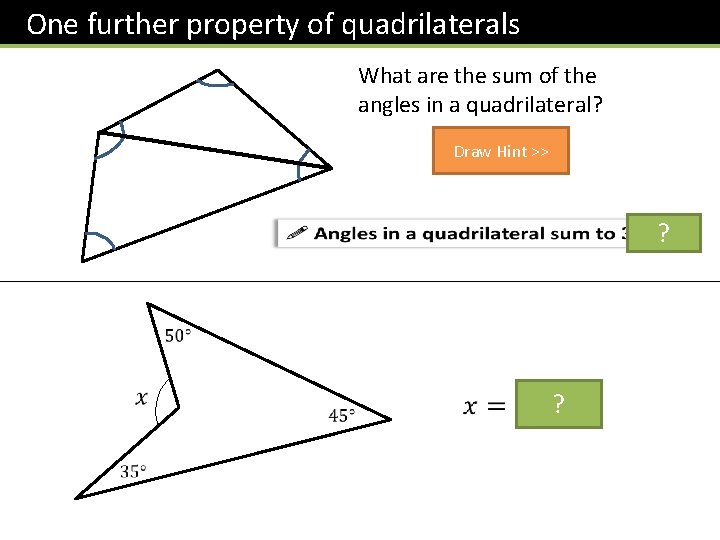
One further property of quadrilaterals What are the sum of the angles in a quadrilateral? Draw Hint >> ?
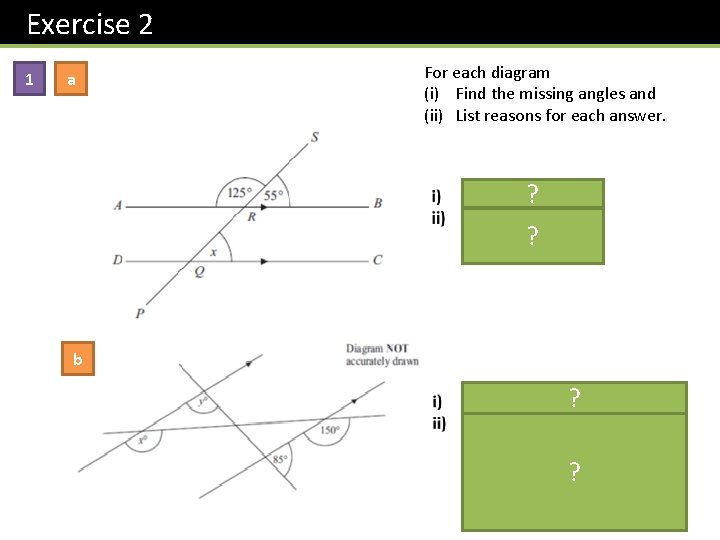
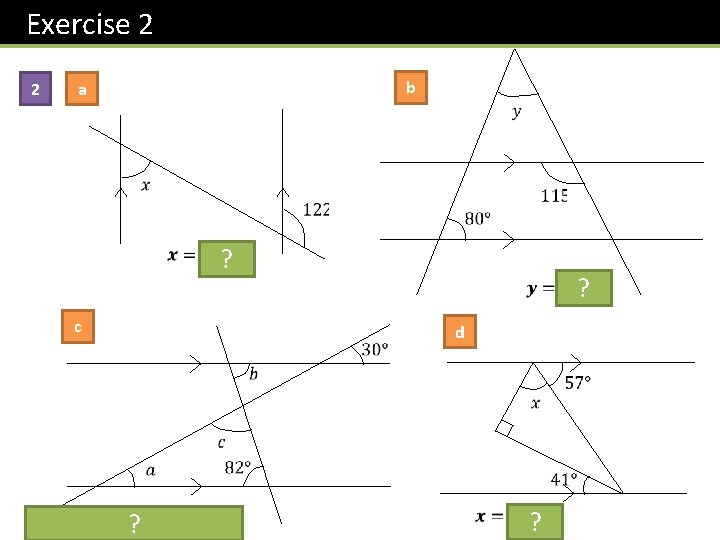
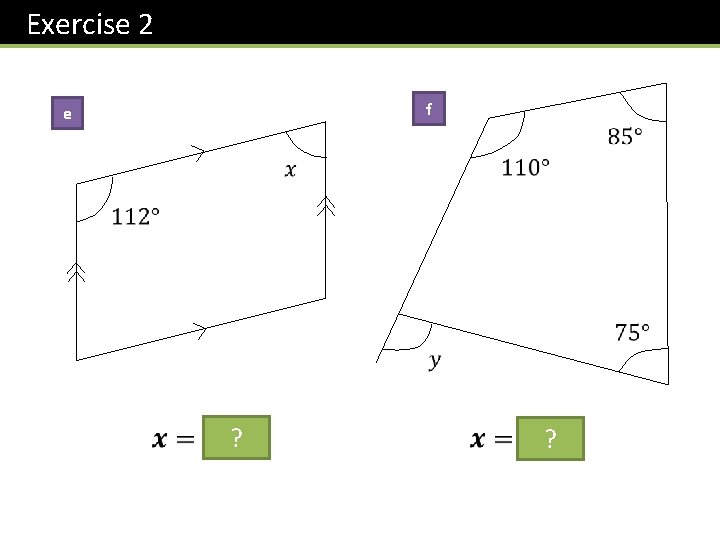
Exercise 2 1 a For each diagram (i) Find the missing angles and (ii) List reasons for each answer. ? ? b ? ?
Exercise 2 2 b a ? ? c d ? ?
Exercise 2 f e ? ?
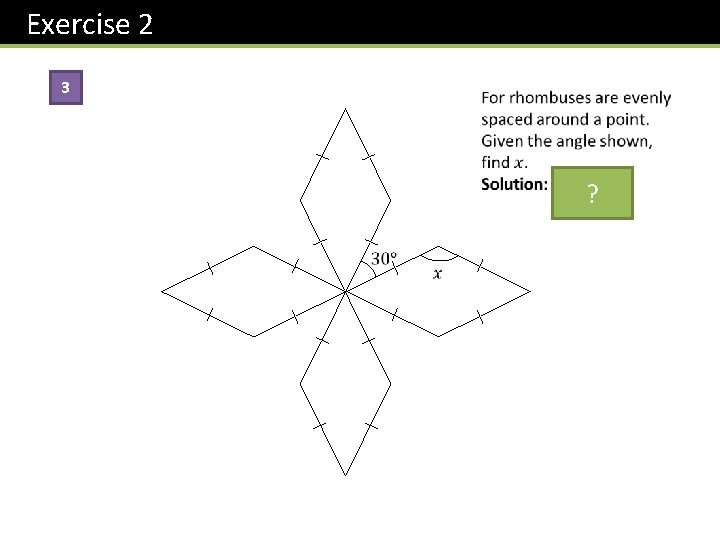
Exercise 2 3 ?
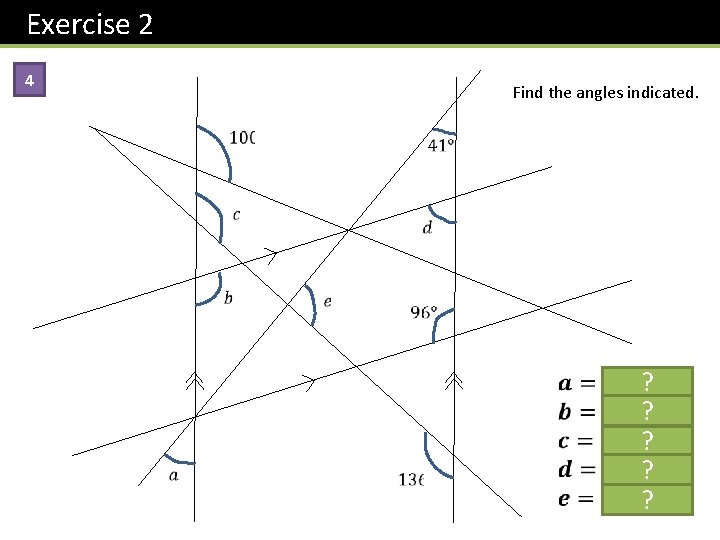
Exercise 2 4 Find the angles indicated. ? ? ?
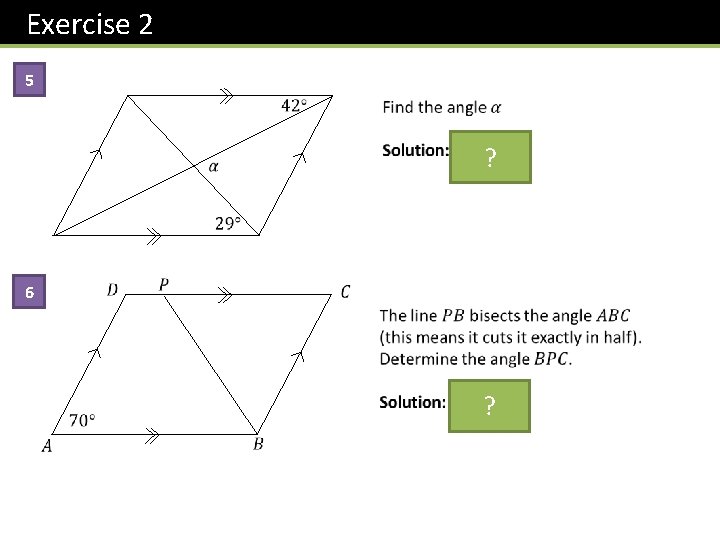
Exercise 2 5 ? 6 ?
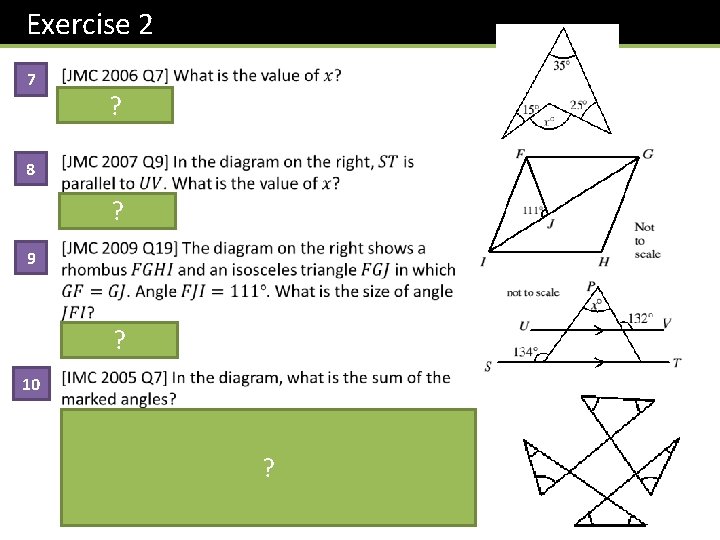
Exercise 2 7 ? 8 ? 9 ? 10 ?
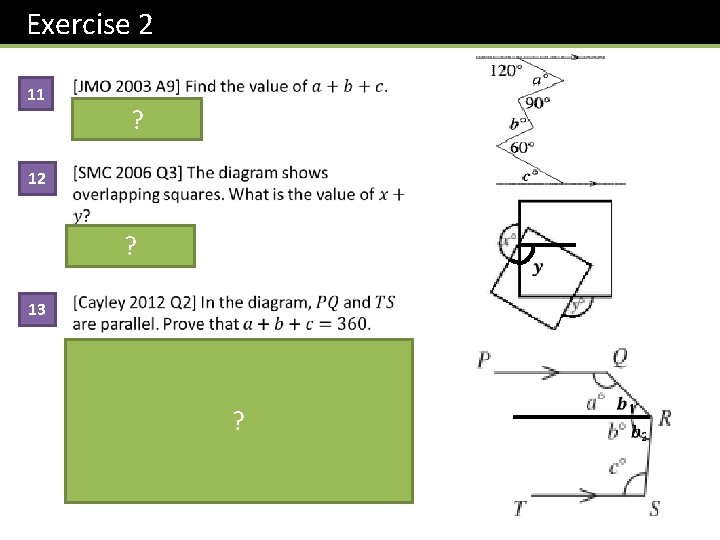
Exercise 2 11 ? 12 ? 13 ?
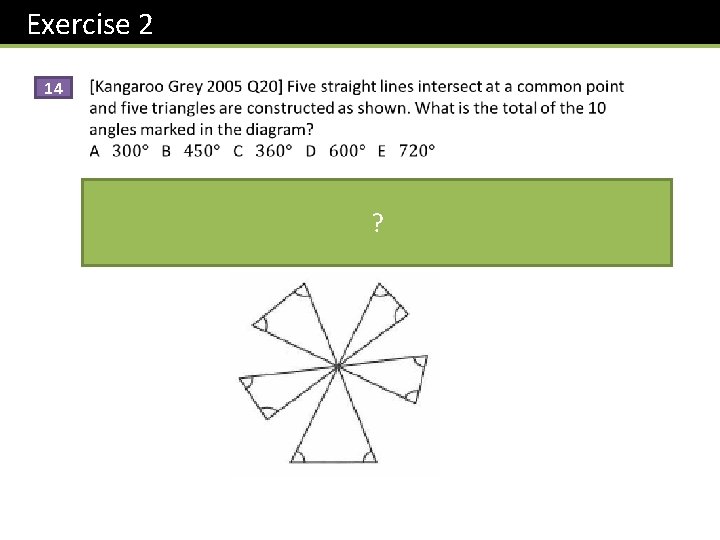
Exercise 2 14 ?
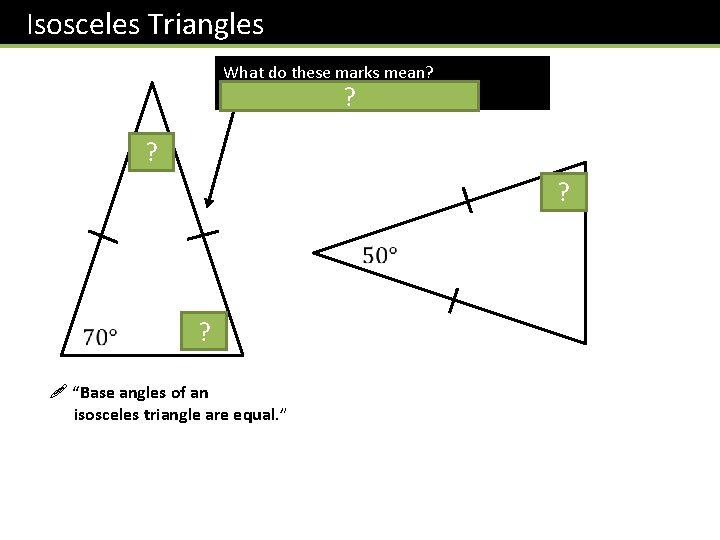
Isosceles Triangles What do these marks mean? The lines are of the ? same length. ? ! “Base angles of an isosceles triangle are equal. ” ?
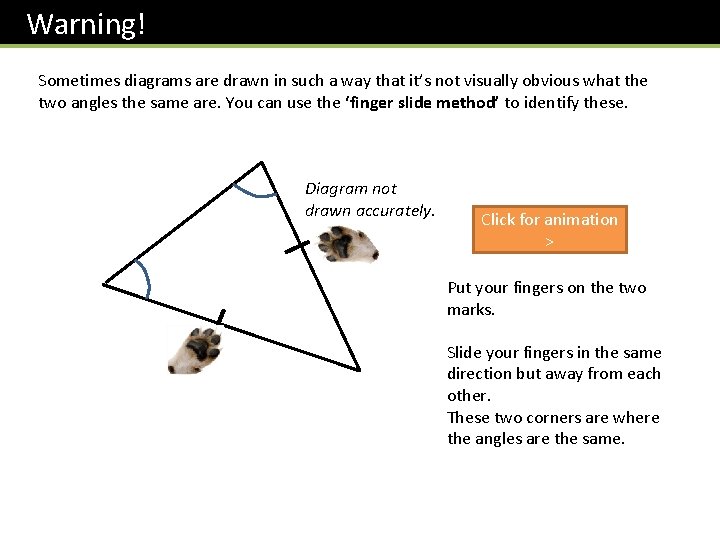
Warning! Sometimes diagrams are drawn in such a way that it’s not visually obvious what the two angles the same are. You can use the ‘finger slide method’ to identify these. Diagram not drawn accurately. Click for animation > Put your fingers on the two marks. Slide your fingers in the same direction but away from each other. These two corners are where the angles are the same.
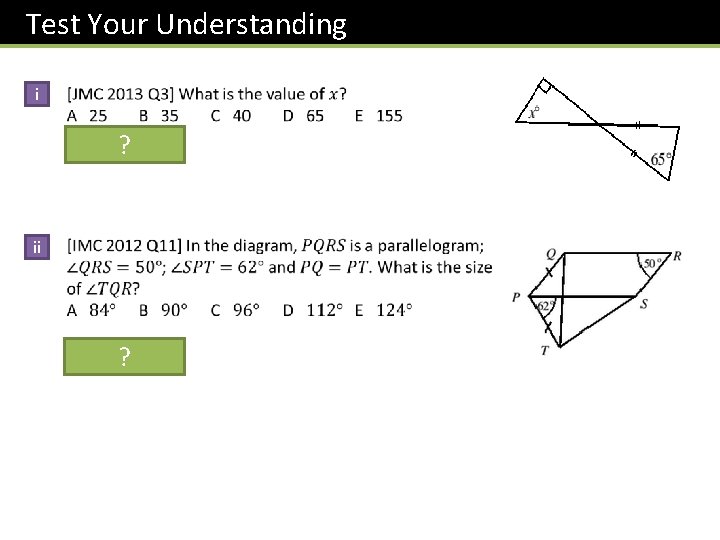
Test Your Understanding i ? ii ?
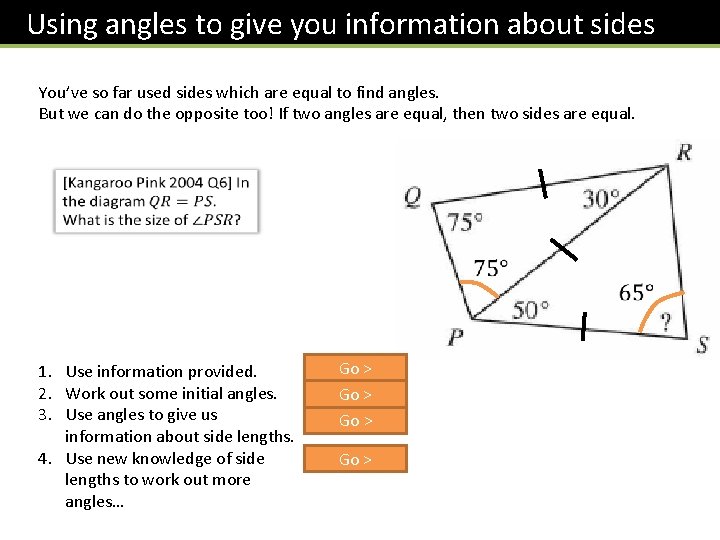
Using angles to give you information about sides You’ve so far used sides which are equal to find angles. But we can do the opposite too! If two angles are equal, then two sides are equal. 1. Use information provided. 2. Work out some initial angles. 3. Use angles to give us information about side lengths. 4. Use new knowledge of side lengths to work out more angles… Go >
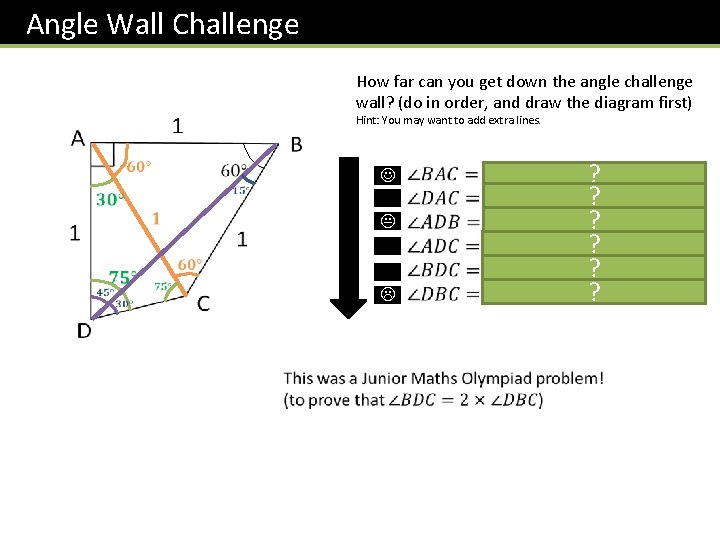
Angle Wall Challenge How far can you get down the angle challenge wall? (do in order, and draw the diagram first) Hint: You may want to add extra lines. ? ? ?
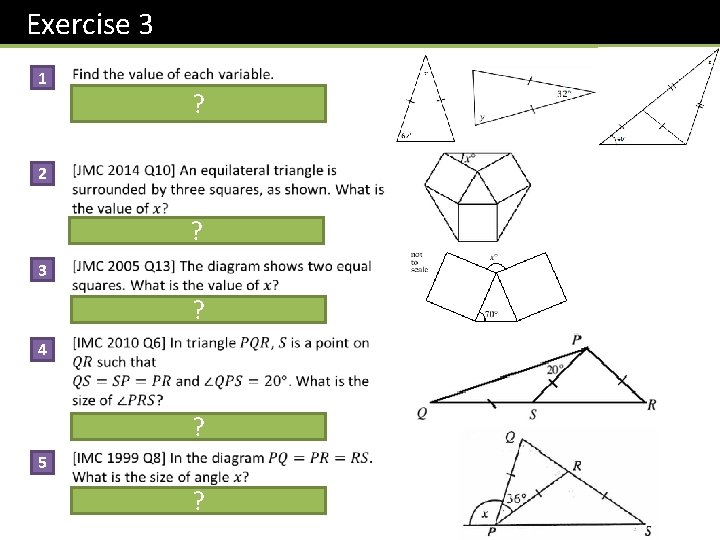
Exercise 3 1 ? 2 ? 3 ? 4 ? 5 ?
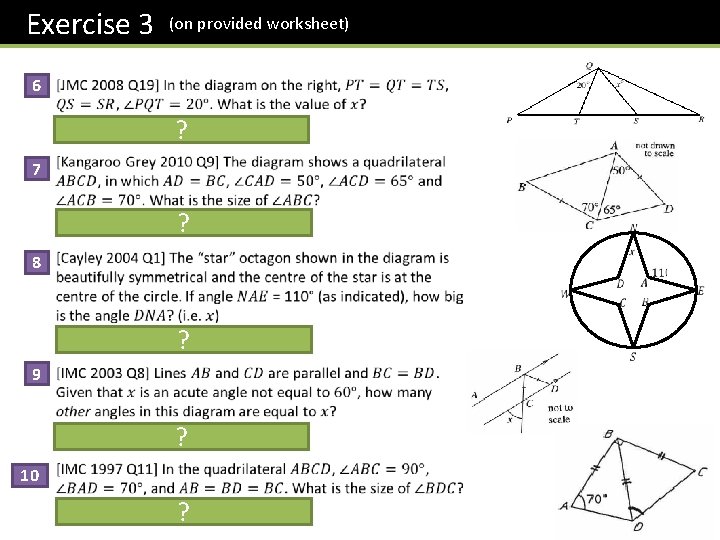
Exercise 3 (on provided worksheet) 6 ? 7 ? 8 ? 9 ? 10 ?
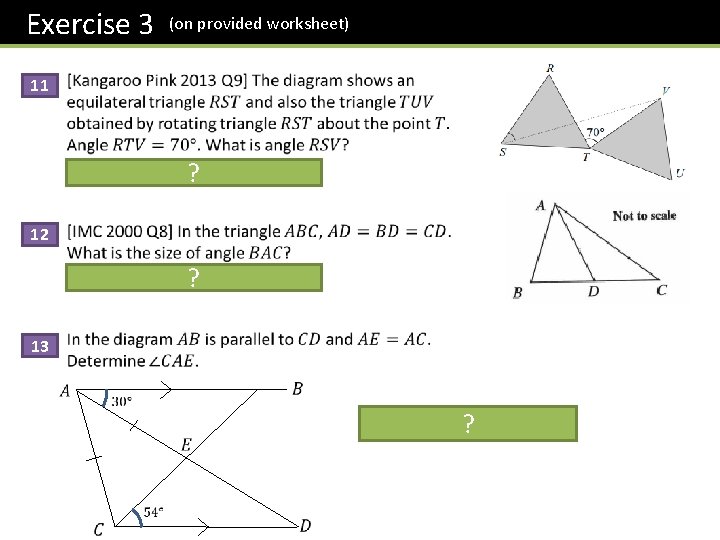
Exercise 3 (on provided worksheet) 11 ? 12 ? 13 ?
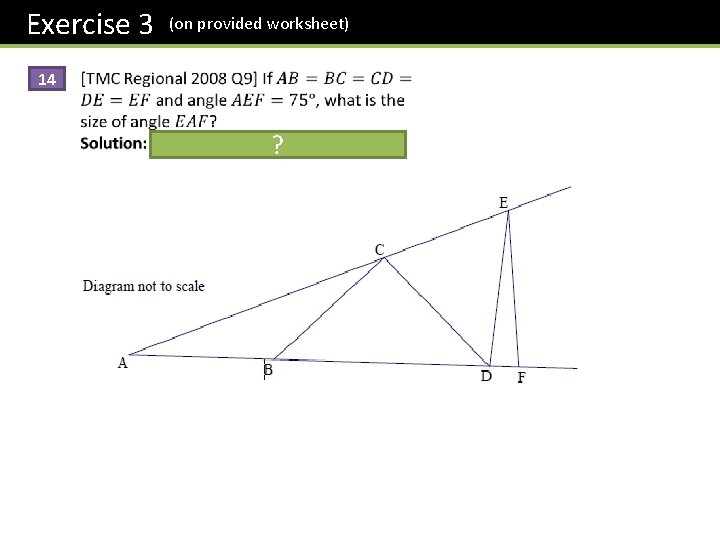
Exercise 3 14 (on provided worksheet) ?
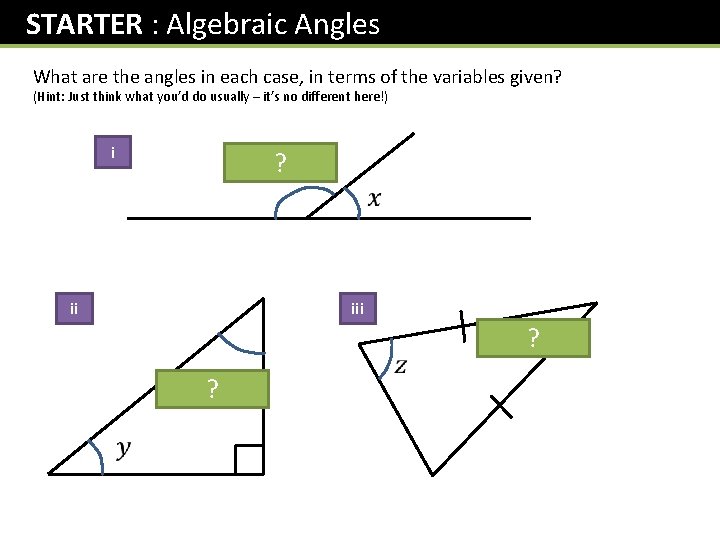
STARTER : Algebraic Angles What are the angles in each case, in terms of the variables given? (Hint: Just think what you’d do usually – it’s no different here!) i ? ii iii ? ?
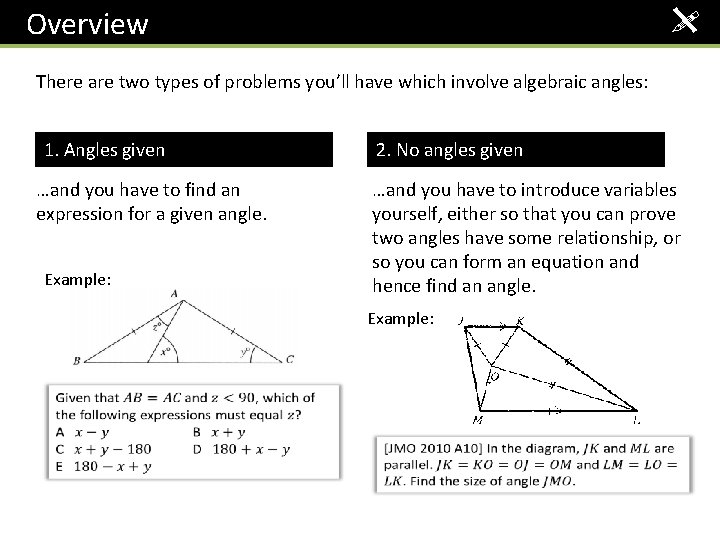
Overview ! There are two types of problems you’ll have which involve algebraic angles: 1. Angles given …and you have to find an expression for a given angle. Example: 2. No angles given …and you have to introduce variables yourself, either so that you can prove two angles have some relationship, or so you can form an equation and hence find an angle. Example:
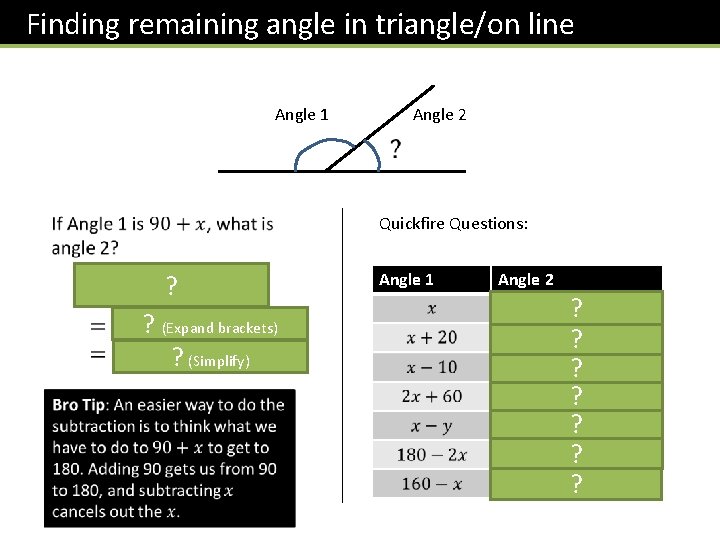
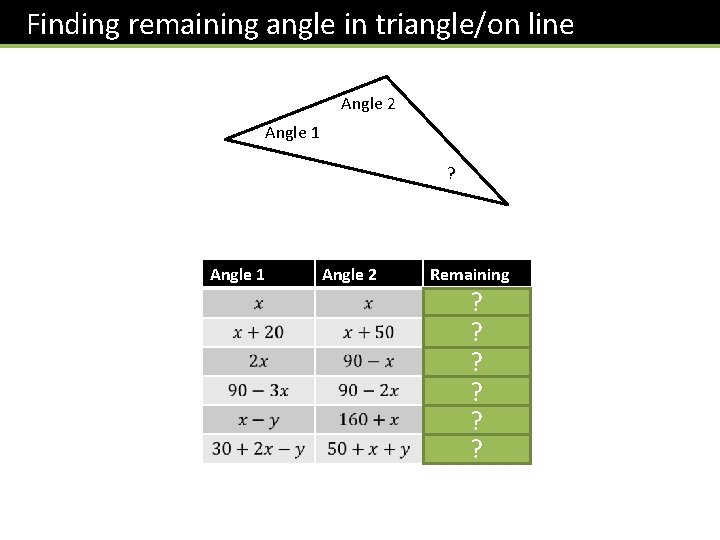
Finding remaining angle in triangle/on line Angle 1 Angle 2 Quickfire Questions: ? ? (Expand brackets) ? (Simplify) Angle 1 Angle 2 ? ? ? ?
Finding remaining angle in triangle/on line Angle 2 Angle 1 ? Angle 1 Angle 2 Remaining ? ? ?
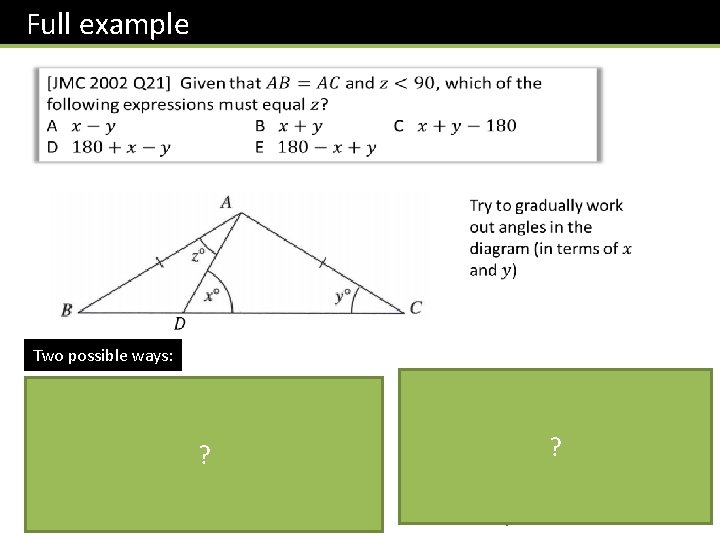
Full example Two possible ways: ? ?
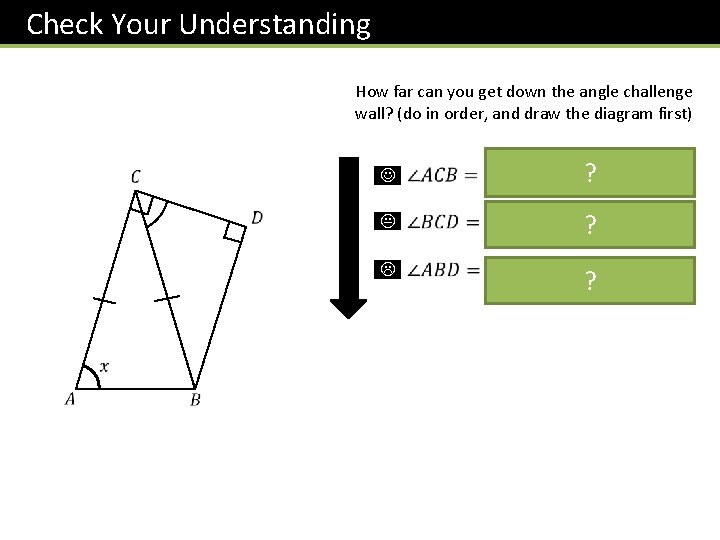
Check Your Understanding How far can you get down the angle challenge wall? (do in order, and draw the diagram first) ? ? ?
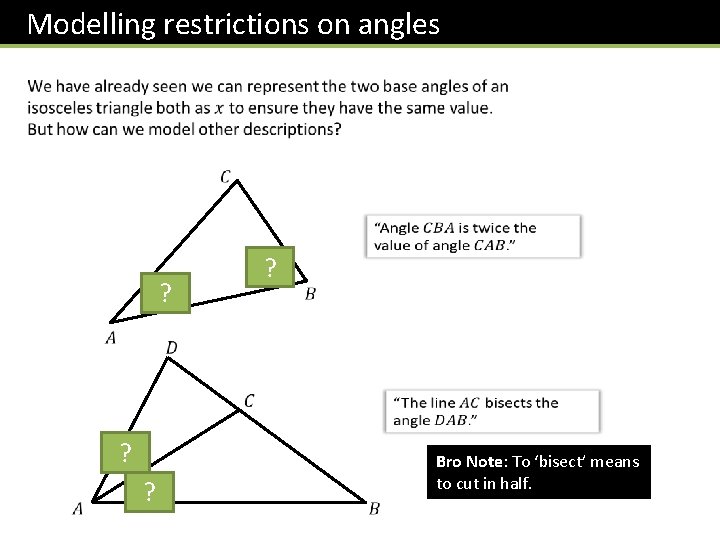
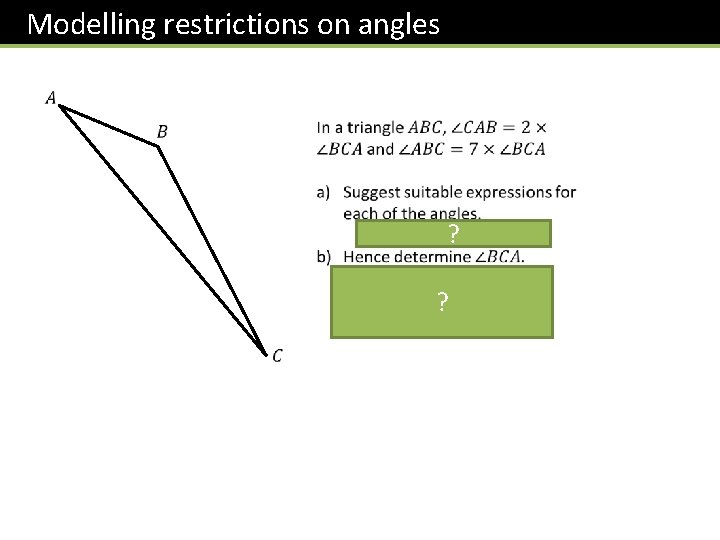
Modelling restrictions on angles ? ? Bro Note: To ‘bisect’ means to cut in half.
Modelling restrictions on angles ? ?
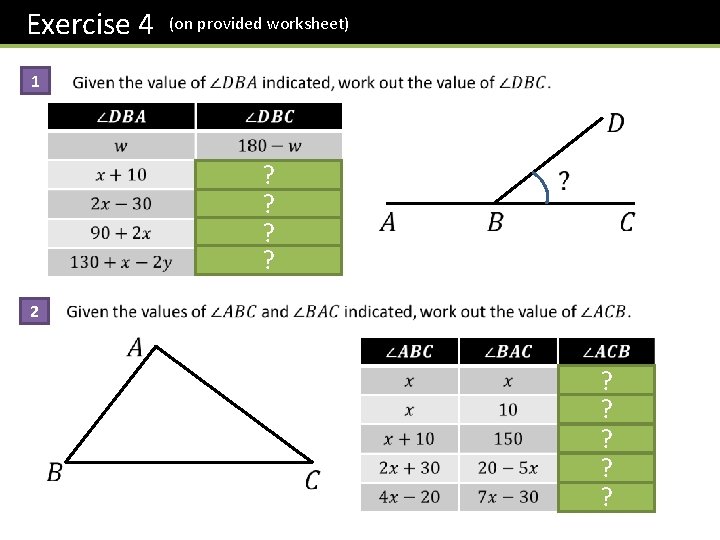
Exercise 4 1 (on provided worksheet) ? ? 2 ? ? ?
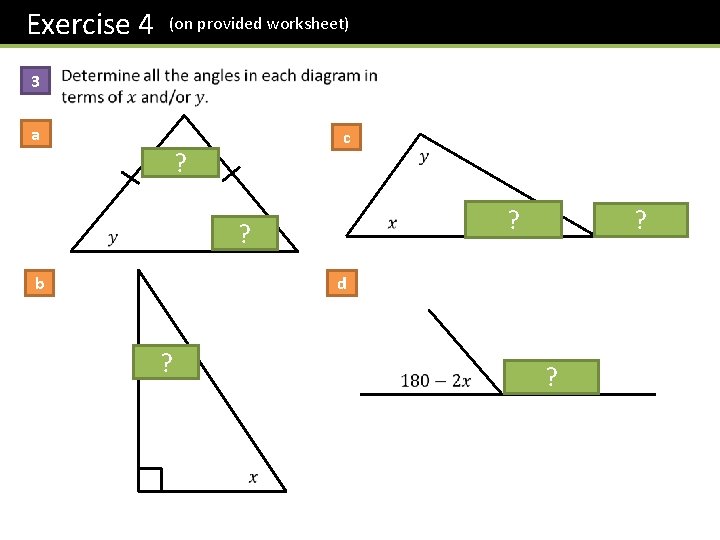
Exercise 4 3 (on provided worksheet) a c ? b ? d ? ? ?
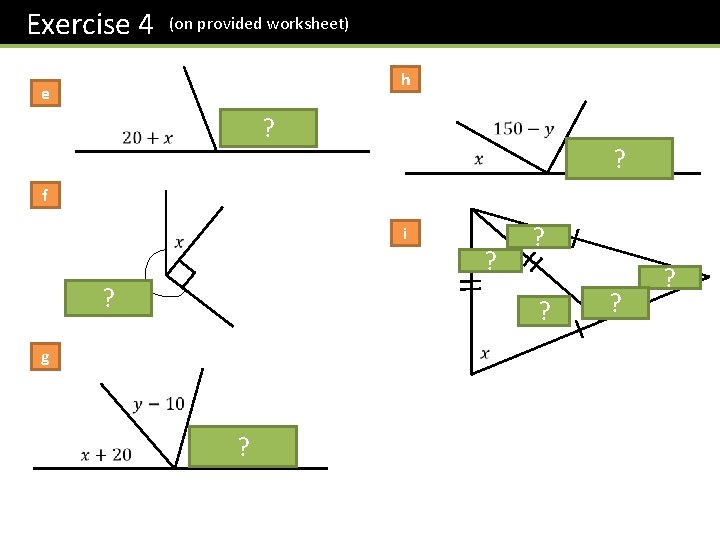
Exercise 4 (on provided worksheet) h e ? f i ? ? ? g ? ? ? ?
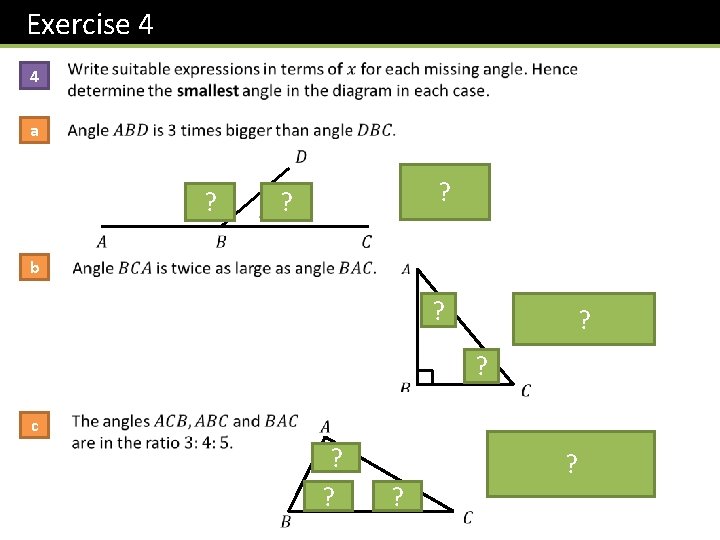
Exercise 4 4 a ? b ? ? ? c ? ? ?
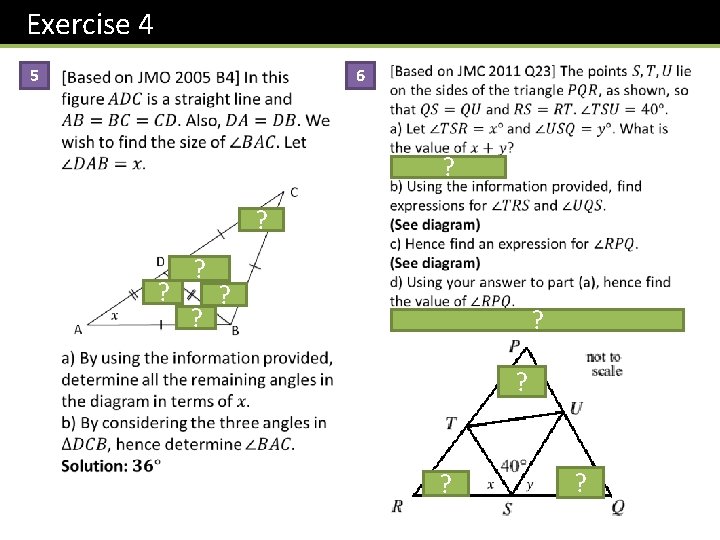
Exercise 4 5 6 ? ? ? ? ?
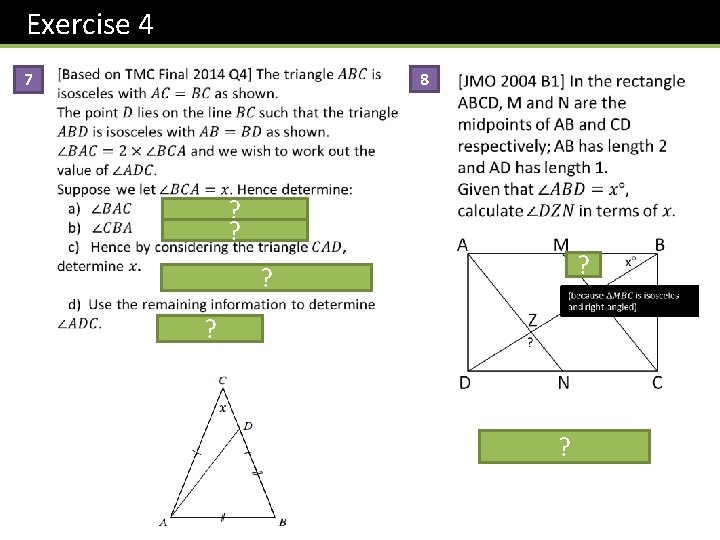
Exercise 4 7 8 ? ? ?
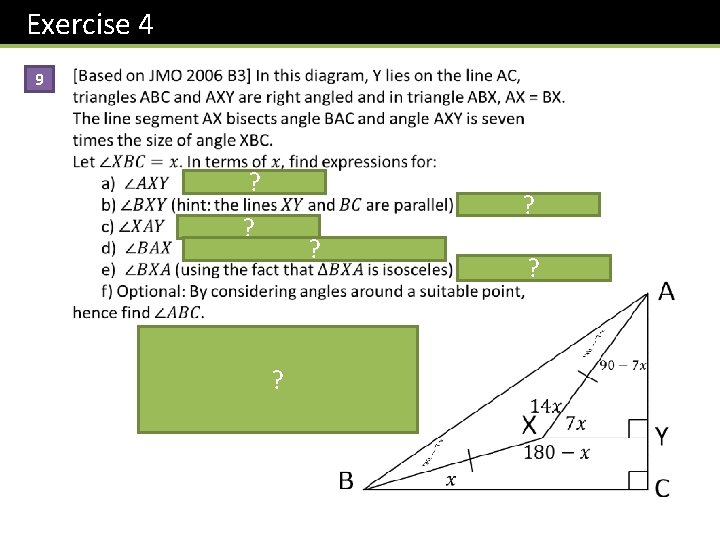
Exercise 4 9 ? ? ?
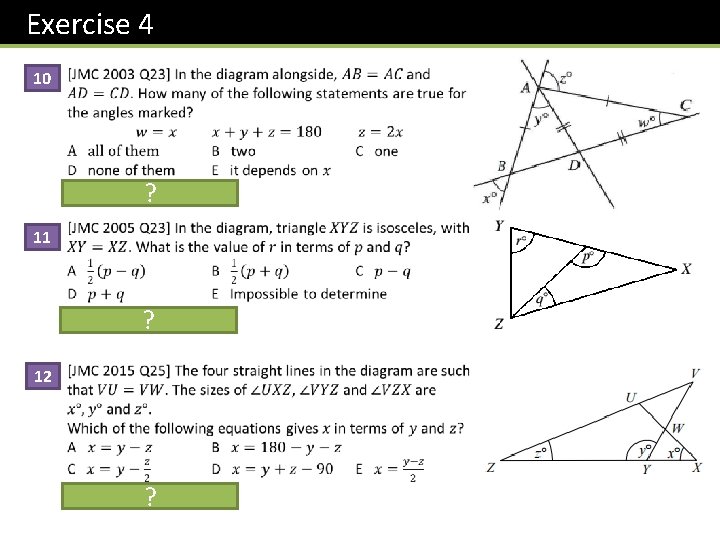
Exercise 4 10 ? 11 ? 12 ?
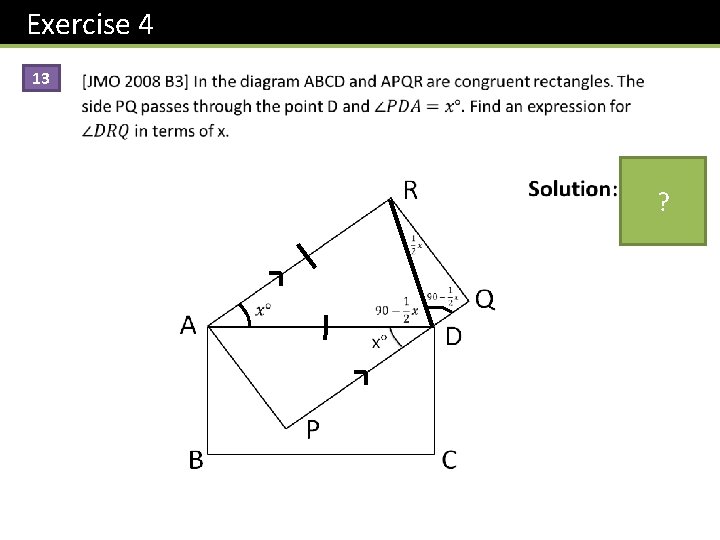
Exercise 4 13 ?
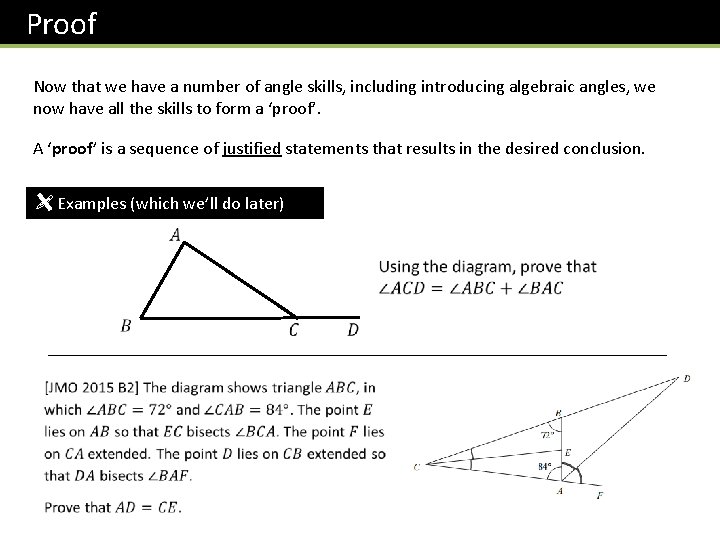
Proof Now that we have a number of angle skills, including introducing algebraic angles, we now have all the skills to form a ‘proof’. A ‘proof’ is a sequence of justified statements that results in the desired conclusion. ! Examples (which we’ll do later)
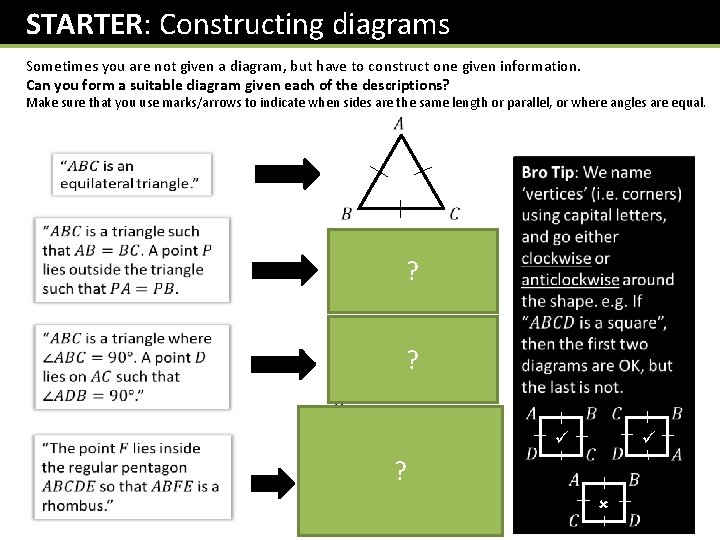
STARTER: Constructing diagrams Sometimes you are not given a diagram, but have to construct one given information. Can you form a suitable diagram given each of the descriptions? Make sure that you use marks/arrows to indicate when sides are the same length or parallel, or where angles are equal. ? ? Bro Note: For parallelograms/ rhombuses, we need not indicate parallel sides because it is implied by the lengths.
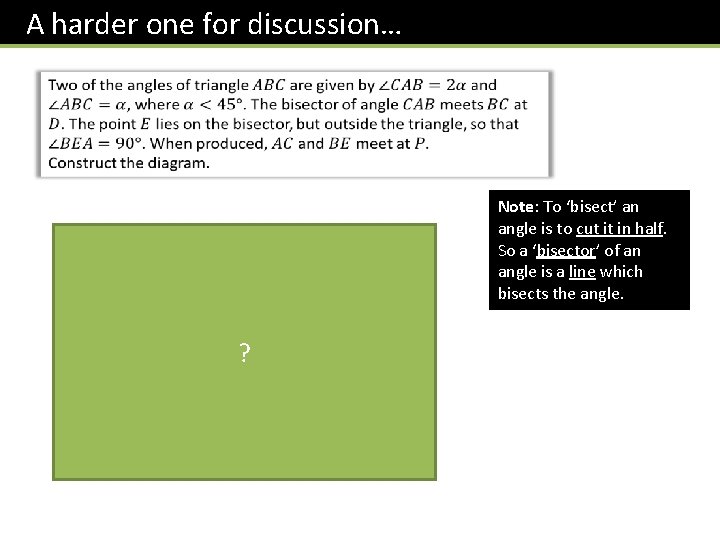
A harder one for discussion… Note: To ‘bisect’ an angle is to cut it in half. So a ‘bisector’ of an angle is a line which bisects the angle. ?
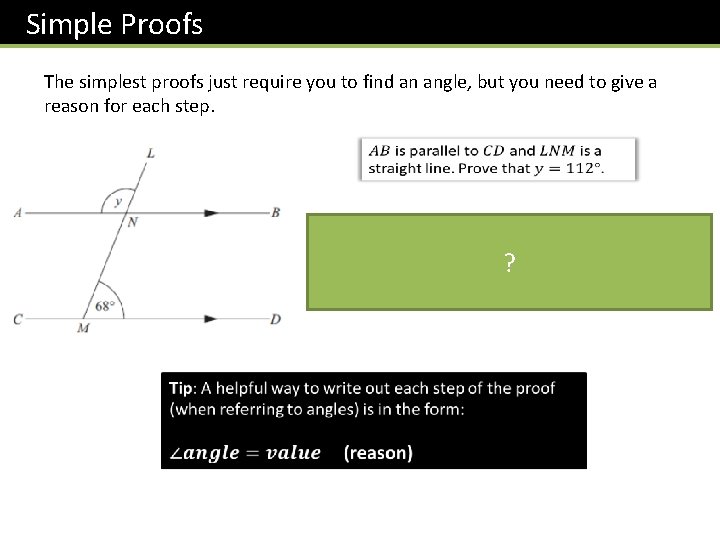
Simple Proofs The simplest proofs just require you to find an angle, but you need to give a reason for each step. ?
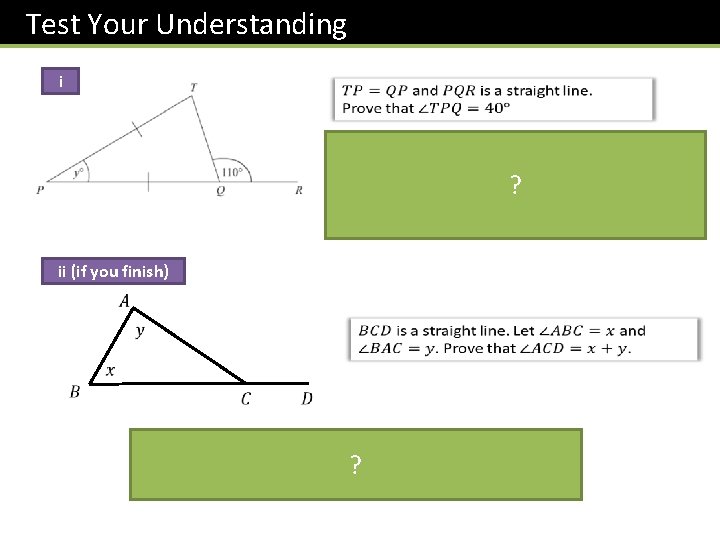
Test Your Understanding i ? ii (if you finish) ?
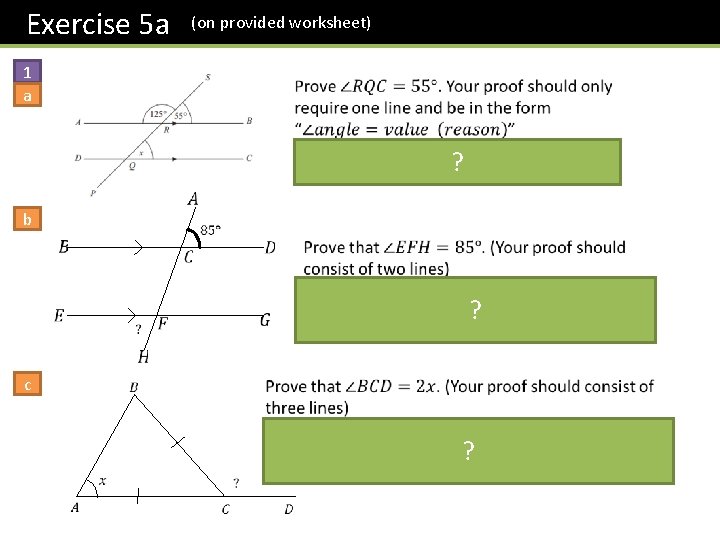
Exercise 5 a (on provided worksheet) 1 a ? b ? c ?
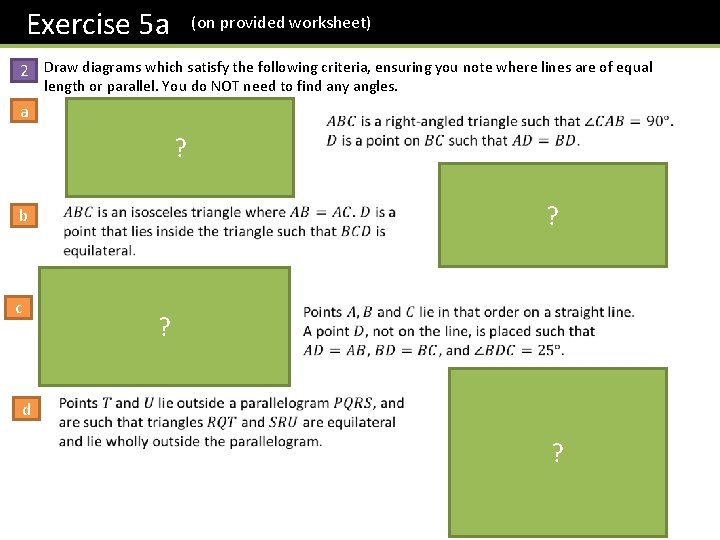
Exercise 5 a (on provided worksheet) 2 Draw diagrams which satisfy the following criteria, ensuring you note where lines are of equal length or parallel. You do NOT need to find any angles. a ? b ? c ? d ?
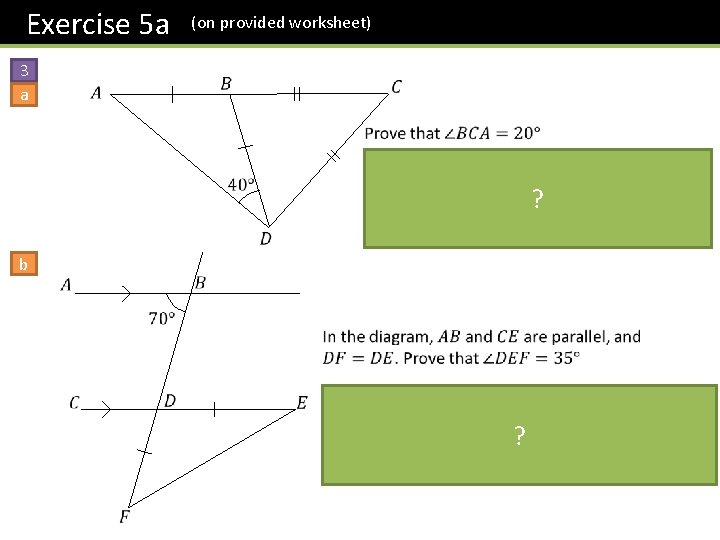
Exercise 5 a 3 a (on provided worksheet) ? b ?
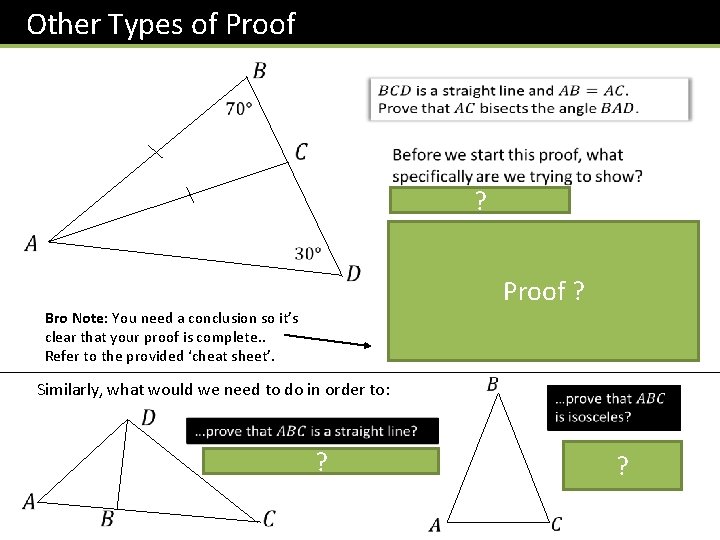
Other Types of Proof ? Proof ? Bro Note: You need a conclusion so it’s clear that your proof is complete. . Refer to the provided ‘cheat sheet’. Similarly, what would we need to do in order to: ?
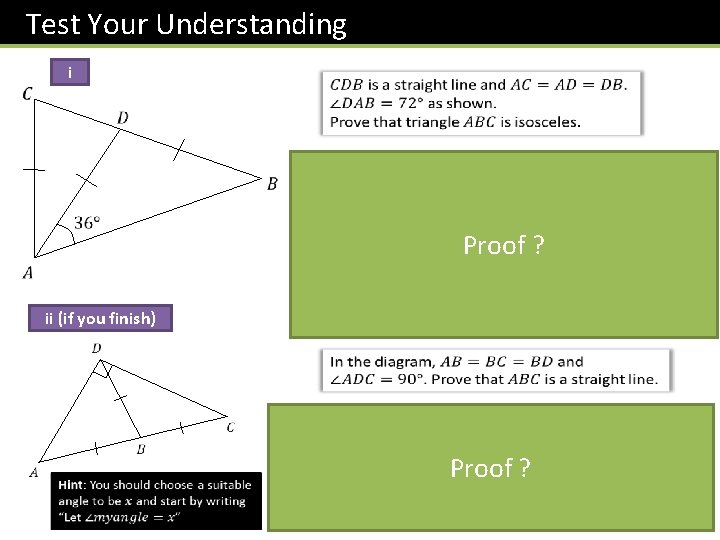
Test Your Understanding i Proof ? ii (if you finish) Proof ?
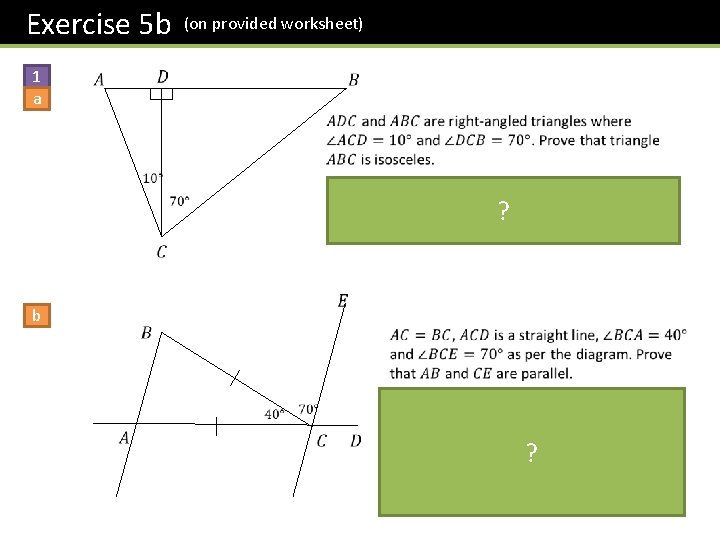
Exercise 5 b 1 a (on provided worksheet) ? b ?
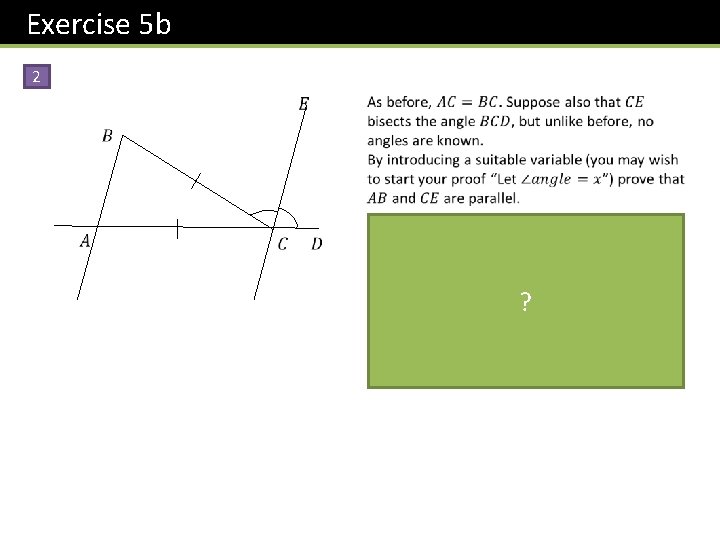
Exercise 5 b 2 ?
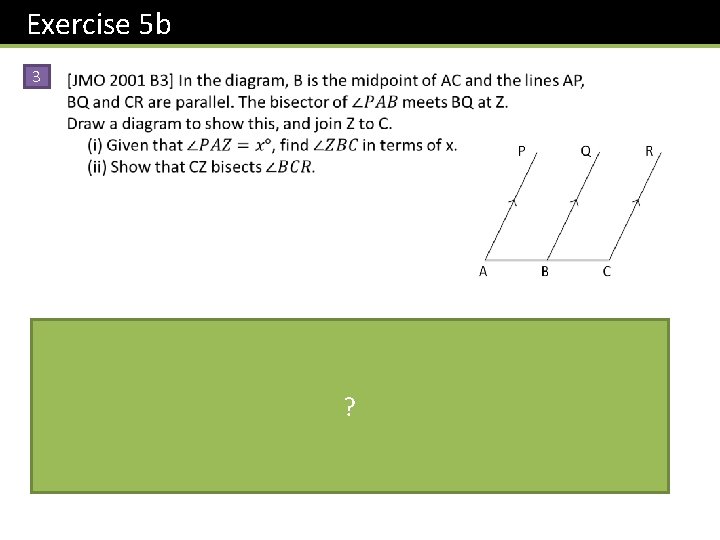
Exercise 5 b 3 ?
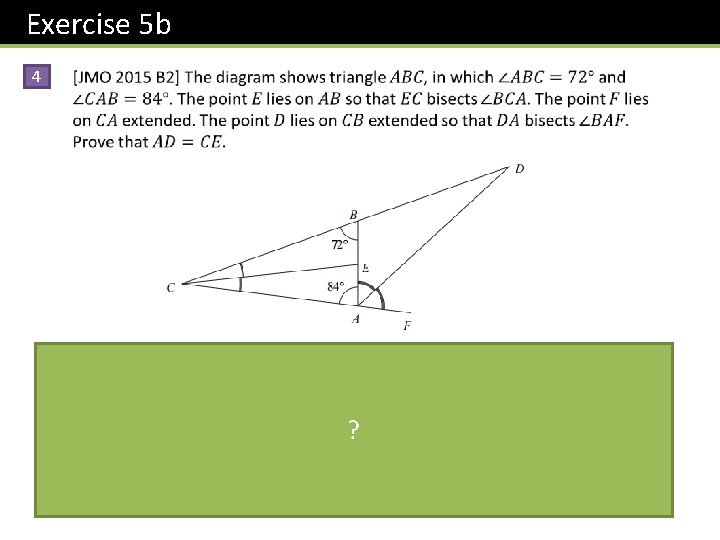
Exercise 5 b 4 ?
KS 3/4: Polygons Skipton Girls’ High School Objectives: Be able to classify shapes, reason about sides and angles, and find interior/exterior angles of polygons.
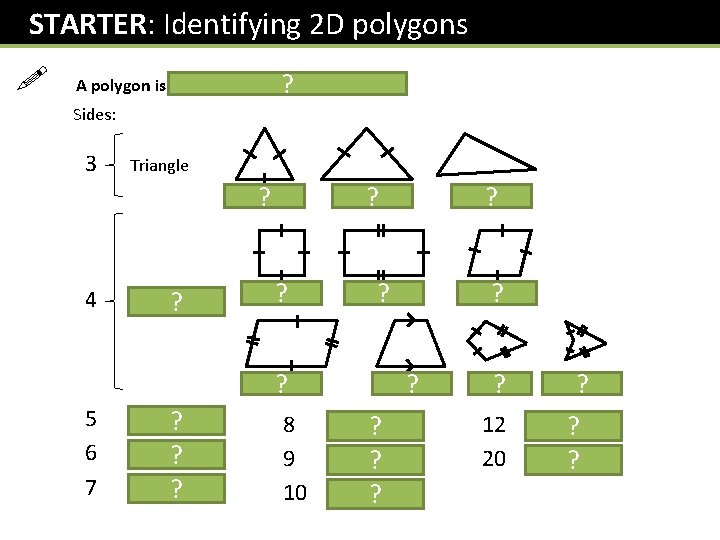
STARTER: Identifying 2 D polygons ! A polygon is a 2 D shape with ? straight sides. Sides: 3 Triangle ? Equilateral 4 Quadrilateral ? ? Square ? Parallelogram 5 6 7 Pentagon ? Hexagon ? Heptagon ? 8 9 10 ? ? Isosceles Scalene ? Rectangle ? Trapezium Octagon ? Nonagon ? Decagon ? ? Rhombus ? Kite 12 20 ? Arrowhead Dodecagon ? Icosagon ?
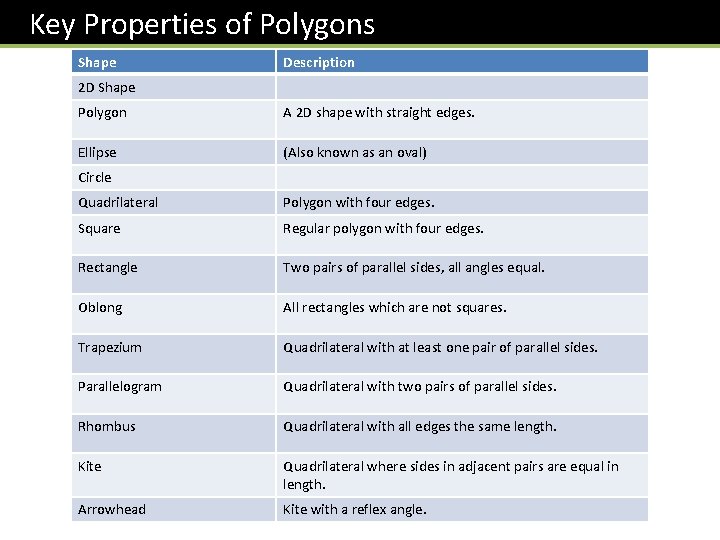
Key Properties of Polygons Shape Description 2 D Shape Polygon A 2 D shape with straight edges. Ellipse (Also known as an oval) Circle Quadrilateral Polygon with four edges. Square Regular polygon with four edges. Rectangle Two pairs of parallel sides, all angles equal. Oblong All rectangles which are not squares. Trapezium Quadrilateral with at least one pair of parallel sides. Parallelogram Quadrilateral with two pairs of parallel sides. Rhombus Quadrilateral with all edges the same length. Kite Quadrilateral where sides in adjacent pairs are equal in length. Arrowhead Kite with a reflex angle.
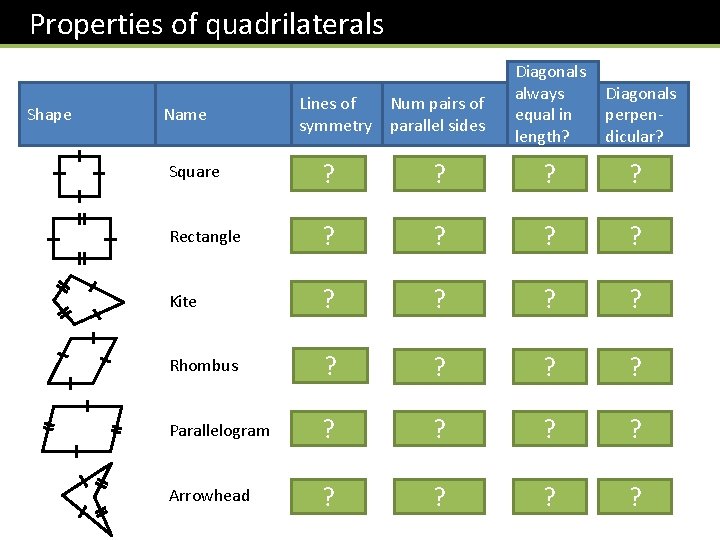
Properties of quadrilaterals Shape Name Lines of Num pairs of symmetry parallel sides Diagonals always Diagonals equal in perpenlength? dicular? Square 4 ? 2 ? Yes? Rectangle 2 ? Yes? No ? Kite 1 ? 0 ? No ? Yes? Rhombus 2 ? No ? Yes? Parallelogram 0 ? 2 ? No ? Arrowhead 1 ? 0 ? No ? Yes?
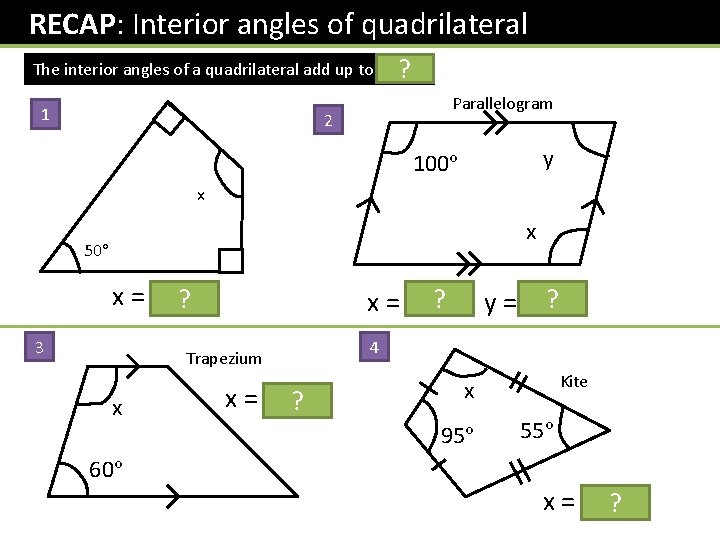
RECAP: Interior angles of quadrilateral The interior angles of a quadrilateral add up to 360. ? 1 Parallelogram 2 y 100° x x 50° x = 130° ? 3 ? y = 80° ? x = 100° Trapezium x 60° x = 120° ? 4 Kite x 95° 55° x = 105° ?
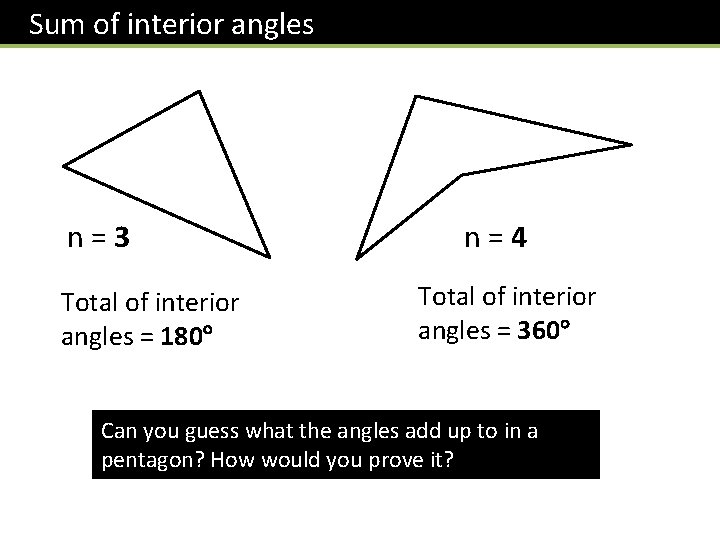
Sum of interior angles n = 3 Total of interior angles = 180° n = 4 Total of interior angles = 360° Can you guess what the angles add up to in a pentagon? How would you prove it?
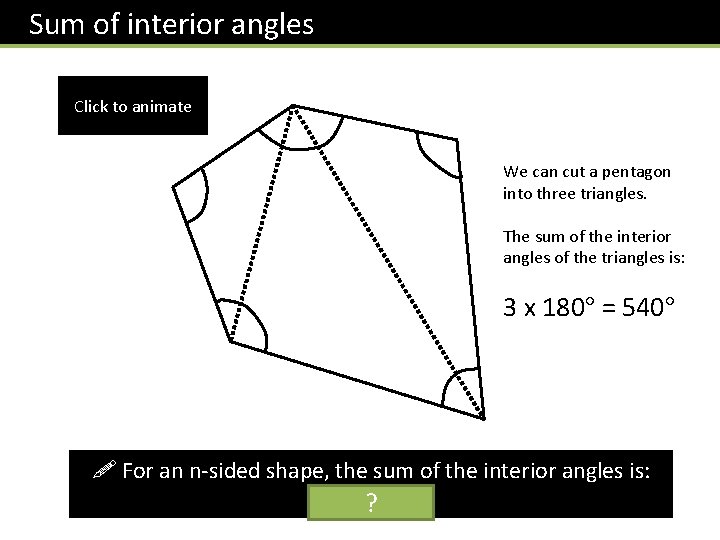
Sum of interior angles Click to animate We can cut a pentagon into three triangles. The sum of the interior angles of the triangles is: 3 x 180° = 540° ! For an n-sided shape, the sum of the interior angles is: 180(n-2) ?
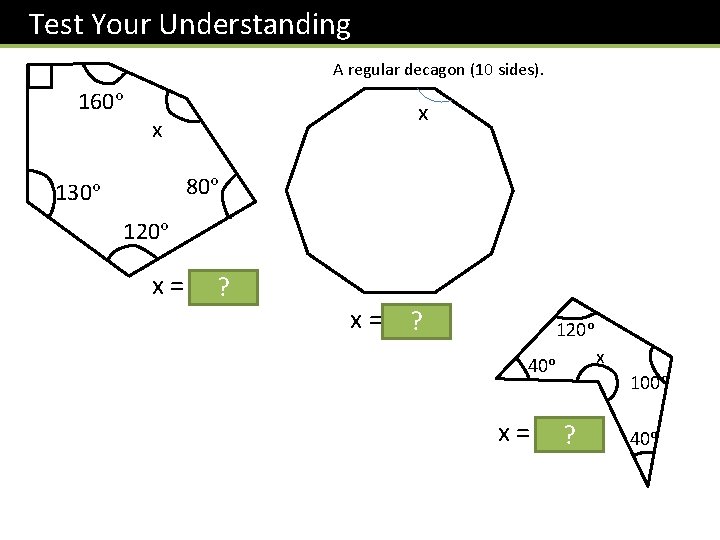
Test Your Understanding A regular decagon (10 sides). 160° x x 80° 130° 120° x = 140° ? x = 144° ? 120° 40° x = 240° ? x 100° 40°
Exercise 1 1 a b c b = 260 ? x = 75 ? x = 25 ? d e a = 100 ? f x = 222 ? x = 309 ?
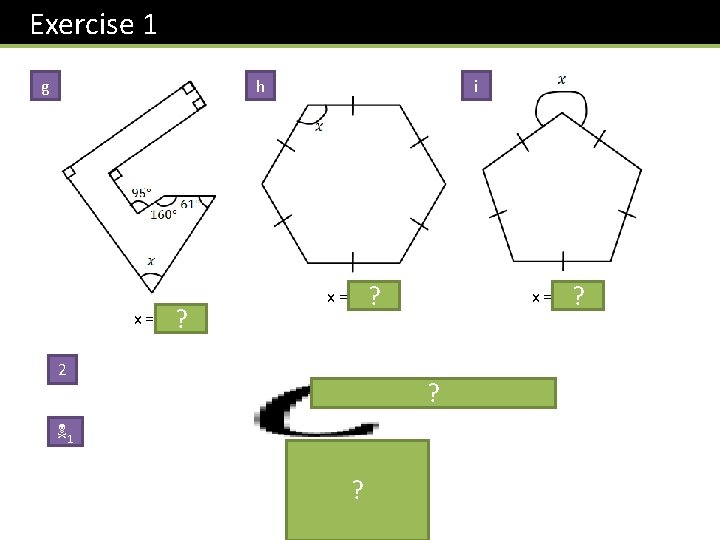
Exercise 1 g h x = 54 ? 2 i x = 120 ? x = 252 ? ? N 1 ?
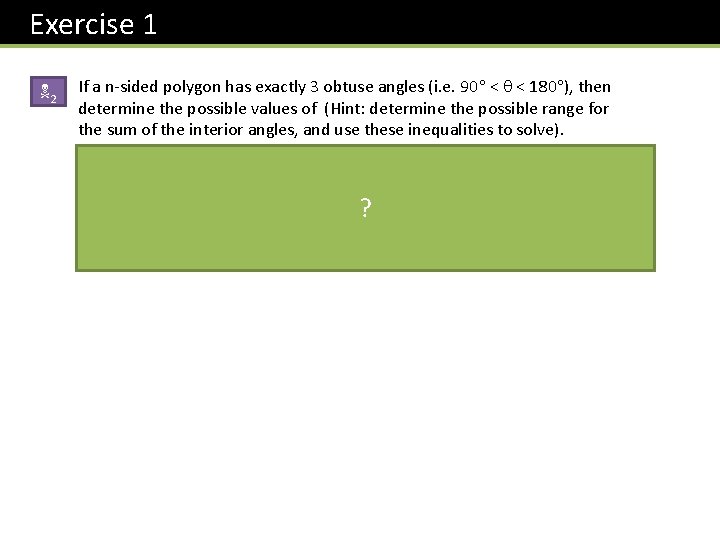
Exercise 1 N 2 If a n-sided polygon has exactly 3 obtuse angles (i. e. 90 < < 180 ), then determine the possible values of (Hint: determine the possible range for the sum of the interior angles, and use these inequalities to solve). ?
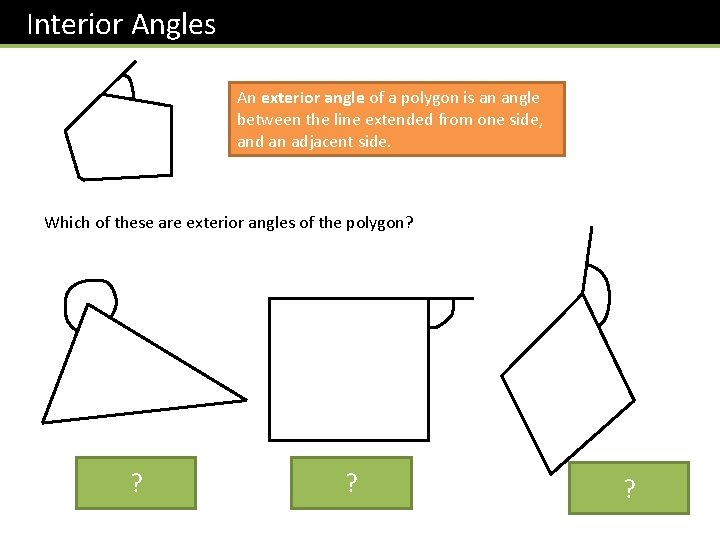
Interior Angles An exterior angle of a polygon is an angle between the line extended from one side, and an adjacent side. Which of these are exterior angles of the polygon? ? NO ? YES NO?
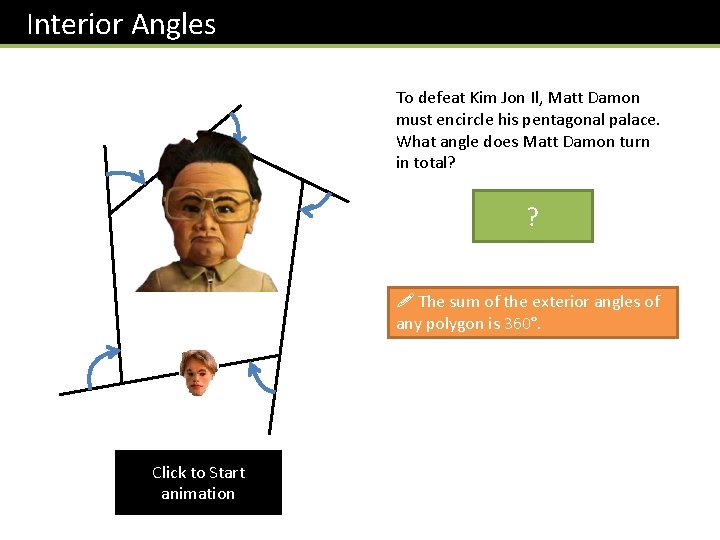
Interior Angles To defeat Kim Jon Il, Matt Damon must encircle his pentagonal palace. What angle does Matt Damon turn in total? 360° ? ! The sum of the exterior angles of any polygon is 360°. Click to Start animation
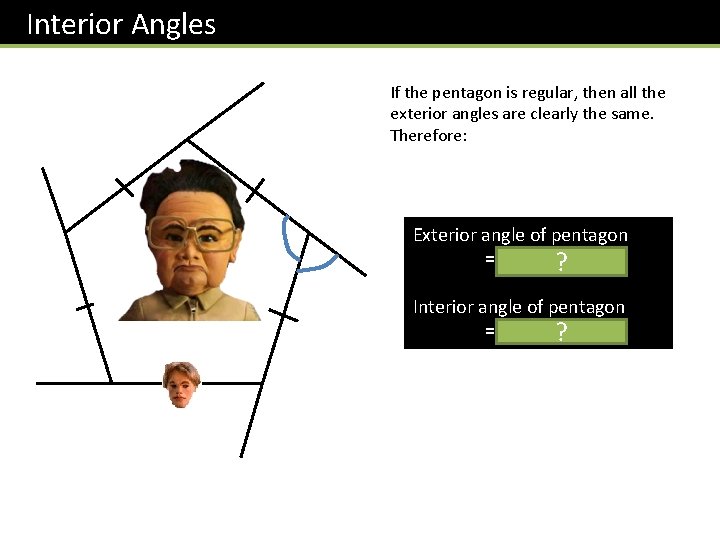
Interior Angles If the pentagon is regular, then all the exterior angles are clearly the same. Therefore: Exterior angle of pentagon = 360 / 5? = 72° Interior angle of pentagon = 180 – 72 ? = 108°
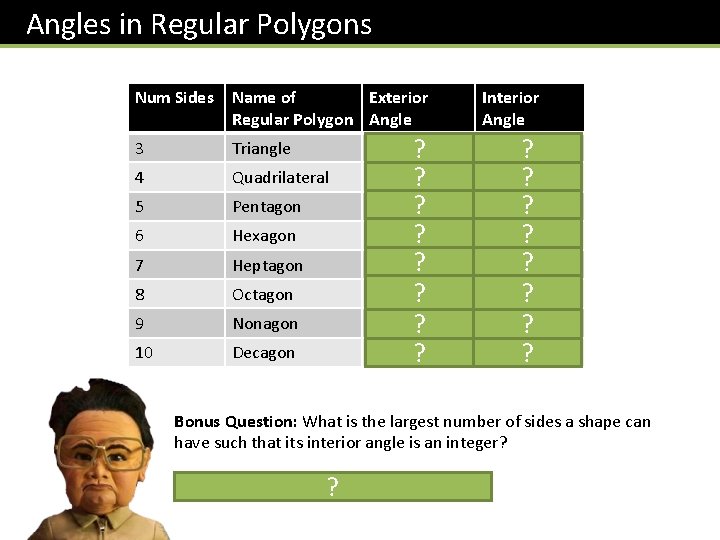
Angles in Regular Polygons Num Sides Name of Exterior Regular Polygon Angle 3 Triangle 4 Quadrilateral 5 Pentagon 6 Hexagon 7 Heptagon 8 Octagon 9 Nonagon 10 Decagon ? 90° ? 72° ? 60° ? 51. 4° ? 45° ? 40° ? 36° ? 120° Interior Angle ? 90° ? 108° ? 120° ? 128. 6°? 135° ? 140° ? 144° ? 60° Bonus Question: What is the largest number of sides a shape can have such that its interior angle is an integer? 360 sides. The interior ? angle will be 179°.
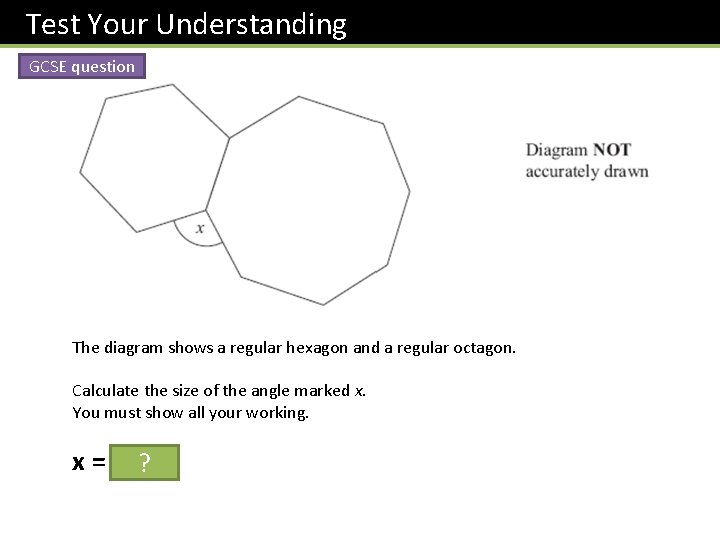
Test Your Understanding GCSE question The diagram shows a regular hexagon and a regular octagon. Calculate the size of the angle marked x. You must show all your working. x = 105° ?
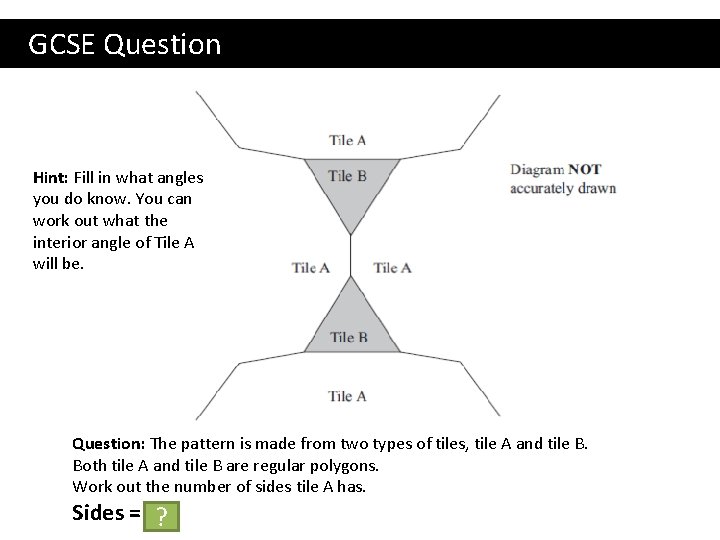
GCSE Question Hint: Fill in what angles you do know. You can work out what the interior angle of Tile A will be. Question: The pattern is made from two types of tiles, tile A and tile B. Both tile A and tile B are regular polygons. Work out the number of sides tile A has. Sides = 12 ?
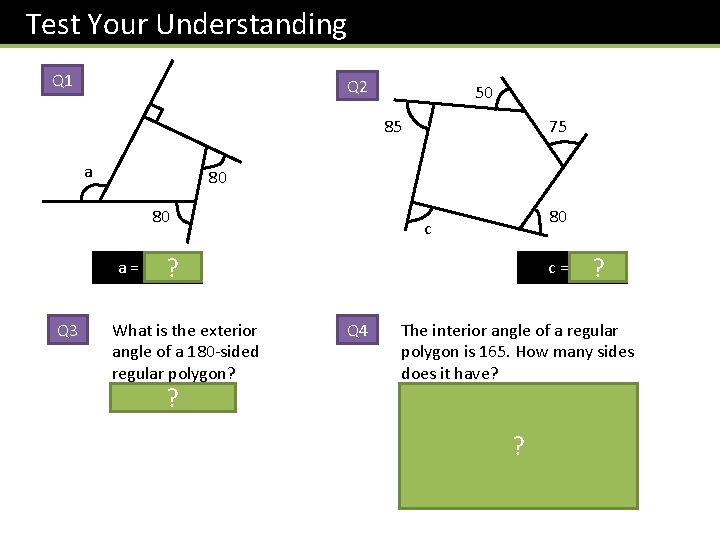
Test Your Understanding Q 1 Q 2 50 85 a 75 80 80 80 c a = 110° ? Q 3 What is the exterior angle of a 180 -sided regular polygon? 360 ÷ 180 ? = 2 c = 70°? Q 4 The interior angle of a regular polygon is 165. How many sides does it have? Interior angle = 180 – 165 = 15 n = 360 ÷ 15 = 24 ? Alternative method: Total interior angle = 165 n Then solve 180(n – 2) = 165 n