
KS 3 Knowledge Organiser Year 7 Instruments of
- Slides: 3
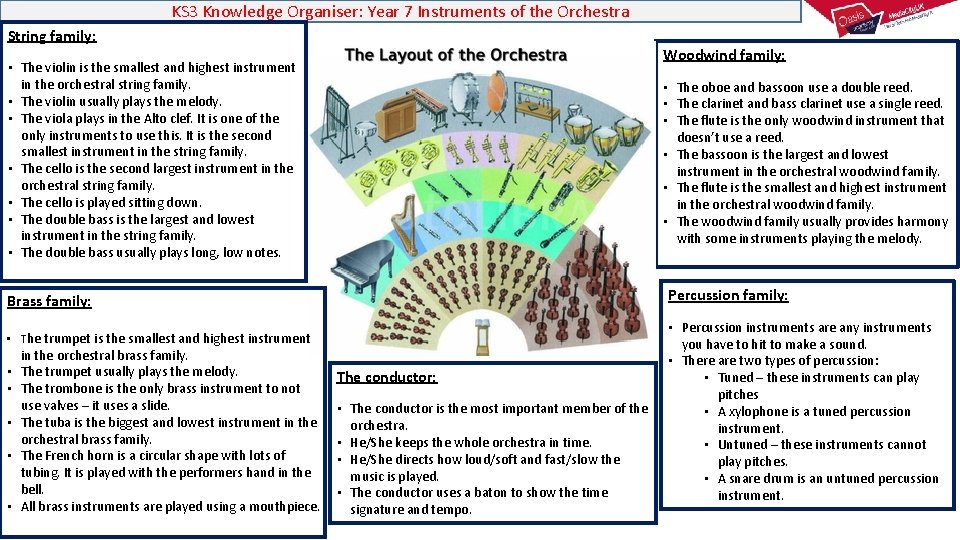
KS 3 Knowledge Organiser: Year 7 Instruments of the Orchestra String family: Woodwind family: • The violin is the smallest and highest instrument in the orchestral string family. • The violin usually plays the melody. • The viola plays in the Alto clef. It is one of the only instruments to use this. It is the second smallest instrument in the string family. • The cello is the second largest instrument in the orchestral string family. • The cello is played sitting down. • The double bass is the largest and lowest instrument in the string family. • The double bass usually plays long, low notes. • The oboe and bassoon use a double reed. • The clarinet and bass clarinet use a single reed. • The flute is the only woodwind instrument that doesn’t use a reed. • The bassoon is the largest and lowest instrument in the orchestral woodwind family. • The flute is the smallest and highest instrument in the orchestral woodwind family. • The woodwind family usually provides harmony with some instruments playing the melody. Percussion family: Brass family: • The trumpet is the smallest and highest instrument • • • in the orchestral brass family. The trumpet usually plays the melody. The trombone is the only brass instrument to not use valves – it uses a slide. The tuba is the biggest and lowest instrument in the orchestral brass family. The French horn is a circular shape with lots of tubing. It is played with the performers hand in the bell. All brass instruments are played using a mouthpiece. The conductor: • The conductor is the most important member of the orchestra. • He/She keeps the whole orchestra in time. • He/She directs how loud/soft and fast/slow the music is played. • The conductor uses a baton to show the time signature and tempo. • Percussion instruments are any instruments you have to hit to make a sound. • There are two types of percussion: • Tuned – these instruments can play pitches • A xylophone is a tuned percussion instrument. • Untuned – these instruments cannot play pitches. • A snare drum is an untuned percussion instrument.
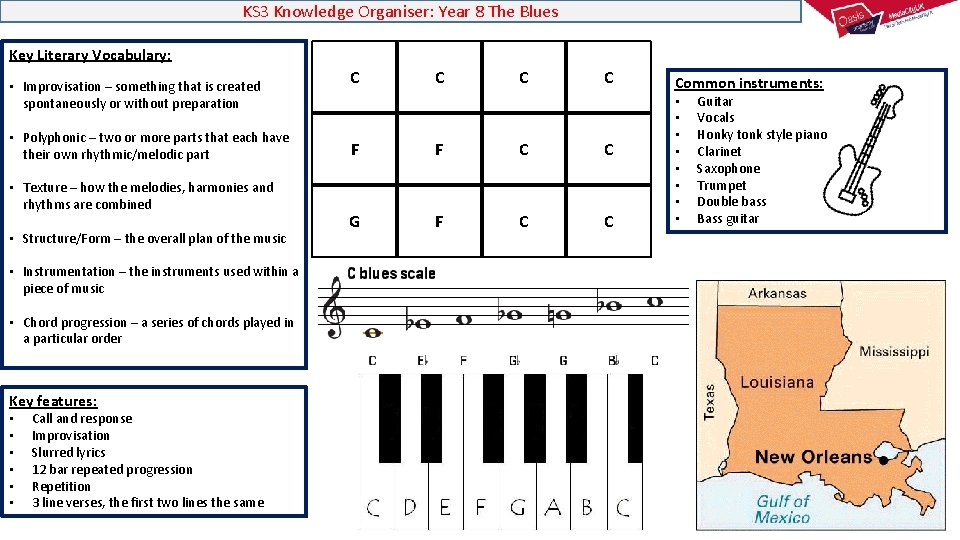
KS 3 Knowledge Organiser: Year 8 The Blues Key Literary Vocabulary: • Improvisation – something that is created spontaneously or without preparation • Polyphonic – two or more parts that each have their own rhythmic/melodic part • Texture – how the melodies, harmonies and rhythms are combined • Structure/Form – the overall plan of the music • Instrumentation – the instruments used within a piece of music • Chord progression – a series of chords played in a particular order Key features: • • • Call and response Improvisation Slurred lyrics 12 bar repeated progression Repetition 3 line verses, the first two lines the same C C F F C C G F C C Common instruments: • • Guitar Vocals Honky tonk style piano Clarinet Saxophone Trumpet Double bass Bass guitar
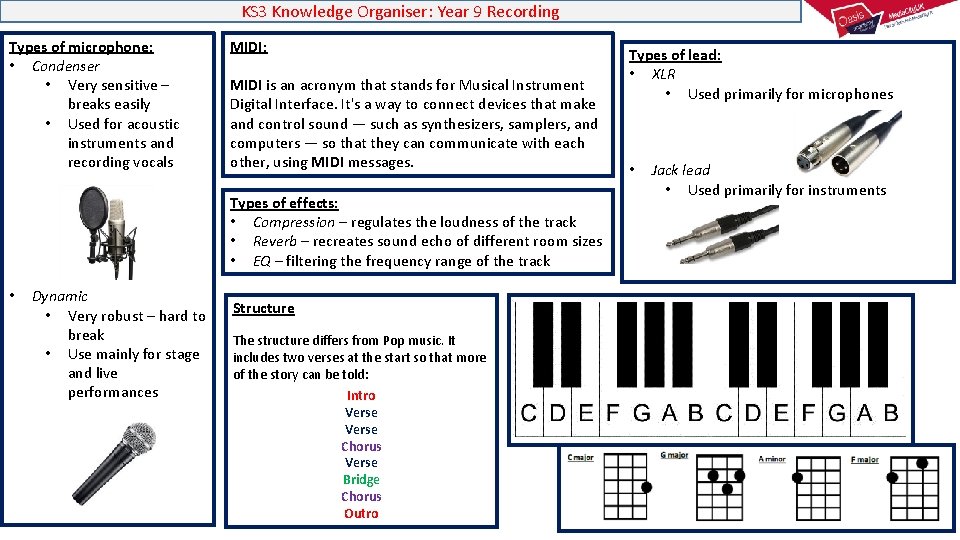
KS 3 Knowledge Organiser: Year 9 Recording Types of microphone: • Condenser • Very sensitive – breaks easily • Used for acoustic instruments and recording vocals MIDI: MIDI is an acronym that stands for Musical Instrument Digital Interface. It's a way to connect devices that make and control sound — such as synthesizers, samplers, and computers — so that they can communicate with each other, using MIDI messages. Types of effects: • Compression – regulates the loudness of the track • Reverb – recreates sound echo of different room sizes • EQ – filtering the frequency range of the track • Dynamic • Very robust – hard to break • Use mainly for stage and live performances Structure The structure differs from Pop music. It includes two verses at the start so that more of the story can be told: Intro Verse Chorus Verse Bridge Chorus Outro Types of lead: • XLR • Used primarily for microphones • Jack lead • Used primarily for instruments