
KS 3 Geography Knowledge East Africa Kenya Lesson
- Slides: 2
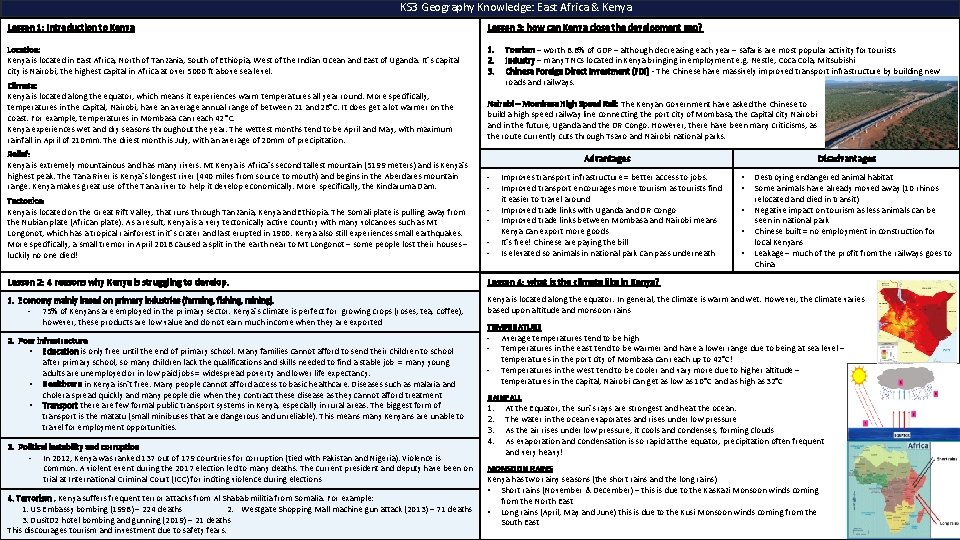
KS 3 Geography Knowledge: East Africa & Kenya Lesson 1: Introduction to Kenya Lesson 3: how can Kenya close the development gap? Location: Kenya is located in East Africa, North of Tanzania, South of Ethiopia, West of the Indian Ocean and East of Uganda. It’s capital city is Nairobi, the highest capital in Africa at over 5000 ft above sea level. 1. 2. 3. Climate: Kenya is located along the equator, which means it experiences warm temperatures all year round. More specifically, temperatures in the capital, Nairobi, have an average annual range of between 21 and 26°C. It does get a lot warmer on the coast. For example, temperatures in Mombasa can reach 42°C. Kenya experiences wet and dry seasons throughout the year. The wettest months tend to be April and May, with maximum rainfall in April of 210 mm. The driest month is July, with an average of 20 mm of precipitation. Nairobi – Mombasa High Speed Rail: The Kenyan Government have asked the Chinese to build a high speed railway line connecting the port city of Mombasa, the capital city Nairobi and in the future, Uganda and the DR Congo. However, there have been many criticisms, as the route currently cuts through Tsavo and Nairobi national parks. Relief: Kenya is extremely mountainous and has many rivers. Mt Kenya is Africa’s second tallest mountain (5199 meters) and is Kenya’s highest peak. The Tana River is Kenya’s longest river (440 miles from source to mouth) and begins in the Aberdares mountain range. Kenya makes great use of the Tana river to help it develop economically. More specifically, the Kindaruma Dam. Tectonics: Kenya is located on the Great Rift Valley, that runs through Tanzania, Kenya and Ethiopia. The Somali plate is pulling away from the Nubian plate (African plate). As a result, Kenya is a very tectonically active country with many volcanoes such as Mt Longonot, which has a tropical rainforest in it’s crater and last erupted in 1900. Kenya also still experiences small earthquakes. More specifically, a small tremor in April 2018 caused a split in the earth near to Mt Longonot – some people lost their houses – luckily no one died! Tourism – worth 8. 8% of GDP – although decreasing each year – safaris are most popular activity for tourists Industry – many TNCs located in Kenya bringing in employment e. g. Nestle, Coca Cola, Mitsubishi Chinese Foreign Direct Investment (FDI) - The Chinese have massively improved transport infrastructure by building new roads and railways. Advantages - Improves transport infrastructure = better access to jobs. Improved transport encourages more tourism as tourists find it easier to travel around Improved trade links with Uganda and DR Congo Improved trade links between Mombasa and Nairobi means Kenya can export more goods It’s free! Chinese are paying the bill Is elevated so animals in national park can pass underneath Disadvantages • • • Destroying endangered animal habitat Some animals have already moved away (10 rhinos relocated and died in transit) Negative impact on tourism as less animals can be seen in national park Chinese built = no employment in construction for local Kenyans Leakage – much of the profit from the railways goes to China Lesson 2: 4 reasons why Kenya is struggling to develop. Lesson 4: what is the climate like in Kenya? 1. Economy mainly based on primary industries (farming, fishing, mining). - 75% of Kenyans are employed in the primary sector. Kenya’s climate is perfect for growing crops (roses, tea, coffee), however, these products are low value and do not earn much income when they are exported Kenya is located along the equator. In general, the climate is warm and wet. However, the climate varies based upon altitude and monsoon rains 2. Poor infrastructure • Education is only free until the end of primary school. Many families cannot afford to send their children to school after primary school, so many children lack the qualifications and skills needed to find a stable job = many young adults are unemployed or in low paid jobs = widespread poverty and lower life expectancy. • Healthcare in Kenya isn’t free. Many people cannot afford access to basic healthcare. Diseases such as malaria and cholera spread quickly and many people die when they contract these disease as they cannot afford treatment • Transport there are few formal public transport systems in Kenya, especially in rural areas. The biggest form of transport is the matatu (small minibuses that are dangerous and unreliable). This means many Kenyans are unable to travel for employment opportunities. 3. Political instability and corruption - In 2012, Kenya was ranked 137 out of 179 countries for corruption (tied with Pakistan and Nigeria). Violence is common. A violent event during the 2017 election led to many deaths. The current president and deputy have been on trial at International Criminal Court (ICC) for inciting violence during elections 4. Terrorism. Kenya suffers frequent terror attacks from Al Shabab militia from Somalia. For example: 1. US Embassy bombing (1998) – 224 deaths 2. Westgate Shopping Mall machine gun attack (2013) – 71 deaths 3. Dusit. D 2 hotel bombing and gunning (2019) – 21 deaths This discourages tourism and investment due to safety fears. TEMPERATURE - Average temperatures tend to be high - Temperatures in the east tend to be warmer and have a lower range due to being at sea level – temperatures in the port city of Mombasa can reach up to 42°C! - Temperatures in the west tend to be cooler and vary more due to higher altitude – temperatures in the capital, Nairobi can get as low as 10°C and as high as 32°C RAINFALL 1. At the Equator, the sun’s rays are strongest and heat the ocean. 2. The water in the ocean evaporates and rises under low pressure 3. As the air rises under low pressure, it cools and condenses, forming clouds 4. As evaporation and condensation is so rapid at the equator, precipitation often frequent and very heavy! MONSOON RAINS Kenya has two rainy seasons (the short rains and the long rains) • Short rains (November & December) – this is due to the Kas. Kazi Monsoon winds coming from the North East • Long rains (April, May and June) this is due to the Kusi Monsoon winds coming from the South East
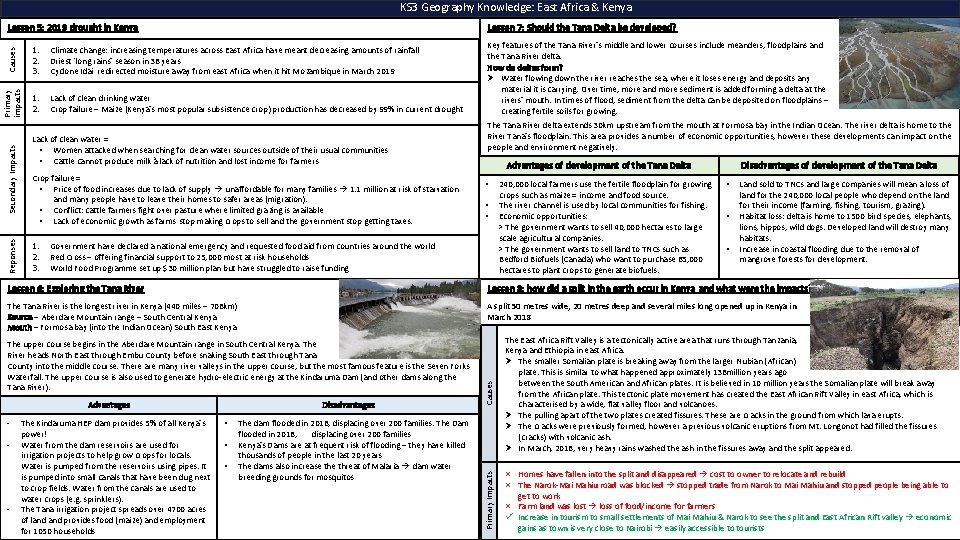
KS 3 Geography Knowledge: East Africa & Kenya 1. 2. 3. Climate change: increasing temperatures across East Africa have meant decreasing amounts of rainfall Driest ‘long rains’ season in 38 years Cyclone Idai redirected moisture away from east Africa when it hit Mozambique in March 2019 1. 2. Lack of clean drinking water Crop failure – Maize (Kenya’s most popular subsistence crop) production has decreased by 99% in current drought Reponses Secondary Impacts Causes Lesson 7: Should the Tana Delta be developed? Primary impacts Lesson 5: 2019 drought in Kenya Lack of clean water = • Women attacked when searching for clean water sources outside of their usual communities • Cattle cannot produce milk à lack of nutrition and lost income for farmers Crop failure = • Price of food increases due to lack of supply unaffordable for many families 1. 1 million at risk of starvation and many people have to leave their homes to safer areas (migration). • Conflict: cattle farmers fight over pasture where limited grazing is available • Lack of economic growth as farms stop making crops to sell and the government stop getting taxes. 1. 2. 3. Key features of the Tana River’s middle and lower courses include meanders, floodplains and the Tana River delta. How do deltas form? Ø Water flowing down the river reaches the sea, where it loses energy and deposits any material it is carrying. Over time, more and more sediment is added forming a delta at the rivers’ mouth. In times of flood, sediment from the delta can be deposited on floodplains – creating fertile soils for growing. The Tana River delta extends 30 km upstream from the mouth at Formosa bay in the Indian Ocean. The river delta is home to the River Tana’s floodplain. This area provides a number of economic opportunities, however these developments can impact on the people and environment negatively. Advantages of development of the Tana Delta • • • Government have declared a national emergency and requested food aid from countries around the world Red Cross – offering financial support to 25, 000 most at risk households World Food Programme set up $30 million plan but have struggled to raise funding 240, 000 local farmers use the fertile floodplain for growing crops such as maize = income and food source. The river channel is used by local communities for fishing. Economic opportunities: > The government wants to sell 40, 000 hectares to large scale agricultural companies. > The government wants to sell land to TNCs such as Bedford Biofuels (Canada) who want to purchase 65, 000 hectares to plant crops to generate biofuels. Disadvantages of development of the Tana Delta • • • Land sold to TNCs and large companies will mean a loss of land for the 240, 000 local people who depend on the land for their income (farming, fishing, tourism, grazing). Habitat loss: delta is home to 1500 bird species, elephants, lions, hippos, wild dogs. Developed land will destroy many habitats. Increase in coastal flooding due to the removal of mangrove forests for development. Lesson 8: how did a split in the earth occur in Kenya and what were the impacts? The Tana River is the longest river in Kenya (440 miles – 708 km) Source – Aberdare Mountain range – South Central Kenya Mouth – Formosa bay (into the Indian Ocean) South East Kenya A split 50 metres wide, 20 metres deep and several miles long opened up in Kenya in March 2018 Advantages - - The Kindaruma HEP dam provides 5% of all Kenya’s power! Water from the dam reservoirs are used for irrigation projects to help grow crops for locals. Water is pumped from the reservoirs using pipes. It is pumped into small canals that have been dug next to crop fields. Water from the canals are used to water crops (e. g. sprinklers). The Tana irrigation project spreads over 4700 acres of land provides food (maize) and employment for 1050 households Disadvantages • • • The dam flooded in 2018, displacing over 200 families. The Dam flooded in 2018, displacing over 200 families Kenya’s Dams are at frequent risk of flooding – they have killed thousands of people in the last 20 years The dams also increase threat of Malaria dam water breeding grounds for mosquitos Primary Impacts The upper course begins in the Aberdare Mountain range in South Central Kenya. The River heads North East through Embu County before snaking South East through Tana County into the middle course. There are many river valleys in the upper course, but the most famous feature is the Seven Forks Waterfall. The upper course is also used to generate hydro-electric energy at the Kindaruma Dam (and other dams along the Tana River). Causes Lesson 6: Exploring the Tana River The East Africa Rift Valley is a tectonically active area that runs through Tanzania, Kenya and Ethiopia in east Africa. Ø The smaller Somalian plate is breaking away from the larger Nubian (African) plate. This is similar to what happened approximately 138 million years ago between the South American and African plates. It is believed in 10 million years the Somalian plate will break away from the African plate. This tectonic plate movement has created the East African Rift Valley in east Africa, which is characterised by a wide, flat valley floor and volcanoes. Ø The pulling apart of the two plates created fissures. These are cracks in the ground from which lava erupts. Ø The cracks were previously formed, however a previous volcanic eruptions from Mt. Longonot had filled the fissures (cracks) with volcanic ash. Ø In March, 2018, very heavy rains washed the ash in the fissures away and the split appeared. × Homes have fallen into the split and disappeared cost to owner to relocate and rebuild × The Narok-Mai Mahiu road was blocked stopped trade from Narok to Mai Mahiu and stopped people being able to get to work × Farm land was lost loss of food/income for farmers ü Increase in tourism to small settlements of Mai Mahiu & Narok to see the split and East African Rift valley economic gains as town is very close to Nairobi easily accessible to tourists