
KS 3 Geography Knowledge Coasts Coastline The outline

- Slides: 2
KS 3 Geography Knowledge: Coasts Coastline The outline of the land, where the land meets the sea. Social uses of the coastline Plymouth – sightseeing, beaches, yacht clubs, marinas, fishing, sailing Brighton – beaches, theme park on Brighton Pier, windsurfing, sailing, Portsmouth – Spinnaker Tower has a viewing platform for tourists. Economic uses of the coastline Plymouth – shipping port (import, export), ferry and Royal Navy shipbuilding yard = jobs. Portsmouth – Royal Navy port, tourism industry, transport (ferry) industry Brighton – tourism industry, fishing industry. Environmental uses of the coastline Plymouth – nature reserves. Portsmouth – 7 wildlife conservation areas where they look after habitats Erosion The wearing away or breakdown of rocks by wind, water or ice. Hydraulic Action The power of the waves forces water and air into cracks in the cliff. The increase in pressure and force causes cracks to get bigger. Abrasion Waves pick up rocks in the sea and throw them against the cliff face. This acts like sandpaper and removes material. Corrosion Chemicals in the water dissolve the rocks, such as limestone Attrition Rocks in the sea hit into each other. This makes then smaller, smoother and rounder. Weathering The breakdown of rocks caused by the day-to-day changes in the atmosphere. Freeze-thaw • • Chemical weathering Chemicals in the rain (acid rain) dissolve rocks. Biological weathering Plant roots grow in cracks in the rocks and break them apart. Animals burrow into weak rocks and break it apart. Longshore drift The transportation of material along the coast in a zig zag pattern. Swash Breaking waves rush water and sediment up the beach. Backwash The water that rushes flows back to the sea. LANDFORMS FORMED BY WEATHERING AND EROSION HEADLAND BAY Headland bays occur along coastlines that hand different types of rock, as the rocks erode at different speeds. • The hard rock (granite) erodes more slowly than the soft rock, creating headlands that jut out to sea. • The soft rock (clay) will erode more quickly than the hard rock, creating bays. • Bays are sheltered = deposition = beaches are formed. CAVE, ARCH, STACK • Erosion (hydraulic action, abrasion) attacks a line of weakness in the cliff. This makes eventually collapses = stack. • Erosion and weathering erode the stack to form a stump. MASS MOVEMENT Mass movement is the downhill movement of material caused by gravity. ROTATIONAL SLUMP A rotational slump is the downhill movement of material along a curved line of weakness. It occurs where permeable rock, overlies impermeable rock. • Heavy rain infiltrates the permeable rock, making it heavier. The cliff becomes unstable. • Waves erode the base of the cliff, making the cliff more unstable. • Eventually a curved line of weakness (slip plane) is formed. • The rocks slide down the curved line of weakness. Water collects in cracks. At night this water freezes and expands. The cracks get larger. In the day the temperature rises and the ice melts (thaws) = the pressure on rocks is reduced. This process is repeated. The repeated freezing and thawing weakens the rock = breaks apart. Deposition The dropping of material due to a loss in energy. Infiltration The process when a liquid enters a rock. Saturation A rock that is full of liquid. Impermeable rock Rocks that do not allow liquid to pass through Permeable rock Rocks that allow liquid to pass through Slip plane A line of weakness along which movement occurs. the line of weakness bigger, creating a cave. • Continued erosion, erodes the back of the cave = arch. • Weathering (freeze-thaw, animals) weakens the top of the arch, making it unstable. It LANDFORMS FORMED BY TRANSPORTATION AND DEPOSITION SPIT BAR 1. 2. 3. 4. 5. LONGSHORE DRIFT transports material along the coastline in a zigzag pattern. Where there is a sudden BEND in the coastline, the waves lose energy = material is deposited. REPEAT: Continued longshore drift and deposition, deposits material out to sea. Strong winds and waves curve the end of the spit = RECURVED END. The area behind the spit is sheltered from waves = low energy = deposition. SALTMARSHES and mud flats are common here. They attract lots of wildlife. TOMBOLO A BAR is formed when a spit joins two headlands together. A lagoon forms behind the bar. A TOMBOLO is formed when a spit joins to an island.
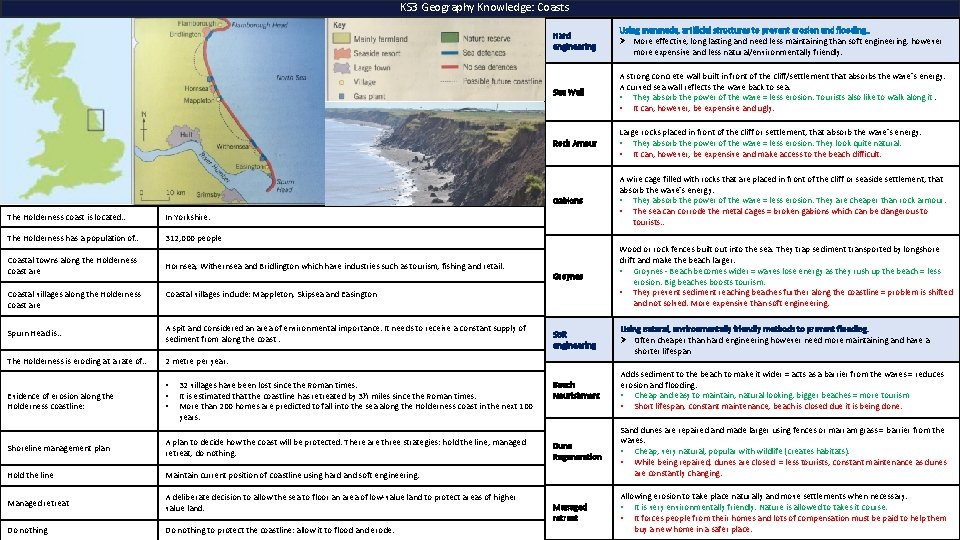
KS 3 Geography Knowledge: Coasts The Holderness coast is located… In Yorkshire. The Holderness has a population of… 312, 000 people Coastal towns along the Holderness coast are Coastal villages along the Holderness coast are Hornsea, Withernsea and Bridlington which have industries such as tourism, fishing and retail. Hard engineering Using manmade, artificial structures to prevent erosion and flooding. . Ø More effective, long lasting and need less maintaining than soft engineering, however more expensive and less natural/environmentally friendly. Sea Wall A strong concrete wall built in front of the cliff/settlement that absorbs the wave’s energy. A curved sea wall reflects the wave back to sea. • They absorb the power of the wave = less erosion. Tourists also like to walk along it. • It can, however, be expensive and ugly. Rock Amour Large rocks placed in front of the cliff or settlement, that a bsorb the wave’s energy. • They absorb the power of the wave = less erosion. They look quite natural. • It can, however, be expensive and make access to the beach difficult. Gabions A wire cage filled with rocks that are placed in front of the cliff or seaside settlement, that absorb the wave’s energy. • They absorb the power of the wave = less erosion. They are cheaper than rock armour. • The sea can corrode the metal cages = broken gabions which can be dangerous to tourists. . Groynes Wood or rock fences built out into the sea. They trap sediment transported by longshore drift and make the beach larger. • Groynes - Beach becomes wider = waves lose energy as they rush up the beach = less erosion. Big beaches boosts tourism. • They prevent sediment reaching beaches further along the coastline = problem is shifted and not solved. More expensive than soft engineering. Soft engineering Using natural, environmentally friendly methods to prevent flooding. Ø Often cheaper than hard engineering however need more maintaining and have a shorter lifespan Beach Nourishment Adds sediment to the beach to make it wider = acts as a barrier from the waves = reduces erosion and flooding. • Cheap and easy to maintain, natural looking, bigger beaches = more tourism • Short lifespan, constant maintenance, beach is closed due it is being done. Dune Regeneration Sand dunes are repaired and made larger using fences or marram grass = barrier from the waves. • Cheap, very natural, popular with wildlife (creates habitats). • While being repaired, dunes are closed = less tourists, constant maintenance as dunes are constantly changing. Managed retreat Allowing erosion to take place naturally and move settlements when necessary. • It is very environmentally friendly. Nature is allowed to takes it course. • It forces people from their homes and lots of compensation must be paid to help them buy a new home in a safer place. Coastal villages include: Mappleton, Skipsea and Easington Spurn Head is… A spit and considered an area of environmental importance. It needs to receive a constant supply of sediment from along the coast. The Holderness is eroding at a rate of… 2 metre per year. Evidence of erosion along the Holderness coastline: • • • 32 villages have been lost since the Roman times. It is estimated that the coastline has retreated by 3½ miles since the Roman times. More than 200 homes are predicted to fall into the sea along the Holderness coast in the next 100 years. Shoreline management plan A plan to decide how the coast will be protected. There are three strategies: hold the line, managed retreat, do nothing. Hold the line Maintain current position of coastline using hard and soft engineering. Managed retreat A deliberate decision to allow the sea to floor an area of low-value land to protect areas of higher value land. Do nothing to protect the coastline: allow it to flood and erode.