
KS 3 Biology 9 B Fit and Healthy
KS 3 Biology • 9 B Fit and Healthy 1 of 39 20 © Boardworks Ltd 2005 2004
Contents 9 B Fit and Healthy Being fit and healthy Smoking Diet, alcohol and drugs Maintaining fitness Summary activities 1 20 2 of 39 © Boardworks Ltd 2005 2004
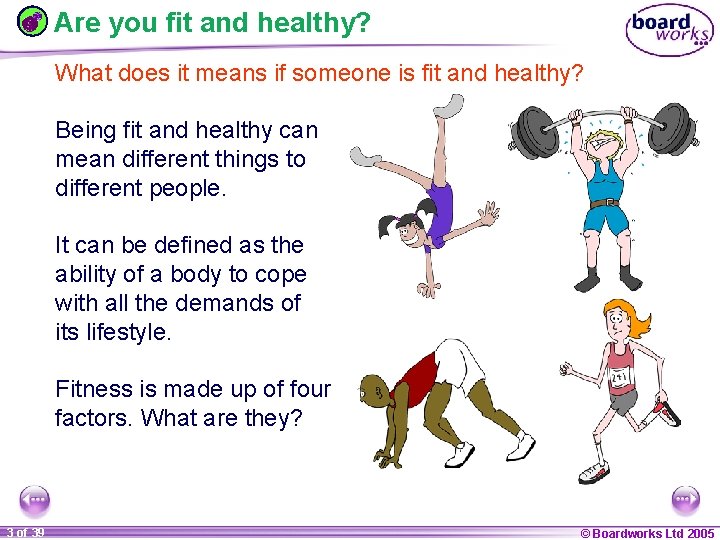
Are you fit and healthy? What does it means if someone is fit and healthy? Being fit and healthy can mean different things to different people. It can be defined as the ability of a body to cope with all the demands of its lifestyle. Fitness is made up of four factors. What are they? 1 20 3 of 39 © Boardworks Ltd 2005 2004
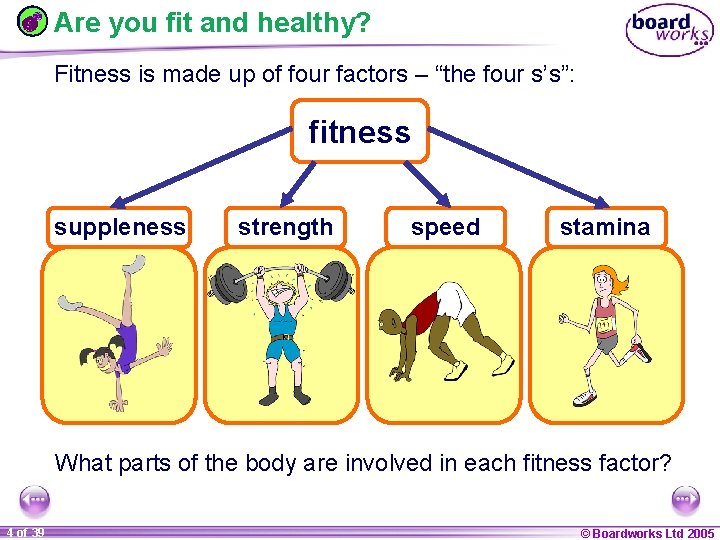
Are you fit and healthy? Fitness is made up of four factors – “the four s’s”: fitness suppleness strength speed stamina What parts of the body are involved in each fitness factor? 1 20 4 of 39 © Boardworks Ltd 2005 2004
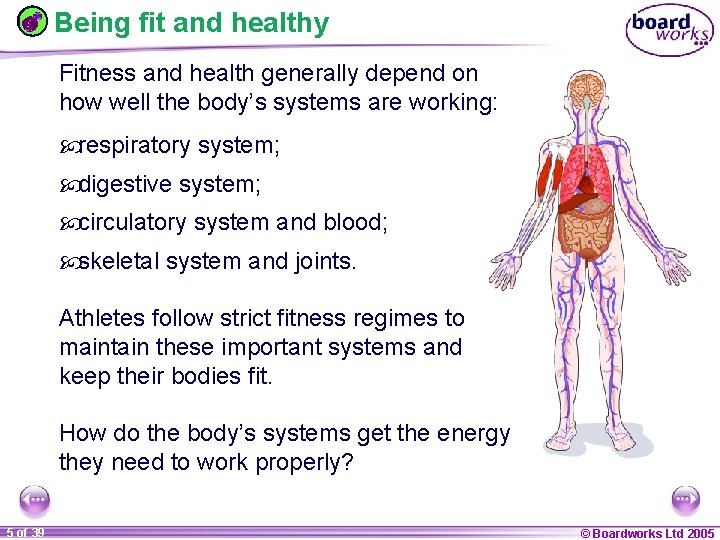
Being fit and healthy Fitness and health generally depend on how well the body’s systems are working: respiratory system; digestive system; circulatory system and blood; skeletal system and joints. Athletes follow strict fitness regimes to maintain these important systems and keep their bodies fit. How do the body’s systems get the energy they need to work properly? 1 20 5 of 39 © Boardworks Ltd 2005 2004

The utilization of energy and respiration The body’s cells carry out respiration to provide the body’s systems with the energy needed to work properly. Glucose and oxygen react in the body’s cells to release energy by the following chemical reaction: glucose oxygen carbon dioxide water energy Which body systems are involved in providing the reactants involved in respiration? Which body system is involved in transporting the reactants and products of respiration around the body? 1 20 6 of 39 © Boardworks Ltd 2005 2004
The utilization of energy 1 20 7 of 39 © Boardworks Ltd 2005 2004
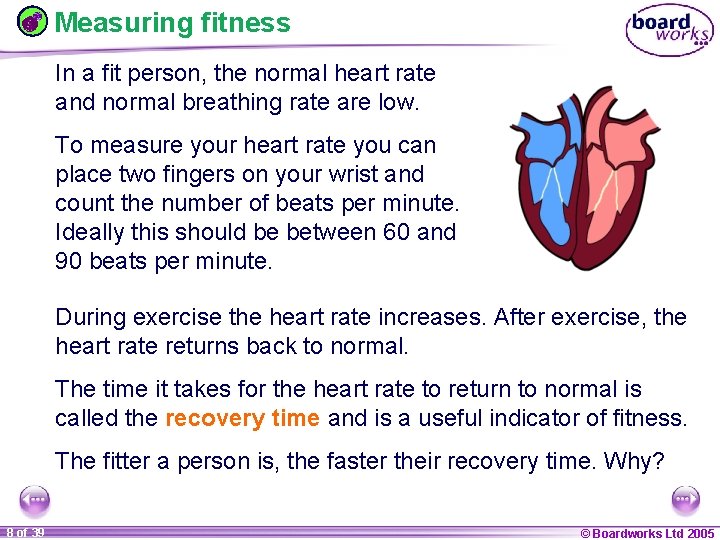
Measuring fitness In a fit person, the normal heart rate and normal breathing rate are low. To measure your heart rate you can place two fingers on your wrist and count the number of beats per minute. Ideally this should be between 60 and 90 beats per minute. During exercise the heart rate increases. After exercise, the heart rate returns back to normal. The time it takes for the heart rate to return to normal is called the recovery time and is a useful indicator of fitness. The fitter a person is, the faster their recovery time. Why? 1 20 8 of 39 © Boardworks Ltd 2005 2004
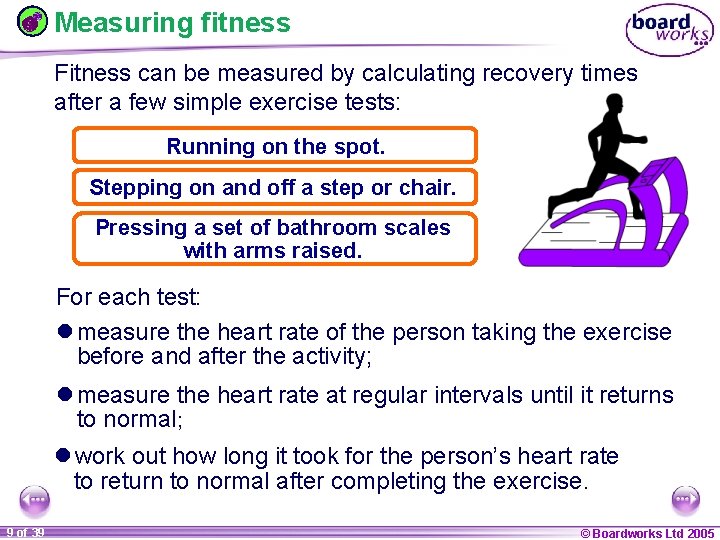
Measuring fitness Fitness can be measured by calculating recovery times after a few simple exercise tests: Running on the spot. Stepping on and off a step or chair. Pressing a set of bathroom scales with arms raised. For each test: l measure the heart rate of the person taking the exercise before and after the activity; l measure the heart rate at regular intervals until it returns to normal; l work out how long it took for the person’s heart rate to return to normal after completing the exercise. 1 20 9 of 39 © Boardworks Ltd 2005 2004
Contents 9 B Fit and Healthy Being fit and healthy Smoking Diet, alcohol and drugs Maintaining fitness Summary activities 1 10 ofof 20 39 © Boardworks Ltd 2005 2004
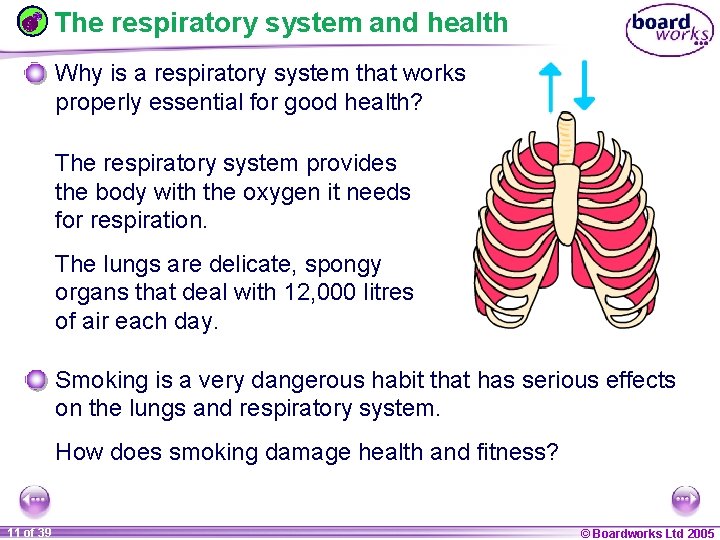
The respiratory system and health Why is a respiratory system that works properly essential for good health? The respiratory system provides the body with the oxygen it needs for respiration. The lungs are delicate, spongy organs that deal with 12, 000 litres of air each day. Smoking is a very dangerous habit that has serious effects on the lungs and respiratory system. How does smoking damage health and fitness? 1 11 ofof 20 39 © Boardworks Ltd 2005 2004
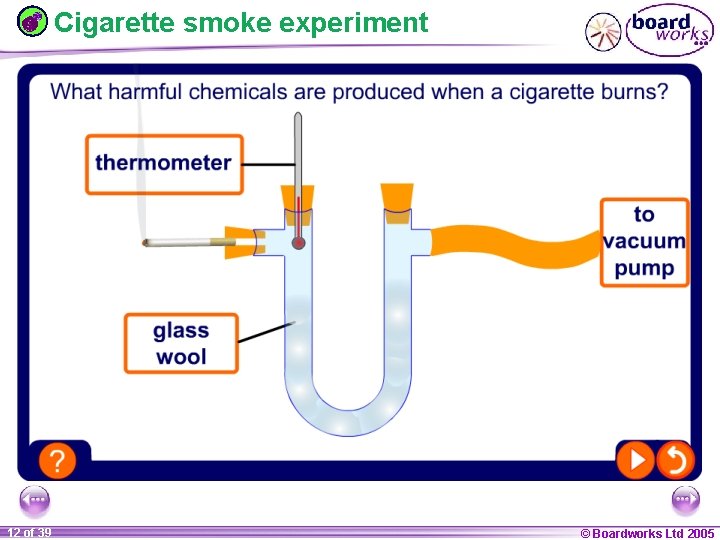
Cigarette smoke experiment 1 12 ofof 20 39 © Boardworks Ltd 2005 2004
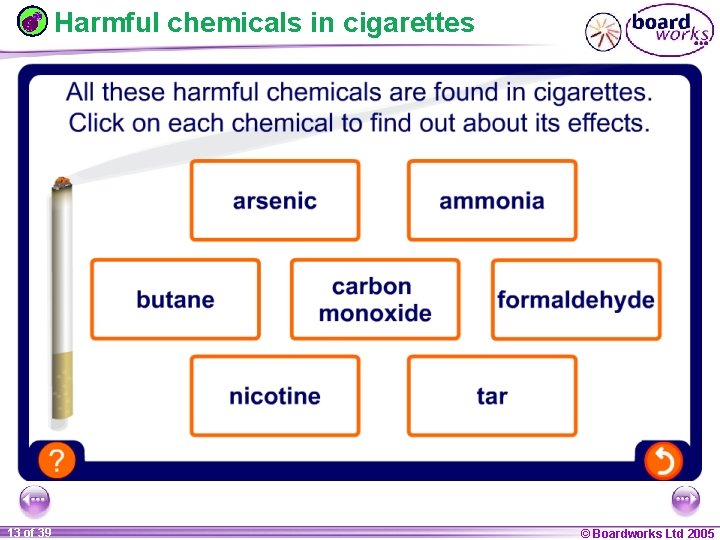
Harmful chemicals in cigarettes 1 13 ofof 20 39 © Boardworks Ltd 2005 2004
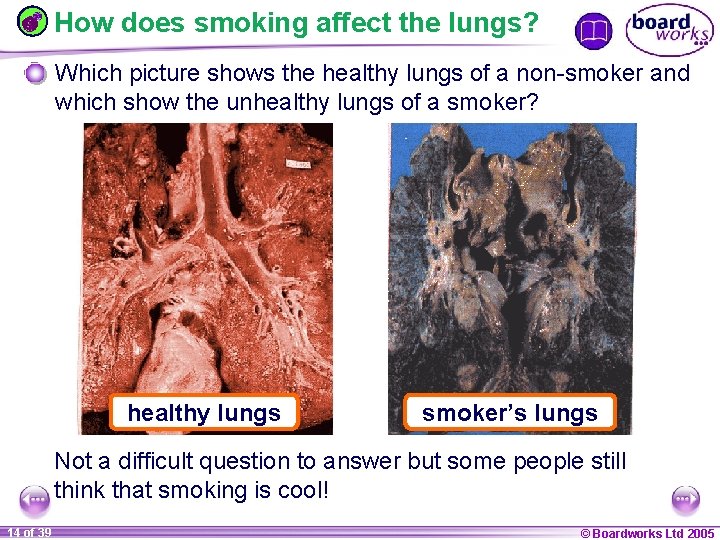
How does smoking affect the lungs? Which picture shows the healthy lungs of a non-smoker and which show the unhealthy lungs of a smoker? healthy lungs smoker’s lungs Not a difficult question to answer but some people still think that smoking is cool! 1 14 ofof 20 39 © Boardworks Ltd 2005 2004

How does smoking affect health? How will these chemicals be harmful to the body’s systems? l Carbon monoxide – A poisonous gas that reduces the around of oxygen that red blood cells carry around the body. l Tar – A brown, sticky substance that consists of tiny particles and is formed when tobacco smoke condenses. It is deposited in the lungs and coats the surface of the alveoli. l Nicotine – An addictive drug that affects the central nervous system. It increases the heart rate and narrows the blood vessels, causing high blood pressure. Smoking affects the respiratory and circulatory systems but has many other effects on the body. What other health problems and diseases are related to this habit? 1 15 ofof 20 39 © Boardworks Ltd 2005 2004
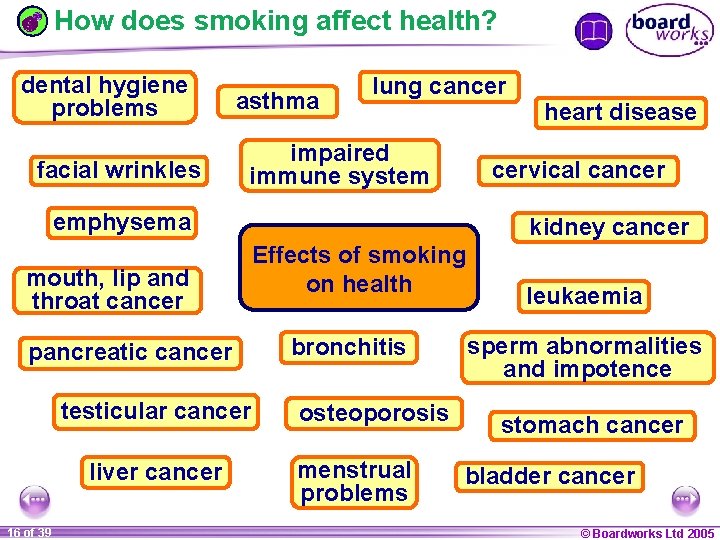
How does smoking affect health? dental hygiene problems facial wrinkles asthma lung cancer impaired immune system cervical cancer emphysema mouth, lip and throat cancer pancreatic cancer testicular cancer liver cancer 1 16 ofof 20 39 heart disease kidney cancer Effects of smoking on health bronchitis osteoporosis menstrual problems leukaemia sperm abnormalities and impotence stomach cancer bladder cancer © Boardworks Ltd 2005 2004
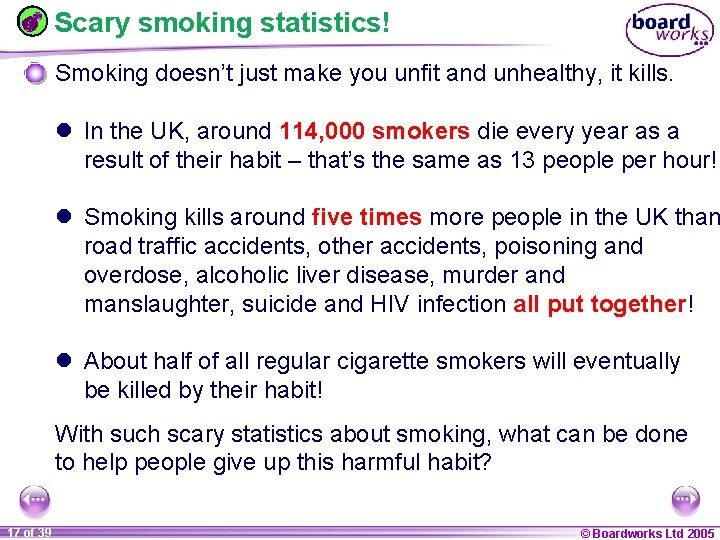
Scary smoking statistics! Smoking doesn’t just make you unfit and unhealthy, it kills. l In the UK, around 114, 000 smokers die every year as a result of their habit – that’s the same as 13 people per hour! l Smoking kills around five times more people in the UK than road traffic accidents, other accidents, poisoning and overdose, alcoholic liver disease, murder and manslaughter, suicide and HIV infection all put together! l About half of all regular cigarette smokers will eventually be killed by their habit! With such scary statistics about smoking, what can be done to help people give up this harmful habit? 1 17 ofof 20 39 © Boardworks Ltd 2005 2004
Smoking ban Passive smoking has health implications for people who do not smoke. l People living with a smoker are 25% more likely to get lung cancer. l Every year, 17, 000 children are admitted to hospital due to inhaling smoke from those around them. Due to the serious effects of smoking on smokers and nonsmokers, the government have proposed a ban in every cafe, restaurant and pub that sells food in England. Will everyone have the same response to this proposal to protect public health? 1 18 ofof 20 39 © Boardworks Ltd 2005 2004
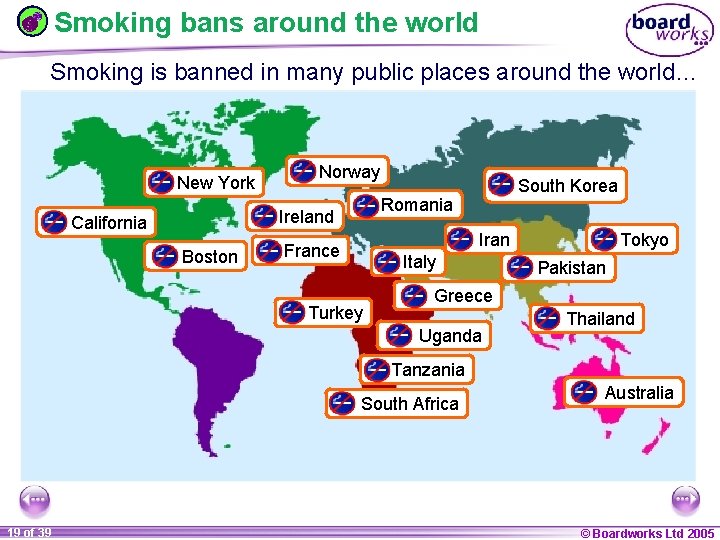
Smoking bans around the world Smoking is banned in many public places around the world… New York Norway Romania Ireland California Boston South Korea Iran France Italy Turkey Tokyo Pakistan Greece Uganda Thailand Tanzania South Africa 1 19 ofof 20 39 Australia © Boardworks Ltd 2005 2004
Smoking ban opinions 1 20 ofof 20 39 © Boardworks Ltd 2005 2004
Smoking – true or false? 1 21 ofof 20 39 © Boardworks Ltd 2005 2004
Contents 9 B Fit and Healthy Being fit and healthy Smoking Diet, alcohol and drugs Maintaining fitness Summary activities 1 22 ofof 20 39 © Boardworks Ltd 2005 2004
A balanced diet Diet is the usual food and drink that each person consumes and is a very important part of health. A balanced diet means eating the right types of food in the right amounts so that the body gets the nutrients it needs. • What are the seven nutrients needed in a balanced diet? l carbohydrates l proteins l fats l vitamins l minerals l water l fibre Why are these nutrients needed and what foods contain them? 1 23 ofof 20 39 © Boardworks Ltd 2005 2004
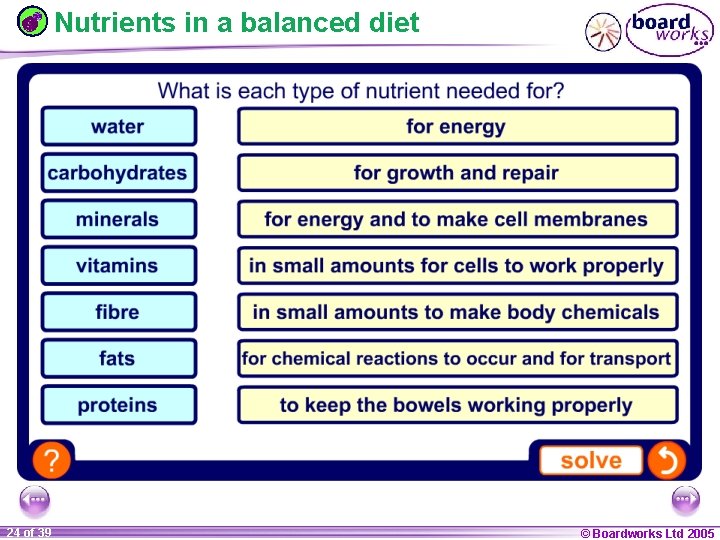
Nutrients in a balanced diet 1 24 ofof 20 39 © Boardworks Ltd 2005 2004
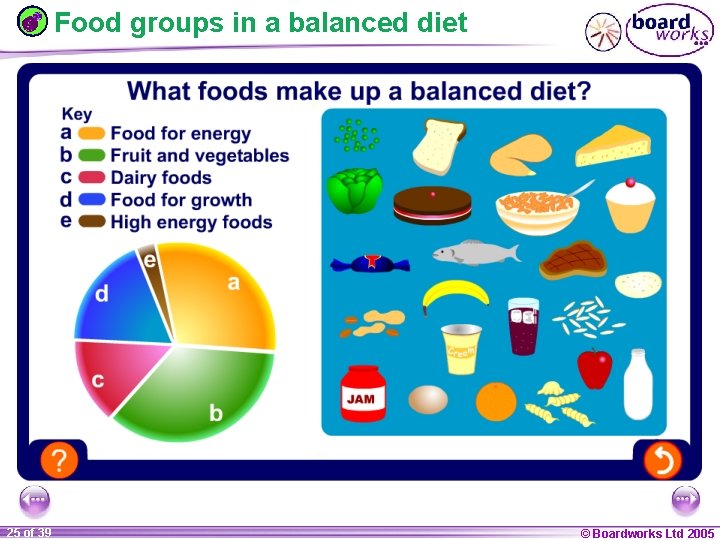
Food groups in a balanced diet 1 25 ofof 20 39 © Boardworks Ltd 2005 2004
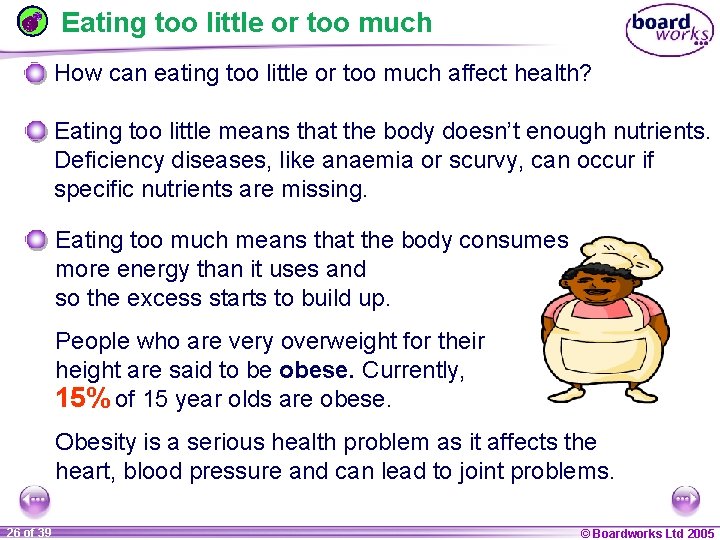
Eating too little or too much How can eating too little or too much affect health? Eating too little means that the body doesn’t enough nutrients. Deficiency diseases, like anaemia or scurvy, can occur if specific nutrients are missing. Eating too much means that the body consumes more energy than it uses and so the excess starts to build up. People who are very overweight for their height are said to be obese. Currently, 15% of 15 year olds are obese. Obesity is a serious health problem as it affects the heart, blood pressure and can lead to joint problems. 1 26 ofof 20 39 © Boardworks Ltd 2005 2004
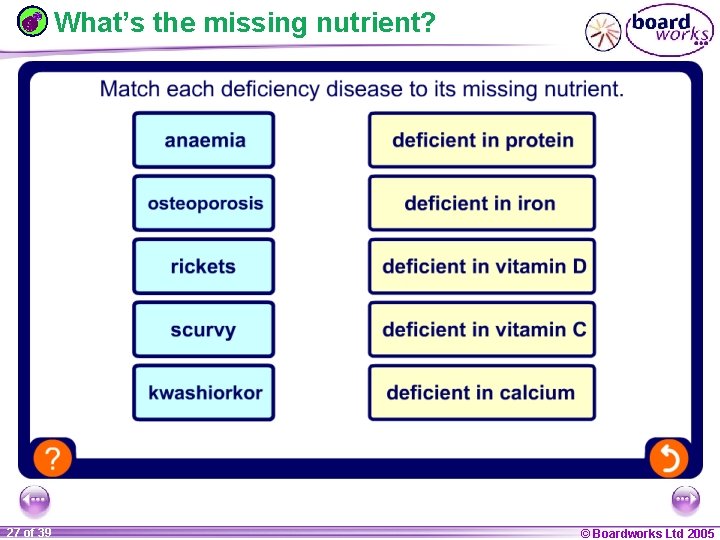
What’s the missing nutrient? 1 27 ofof 20 39 © Boardworks Ltd 2005 2004
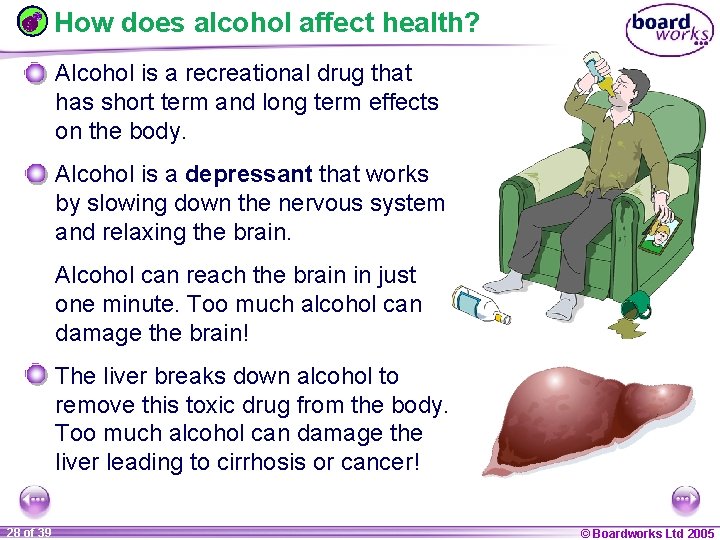
How does alcohol affect health? Alcohol is a recreational drug that has short term and long term effects on the body. Alcohol is a depressant that works by slowing down the nervous system and relaxing the brain. Alcohol can reach the brain in just one minute. Too much alcohol can damage the brain! The liver breaks down alcohol to remove this toxic drug from the body. Too much alcohol can damage the liver leading to cirrhosis or cancer! 1 28 ofof 20 39 © Boardworks Ltd 2005 2004
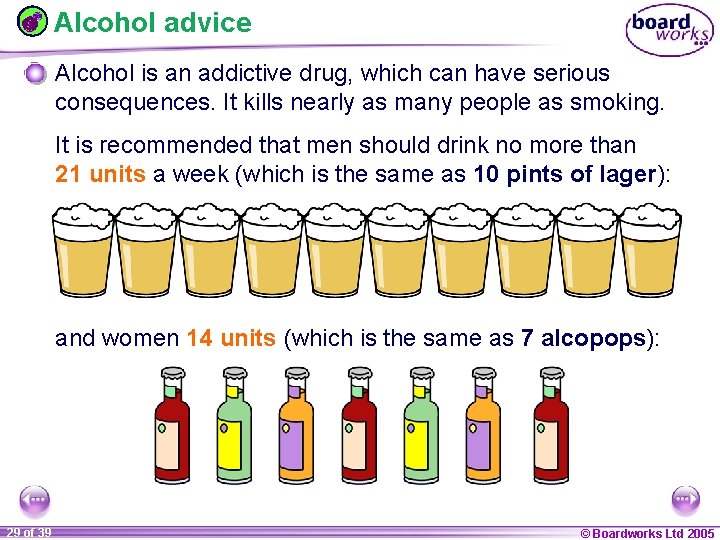
Alcohol advice Alcohol is an addictive drug, which can have serious consequences. It kills nearly as many people as smoking. It is recommended that men should drink no more than 21 units a week (which is the same as 10 pints of lager): and women 14 units (which is the same as 7 alcopops): 1 29 ofof 20 39 © Boardworks Ltd 2005 2004
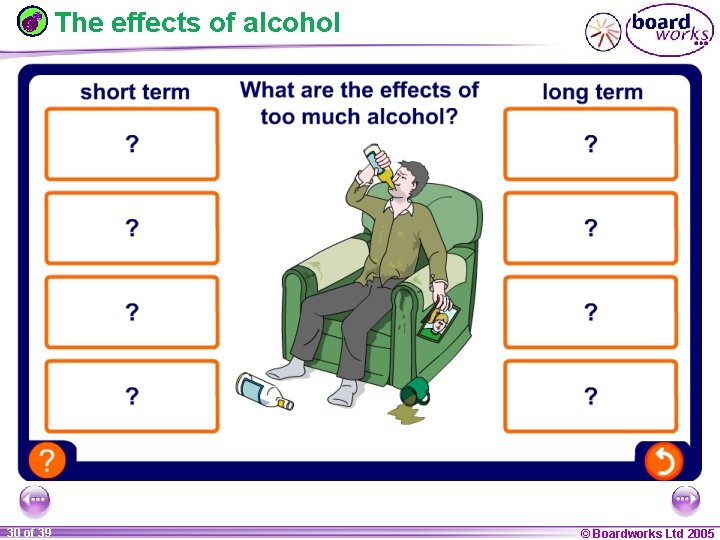
The effects of alcohol 1 30 ofof 20 39 © Boardworks Ltd 2005 2004
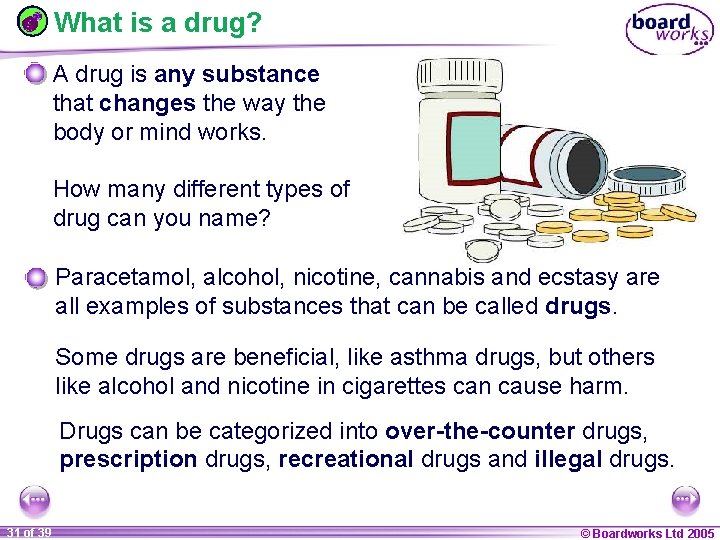
What is a drug? A drug is any substance that changes the way the body or mind works. How many different types of drug can you name? Paracetamol, alcohol, nicotine, cannabis and ecstasy are all examples of substances that can be called drugs. Some drugs are beneficial, like asthma drugs, but others like alcohol and nicotine in cigarettes can cause harm. Drugs can be categorized into over-the-counter drugs, prescription drugs, recreational drugs and illegal drugs. 1 31 ofof 20 39 © Boardworks Ltd 2005 2004
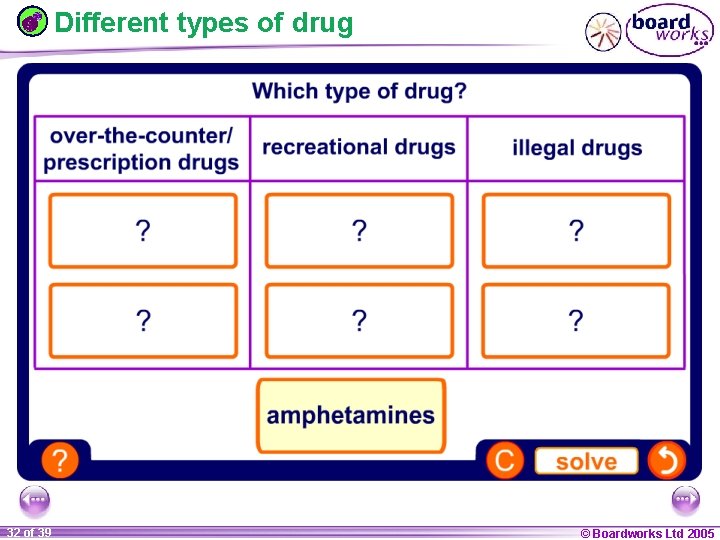
Different types of drug 1 32 ofof 20 39 © Boardworks Ltd 2005 2004
Contents 9 B Fit and Healthy Being fit and healthy Smoking Diet, alcohol and drugs Maintaining fitness Summary activities 1 33 ofof 20 39 © Boardworks Ltd 2005 2004
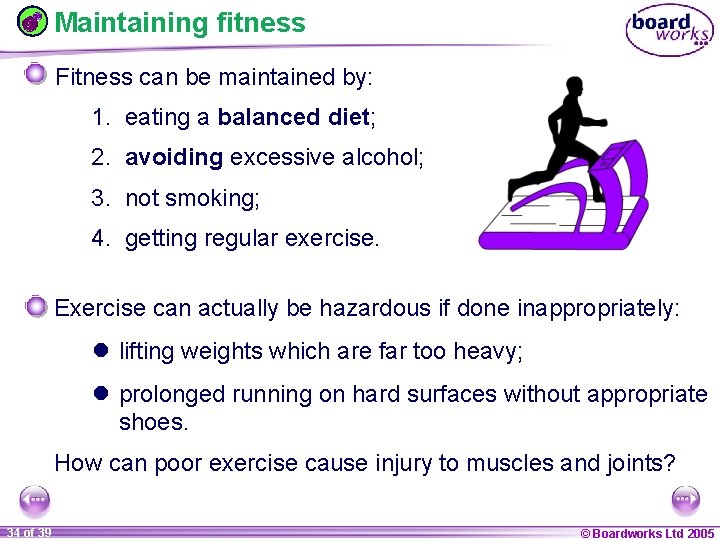
Maintaining fitness Fitness can be maintained by: 1. eating a balanced diet; 2. avoiding excessive alcohol; 3. not smoking; 4. getting regular exercise. Exercise can actually be hazardous if done inappropriately: l lifting weights which are far too heavy; l prolonged running on hard surfaces without appropriate shoes. How can poor exercise cause injury to muscles and joints? 1 34 ofof 20 39 © Boardworks Ltd 2005 2004
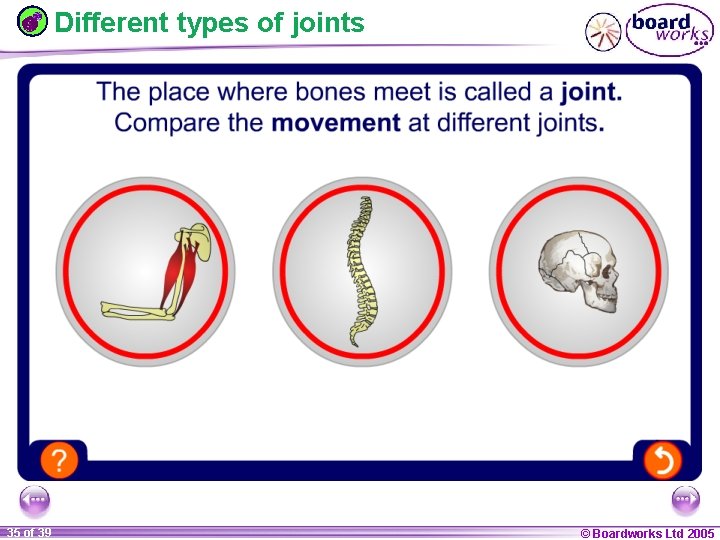
Different types of joints 1 35 ofof 20 39 © Boardworks Ltd 2005 2004
Contents 9 B Fit and Healthy Being fit and healthy Smoking Diet, alcohol and drugs Maintaining fitness Summary activities 1 36 ofof 20 39 © Boardworks Ltd 2005 2004
Glossary l alcohol – An addictive drug that acts a depressant and affects the brain and the liver. l balanced diet – Eating the right types of food in the right amounts so that the body gets the nutrients it needs. l carbon monoxide – A poisonous gas in cigarette smoke that reduces the amount of oxygen in blood. l drug – A substance that changes how the body works. l fitness – Good health or physical condition, especially as the result of exercise and proper nutrition. l nicotine – A poisonous, addictive drug in cigarettes that affects the central nervous system and heart rate. l tar – A brown, sticky chemical produced by tobacco when it burns that coats the surface of the lungs. 1 37 ofof 20 39 © Boardworks Ltd 2005 2004
Anagrams 1 38 ofof 20 39 © Boardworks Ltd 2005 2004
Multiple-choice quiz 1 39 ofof 20 39 © Boardworks Ltd 2005 2004
- Slides: 39