
KS 3 4 HOME LEARNING Sharing information safely
- Slides: 11
KS 3 -4 HOME LEARNING Sharing information safely online Play this slideshow from beginning © PSHE Association 2020 1
We are learning about online fraud and staying safe online Keywords for this session: We will be able to: describe what information should be kept private and what is safe to share online explain the risks of sharing personal information online analyse different strategies to ensure online safety © PSHE Association 2020 Fraud — illegal deception intended for financial or personal reward Identity fraud — when a fraudster uses someone else’s identity (or creates a fake identity) to access a product or service so they don’t have to pay for it themselves 2
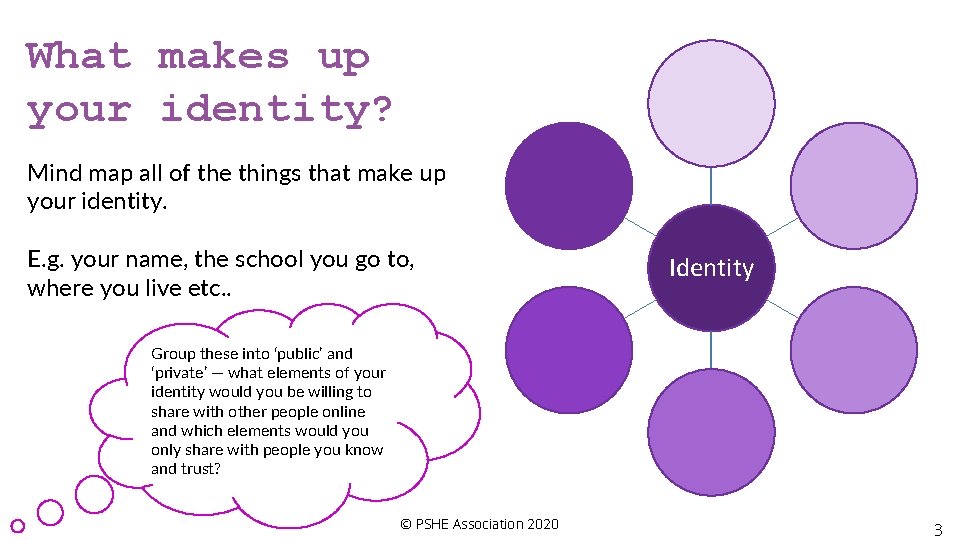
What makes up your identity? Mind map all of the things that make up your identity. E. g. your name, the school you go to, where you live etc. . Identity Group these into ‘public’ and ‘private’ — what elements of your identity would you be willing to share with other people online and which elements would you only share with people you know and trust? © PSHE Association 2020 3
How much should be shared online? How much of someone’s identity should they share online? For each statement on Worksheet 1, state whether you think the action is: - Safe - Unsafe - It depends If you’ve answered ‘it depends’, note down in what circumstances the action might be safe or unsafe. Click the image to reveal key learning points! • Always think before posting and be prepared for anyone (family, teachers, online ‘friends’, a fraudster) to see what has been uploaded. • Be wary when using public computers or accessing public Wi. Fi. • Recognise the risks of sharing too many distinguishing features, such as school logos, addresses, location, check-ins etc. as this might be used to build a picture of someone’s identity. This could be used by fraudsters or others who want to gain their trust, 'befriend’ them, or find out their location offline. © PSHE Association 2020 4
What might the consequences be of sharing personal information online? Watch the Data To Go video which shows how a hacker or fraudster might be able to access personal information online. As you watch, answer the following questions: • How did people react in this video when they were presented with their information? • What parts of their identity were the team able to find out about them? • What could these people have done to protect their information? • What do you think a fraudster would use this information for? • What might be the consequences of having this information publicly available? Read about potential consequences on the next slide… © PSHE Association 2020 5
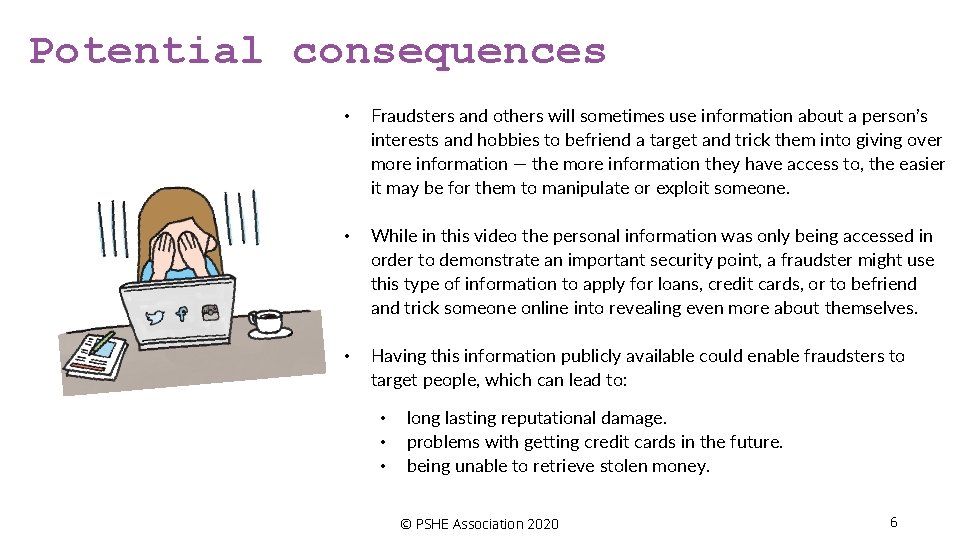
Potential consequences • Fraudsters and others will sometimes use information about a person’s interests and hobbies to befriend a target and trick them into giving over more information — the more information they have access to, the easier it may be for them to manipulate or exploit someone. • While in this video the personal information was only being accessed in order to demonstrate an important security point, a fraudster might use this type of information to apply for loans, credit cards, or to befriend and trick someone online into revealing even more about themselves. • Having this information publicly available could enable fraudsters to target people, which can lead to: • • • long lasting reputational damage. problems with getting credit cards in the future. being unable to retrieve stolen money. © PSHE Association 2020 6
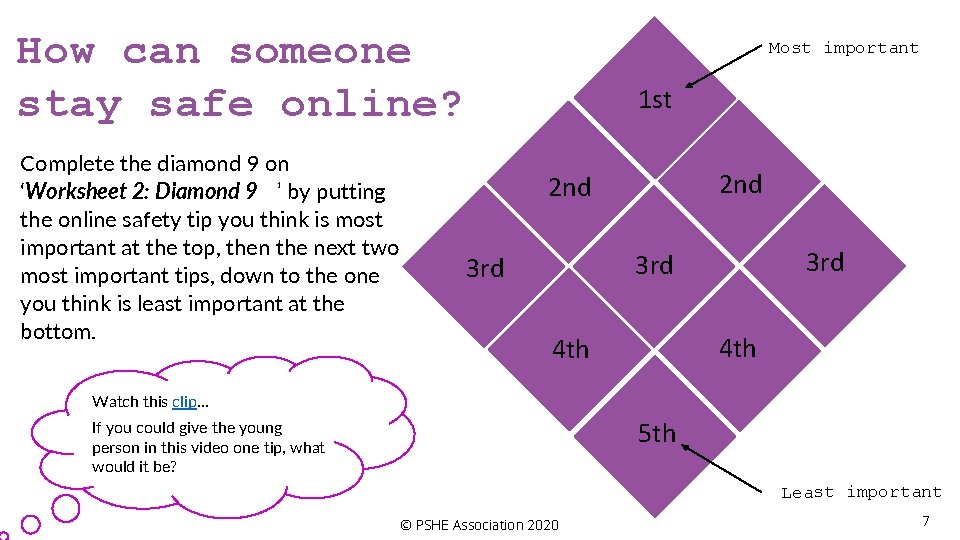
How can someone stay safe online? Complete the diamond 9 on ‘Worksheet 2: Diamond 9 ’ by putting the online safety tip you think is most important at the top, then the next two most important tips, down to the one you think is least important at the bottom. Most important 1 st 2 nd 3 rd 3 rd 4 th Watch this clip… 5 th If you could give the young person in this video one tip, what would it be? Least important © PSHE Association 2020 7
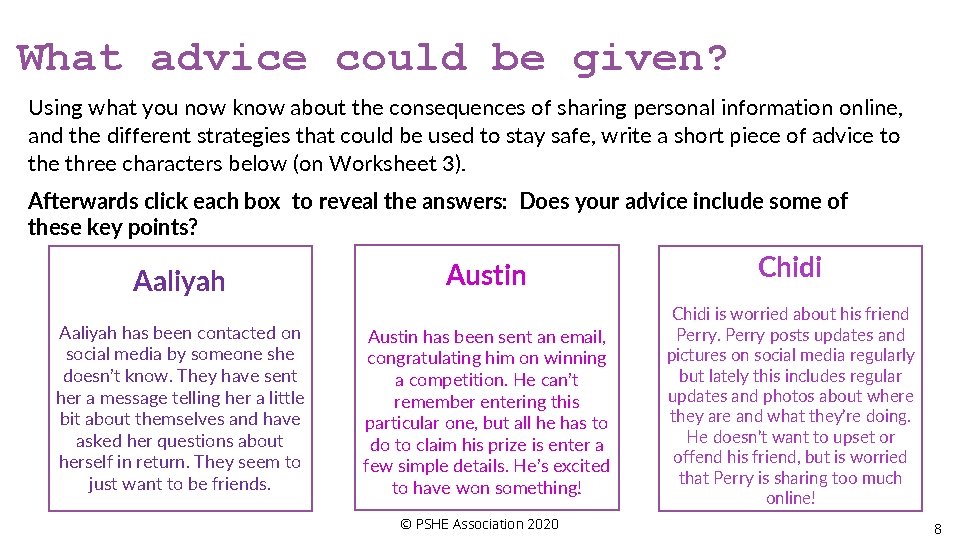
What advice could be given? Using what you now know about the consequences of sharing personal information online, and the different strategies that could be used to stay safe, write a short piece of advice to the three characters below (on Worksheet 3). Afterwards click each box to reveal the answers: Does your advice include some of these key points? Aaliyah should be careful about what is shared, both publicly and Aaliyah has been with people she doescontacted not know on face to face (even they seem she social media byif someone friendly). doesn’t know. They have sent her a message telling her a little She could change the privacy bit about themselves and have settings on her social media asked her questions about accounts so only friends, or friends return. ofherself friendsin can follow. They or likeseem posts. to just want to be friends. Austin could check that he does not have his address, email or phone number on sent any profile Austin has been an email, pages that anyone could access congratulating him on winning andause to contact him. competition. He can’t remember entering this Personal information or bank particular one, never but all hasout to details should be he given do to unknown claim hissource. prize is enter a to an few simple details. He’s excited to have won something! © PSHE Association 2020 Chidi could remind Perry that having personal information Chidi is worried about hismake friend publicly available could someone likely to be and Perrymore posts updates targeted fraudsters pictures on by social media and regularly others. but lately this includes regular updates and photos about where They regularly check their they arecould and what they’re doing. privacy settings, He doesn’t wantespecially to upset after or updates, to make sure only offend his friend, but is worried friends/friends-of-friends can that Perry is sharing too much see social media updates. online! 8
Personal reflection Using what you have learnt today, write down three things that you will aim to do in future to increase your safety online. © PSHE Association 2020 9
Further support If you’re worried about online fraud, or any aspect of online safety, you should always speak to your parent or carer or a teacher in school so they can help you. Further information and support can be found at: www. childline. org. uk www. thinkuknow. co. uk www. cifas. org. uk © PSHE Association 2020 10
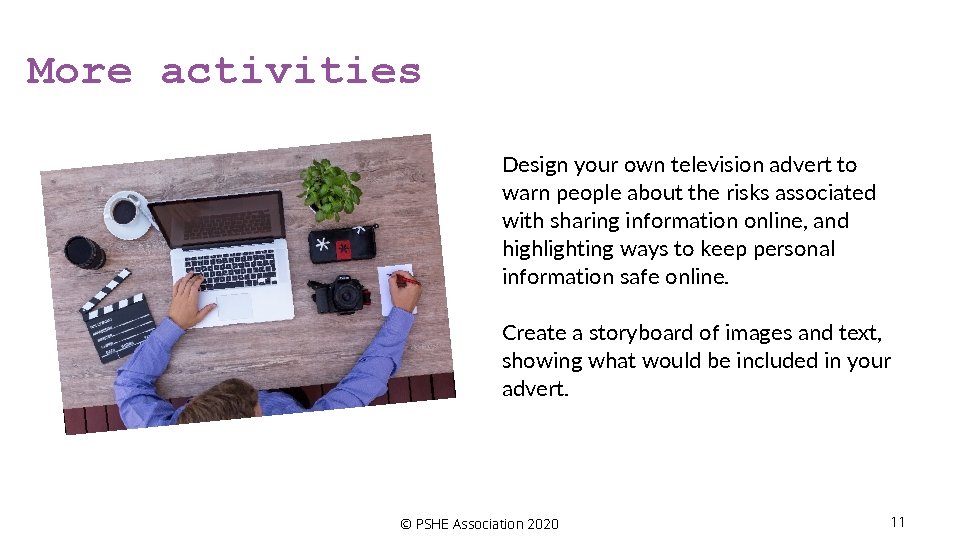
More activities Design your own television advert to warn people about the risks associated with sharing information online, and highlighting ways to keep personal information safe online. Create a storyboard of images and text, showing what would be included in your advert. © PSHE Association 2020 11