
Kruskals algorithm 1 Kruskals algorithm Kruskals algorithm Kruskals
- Slides: 49
Kruskal’s algorithm 1 Kruskal’s algorithm
Kruskal’s algorithm Kruskal’s Algorithm 2 Kruskal’s algorithm sorts the edges by weight and goes through the edges from least weight to greatest weight adding the edges to an empty graph so long as the addition does not create a cycle The halting point is: ◦ When |V| – 1 edges have been added �In this case we have a minimum spanning tree ◦ We have gone through all edges, in which case, we have a forest of minimum spanning trees on all connected sub-graphs
Kruskal’s algorithm Outline This topic covers Kruskal’s algorithm: ◦ ◦ Finding a minimum spanning tree The idea and the algorithm An example Using a disjoint set data structure 3
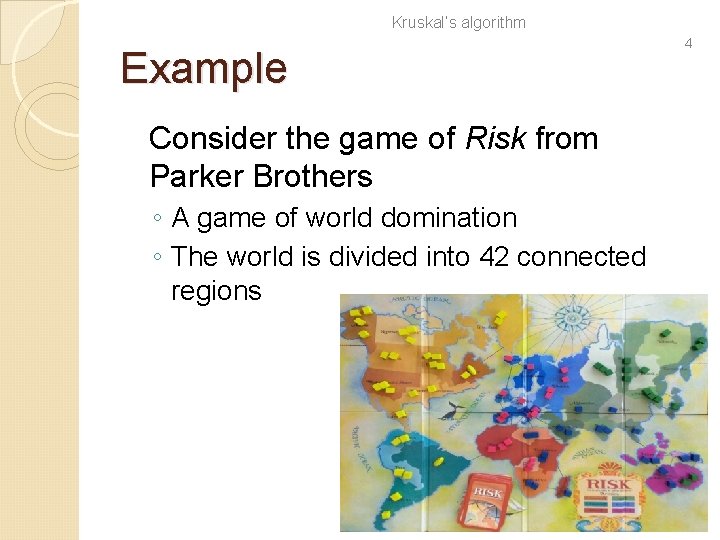
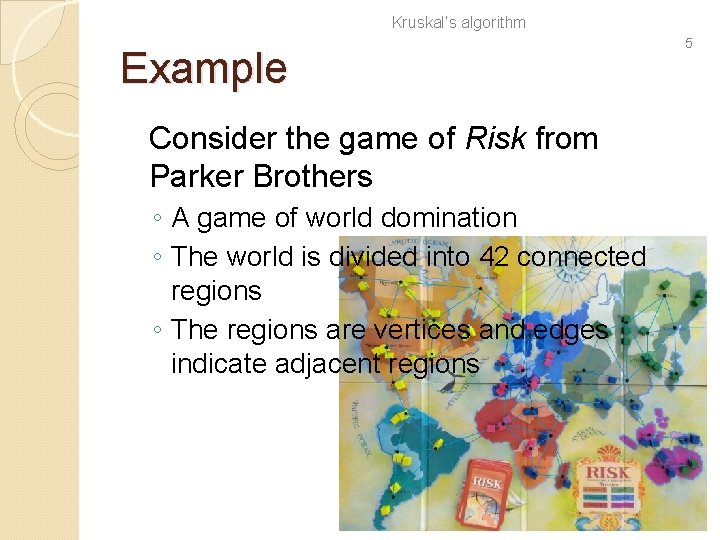
Kruskal’s algorithm Example Consider the game of Risk from Parker Brothers ◦ A game of world domination ◦ The world is divided into 42 connected regions 4
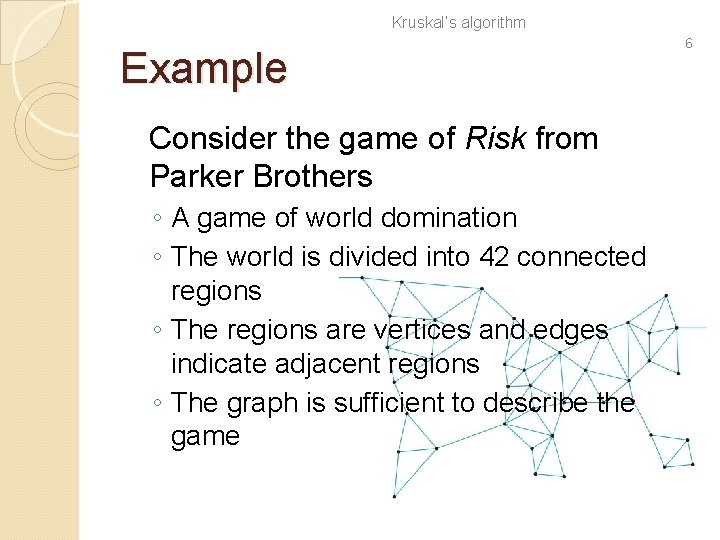
Kruskal’s algorithm Example Consider the game of Risk from Parker Brothers ◦ A game of world domination ◦ The world is divided into 42 connected regions ◦ The regions are vertices and edges indicate adjacent regions 5
Kruskal’s algorithm Example Consider the game of Risk from Parker Brothers ◦ A game of world domination ◦ The world is divided into 42 connected regions ◦ The regions are vertices and edges indicate adjacent regions ◦ The graph is sufficient to describe the game 6
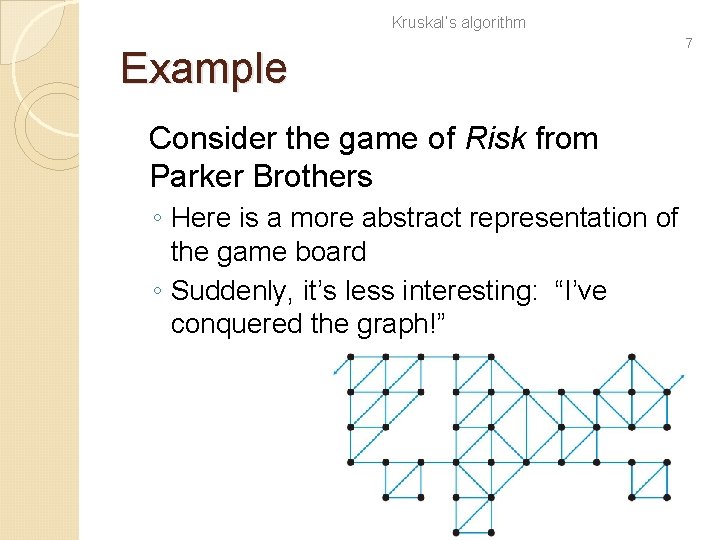
Kruskal’s algorithm Example Consider the game of Risk from Parker Brothers ◦ Here is a more abstract representation of the game board ◦ Suddenly, it’s less interesting: “I’ve conquered the graph!” 7
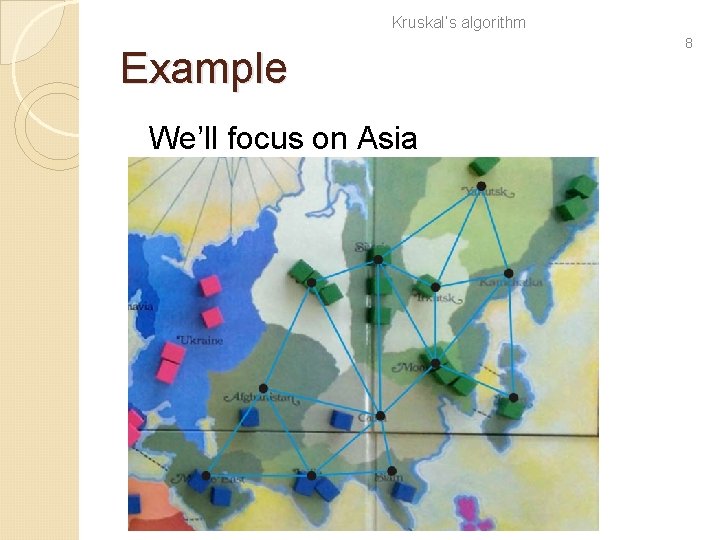
Kruskal’s algorithm Example We’ll focus on Asia 8
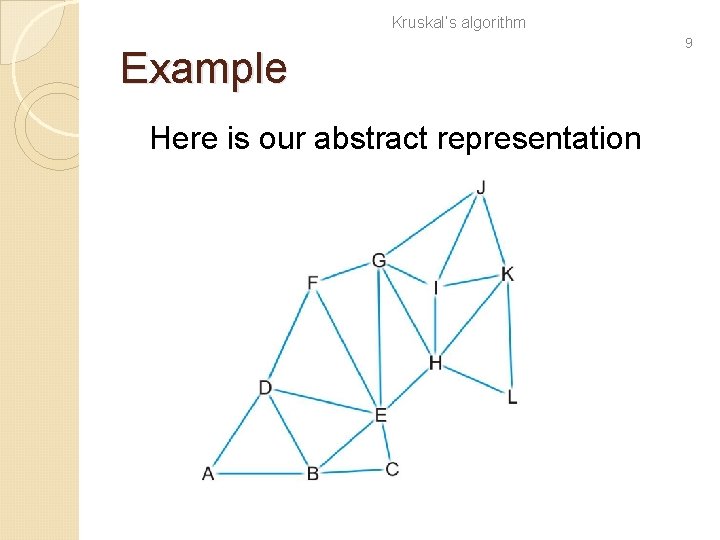
Kruskal’s algorithm Example Here is our abstract representation 9
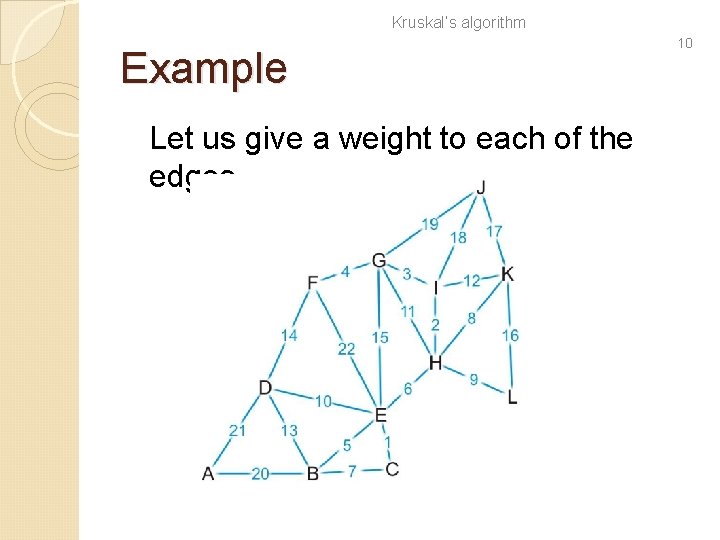
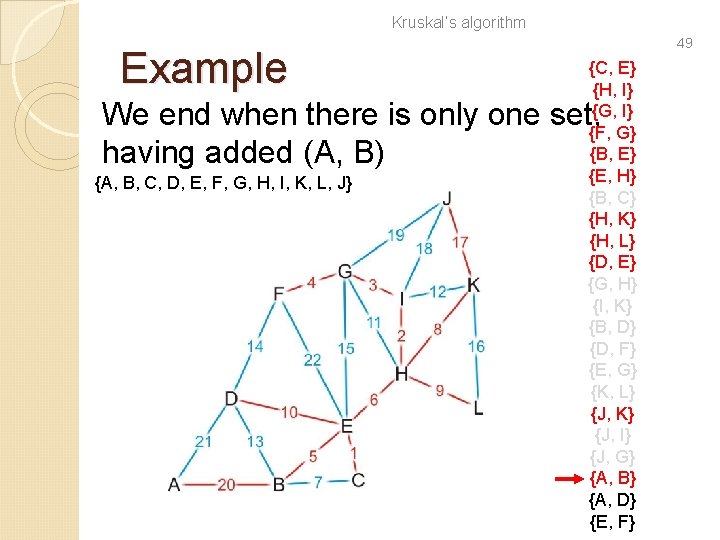
Kruskal’s algorithm Example Let us give a weight to each of the edges 10
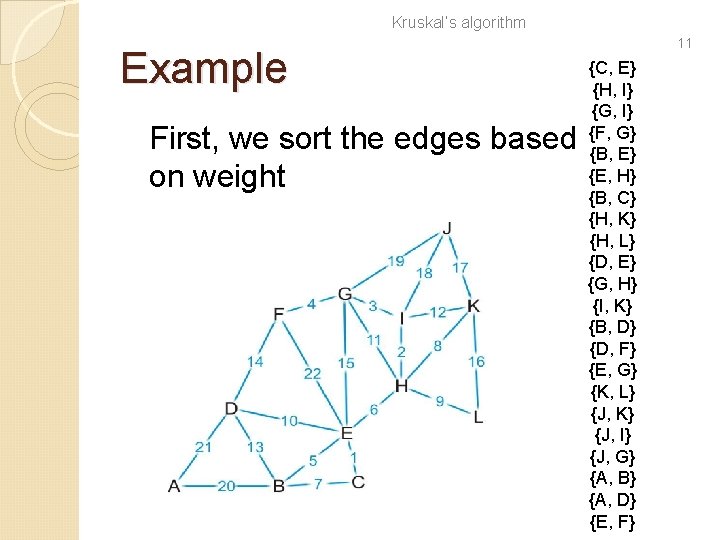
Kruskal’s algorithm Example First, we sort the edges based on weight 11 {C, E} {H, I} {G, I} {F, G} {B, E} {E, H} {B, C} {H, K} {H, L} {D, E} {G, H} {I, K} {B, D} {D, F} {E, G} {K, L} {J, K} {J, I} {J, G} {A, B} {A, D} {E, F}
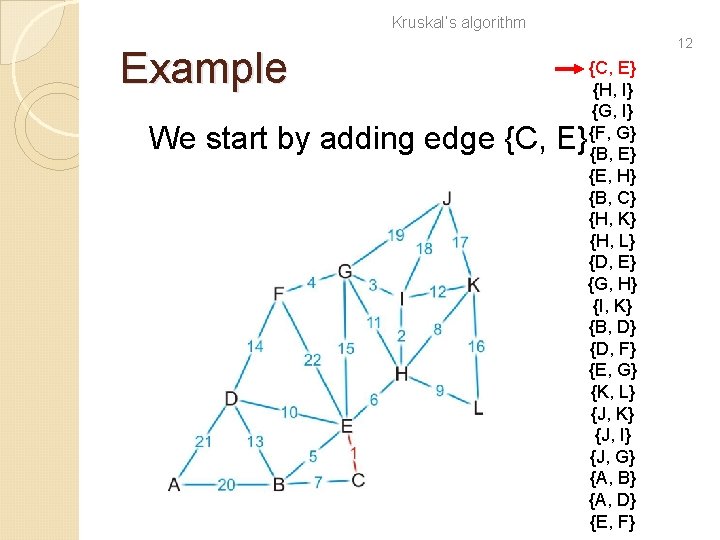
Kruskal’s algorithm Example We start by adding edge {C, E} 12 {C, E} {H, I} {G, I} {F, G} {B, E} {E, H} {B, C} {H, K} {H, L} {D, E} {G, H} {I, K} {B, D} {D, F} {E, G} {K, L} {J, K} {J, I} {J, G} {A, B} {A, D} {E, F}
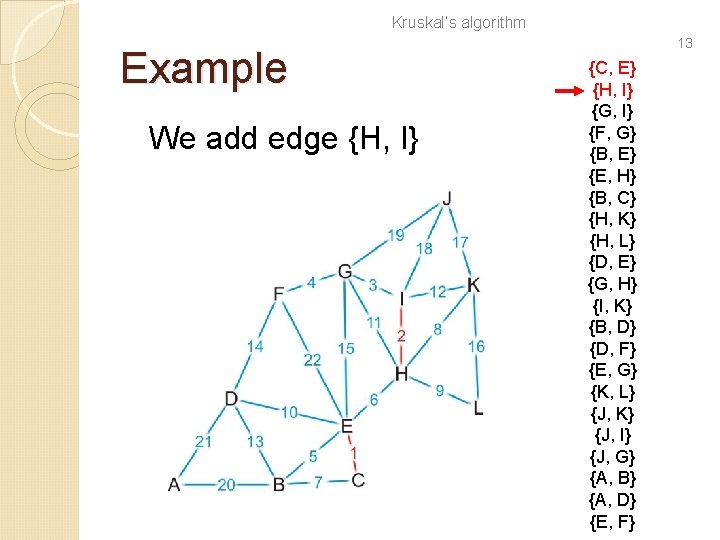
Kruskal’s algorithm Example We add edge {H, I} 13 {C, E} {H, I} {G, I} {F, G} {B, E} {E, H} {B, C} {H, K} {H, L} {D, E} {G, H} {I, K} {B, D} {D, F} {E, G} {K, L} {J, K} {J, I} {J, G} {A, B} {A, D} {E, F}
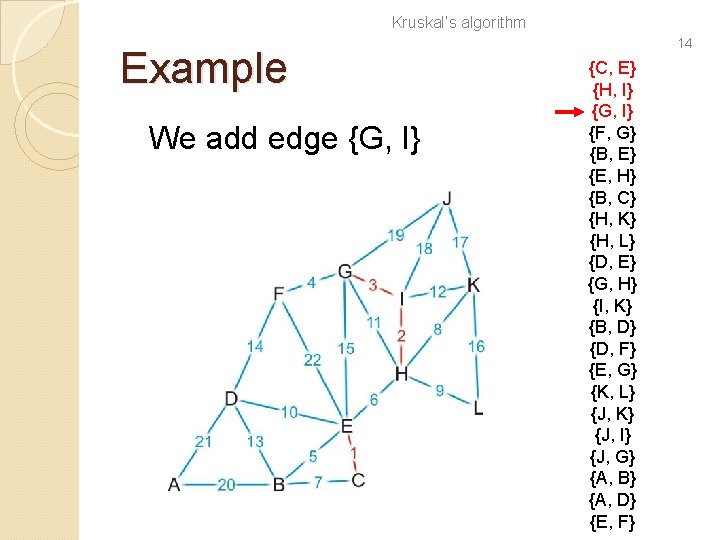
Kruskal’s algorithm Example We add edge {G, I} 14 {C, E} {H, I} {G, I} {F, G} {B, E} {E, H} {B, C} {H, K} {H, L} {D, E} {G, H} {I, K} {B, D} {D, F} {E, G} {K, L} {J, K} {J, I} {J, G} {A, B} {A, D} {E, F}
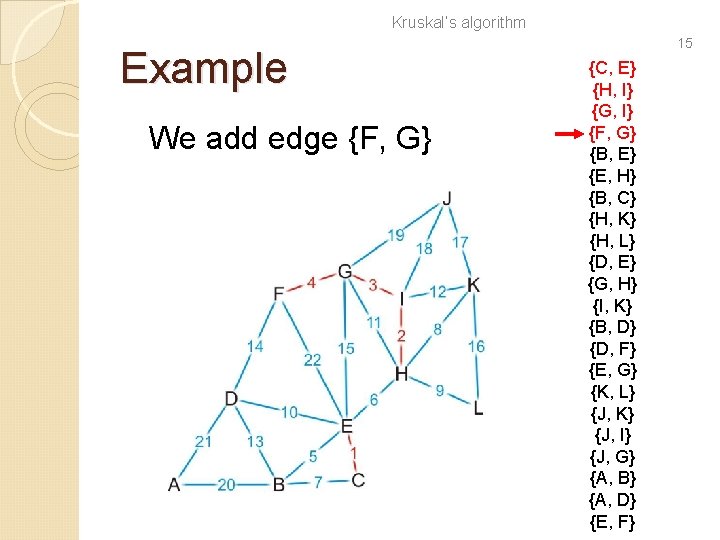
Kruskal’s algorithm Example We add edge {F, G} 15 {C, E} {H, I} {G, I} {F, G} {B, E} {E, H} {B, C} {H, K} {H, L} {D, E} {G, H} {I, K} {B, D} {D, F} {E, G} {K, L} {J, K} {J, I} {J, G} {A, B} {A, D} {E, F}
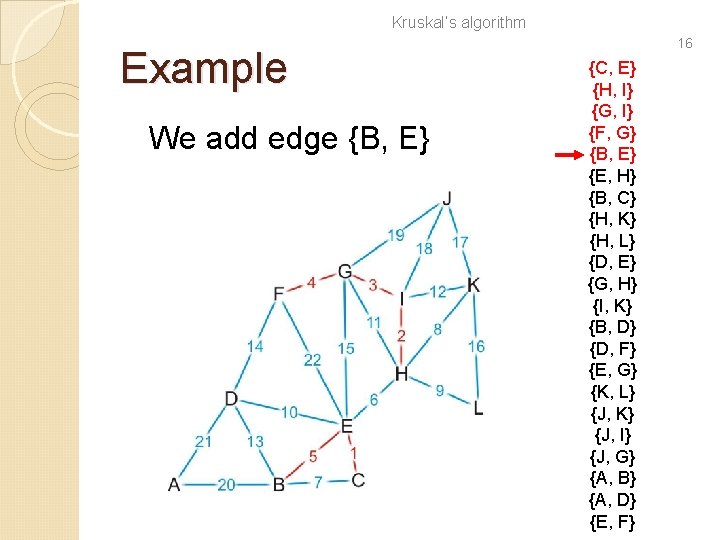
Kruskal’s algorithm Example We add edge {B, E} 16 {C, E} {H, I} {G, I} {F, G} {B, E} {E, H} {B, C} {H, K} {H, L} {D, E} {G, H} {I, K} {B, D} {D, F} {E, G} {K, L} {J, K} {J, I} {J, G} {A, B} {A, D} {E, F}
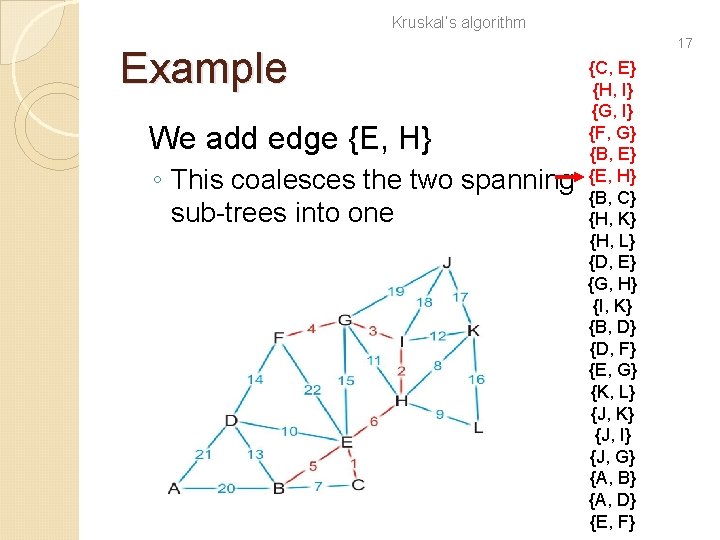
Kruskal’s algorithm Example We add edge {E, H} ◦ This coalesces the two spanning sub-trees into one 17 {C, E} {H, I} {G, I} {F, G} {B, E} {E, H} {B, C} {H, K} {H, L} {D, E} {G, H} {I, K} {B, D} {D, F} {E, G} {K, L} {J, K} {J, I} {J, G} {A, B} {A, D} {E, F}
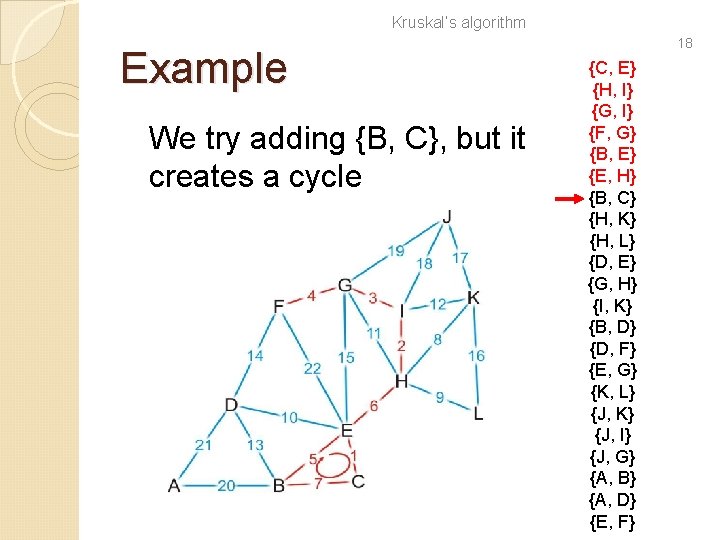
Kruskal’s algorithm Example We try adding {B, C}, but it creates a cycle 18 {C, E} {H, I} {G, I} {F, G} {B, E} {E, H} {B, C} {H, K} {H, L} {D, E} {G, H} {I, K} {B, D} {D, F} {E, G} {K, L} {J, K} {J, I} {J, G} {A, B} {A, D} {E, F}
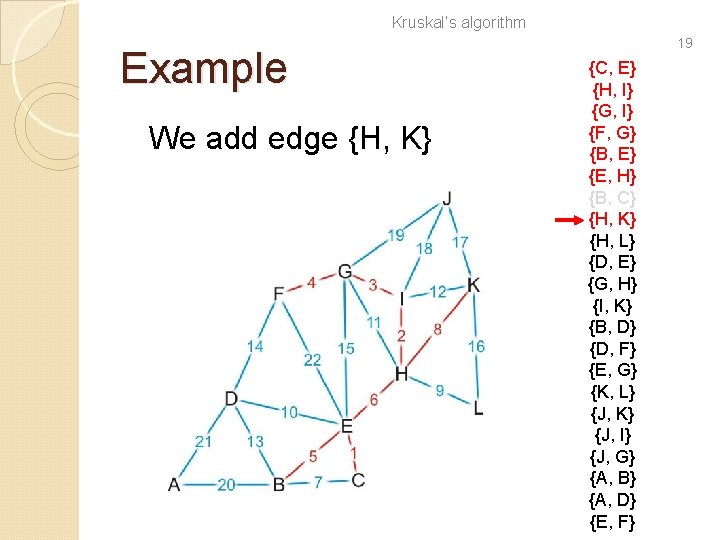
Kruskal’s algorithm Example We add edge {H, K} 19 {C, E} {H, I} {G, I} {F, G} {B, E} {E, H} {B, C} {H, K} {H, L} {D, E} {G, H} {I, K} {B, D} {D, F} {E, G} {K, L} {J, K} {J, I} {J, G} {A, B} {A, D} {E, F}
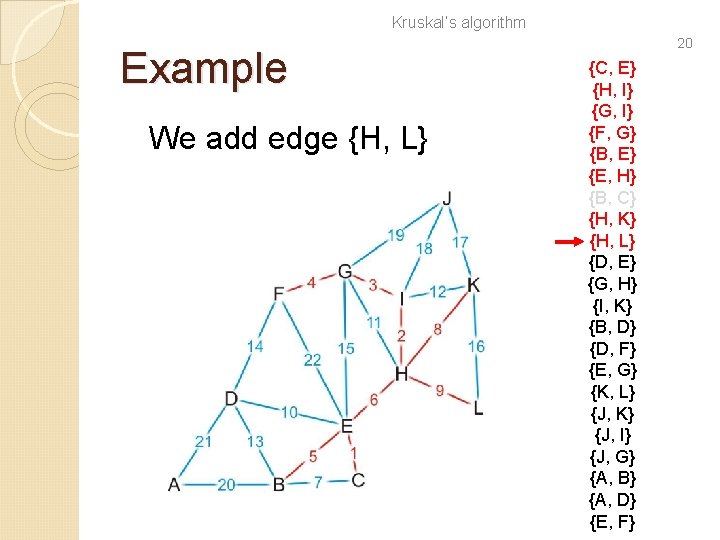
Kruskal’s algorithm Example We add edge {H, L} 20 {C, E} {H, I} {G, I} {F, G} {B, E} {E, H} {B, C} {H, K} {H, L} {D, E} {G, H} {I, K} {B, D} {D, F} {E, G} {K, L} {J, K} {J, I} {J, G} {A, B} {A, D} {E, F}
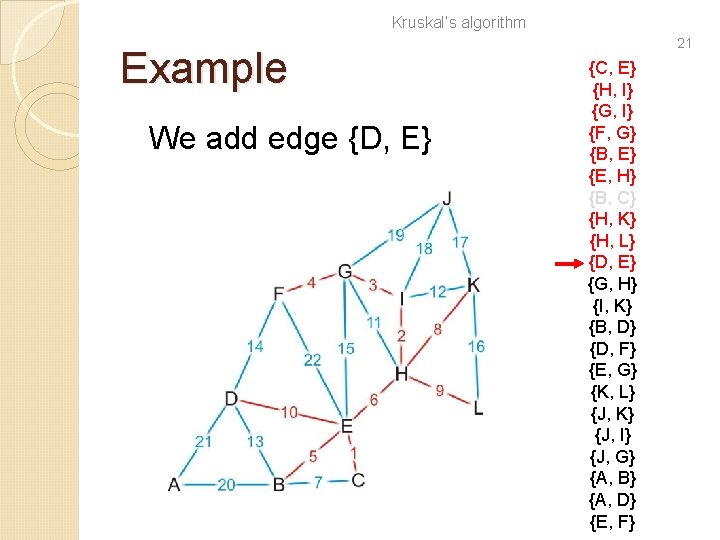
Kruskal’s algorithm Example We add edge {D, E} 21 {C, E} {H, I} {G, I} {F, G} {B, E} {E, H} {B, C} {H, K} {H, L} {D, E} {G, H} {I, K} {B, D} {D, F} {E, G} {K, L} {J, K} {J, I} {J, G} {A, B} {A, D} {E, F}
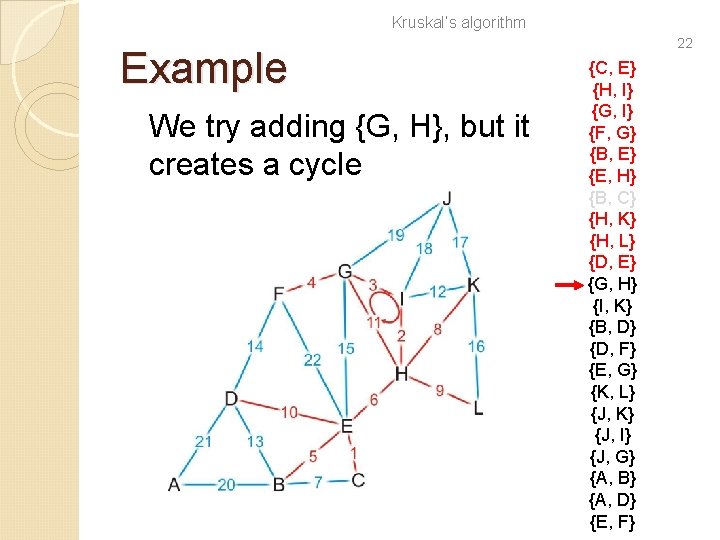
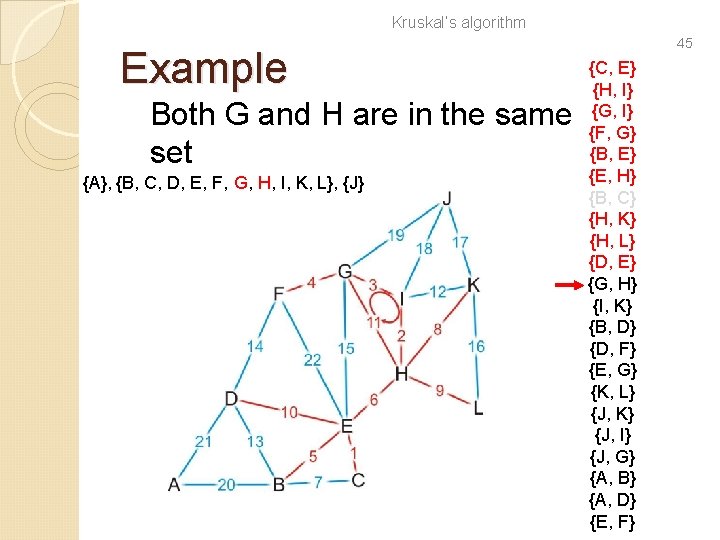
Kruskal’s algorithm Example We try adding {G, H}, but it creates a cycle 22 {C, E} {H, I} {G, I} {F, G} {B, E} {E, H} {B, C} {H, K} {H, L} {D, E} {G, H} {I, K} {B, D} {D, F} {E, G} {K, L} {J, K} {J, I} {J, G} {A, B} {A, D} {E, F}
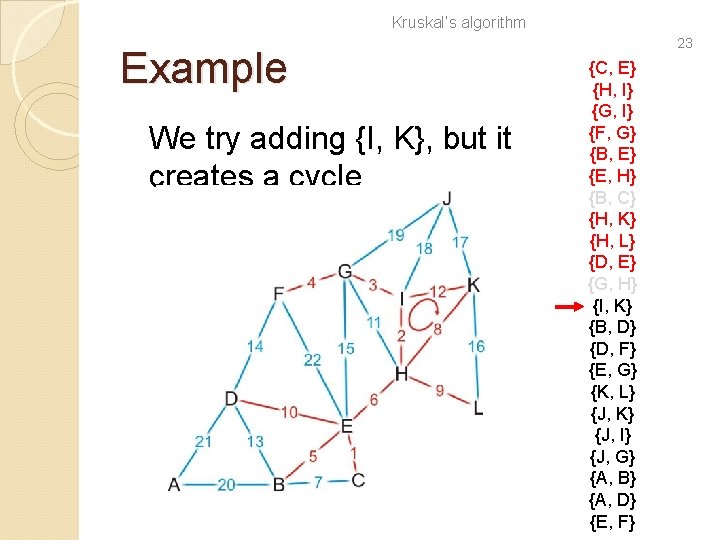
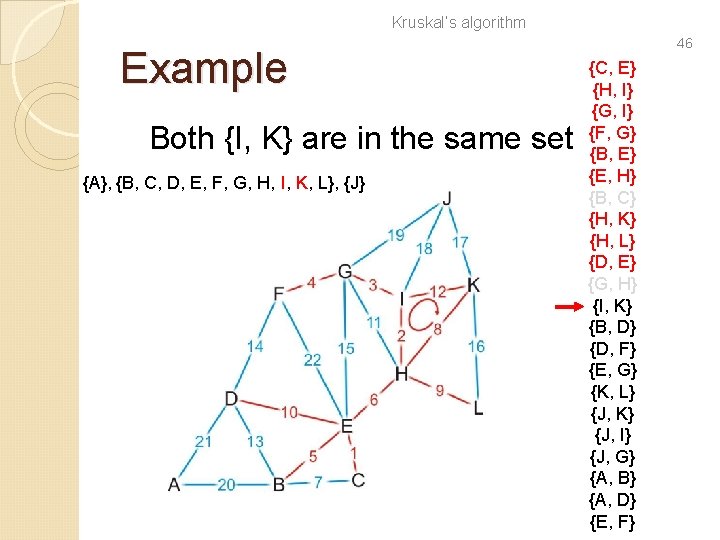
Kruskal’s algorithm Example We try adding {I, K}, but it creates a cycle 23 {C, E} {H, I} {G, I} {F, G} {B, E} {E, H} {B, C} {H, K} {H, L} {D, E} {G, H} {I, K} {B, D} {D, F} {E, G} {K, L} {J, K} {J, I} {J, G} {A, B} {A, D} {E, F}
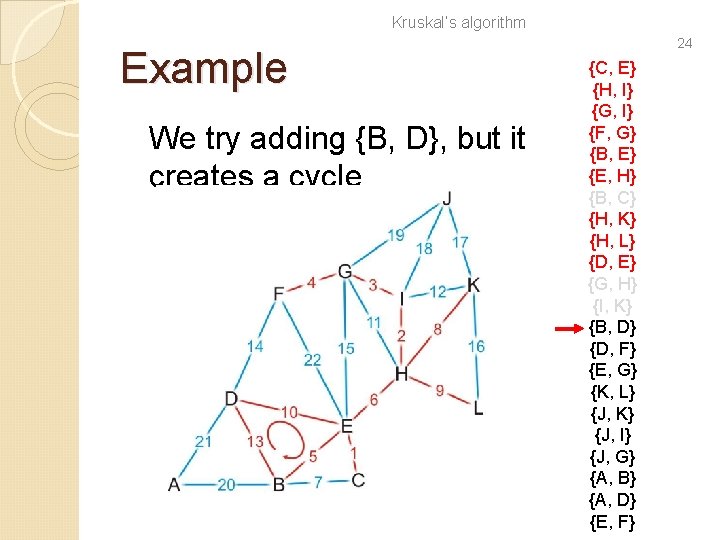
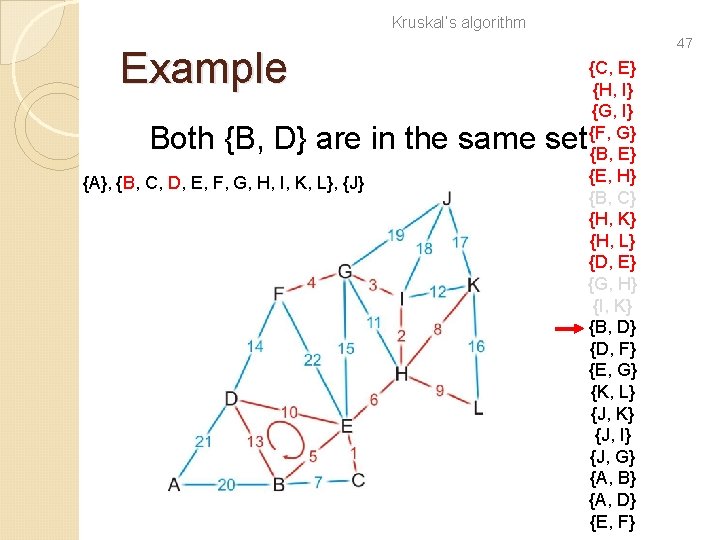
Kruskal’s algorithm Example We try adding {B, D}, but it creates a cycle 24 {C, E} {H, I} {G, I} {F, G} {B, E} {E, H} {B, C} {H, K} {H, L} {D, E} {G, H} {I, K} {B, D} {D, F} {E, G} {K, L} {J, K} {J, I} {J, G} {A, B} {A, D} {E, F}
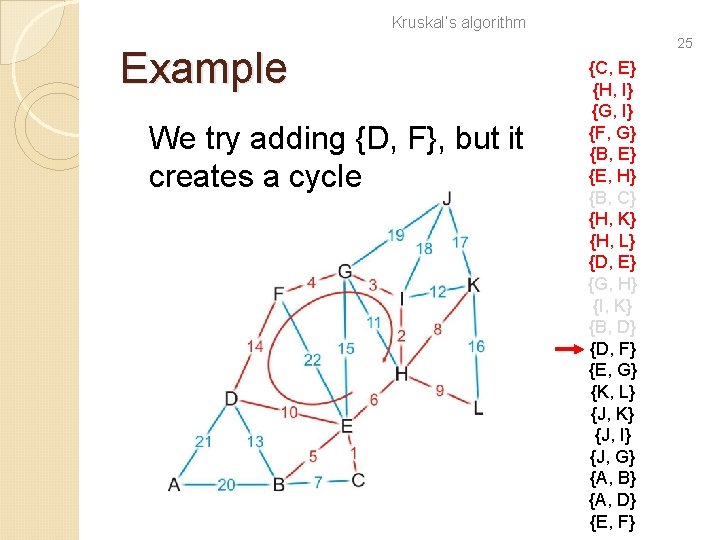
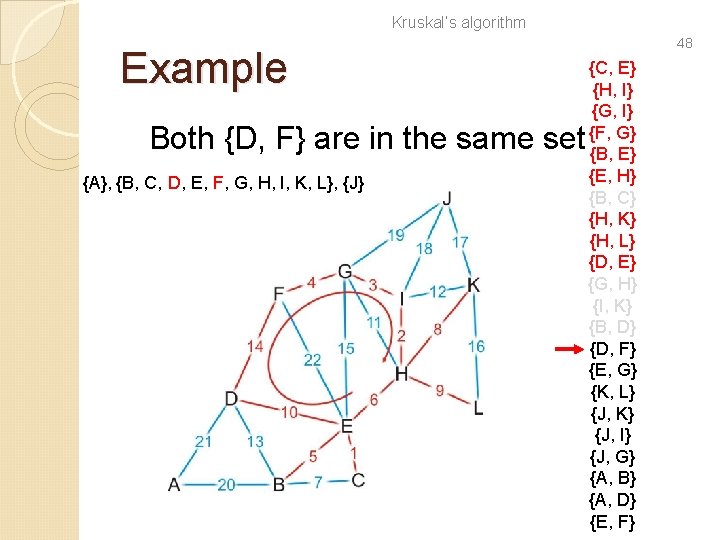
Kruskal’s algorithm Example We try adding {D, F}, but it creates a cycle 25 {C, E} {H, I} {G, I} {F, G} {B, E} {E, H} {B, C} {H, K} {H, L} {D, E} {G, H} {I, K} {B, D} {D, F} {E, G} {K, L} {J, K} {J, I} {J, G} {A, B} {A, D} {E, F}
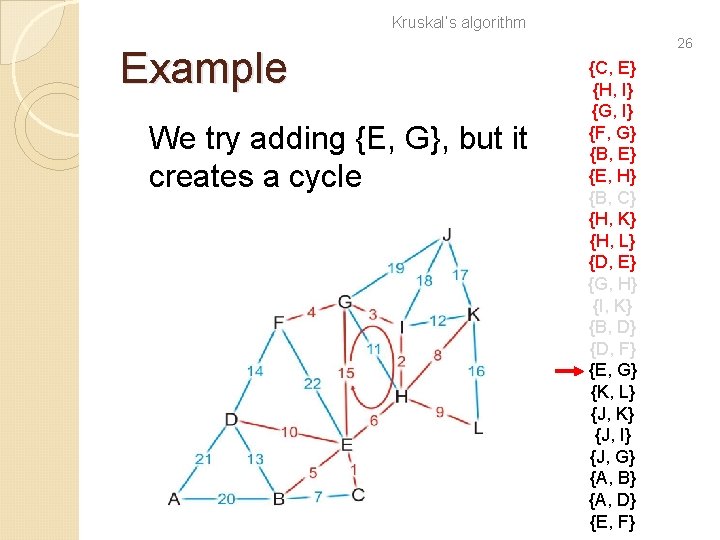
Kruskal’s algorithm Example We try adding {E, G}, but it creates a cycle 26 {C, E} {H, I} {G, I} {F, G} {B, E} {E, H} {B, C} {H, K} {H, L} {D, E} {G, H} {I, K} {B, D} {D, F} {E, G} {K, L} {J, K} {J, I} {J, G} {A, B} {A, D} {E, F}
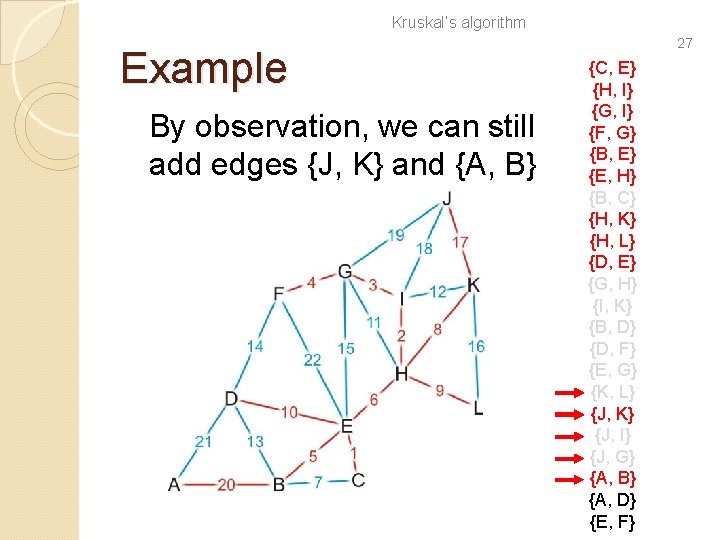
Kruskal’s algorithm Example By observation, we can still add edges {J, K} and {A, B} 27 {C, E} {H, I} {G, I} {F, G} {B, E} {E, H} {B, C} {H, K} {H, L} {D, E} {G, H} {I, K} {B, D} {D, F} {E, G} {K, L} {J, K} {J, I} {J, G} {A, B} {A, D} {E, F}
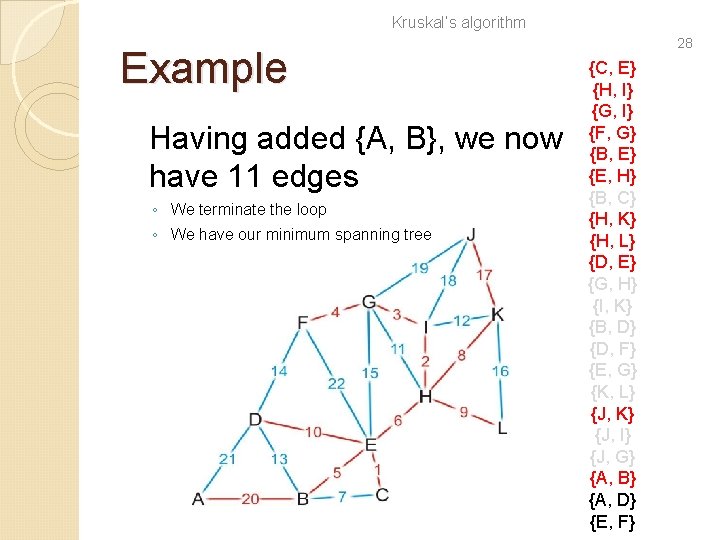
Kruskal’s algorithm Example Having added {A, B}, we now have 11 edges ◦ We terminate the loop ◦ We have our minimum spanning tree 28 {C, E} {H, I} {G, I} {F, G} {B, E} {E, H} {B, C} {H, K} {H, L} {D, E} {G, H} {I, K} {B, D} {D, F} {E, G} {K, L} {J, K} {J, I} {J, G} {A, B} {A, D} {E, F}
Kruskal’s algorithm Analysis 29 Implementation ◦ We would store the edges and their weights in an array ◦ We would sort the edges using either quicksort or some distribution sort ◦ To determine if a cycle is created, we could perform a traversal � A run-time of O(|V|) ◦ Consequently, the run-time would be O(|E| ln(|E|) + |E|·|V|) ◦ However, |E| = O(|V|2), so ln(E) = O(ln(|V|2)) = O(2 ln(|V|)) = O(ln(|V|)) ◦ Consequently, the run-time would be O(|E| ln(|V|) + |E||V|) = O(|E|·|V|) The critical operation is determining if two vertices are connected
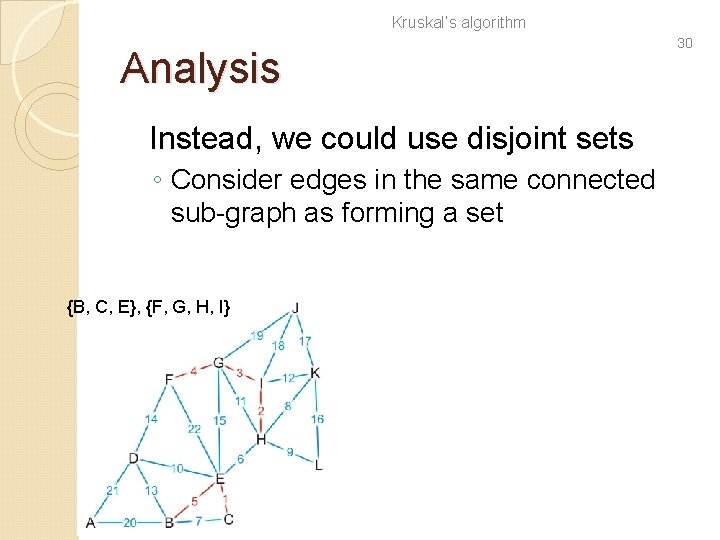
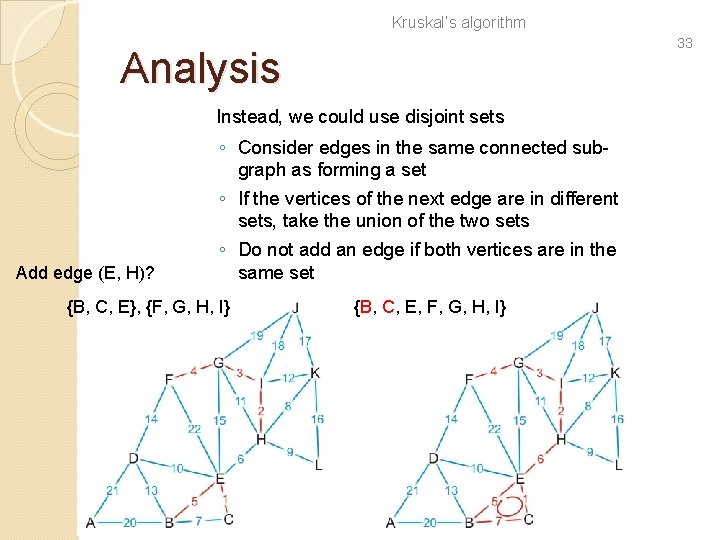
Kruskal’s algorithm Analysis Instead, we could use disjoint sets ◦ Consider edges in the same connected sub-graph as forming a set {B, C, E}, {F, G, H, I} 30
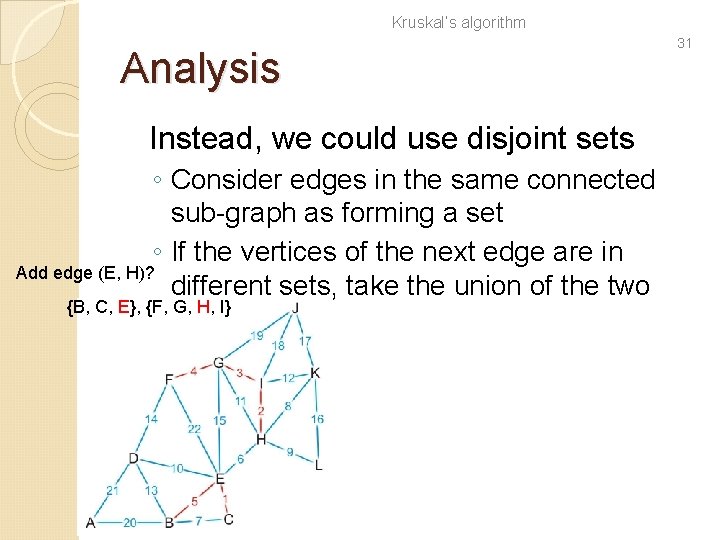
Kruskal’s algorithm Analysis Instead, we could use disjoint sets ◦ Consider edges in the same connected sub-graph as forming a set ◦ If the vertices of the next edge are in Add edge (E, H)? different sets, take the union of the two {B, C, E}, {F, G, H, I} sets 31
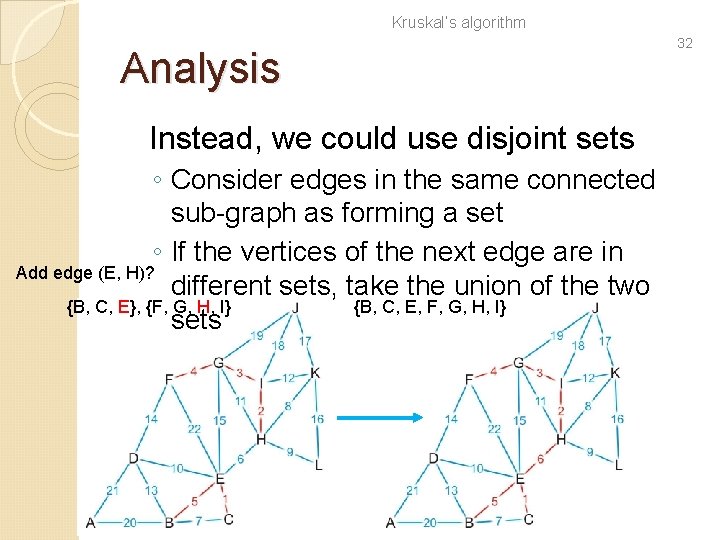
Kruskal’s algorithm Analysis Instead, we could use disjoint sets ◦ Consider edges in the same connected sub-graph as forming a set ◦ If the vertices of the next edge are in Add edge (E, H)? different sets, take the union of the two {B, C, E}, {F, G, H, I} {B, C, E, F, G, H, I} sets 32
Kruskal’s algorithm 33 Analysis Instead, we could use disjoint sets Add edge (E, H)? ◦ Consider edges in the same connected subgraph as forming a set ◦ If the vertices of the next edge are in different sets, take the union of the two sets ◦ Do not add an edge if both vertices are in the same set {B, C, E}, {F, G, H, I} {B, C, E, F, G, H, I}
Kruskal’s algorithm Analysis 34 The disjoint set data structure has the following average run-times: ◦ Checking if two vertices are in the same set is Q(a(|V|)) ◦ Taking the union of two disjoint sets is Q(a(|V|)) ◦ For all possible sizes of |V|, a(|V|) = Q(1)
Kruskal’s algorithm Analysis 35 Thus, checking and building the minimum spanning tree is now O(|E|) The dominant time is now the time required to sort the edges: ◦ Using quicksort, the run-time is O(|E| ln(|E|)) = O(|E| ln(|V|)) ◦ If there is an efficient Q(|E|) sorting algorithm, the run-time is then Q(|E|)
Kruskal’s algorithm Example 36 Going through the example again with disjoint sets
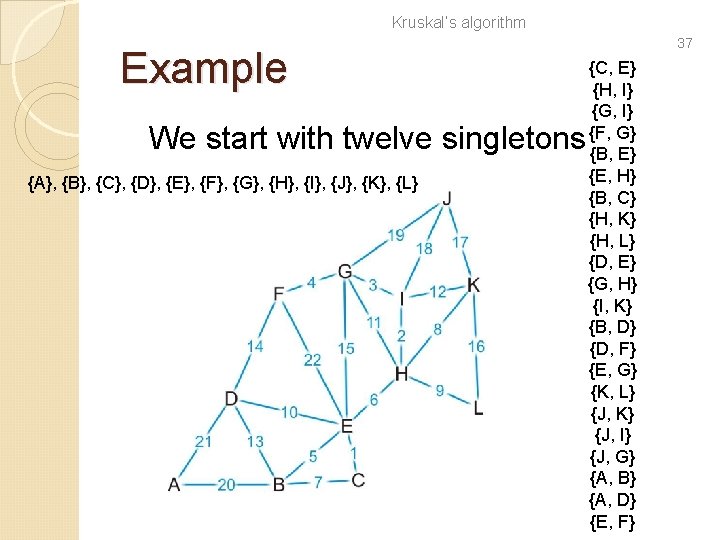
Kruskal’s algorithm Example We start with twelve singletons {A}, {B}, {C}, {D}, {E}, {F}, {G}, {H}, {I}, {J}, {K}, {L} 37 {C, E} {H, I} {G, I} {F, G} {B, E} {E, H} {B, C} {H, K} {H, L} {D, E} {G, H} {I, K} {B, D} {D, F} {E, G} {K, L} {J, K} {J, I} {J, G} {A, B} {A, D} {E, F}
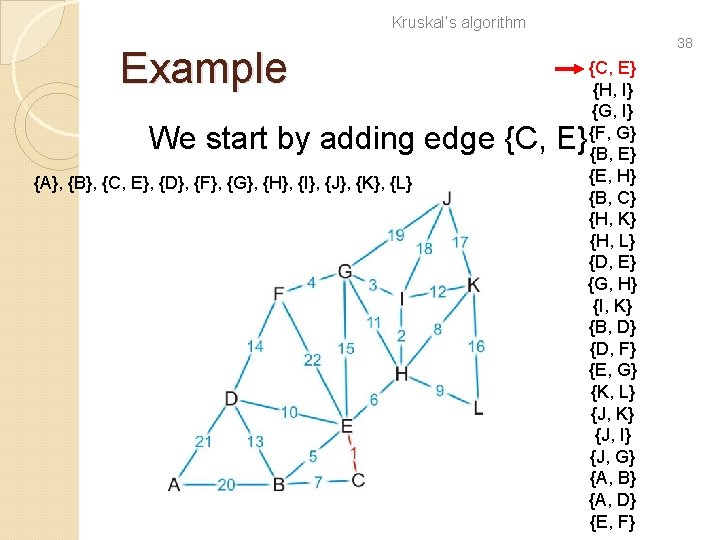
Kruskal’s algorithm Example We start by adding edge {C, E} {A}, {B}, {C, E}, {D}, {F}, {G}, {H}, {I}, {J}, {K}, {L} 38 {C, E} {H, I} {G, I} {F, G} {B, E} {E, H} {B, C} {H, K} {H, L} {D, E} {G, H} {I, K} {B, D} {D, F} {E, G} {K, L} {J, K} {J, I} {J, G} {A, B} {A, D} {E, F}
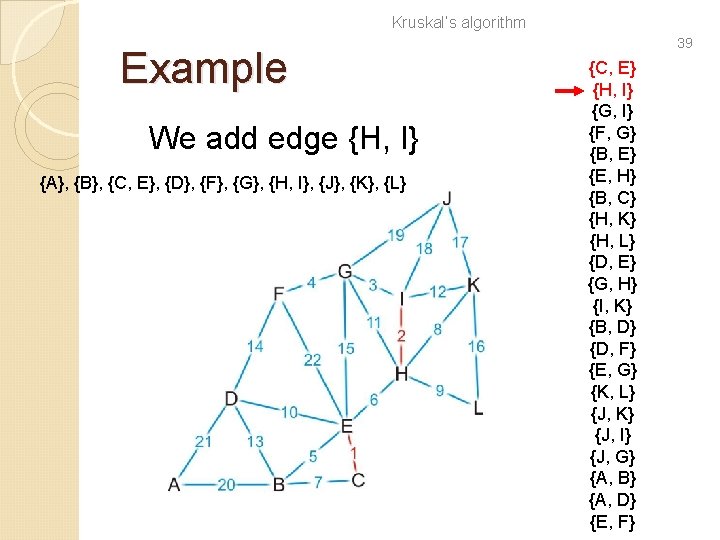
Kruskal’s algorithm Example We add edge {H, I} {A}, {B}, {C, E}, {D}, {F}, {G}, {H, I}, {J}, {K}, {L} 39 {C, E} {H, I} {G, I} {F, G} {B, E} {E, H} {B, C} {H, K} {H, L} {D, E} {G, H} {I, K} {B, D} {D, F} {E, G} {K, L} {J, K} {J, I} {J, G} {A, B} {A, D} {E, F}
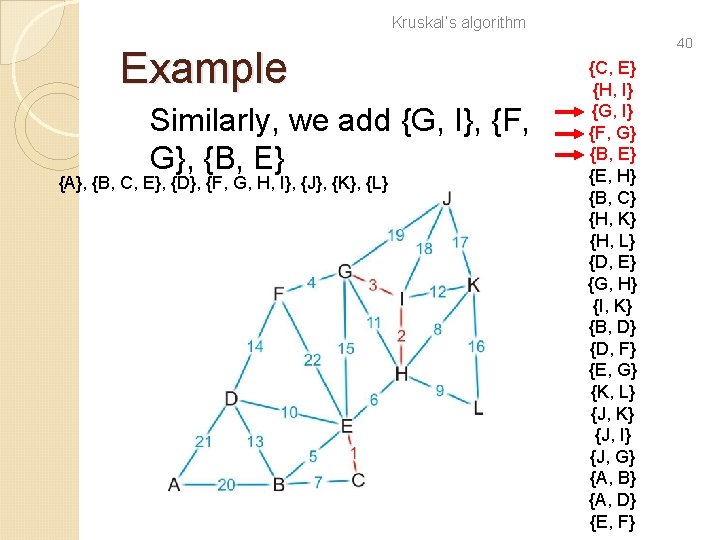
Kruskal’s algorithm Example Similarly, we add {G, I}, {F, G}, {B, E} {A}, {B, C, E}, {D}, {F, G, H, I}, {J}, {K}, {L} 40 {C, E} {H, I} {G, I} {F, G} {B, E} {E, H} {B, C} {H, K} {H, L} {D, E} {G, H} {I, K} {B, D} {D, F} {E, G} {K, L} {J, K} {J, I} {J, G} {A, B} {A, D} {E, F}
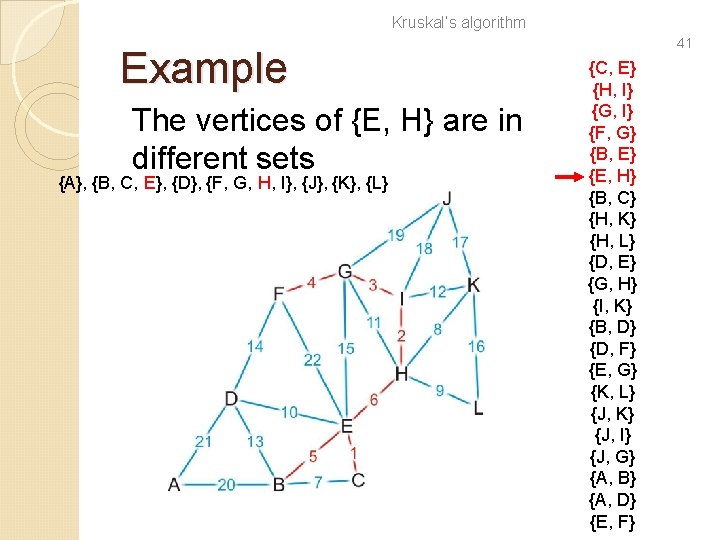
Kruskal’s algorithm Example The vertices of {E, H} are in different sets {A}, {B, C, E}, {D}, {F, G, H, I}, {J}, {K}, {L} 41 {C, E} {H, I} {G, I} {F, G} {B, E} {E, H} {B, C} {H, K} {H, L} {D, E} {G, H} {I, K} {B, D} {D, F} {E, G} {K, L} {J, K} {J, I} {J, G} {A, B} {A, D} {E, F}
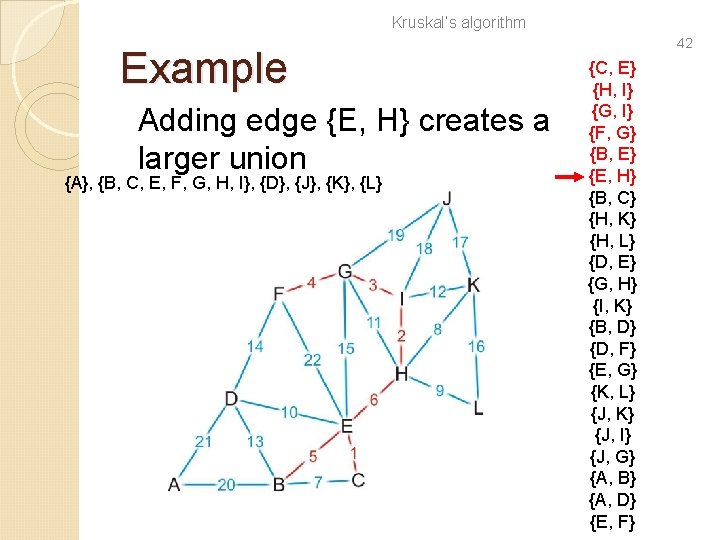
Kruskal’s algorithm Example Adding edge {E, H} creates a larger union {A}, {B, C, E, F, G, H, I}, {D}, {J}, {K}, {L} 42 {C, E} {H, I} {G, I} {F, G} {B, E} {E, H} {B, C} {H, K} {H, L} {D, E} {G, H} {I, K} {B, D} {D, F} {E, G} {K, L} {J, K} {J, I} {J, G} {A, B} {A, D} {E, F}
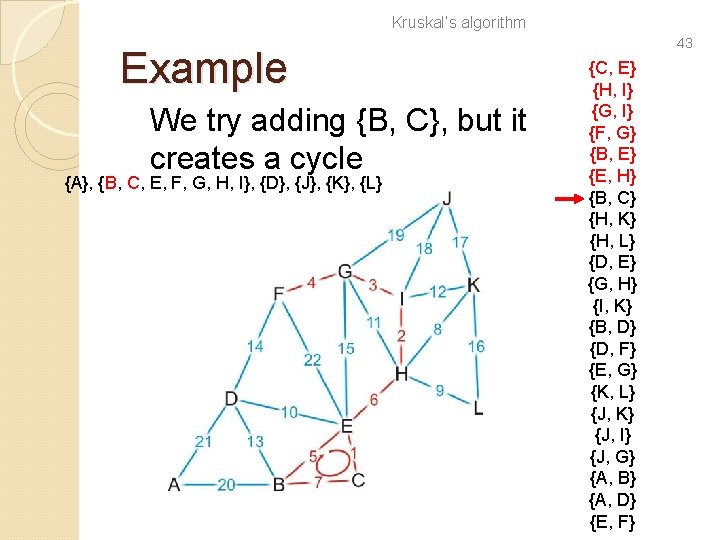
Kruskal’s algorithm Example We try adding {B, C}, but it creates a cycle {A}, {B, C, E, F, G, H, I}, {D}, {J}, {K}, {L} 43 {C, E} {H, I} {G, I} {F, G} {B, E} {E, H} {B, C} {H, K} {H, L} {D, E} {G, H} {I, K} {B, D} {D, F} {E, G} {K, L} {J, K} {J, I} {J, G} {A, B} {A, D} {E, F}
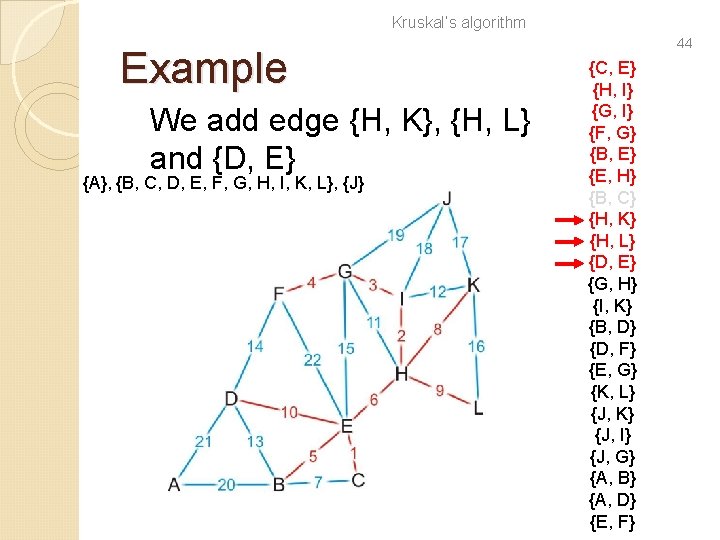
Kruskal’s algorithm Example We add edge {H, K}, {H, L} and {D, E} {A}, {B, C, D, E, F, G, H, I, K, L}, {J} 44 {C, E} {H, I} {G, I} {F, G} {B, E} {E, H} {B, C} {H, K} {H, L} {D, E} {G, H} {I, K} {B, D} {D, F} {E, G} {K, L} {J, K} {J, I} {J, G} {A, B} {A, D} {E, F}
Kruskal’s algorithm Example Both G and H are in the same set {A}, {B, C, D, E, F, G, H, I, K, L}, {J} 45 {C, E} {H, I} {G, I} {F, G} {B, E} {E, H} {B, C} {H, K} {H, L} {D, E} {G, H} {I, K} {B, D} {D, F} {E, G} {K, L} {J, K} {J, I} {J, G} {A, B} {A, D} {E, F}
Kruskal’s algorithm Example Both {I, K} are in the same set {A}, {B, C, D, E, F, G, H, I, K, L}, {J} 46 {C, E} {H, I} {G, I} {F, G} {B, E} {E, H} {B, C} {H, K} {H, L} {D, E} {G, H} {I, K} {B, D} {D, F} {E, G} {K, L} {J, K} {J, I} {J, G} {A, B} {A, D} {E, F}
Kruskal’s algorithm Example Both {B, D} are in the same set {A}, {B, C, D, E, F, G, H, I, K, L}, {J} 47 {C, E} {H, I} {G, I} {F, G} {B, E} {E, H} {B, C} {H, K} {H, L} {D, E} {G, H} {I, K} {B, D} {D, F} {E, G} {K, L} {J, K} {J, I} {J, G} {A, B} {A, D} {E, F}
Kruskal’s algorithm Example Both {D, F} are in the same set {A}, {B, C, D, E, F, G, H, I, K, L}, {J} 48 {C, E} {H, I} {G, I} {F, G} {B, E} {E, H} {B, C} {H, K} {H, L} {D, E} {G, H} {I, K} {B, D} {D, F} {E, G} {K, L} {J, K} {J, I} {J, G} {A, B} {A, D} {E, F}
Kruskal’s algorithm Example 49 {C, E} {H, I} {G, I} {F, G} {B, E} {E, H} {B, C} {H, K} {H, L} {D, E} {G, H} {I, K} {B, D} {D, F} {E, G} {K, L} {J, K} {J, I} {J, G} {A, B} {A, D} {E, F} We end when there is only one set, having added (A, B) {A, B, C, D, E, F, G, H, I, K, L, J}