
Krathwohls Taxonomy of Affective Domains Jennifer Watson February

Krathwohl’s Taxonomy of Affective Domains Jennifer Watson February 14, 2007
Background of Krathwohl’s Taxonomy § "The taxonomy is ordered according to the principle of internalization. Internalization refers to the process whereby a person's affect toward an
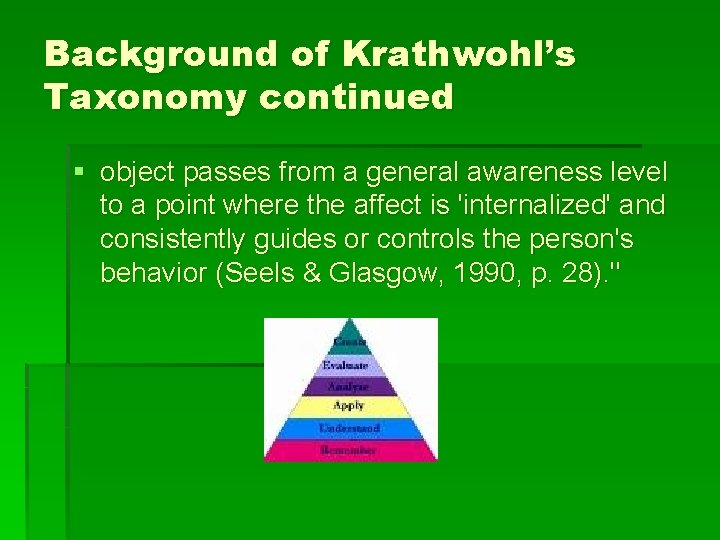
Background of Krathwohl’s Taxonomy continued § object passes from a general awareness level to a point where the affect is 'internalized' and consistently guides or controls the person's behavior (Seels & Glasgow, 1990, p. 28). "
Krathwolh’s Taxonomy A. Receiving is being aware of existence of certain ideas, material, or phenomena and to tolerate them. Examples include: to differentiate, to accept, to listen (for), to respond to. B. Responding is committed to the ideas, materials, or phenomena involved by actively responding to them. Examples are: to comply with, to follow, to commend.
Krathwolh’s Taxonomy C. Valuing is willing to be perceived by others as valuing certain ideas, materials, or phenomena. Examples include: to relinquish, to support, to debate. D. Organization is to relate the new values to current values. Examples are: to discuss, to theorize, to formulate.
Krathwolh’s Taxonomy E. Characterization by value or value set is to act consistently with internalized values. Examples include: to revise, to require, to avoid. F. Organization is to relate the value to those already held Examples are: to discuss, to theorize, to formulate, to balance, to examine.
Krathwolh’s Taxonomy G. Characterization by value or value set is to act consistently in accordance with the values one has internalized. Examples include: to revise, to be rated high in the value, to manage, to resolve.
- Slides: 7