
Krashens Theory of Second Language Acquisition Lynn W
- Slides: 10
Krashen’s Theory of Second Language Acquisition Lynn W Zimmerman, Ph. D
5 Hypotheses �The Learning/Acquisition Hypothesis �The Natural Order Hypothesis �The Monitor Hypothesis �The Input Hypothesis �The Affective Filter Hypothesis
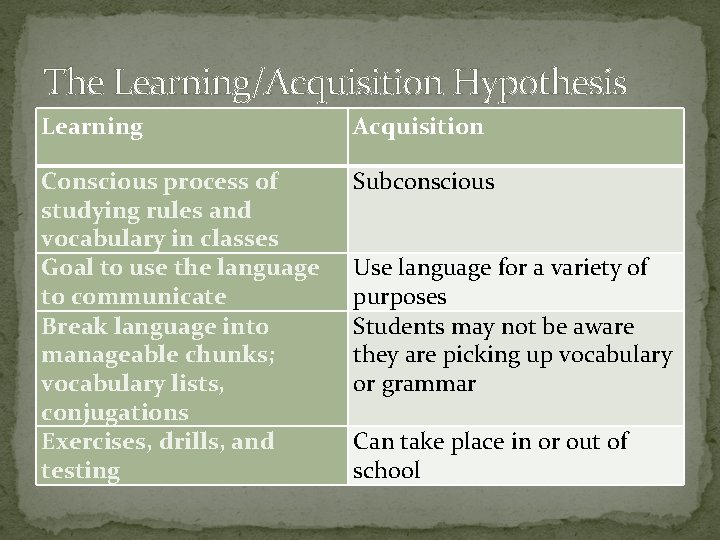
The Learning/Acquisition Hypothesis Learning Acquisition Conscious process of studying rules and vocabulary in classes Goal to use the language to communicate Break language into manageable chunks; vocabulary lists, conjugations Exercises, drills, and testing Subconscious Use language for a variety of purposes Students may not be aware they are picking up vocabulary or grammar Can take place in or out of school
The Natural Order Hypothesis �In first language acquisition, some aspects of language appear in the speech on language learners before other features. �Also a definite order in SLA. Not quite the same order as FLA, but some similarities. �Order depends on the language being acquired
The Monitor Hypothesis �Native speakers can tell when something doesn’t sound right. �FL and SL speakers use conscious monitoring by comparing to rules �FL speakers tend to monitor more in formal situations and in writing. �To monitor effectively, language users must � Have time � Must focus on the focus rather than the meaning � Must know the rules
The Input Hypothesis �Not all input leads to acquisition. �Needs to be i + 1 – slightly above their current level. �A teacher can provide input that so that students can understand most of what they hear or read �Different students will acquire different parts and amounts
The Affective Filter Hypothesis �Affective factors - act as a filter to block incoming messages and prevent acquisition. �Being relaxed is one way to lower the affective filter.
Summary �People acquire a second language �in a natural order �when they receive comprehensible input �have a low affective filter. �Can use learned knowledge of a language to monitor output
Stephen Krashen on Language Acquisition �https: //www. youtube. com/watch? v=Ni. Tsdu. Rreug
References �Freeman, D. E. & Freeman, Y. S. (2014). Essential Linguistics. Portsmouth, NH: Heinemann.