
Kouzes and Posners Leadership Practice Inventory Lecture 8
- Slides: 20
Kouzes and Posner’s Leadership Practice Inventory Lecture 8 Dr. Mensah
About Leadership • According to Kouzes and Posner (1987) Leadership is not about personality; it’s about behavior—an observable set of skills and abilities. • In their research, Kouzes and Posner discovered that when leaders are at their personal best there are five core practices common to all: they 1. Model the Way, 2. Inspire a Shared Vision, 3. Challenge the Process, 4. Enable Others to Act, and last but certainly not least, they 5. Encourage the Heart.
Leadership Practices Inventory • The 5 core leadership practices are measured and validated by the Leadership Practices Inventory (LPI)—one of the most widely used leadership assessment instruments in the world. • Ongoing studies consistently confirm that the 5 Practices and assessment tools are positively related to both the effectiveness of leaders and the level of commitment, engagement, and satisfaction of followers.
1. Model the Way • Leaders establish principles concerning the way people (constituents, peers, colleagues, and customers alike) should be treated and the way goals should be pursued. • They create standards of excellence and then set an example for others to follow. • they set interim goals so that people can achieve small gains as they work toward larger objectives. • they put up signposts when people are unsure of where to go or how to get there; and they create opportunities for victory.
2. Inspire a Shared Vision • Leaders passionately believe that they can make a difference. • They envision the future, creating an ideal and unique image of what the organization can become. • Through their power to attract followers and quiet persuasion, leaders enlist others to their dreams. • They breathe life into their visions and get people to see exciting possibilities for the future.
• A true leader can vision the future and clearly paint a picture for the team to comprehend. • Envision the future and imagine exciting possibilities • Enlist others in a common vision by appealing to shared aspirations through: • always listen first • outline a shared vision statement • put life in the vision • talk from the heart • amplify communication skills • reveal common ground
3. Challenge the Process • Leaders search for opportunities to change the status quo. • They look for innovative ways to improve the organization. In doing so, they experiment and take risks. • And because leaders know that risk taking involves mistakes and failures, they accept the inevitable disappointments as learning opportunities
• Search for opportunities by seeking innovative easy to change, grow and improve methods • Experiment and take risks by constantly generating small wins and learning from mistakes through: • Treating every job as an adventure • searching for meaningful challenges • generating meaningful challenge for others and give choices • Question the status quo and acknowledge mistakes • Conduct pre and post mortems of every mission • Look to the outside world for ideas and make work fun
4. Enable Others to Act • Leaders foster collaboration and build dynamic teams. • They actively involve others. • Leaders understand that mutual respect is what sustains extraordinary efforts; • they strive to create an atmosphere of trust and human dignity. • They strengthen others, making each person feel capable and powerful.
• Foster collaboration by promoting cooperative goals and building trust • Strengthen others by sharing power and discretion through: • questioning, listening • receiving advice from others • staying focused on the gains not losses • offering support • enriching others • Generating and fostering a learning climate and education
5. Encourage the Heart • Accomplishing extraordinary things in organizations is hard work. • To keep hope and determination alive, leaders recognize contributions that individuals make. • In every winning team, the members need to share in the rewards of their efforts, so leaders celebrate accomplishments. • They make people feel like heroes
• Recognize contributions/show appreciation for excellence • Celebrate the values and victories/create a strength of community through: • including celebrations in work activities • being creative regarding rewards • promoting positive expectations • Paying tribute to commendable actions • displaying care • By being compassionate • By including fun in work activities • Setting good examples
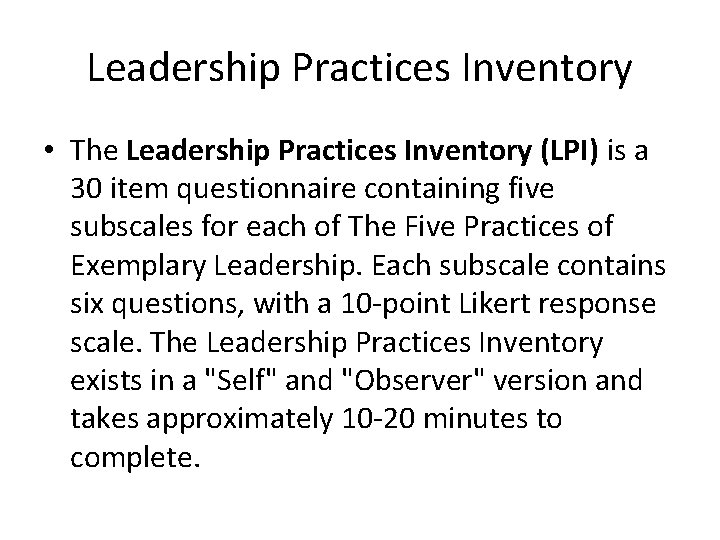
Leadership Practices Inventory • The Leadership Practices Inventory (LPI) is a 30 item questionnaire containing five subscales for each of The Five Practices of Exemplary Leadership. Each subscale contains six questions, with a 10 -point Likert response scale. The Leadership Practices Inventory exists in a "Self" and "Observer" version and takes approximately 10 -20 minutes to complete.
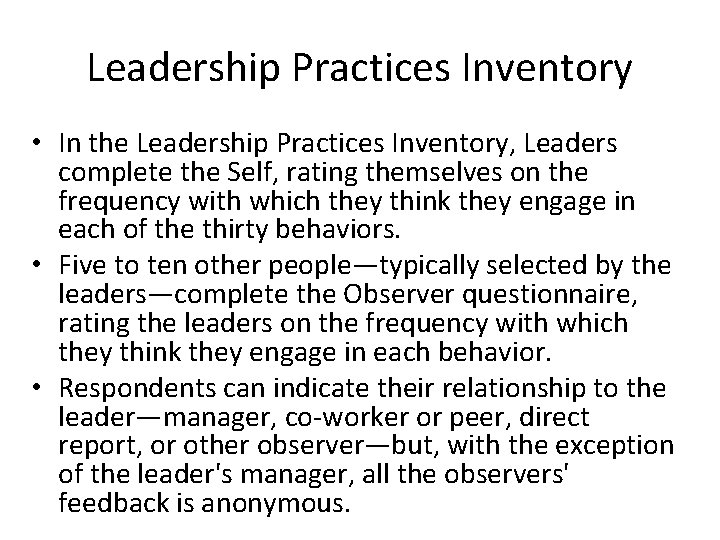
Leadership Practices Inventory • In the Leadership Practices Inventory, Leaders complete the Self, rating themselves on the frequency with which they think they engage in each of the thirty behaviors. • Five to ten other people—typically selected by the leaders—complete the Observer questionnaire, rating the leaders on the frequency with which they think they engage in each behavior. • Respondents can indicate their relationship to the leader—manager, co-worker or peer, direct report, or other observer—but, with the exception of the leader's manager, all the observers' feedback is anonymous.
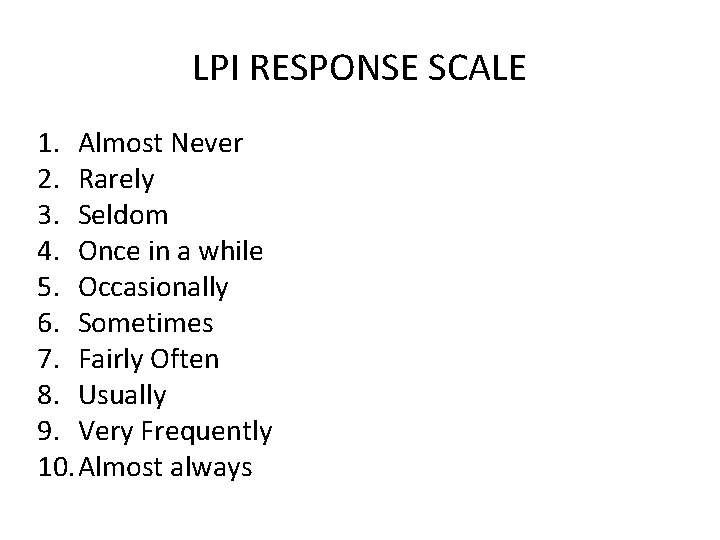
LPI RESPONSE SCALE 1. Almost Never 2. Rarely 3. Seldom 4. Once in a while 5. Occasionally 6. Sometimes 7. Fairly Often 8. Usually 9. Very Frequently 10. Almost always
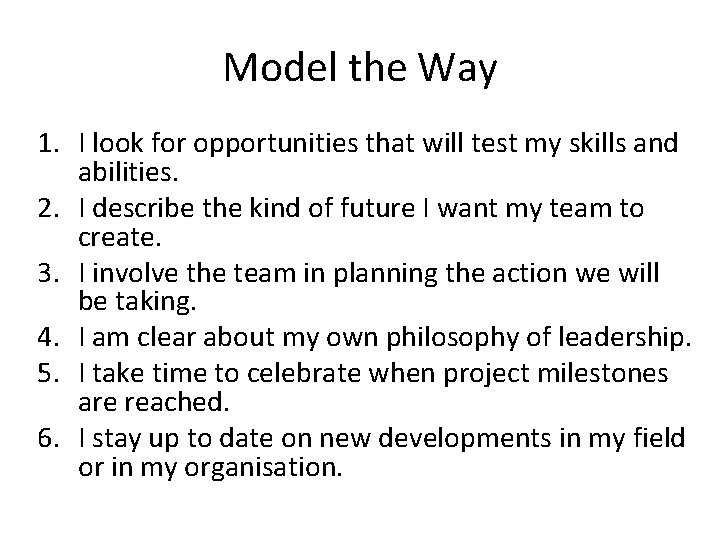
Model the Way 1. I look for opportunities that will test my skills and abilities. 2. I describe the kind of future I want my team to create. 3. I involve the team in planning the action we will be taking. 4. I am clear about my own philosophy of leadership. 5. I take time to celebrate when project milestones are reached. 6. I stay up to date on new developments in my field or in my organisation.
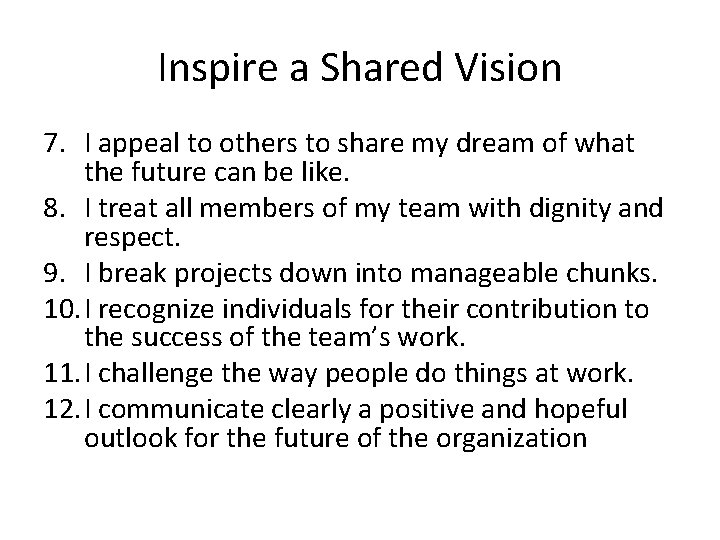
Inspire a Shared Vision 7. I appeal to others to share my dream of what the future can be like. 8. I treat all members of my team with dignity and respect. 9. I break projects down into manageable chunks. 10. I recognize individuals for their contribution to the success of the team’s work. 11. I challenge the way people do things at work. 12. I communicate clearly a positive and hopeful outlook for the future of the organization
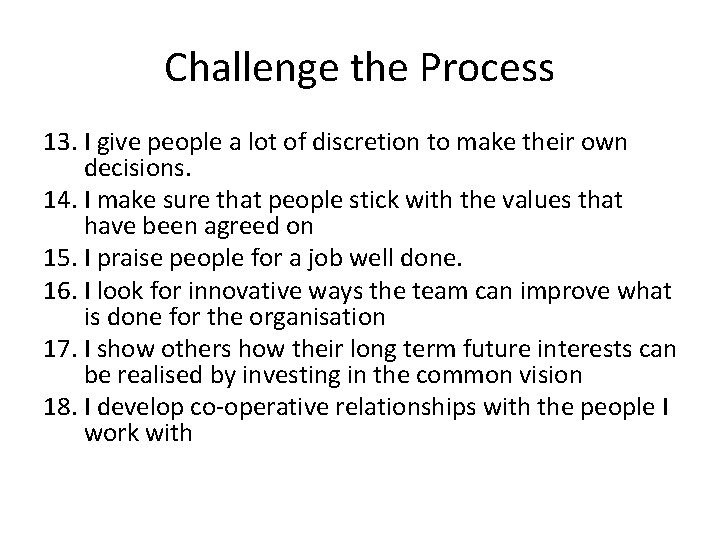
Challenge the Process 13. I give people a lot of discretion to make their own decisions. 14. I make sure that people stick with the values that have been agreed on 15. I praise people for a job well done. 16. I look for innovative ways the team can improve what is done for the organisation 17. I show others how their long term future interests can be realised by investing in the common vision 18. I develop co-operative relationships with the people I work with
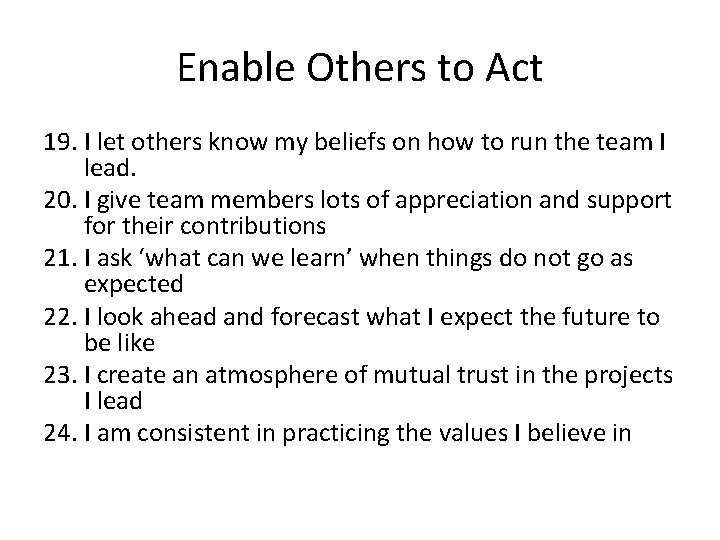
Enable Others to Act 19. I let others know my beliefs on how to run the team I lead. 20. I give team members lots of appreciation and support for their contributions 21. I ask ‘what can we learn’ when things do not go as expected 22. I look ahead and forecast what I expect the future to be like 23. I create an atmosphere of mutual trust in the projects I lead 24. I am consistent in practicing the values I believe in
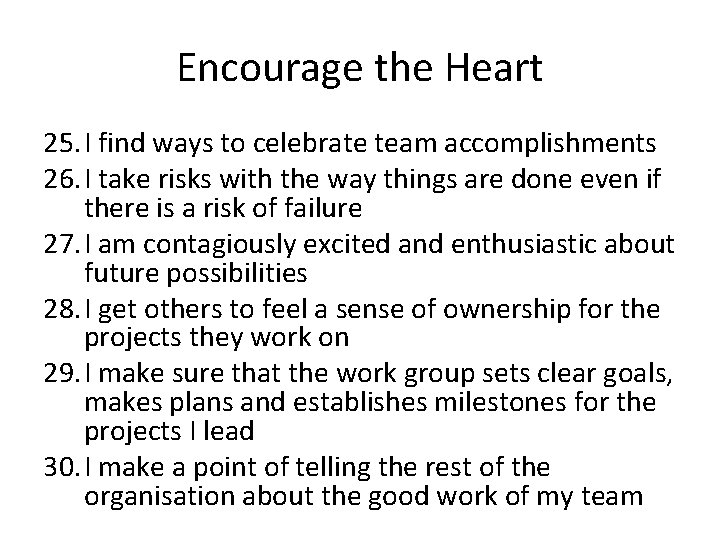
Encourage the Heart 25. I find ways to celebrate team accomplishments 26. I take risks with the way things are done even if there is a risk of failure 27. I am contagiously excited and enthusiastic about future possibilities 28. I get others to feel a sense of ownership for the projects they work on 29. I make sure that the work group sets clear goals, makes plans and establishes milestones for the projects I lead 30. I make a point of telling the rest of the organisation about the good work of my team