
Korean Romanization Revision Project By Yunah Sung April
Korean Romanization Revision Project By Yunah Sung April 6, 2006 Committee on Korean Materials CEAL
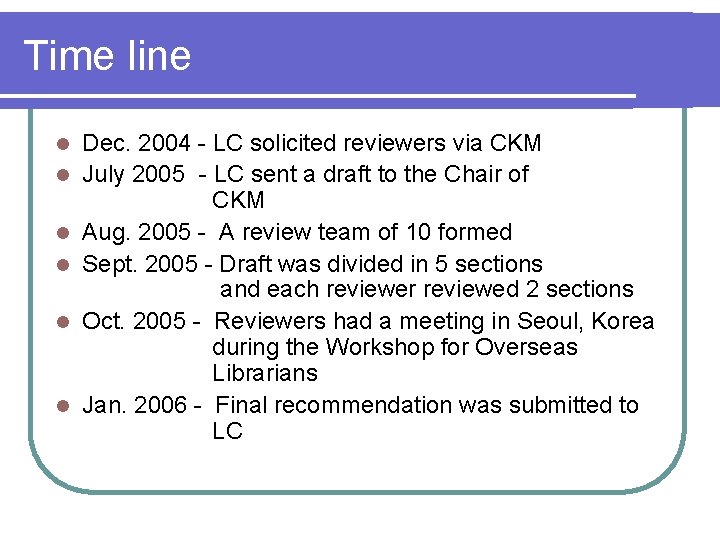
Time line l l l Dec. 2004 - LC solicited reviewers via CKM July 2005 - LC sent a draft to the Chair of CKM Aug. 2005 - A review team of 10 formed Sept. 2005 - Draft was divided in 5 sections and each reviewer reviewed 2 sections Oct. 2005 - Reviewers had a meeting in Seoul, Korea during the Workshop for Overseas Librarians Jan. 2006 - Final recommendation was submitted to LC
Proposal For Korean Romanization and Word Division Revision l Prepared by Elaine Kim (Cataloging Specialist; Korean/Chinese Team RCCD) Young Ki Lee (Senior Cataloging Specialist; Korean/Chinese Team) l With assistance of LC Korean staff Philip Melzer
Proposal Review Team members l l l l l Mikyung Kang (Stanford University) Hana Kim (University of Toronto) Joy Kim (University of Southern California) Bill Mc. Cloy (University of Washington) Seunghi Paek (Harvard University) Heija Ryoo (University of Washington) Hee-Sook Shin (Columbia University) Younghee Sohn (Chicago University) Hyokyoung Yi (University of Washington) Coordinator Yunah Sung (University of Michigan)
LC’s Revision Goals l l l l Base the guidelines upon the standard Korean practice (such as the Revised Korean Spelling System (1988)), which is commonly recognized by Korean people and Korean studies scholars. Simplify the principles and rules, so the users are able to use and able to easily remember them. Apply the same philosophy and principles throughout the whole guidelines. Minimize the number of exceptions. Simplify the terminology that is used in the guidelines. Insofar as possible, have the guidelines facilitate machine searching in large databases. Add more examples
Table of Contents l Romanization l Word Division l Appendix 1: List of Prefixes l Appendix 2: List of Suffixes l Appendix 3: List of Imperfect Nouns l Works consulted

Romanization Rule 1: General Practice Rule 2: Authorities Rule 3: Conflict Between Romanization Rule and Pronunciation Rule 4: Medial ㅅ Rule 5: Medials and Final Consonants Not Covered by the Original Mc. Cune-Reischauer Guidelines Rule 6: ㅎ, ㄶ, ㅀ Rule 7: ㄴ and ㄹ Rule 8: Personal Names Rule 9: Following Hyphens Rule 10: Words of Western Origin Rule 11: Romanization of Archaic Korean
Word Division l l l l Basic Principles Chapter 1: Particles (조사) Chapter 2: Predicates (용언) Chapter 3: Nominals (체언) Chapter 4: Determiner (관형사), Exclamation (감탄사) Chapter 5: Affixes (접사) Chapter 6: Personal Names Chapter 7: Corporate Names, Geographical Names, Publication titles Chapter 8: Abbreviated Forms Chapter 9: Numerals (수사) Chapter 10: Western Origin Terms (외래어) Chapter 11: Capitalization Chapter 12: Punctuation Chapter 13: Special Characters and Character Modifiers in Romanization
Comments on the draft l l l l Overview The Revised Korean Spelling System (1988) Grammatical terms used in the text Format Examples Suggested dictionaries Web Online Library Catalog
Overview l Showed a great improvement on analyzing Korean phrases and sentences grammatically in an effort to clarify ambiguous issues on word division l added new specific rules in romanization and word division to the current ones
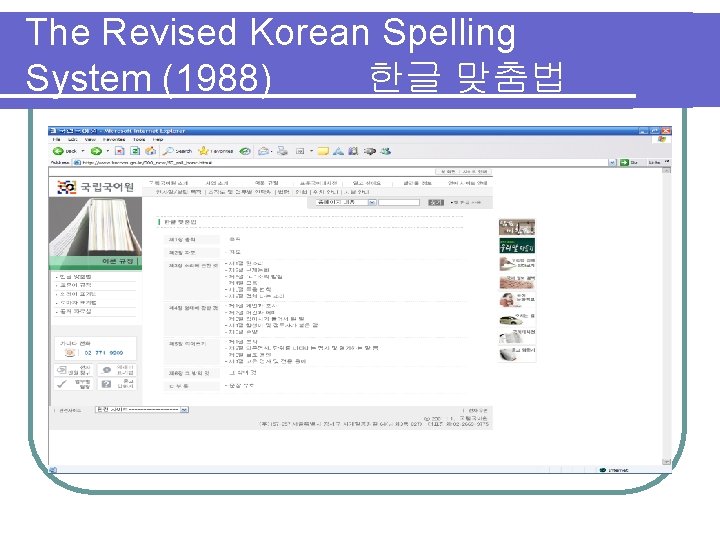
The Revised Korean Spelling System (1988) 한글 맞춤법
The Revised Korean Spelling System (1988) 한글 맞춤법 l The revision adopts certain rules of the Revised Korean Spelling System, which causes more confusion l A comparison chart of significantly different rules between the Revised Korean Spelling System and the LC’s Korean Romanization and Word Division would be helpful
Grammatical terms used in the text 9 categories of parts of speech l l l l l 명사 Noun 대명사 Pronoun 수사 Numeral 동사 Verb (or Action Verb) 형용사 Adjective (or Descriptive Verb) 관형사 Determiners (or Adnominal) 부사 Adverb 감탄사 Exclamation 조사 Particle Confusing terms: Predicates (용언), simple inflected verb (동사), attributive adjective ( 한정 형용사), simple inflected verb (동사 어미 변화), single syllable modifier (단 음절 수식어), demonstrative determiner (지시 관형사), attributive determiner ( 성상 관형사)
Grammatical terms used in the text l Grammatical terms are very difficult to understand confusing l Having a list of parts of speech in Korean and English is helpful
Format l Rules written in bilingual l Searchable full-text index l Hypertext links l Well organized table of contents along with an index of terms and examples
Examples l Underlines in examples l Grouping examples l Straightforward examples
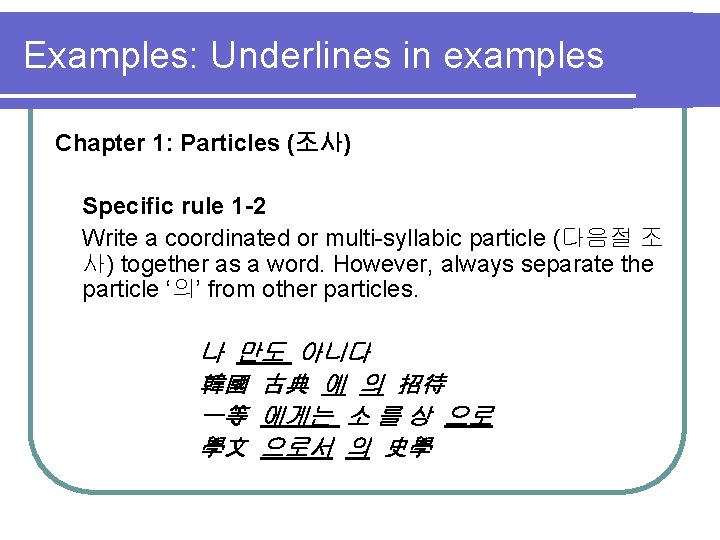
Examples: Underlines in examples Chapter 1: Particles (조사) Specific rule 1 -2 Write a coordinated or multi-syllabic particle (다음절 조 사) together as a word. However, always separate the particle ‘의’ from other particles. 나 만도 아니다 韓國 古典 에 의 招待 一等 에게는 소 를 상 으로 學文 으로서 의 史學

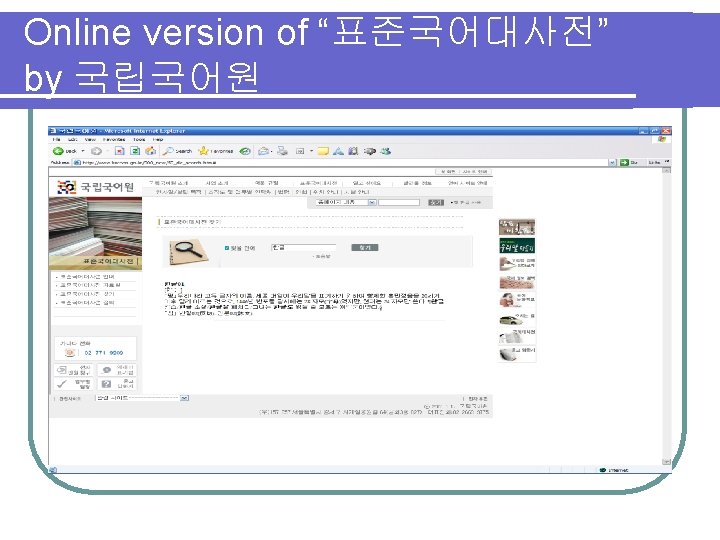
Suggested dictionaries Online version of “표준국어대사전” by 국립국 어원 l Currently available dictionary for reading and pronunciation of Chinese characters l Online Korean Mc. Cune-Reischauer Romanization Dictionary (http: //www. romanization. org/) l 로마자 변환기 (http: //urimal. cs. pusan. ac. kr/edu_sys_new/rom anwebdll/romanweb. htm ) l
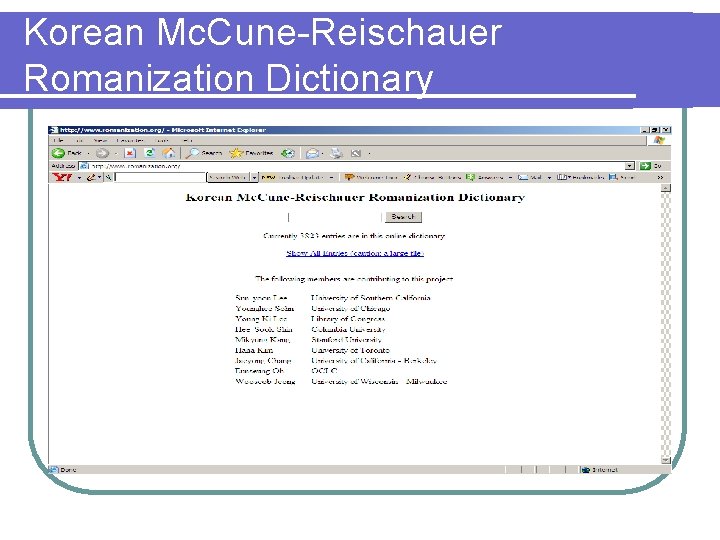
Korean Mc. Cune-Reischauer Romanization Dictionary
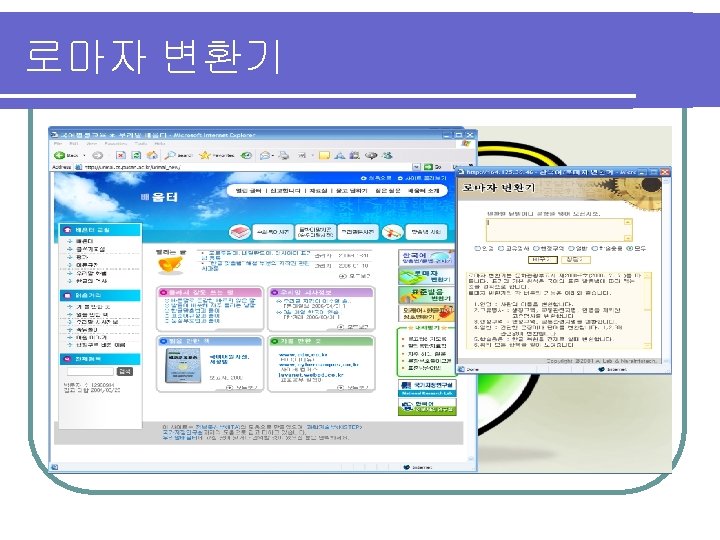
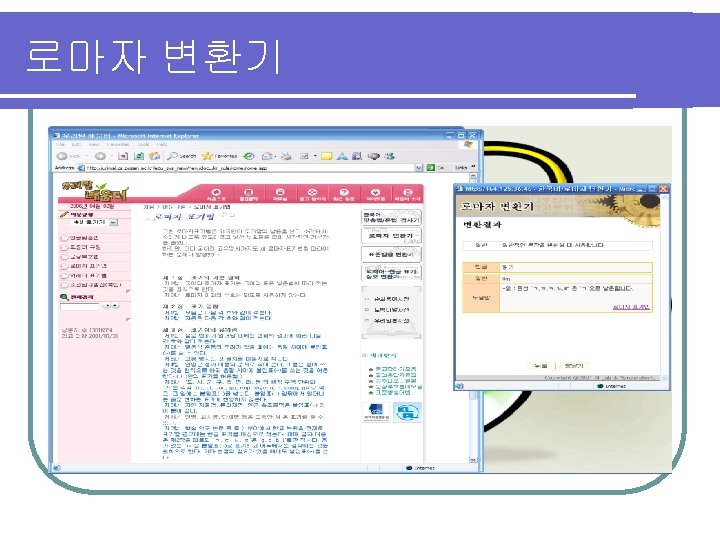
Web Online Library Catalog l Research about the most effective searching methods in online catalog for a Korean material user l Numerous tests on binaries and hyphens in a searching word
Romanization l Continue to follow the Mc. Cune-Reischauer system to romanize Korean l Prefer to represent the pronunciation, when romanization rules conflict with the pronunciation of a word l Omit a hyphen and indicate phonetic change in a given name Ex) 이 석민 Yi Sǒngmin l Do not indicate sound change following a hyphen EX) 강원도 Kangwǒn-to 경상북도 Kyǒngsang-pukto l Strictly apply Mc. Cune-Reischauer rules and tables for the Romanization of Archaic Korean (옛한글) EX) T‘yǒnjyu 텬쥬 not: Chŏnju
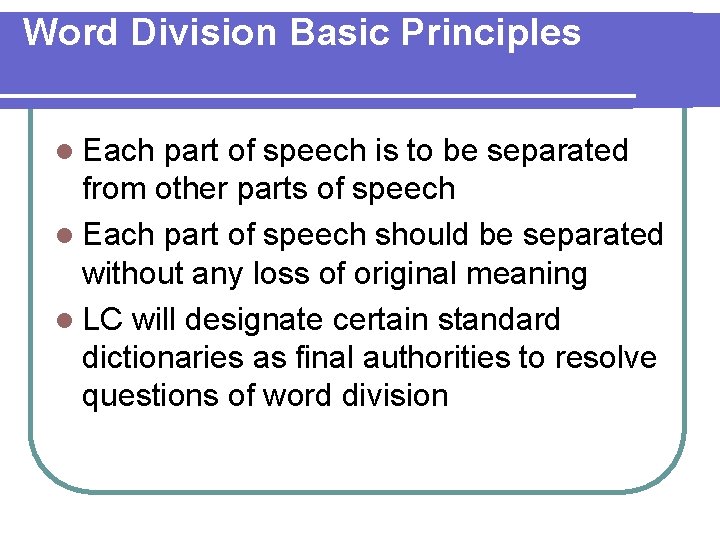
Word Division Basic Principles l Each part of speech is to be separated from other parts of speech l Each part of speech should be separated without any loss of original meaning l LC will designate certain standard dictionaries as final authorities to resolve questions of word division
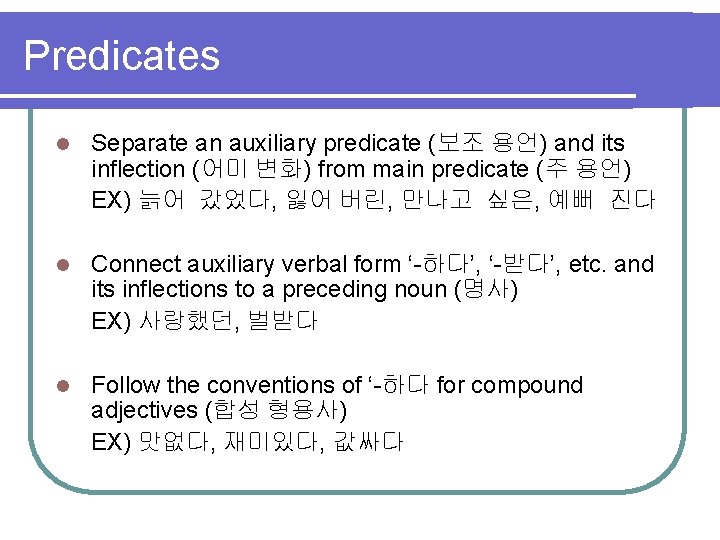
Predicates l Separate an auxiliary predicate (보조 용언) and its inflection (어미 변화) from main predicate (주 용언) EX) 늙어 갔었다, 잃어 버린, 만나고 싶은, 예뻐 진다 l Connect auxiliary verbal form ‘-하다’, ‘-받다’, etc. and its inflections to a preceding noun (명사) EX) 사랑했던, 벌받다 l Follow the conventions of ‘-하다 for compound adjectives (합성 형용사) EX) 맛없다, 재미있다, 값싸다
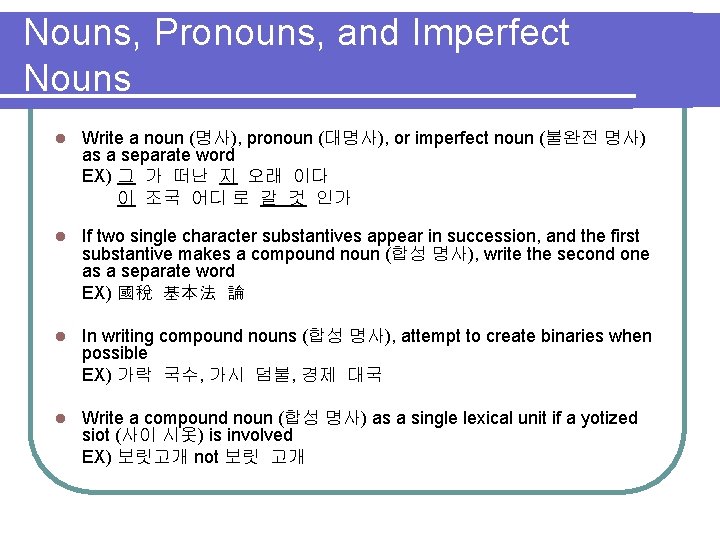
Nouns, Pronouns, and Imperfect Nouns l Write a noun (명사), pronoun (대명사), or imperfect noun (불완전 명사) as a separate word EX) 그 가 떠난 지 오래 이다 이 조국 어디 로 갈 것 인가 l If two single character substantives appear in succession, and the first substantive makes a compound noun (합성 명사), write the second one as a separate word EX) 國稅 基本法 論 l In writing compound nouns (합성 명사), attempt to create binaries when possible EX) 가락 국수, 가시 덤불, 경제 대국 l Write a compound noun (합성 명사) as a single lexical unit if a yotized siot (사이 시옷) is involved EX) 보릿고개 not 보릿 고개
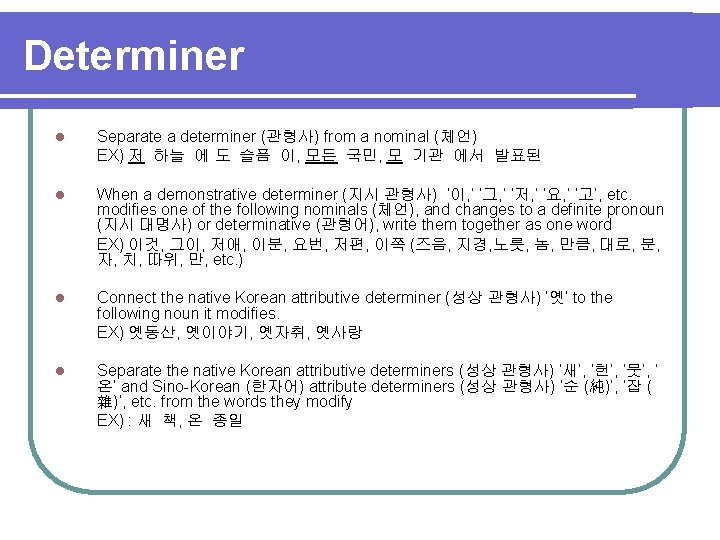
Determiner l Separate a determiner (관형사) from a nominal (체언) EX) 저 하늘 에 도 슬픔 이, 모든 국민, 모 기관 에서 발표된 l When a demonstrative determiner (지시 관형사) ‘이, ’ ‘그, ’ ‘저, ’ ‘요, ’ ‘고’, etc. modifies one of the following nominals (체언), and changes to a definite pronoun (지시 대명사) or determinative (관형어), write them together as one word EX) 이것, 그이, 저애, 이분, 요번, 저편, 이쪽 (즈음, 지경, 노릇, 놈, 만큼, 대로, 분, 자, 치, 따위, 만, etc. ) l Connect the native Korean attributive determiner (성상 관형사) ‘옛’ to the following noun it modifies. EX) 옛동산, 옛이야기, 옛자취, 옛사랑 l Separate the native Korean attributive determiners (성상 관형사) ‘새’, ‘헌’, ‘뭇’, ‘ 온’ and Sino-Korean (한자어) attribute determiners (성상 관형사) ‘순 (純)’, ‘잡 ( 雜)’, etc. from the words they modify EX) : 새 책, 온 종일
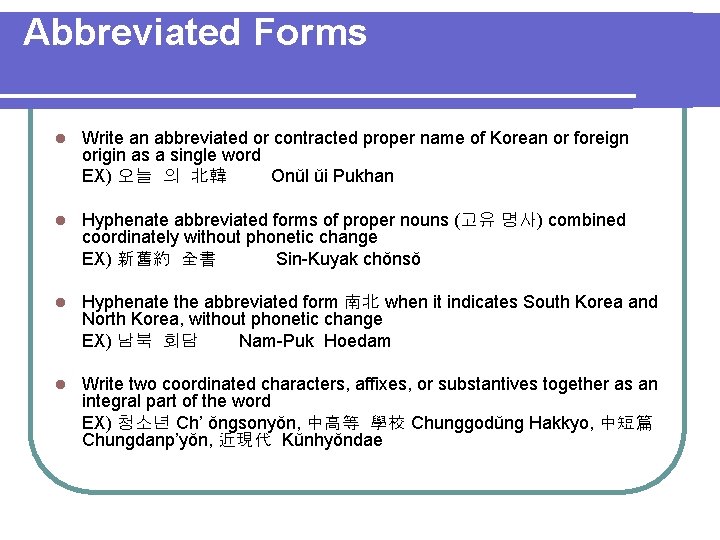
Abbreviated Forms l Write an abbreviated or contracted proper name of Korean or foreign origin as a single word EX) 오늘 의 北韓 Onŭl ŭi Pukhan l Hyphenate abbreviated forms of proper nouns (고유 명사) combined coordinately without phonetic change EX) 新舊約 全書 Sin-Kuyak chŏnsŏ l Hyphenate the abbreviated form 南北 when it indicates South Korea and North Korea, without phonetic change EX) 남북 회담 Nam-Puk Hoedam l Write two coordinated characters, affixes, or substantives together as an integral part of the word EX) 청소년 Ch’ ŏngsonyŏn, 中高等 學校 Chunggodŭng Hakkyo, 中短篇 Chungdanp’yŏn, 近現代 Kŭnhyŏndae
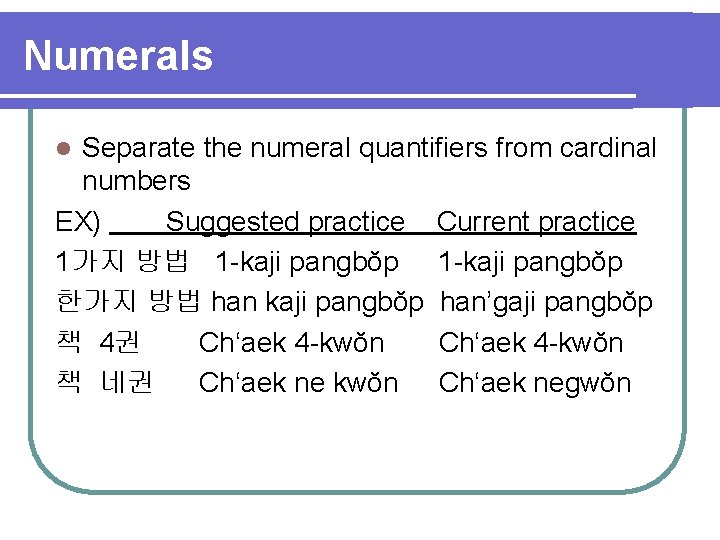
Numerals Separate the numeral quantifiers from cardinal numbers EX) Suggested practice Current practice 1가지 방법 1 -kaji pangbŏp 한가지 방법 han kaji pangbŏp han’gaji pangbŏp 책 4권 Ch‘aek 4 -kwŏn 책 네권 Ch‘aek ne kwŏn Ch‘aek negwŏn l
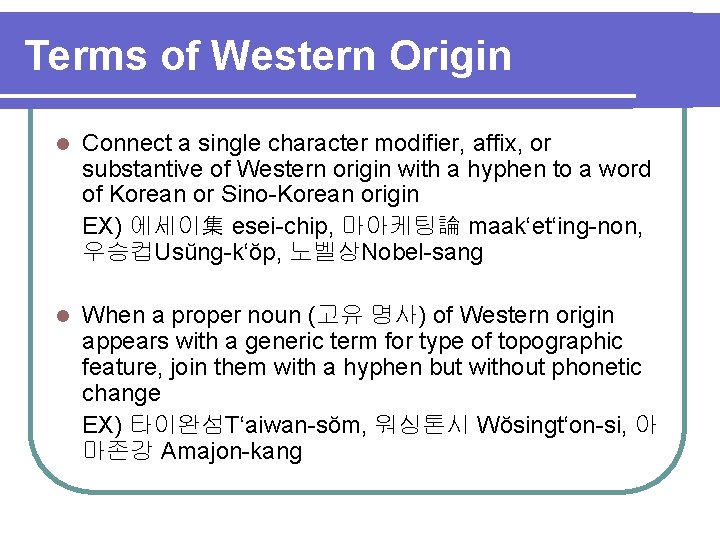
Terms of Western Origin l Connect a single character modifier, affix, or substantive of Western origin with a hyphen to a word of Korean or Sino-Korean origin EX) 에세이集 esei-chip, 마아케팅論 maak‘et‘ing-non, 우승컵Usŭng-k‘ŏp, 노벨상Nobel-sang l When a proper noun (고유 명사) of Western origin appears with a generic term for type of topographic feature, join them with a hyphen but without phonetic change EX) 타이완섬T‘aiwan-sŏm, 워싱톤시 Wŏsingt‘on-si, 아 마존강 Amajon-kang
Korean Romanization Revision Project We will keep you posted! Thank you very much !!!
- Slides: 34