
Korean Culture By Sierra Santiago Lora Kordyshevskiy Korean
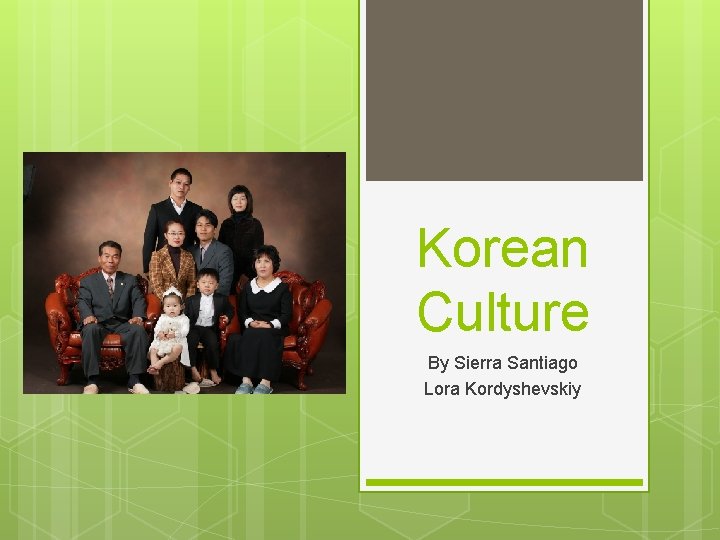
Korean Culture By Sierra Santiago Lora Kordyshevskiy
Korean Community Comprises of about 0. 6% of the US population Or Is 1. 7 million people the 5 th largest Asian American subgroup One of the fastest growing immigrant groups
Language and Non-verbal Communication Expressing a concern of others’ lives is considered polite (OK to ask about marriage, salary, age, and the price paid for personal belongings) “NO” is acceptable Koreans do not touch strangers, esp opposite sex Head houses the soul, touching it puts it in jeopardy Don’t smile and avoid strangers
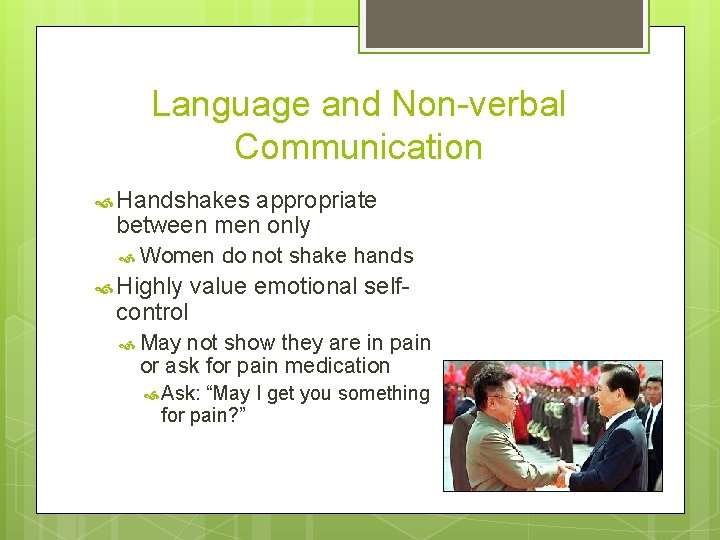
Language and Non-verbal Communication Handshakes appropriate between men only Women Highly control do not shake hands value emotional self- May not show they are in pain or ask for pain medication Ask: “May I get you something for pain? ”
Perception of Illness, Disease, Medical Roles, and Responsibilities Illness and death as a natural part of life (Buddhist/Confucian religion) Symptoms may be viewed as bad karma Health may be viewed as finding a harmony between complimentary energies, “yin and yang” Medical decision is family focused eldest male is often a spokesperson Ask patient whom they want to be included in decision making If possible, engage the whole family in discussion about health/oral care
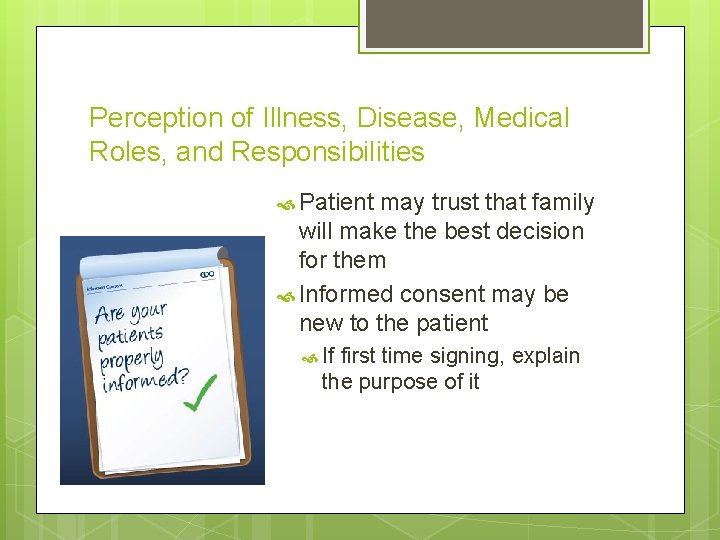
Perception of Illness, Disease, Medical Roles, and Responsibilities Patient may trust that family will make the best decision for them Informed consent may be new to the patient If first time signing, explain the purpose of it
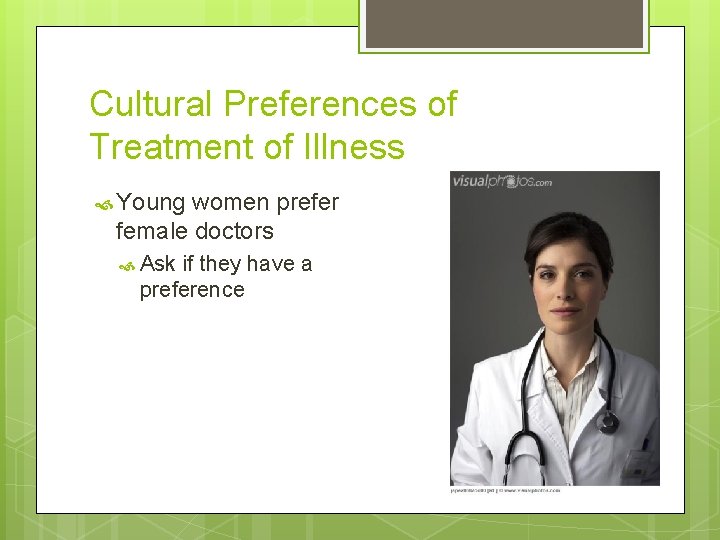
Cultural Preferences of Treatment of Illness Young women prefer female doctors Ask if they have a preference
Authority Perception Interpersonal Hierarchical Use indirect speech to someone in authority “It is somewhat cold today” Direct dependency speech to someone with lower status “Please, close the door” Collectivistic call non-family members by family terms like grandfather, grandmother, uncle, aunt Use of plural possessive form, our country vs. my country, our house vs. my house
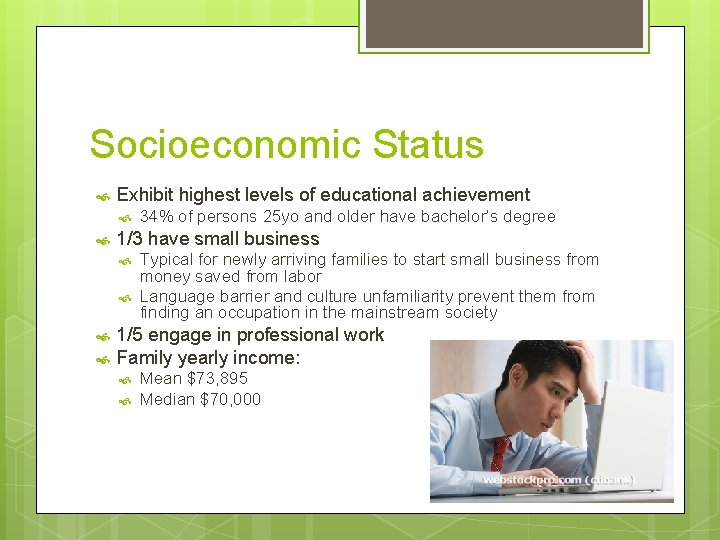
Socioeconomic Status Exhibit highest levels of educational achievement 1/3 have small business 34% of persons 25 yo and older have bachelor’s degree Typical for newly arriving families to start small business from money saved from labor Language barrier and culture unfamiliarity prevent them from finding an occupation in the mainstream society 1/5 engage in professional work Family yearly income: Mean $73, 895 Median $70, 000
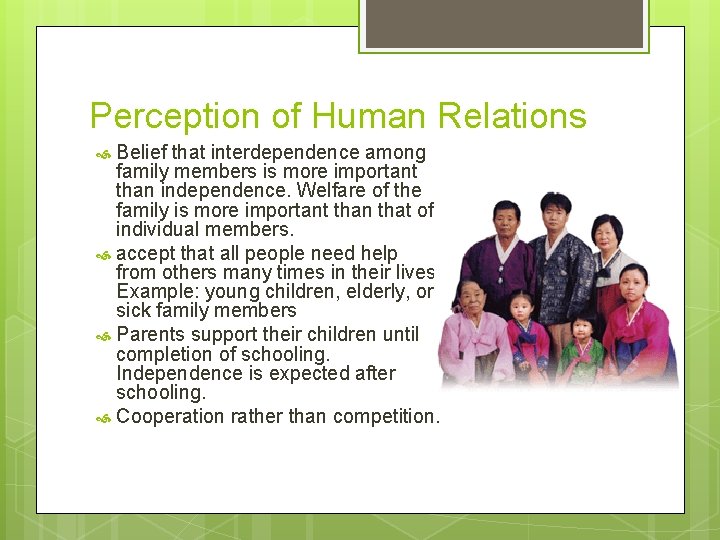
Perception of Human Relations Belief that interdependence among family members is more important than independence. Welfare of the family is more important than that of individual members. accept that all people need help from others many times in their lives. Example: young children, elderly, or sick family members Parents support their children until completion of schooling. Independence is expected after schooling. Cooperation rather than competition.
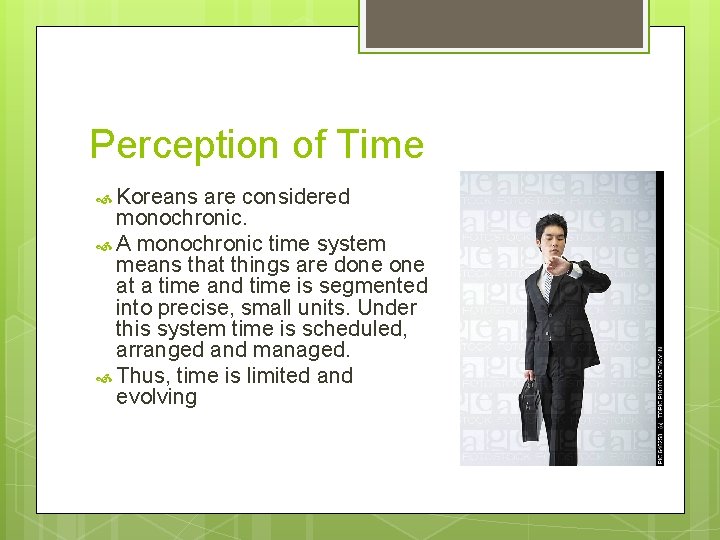
Perception of Time Koreans are considered monochronic. A monochronic time system means that things are done at a time and time is segmented into precise, small units. Under this system time is scheduled, arranged and managed. Thus, time is limited and evolving
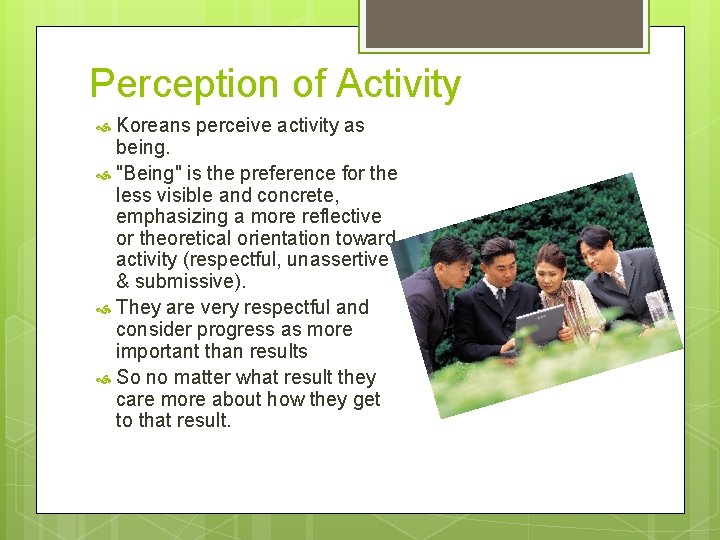
Perception of Activity Koreans perceive activity as being. "Being" is the preference for the less visible and concrete, emphasizing a more reflective or theoretical orientation toward activity (respectful, unassertive & submissive). They are very respectful and consider progress as more important than results So no matter what result they care more about how they get to that result.
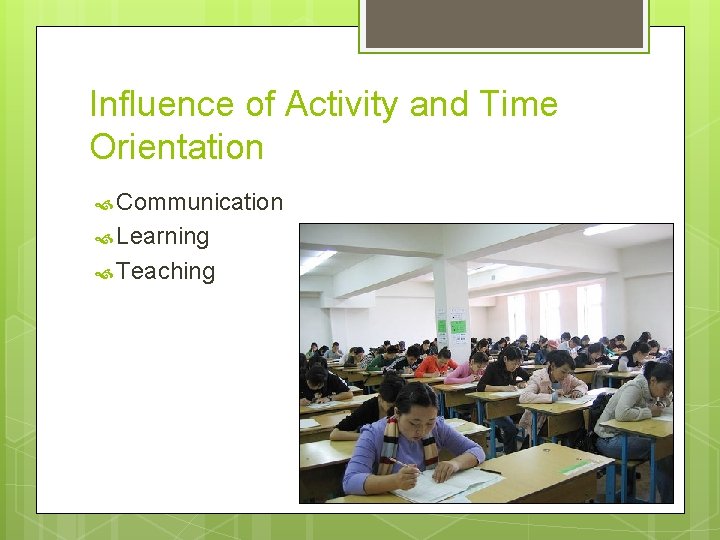
Influence of Activity and Time Orientation Communication Learning Teaching
Suggestions for Approaching this Culture as Dental Patients Cultural differences: depends on age, ethnic group, generation, migration wave, and time away from Korea. Understanding Norms About Eye Contact and Body Language • Do not expect sustained direct eye contact. When you first meet your patient he or she may frequently look at you when you are not looking to become more comfortable. • Handshakes are appropriate between men; women do not shake hands. Respect is shown to authority figures by giving a gentle bow. Understanding Personal Space Your patient may highly value emotional self-control. May not show pain or ask for pain medications. Respect of your patient’s desire to keep emotions in control.
REFERENCES: http: //www. andrews. edu/~tidwell/bsad 560/Non. Verbal. html http: //books. google. com/books? id=H 4 Cs. WDEi 52 IC&pg=PA 10&lpg=PA 10&dq=a. %09 Differenc es+in+languages+and+nonverbal+communication+patterns+and+korean+culture&source=bl&ots=t. DUcgc. S 6 ud&sig=9 ZM Bdvqo. G 4 Ced. IY 0 WZyw. L 30 onok&hl=en&sa=X&ei=HM 2 LUZ_h. CYS 7 ig. Kbwo. Bg&ved=0 CDo. Q 6 AE w. Ag#v=onepage&q=a. %09 Differences%20 in%20 languages%20 and%20 nonverbal%20 communication%20 patterns%20 and%20 korean%20 culture&f=false http: //kurdishkoreanfriendshipbridge. blogspot. com/2011/02/value-of-korean-family. html http: //www. grin. com/en/e-book/104380/differences-in-communication-styles-between-cultures http: //depts. washington. edu/pfes/PDFs/Korean. Culture. Clue. pdf http: //www. visualphotos. com/image/2 x 3916484/female_doctor_portrait https: //en. wikipedia. org/wiki/Korean_American http: //www. sagepub. com/upm-data/11755_Jackson_K_Entries. pdf http: //www. calstatela. edu/centers/ckaks/publication_info/Korean_pop. pdf http: //www. eidohealthcare. com/ http: //www. webstockpro. com/Blend/BLD 062861. Korean-businessman-looking-at-laptop-Photo/ Joo Young =)
- Slides: 15