
Kohlberg and Gilligan Kaity and Meg Kohlberg Expanded

Kohlberg and Gilligan Kaity and Meg

Kohlberg Expanded Piaget’s work Developed Stages of Moral Development Inspired work of Gilligan
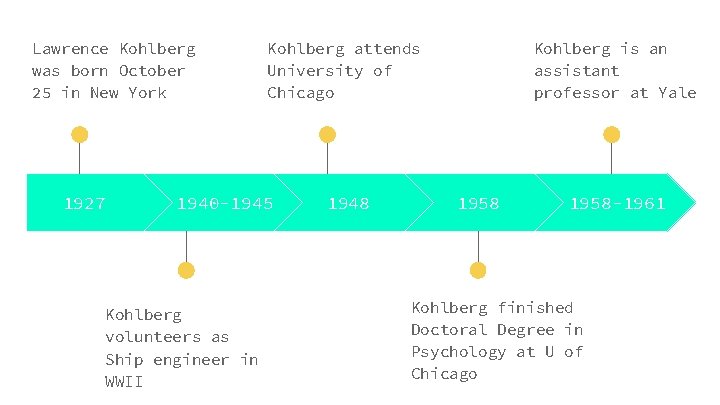
Lawrence Kohlberg was born October 25 in New York 1927 Kohlberg attends University of Chicago 1940 -1945 Kohlberg volunteers as Ship engineer in WWII 1948 Kohlberg is an assistant professor at Yale 1958 -1961 Kohlberg finished Doctoral Degree in Psychology at U of Chicago
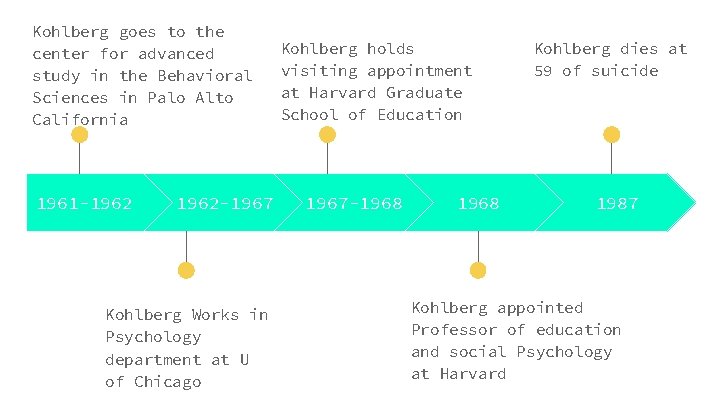
Kohlberg goes to the center for advanced study in the Behavioral Sciences in Palo Alto California 1961 -1962 -1967 Kohlberg Works in Psychology department at U of Chicago Kohlberg holds visiting appointment at Harvard Graduate School of Education 1967 -1968 Kohlberg dies at 59 of suicide 1987 Kohlberg appointed Professor of education and social Psychology at Harvard
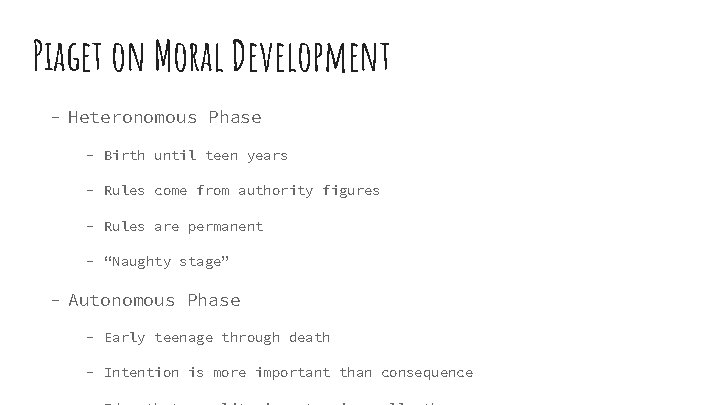
Piaget on Moral Development - Heteronomous Phase - Birth until teen years - Rules come from authority figures - Rules are permanent - “Naughty stage” - Autonomous Phase - Early teenage through death - Intention is more important than consequence
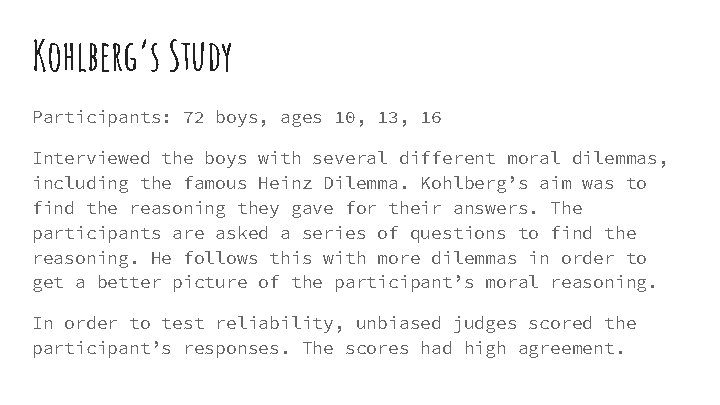
Kohlberg’s Study Participants: 72 boys, ages 10, 13, 16 Interviewed the boys with several different moral dilemmas, including the famous Heinz Dilemma. Kohlberg’s aim was to find the reasoning they gave for their answers. The participants are asked a series of questions to find the reasoning. He follows this with more dilemmas in order to get a better picture of the participant’s moral reasoning. In order to test reliability, unbiased judges scored the participant’s responses. The scores had high agreement.
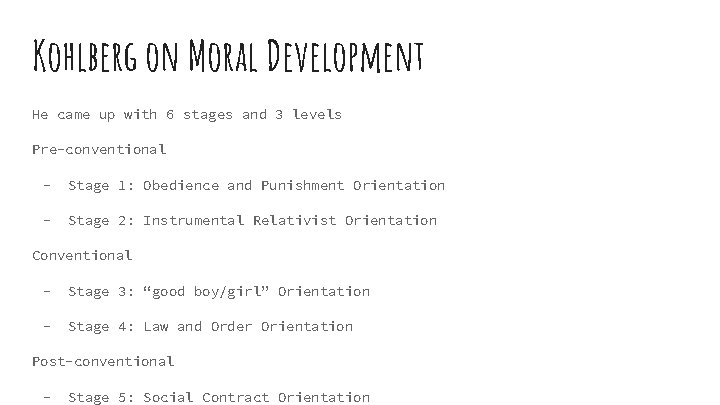
Kohlberg on Moral Development He came up with 6 stages and 3 levels Pre-conventional - Stage 1: Obedience and Punishment Orientation - Stage 2: Instrumental Relativist Orientation Conventional - Stage 3: “good boy/girl” Orientation - Stage 4: Law and Order Orientation Post-conventional - Stage 5: Social Contract Orientation
Gilligan Student of Kohlberg Developed opposing stages of development Studied morality in women
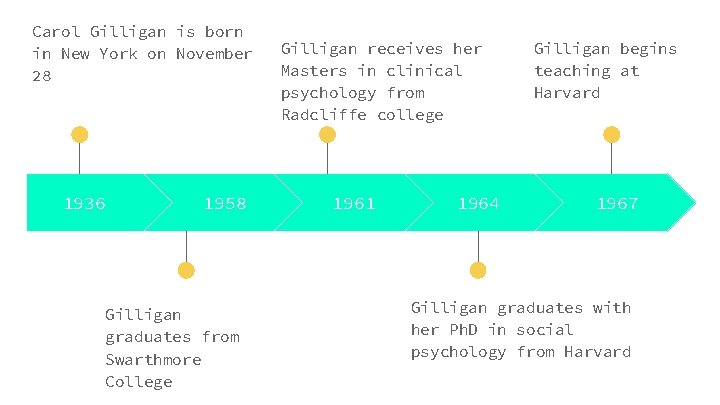
Carol Gilligan is born in New York on November 28 1936 1958 Gilligan graduates from Swarthmore College Gilligan receives her Masters in clinical psychology from Radcliffe college 1961 1964 Gilligan begins teaching at Harvard 1967 Gilligan graduates with her Ph. D in social psychology from Harvard
Gilligan and Kohlberg -criticizes Kohlberg for only working with boys/men -women often get stuck in stage 3 of Kohlberg’s scale -morality of rights vs morality of responsibility -Kohlberg implies that only women who leave the home and enter the male dominated world of the work place will they reach higher stages
Gilligan’s study She wondered why women were regularly scoring lower than men on moral tests. She believed that there could be a fundamental difference. She tested her theory using “reallife dilemmas”, one of her critiques of Kohlberg's study. She involved both genders as participants, though only adults were used. Examples of moral dilemmas she would talk to people about are divorce, abortion, and crime. She had men and women respond to questions based on specific and personal moral dilemmas such as these from their own life.
Gilligan’s findings She found that there was a relationship among “moral orientation” and gender. It was found that women operate more from a care perspective; whereas, males operate more from a justice perspective. Whether a person operated from a justice or care perspective was more applicable in real-life dilemmas. Women discussed care-perspective oriented dilemmas more than justice; males discussed justice-perspective oriented dilemmas more than care. Care perspective : act to avoid hurting others, understanding and reaching people on their level to help relationships Justice perspective equality : act according to what is fair, abiding by laws,
Gilligan’s phases of care perspective -Preconventional morality Focus on survival and self-interest -Conventional Focus on selflessness and caring about others -Post conventional Focus on responsibility for choice and control of own life coupled with care for others
Our Study Do children in Kohlberg’s pre -conventional stage of moral reasoning approach justice through a lens of caring or a lens of fairness? Is there a correlation between gender and the lens through which a child sees a moral dilemma?
Hypothesis The girls will lean toward an emotional lens and the boys will lean toward a justice lens.
Procedure We created a real moral dilemma for the children by putting them in a situation that promoted, but did not demand, sharing. We separated the girls and the boys to see if the different genders had an effect on the same scenario. We noted the conversations, actions, and expressions of each of the children. We then asked a set of questions to understand the lens they saw the situation through. 1. 3 girls/boys were sat down at a table. 2. 1 child is given 3 pencils and told the pencils are theirs and they may do what they would like with them. 3. The researchers then observed for 5 minutes. 4. At the end of the 5 minutes the children were debriefed, questioned, and given their own pencils
The experiment- Boys Boy 3, age 9 - given pencils and immediately, without hesitation shared with the other two boys Initially, all the boys were playing separately with the pencils. They all began to play together with the pencils and erasers. Boy 2, age 7, was slowly becoming more excluded from boy 1, age 9, and boy 3. Boy 1 and 3 were interacting, laughing, actively talking and making up pretend games with each other using the pencils and erasers. Boy 2 was attempting to join in but the other boys were not acknowledging him. Boy 1 and 3 were being imaginative and trying to interact with me. Boy 1 asked if he could trade pencils with boy 3, who responded, “no” to which boy 1 tried to take it and boy 3, who momentarily was annoyed but moved past it. Boy 2 sat there, watching boy 1 and 3, but not playing with his pencil.
The experiment- Girls -Girl 1, age 10, who was given the pencil looks confused, but keeps pencils -Girl 2, age 7, looks sad and whispers under her breath “I want the pencils” -The girls don’t speak for the first 3 minutes. Girl 1 puts the pencils in front of her and begins to read a book. The other 2 girls make no noise but have negative body language such as pouting with their head in their hands. -minute 3 - girl 3, age 8, playfully tries to take pencil. Girl 1 glares at her and girl 2 and 3 giggle. After a few seconds girl 3 tries again. She picks up the pencil, brings it toward her, then quickly puts it back. Girl 2 joins in with the other pencil. This continues 2 more times until girl 2 and 3 decide to keep the pencils. - minute 4. 5 girl 2 and 3 play and talk about pencils while girl 1 reads.
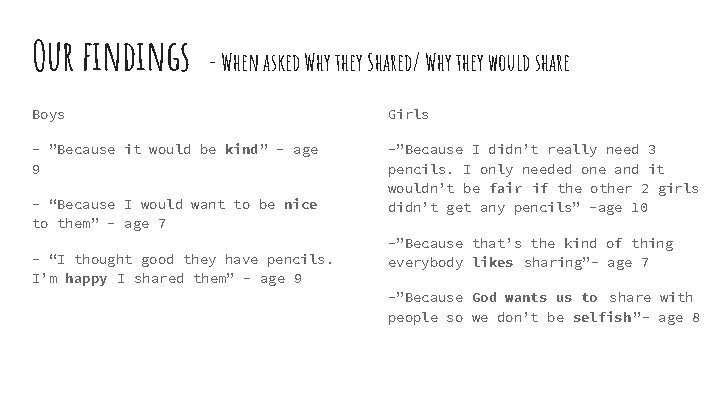
Our findings - When asked Why they Shared/ Why they would share Boys Girls - ”Because it would be kind” - age 9 -”Because I didn’t really need 3 pencils. I only needed one and it wouldn’t be fair if the other 2 girls didn’t get any pencils” -age 10 - “Because I would want to be nice to them” - age 7 - “I thought good they have pencils. I’m happy I shared them” - age 9 -”Because that’s the kind of thing everybody likes sharing”- age 7 -”Because God wants us to share with people so we don’t be selfish ”- age 8
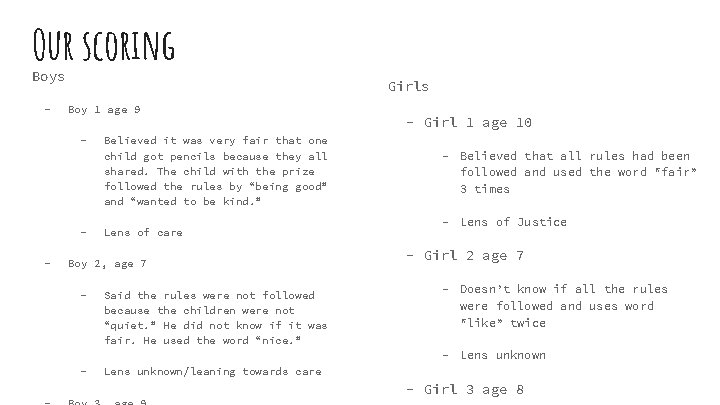
Our scoring Boys - Girls Boy 1 age 9 - - Believed it was very fair that one child got pencils because they all shared. The child with the prize followed the rules by “being good” and “wanted to be kind. ” Lens of care Boy 2, age 7 - - Said the rules were not followed because the children were not “quiet. ” He did not know if it was fair. He used the word “nice. ” - Girl 1 age 10 - Believed that all rules had been followed and used the word “fair” 3 times - Lens of Justice - Girl 2 age 7 - Doesn’t know if all the rules were followed and uses word “like” twice - Lens unknown/leaning towards care - Girl 3 age 8
Possible sources of Error - Number of participants - Boys and girls were in same room, though different tables - The children previously knew each other - The children varied in age - The children were confused/ shy about some questions
Conclusion We cannot conclude anything successfully from this study. Based on what we did find it appears that the boys lean toward a lens of caring and the girls lean toward a lens of justice. It is important to note that this finding may be due to the friendly nature of the boys compared to the stiff nature of the girls.
What we would do differently - More kids - Evaluate moral age before study - Work with groups in multiple stages and contrast - Separate children who are friends or have personal connection
- Slides: 23