
Koehler curves The Koehler curve defines the equilibrium
Koehler curves • The Koehler curve defines the equilibrium vapour humidity, RHeq, over a salt particle. • Different sized salt particles have different Koehler curves. • The important point is that the maxima on the Kohler curves decreases as the particle size increases. • Water condenses onto the particles when the ambient relative humidity is above the equilibrium humidity and vice-versa. • If the equilibrium humidity increases with particle size then the particles are stable for RH>RHeq: an increase in particle size leads to an increase in RHeq, until RH=RHeq. • If the equilibrium humidity decreases with particle size then the particles are unstable for RH>RHeq: an increase in particle size leads to a decrease in RHeq and particles grow into cloud drops. • Thus when a particle `gets over the maximum’ we say it has ‘activated into a cloud drop’. • This leads to interesting competition between particles
Consider the following scenario • Air containing water vapour with RH=0. 9 and a distribution of salt particles cools adiabatically in the atmosphere. • The air saturates and the salt particles grow as the humidity increases. • The air becomes supersaturated and some of the salt particles (the larger ones with lower maximum RHeq) activate into cloud drops.
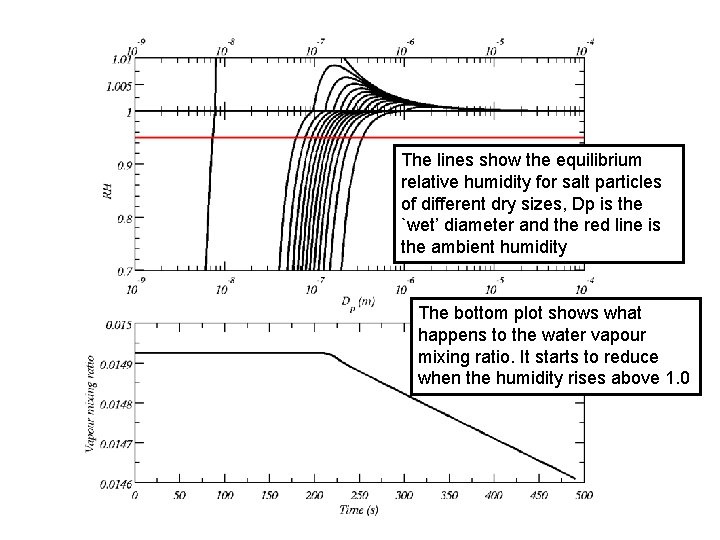
The lines show the equilibrium relative humidity for salt particles of different dry sizes, Dp is the `wet’ diameter and the red line is the ambient humidity The bottom plot shows what happens to the water vapour mixing ratio. It starts to reduce when the humidity rises above 1. 0
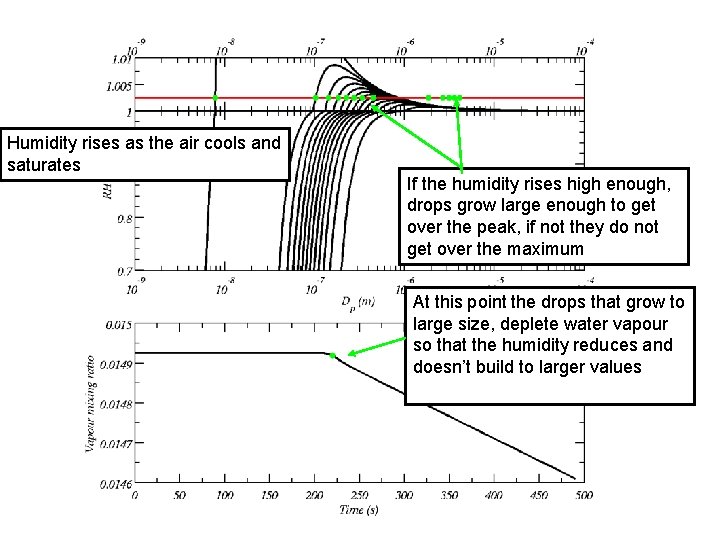
Humidity rises as the air cools and saturates If the humidity rises high enough, drops grow large enough to get over the peak, if not they do not get over the maximum At this point the drops that grow to large size, deplete water vapour so that the humidity reduces and doesn’t build to larger values
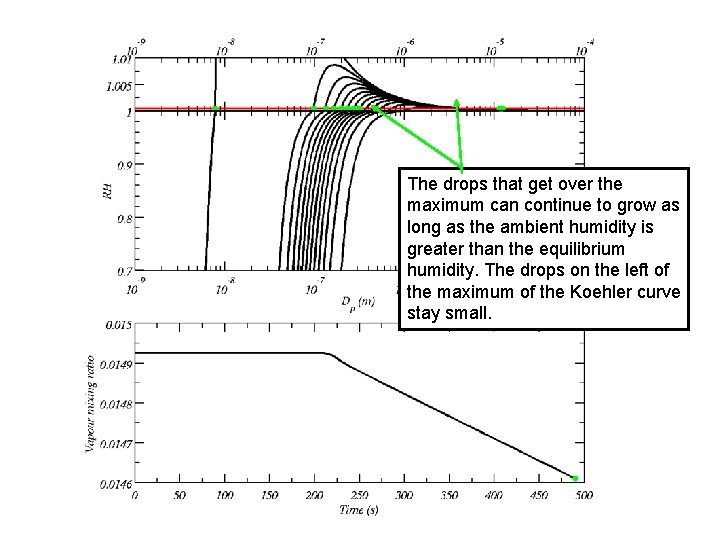
The drops that get over the maximum can continue to grow as long as the ambient humidity is greater than the equilibrium humidity. The drops on the left of the maximum of the Koehler curve stay small.
- Slides: 5