
KNX base components Content Basic characteristics 4 basic
KNX – base components
Content ● Basic characteristics ● 4 basic components ● System devices ● Bus line cable ● Sensors ● Actuators ● KNX software ETS Schneider Electric - IS&C – Aug. 2008 2
Basic characteristics ● KNX is a decentralized, event-controlled bus system with serial data transmission for the controlling, monitoring and signaling of operational functions in a building control network. ● All connected bus devices can exchange data between each other, packed into a telegram and sent over the bus, e. g. from a sensor (the command output) to one or more actuators (the command receiver). Schneider Electric - IS&C – Aug. 2008 3
Basic characteristics ● Today 80 - 90 % of the actual KNX products are using TP (Twisted pair) as communication media. ● A rising importance of IP (Ethernet) as a communication media for KNX can be noticed. Here KNX telegrams will be transmitted encapsulated in IP telegrams for LAN networks as well as the Internet. ● TP bus voltage: DC 24 V SELV (device working range 30 – 20 V) ● TP data transmission speed: 9. 6 kbit/s Schneider Electric - IS&C – Aug. 2008 4
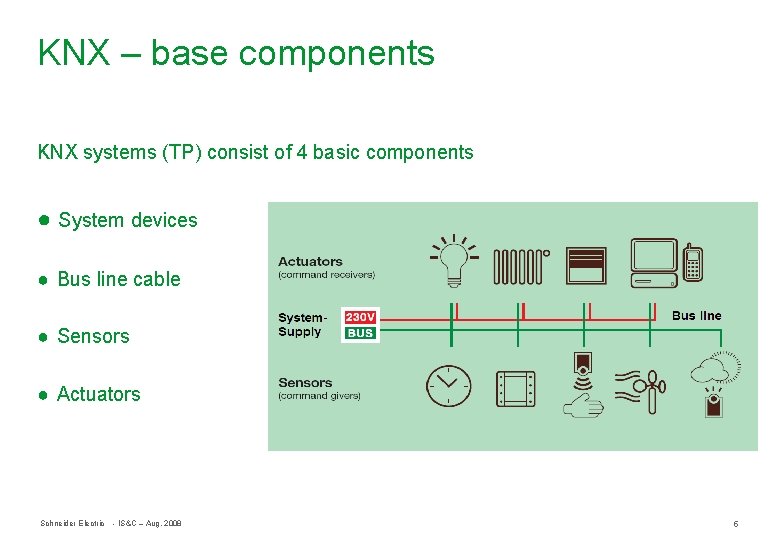
KNX – base components KNX systems (TP) consist of 4 basic components ● System devices ● Bus line cable ● Sensors ● Actuators Schneider Electric - IS&C – Aug. 2008 5
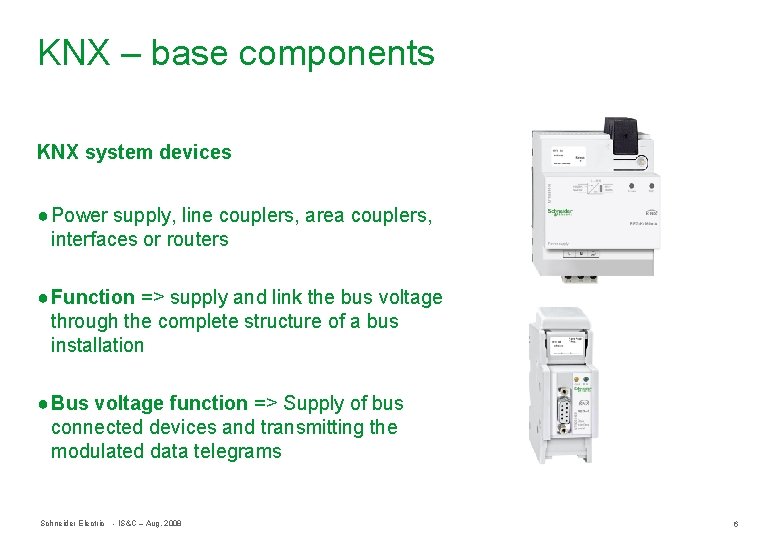
KNX – base components KNX system devices ● Power supply, line couplers, area couplers, interfaces or routers ● Function => supply and link the bus voltage through the complete structure of a bus installation ● Bus voltage function => Supply of bus connected devices and transmitting the modulated data telegrams Schneider Electric - IS&C – Aug. 2008 6
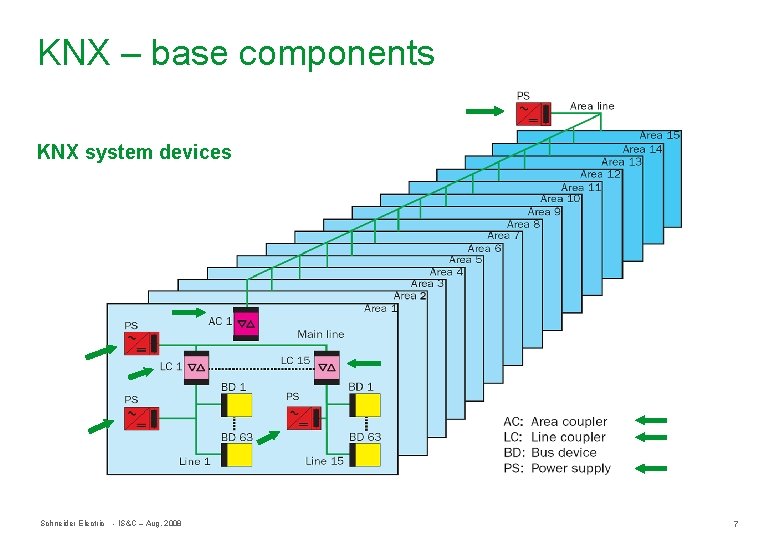
KNX – base components KNX system devices Schneider Electric - IS&C – Aug. 2008 7
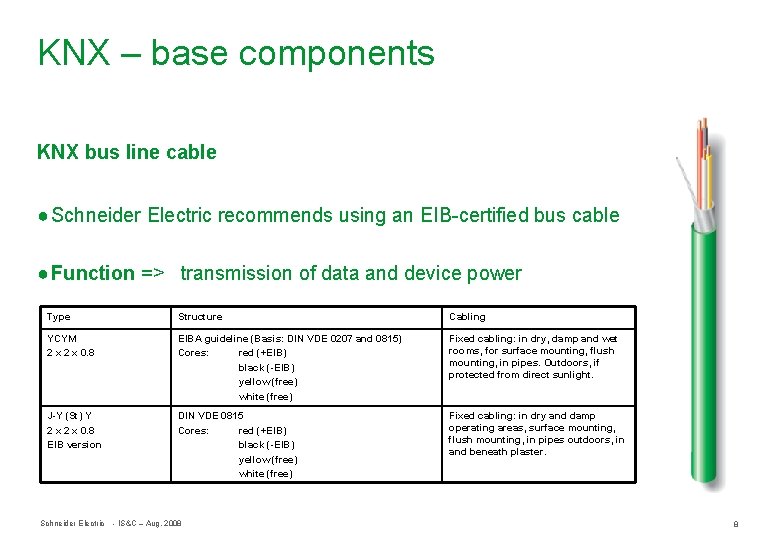
KNX – base components KNX bus line cable ● Schneider Electric recommends using an EIB-certified bus cable ● Function => transmission of data and device power Type Structure Cabling YCYM 2 x 0. 8 EIBA guideline (Basis: DIN VDE 0207 and 0815) Cores: red (+EIB) black (-EIB) yellow (free) white (free) Fixed cabling: in dry, damp and wet rooms, for surface mounting, flush mounting, in pipes. Outdoors, if protected from direct sunlight. J-Y (St) Y 2 x 0. 8 EIB version DIN VDE 0815 Cores: red (+EIB) black (-EIB) yellow (free) white (free) Fixed cabling: in dry and damp operating areas, surface mounting, flush mounting, in pipes outdoors, in and beneath plaster. Schneider Electric - IS&C – Aug. 2008 8
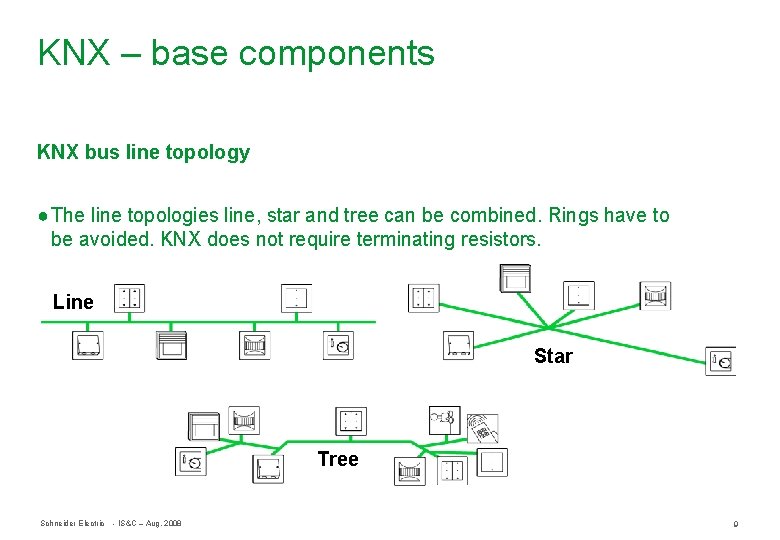
KNX – base components KNX bus line topology ● The line topologies line, star and tree can be combined. Rings have to be avoided. KNX does not require terminating resistors. Line Star Tree Schneider Electric - IS&C – Aug. 2008 9
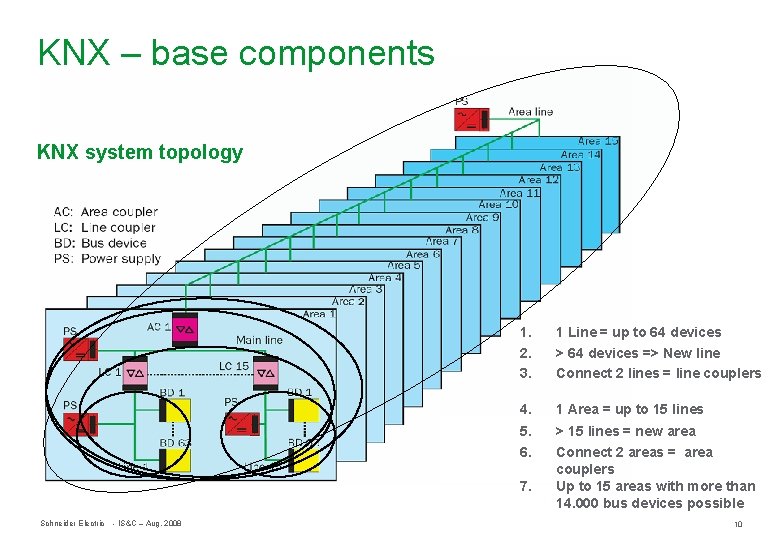
KNX – base components KNX system topology 1. 1 Line = up to 64 devices 2. 3. > 64 devices => New line Connect 2 lines = line couplers 4. 1 Area = up to 15 lines 5. > 15 lines = new area 6. Connect 2 areas = area couplers Up to 15 areas with more than 14. 000 bus devices possible 7. Schneider Electric - IS&C – Aug. 2008 10
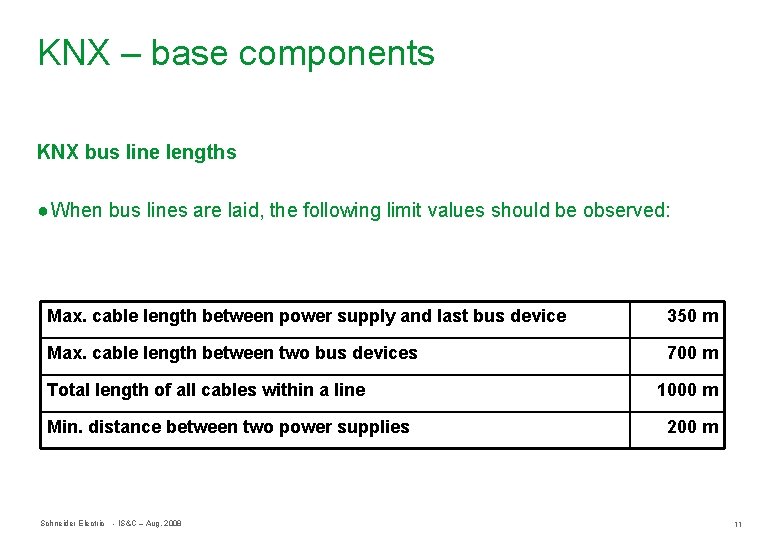
KNX – base components KNX bus line lengths ● When bus lines are laid, the following limit values should be observed: Max. cable length between power supply and last bus device 350 m Max. cable length between two bus devices 700 m Total length of all cables within a line Min. distance between two power supplies Schneider Electric - IS&C – Aug. 2008 1000 m 200 m 11
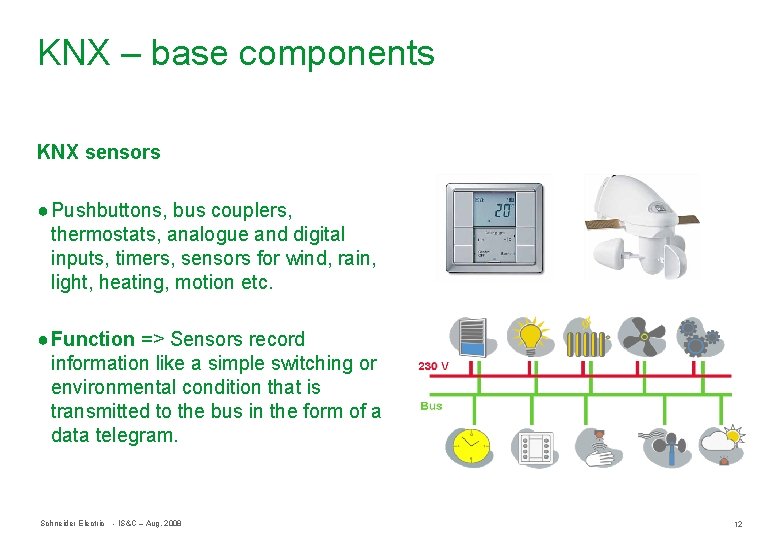
KNX – base components KNX sensors ● Pushbuttons, bus couplers, thermostats, analogue and digital inputs, timers, sensors for wind, rain, light, heating, motion etc. ● Function => Sensors record information like a simple switching or environmental condition that is transmitted to the bus in the form of a data telegram. Schneider Electric - IS&C – Aug. 2008 12
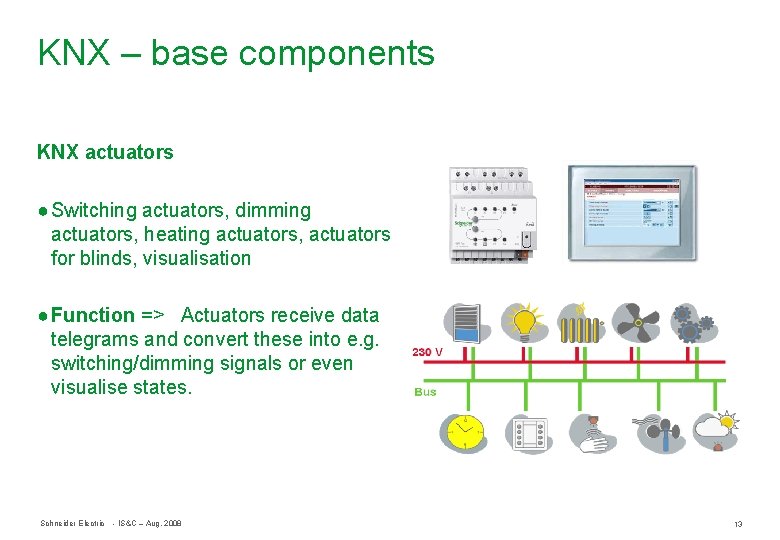
KNX – base components KNX actuators ● Switching actuators, dimming actuators, heating actuators, actuators for blinds, visualisation ● Function => Actuators receive data telegrams and convert these into e. g. switching/dimming signals or even visualise states. Schneider Electric - IS&C – Aug. 2008 13
KNX – base components KNX software ETS ● The manufacturer independent Engineering Tool Software enables to project, commission, document and diagnose a KNX installation. ● The device-function related application programs are part of the free available manufacturer product database. They are loaded into the devices by the ETS via the serial interface of a PC and the bus. ● Besides a onetime fee for the ETS-tool, no additional costs for projecting and commissioning will be charged. ● => By now more than 15. 000 ETS-licenses sold! Schneider Electric - IS&C – Aug. 2008 14
KNX: The World`s Only Open Standard for Home and Building Control Make the most of your energy! Schneider Electric - IS&C – Aug. 2008 15
- Slides: 15