
Knowledgebased approach to Winograd Schema Challenge Igor Boguslavsky
Knowledge-based approach to Winograd Schema Challenge Igor Boguslavsky, Tatiana Frolova, Leonid Iomdin, Alexander Lazursky, Ivan Rygaev, Svetlana Timoshenko Presented by Ivan Rygaev (irygaev@gmail. com) Laboratory of Computational Linguistics Institute for Information Transmission Problems RAS, Moscow, Russia Supported by RSF grant No. 16 -18 -10422 -P Ivan Rygaev | Dialogue 2019 1
Knowledge-based approach to Winograd Schema Challenge Abstract We propose a method to resolve anaphoric pronouns in the framework of Winograd Schema Challenge (WSC) by means of Sem. ETAP – a knowledge-based semantic analyzer. Ivan Rygaev | Dialogue 2019
Knowledge-based approach to Winograd Schema Challenge Table of contents • • Winograd Schema Challenge Related work Sem. ETAP semantic analyzer Our approach to WSC Ivan Rygaev | Dialogue 2019
Knowledge-based approach to Winograd Schema Challenge Table of contents • • Winograd Schema Challenge Related work Sem. ETAP semantic analyzer Our approach to WSC Ivan Rygaev | Dialogue 2019
Knowledge-based approach to Winograd Schema Challenge Turing test criticism • Turing Test was formally passed by a chat-bot Eugene Goostman in 2014 • But does the chat-bot think? • Is conversation the right way of evaluation? – Subjective – Encourage verbal acrobatics and trickery • Turing Test requires deception – Must fool an interrogator that it is a person – Do we need this from an intelligent machine? For which purposes? Ivan Rygaev | Dialogue 2019
Knowledge-based approach to Winograd Schema Challenge Winograd schemas • A better test was proposed in Levesque 2011 • The trophy doesn’t fit in the brown suitcase because it’s too big. What is too big? – the trophy – the suitcase • Joan made sure to thank Susan for all the help she had given. Who had given the help? – Joan – Susan • Terry Winograd provided the first example in 1970 Ivan Rygaev | Dialogue 2019
Knowledge-based approach to Winograd Schema Challenge Winograd schema structure • Anaphora resolution problem • There are two potential antecedents in the sentence • Linguistic features, collocation statistics and selectional restrictions do not help much • Changing a special word in the sentence reverts the correct answer (big -> small) • The trophy doesn’t fit in the brown suitcase because it’s too small. What is too small? – the trophy – the suitcase Ivan Rygaev | Dialogue 2019
Knowledge-based approach to Winograd Schema Challenge Commonsense knowledge • People are good on Windograd Schemas – Tests show 91 -92% “correct” answers • What is required to get the right answer? • Understanding of the verb ‘fit’ – if A fits into B then A must be smaller than B. • Understanding of the connective ‘because’ – Changing it to ‘in spite of’ also reverts the answer. • Implicit information must be extracted from the text to pass the test Ivan Rygaev | Dialogue 2019
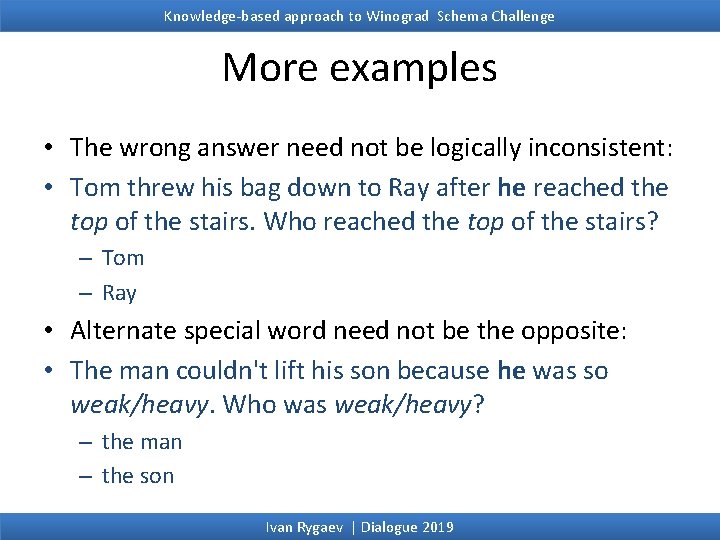
Knowledge-based approach to Winograd Schema Challenge More examples • The wrong answer need not be logically inconsistent: • Tom threw his bag down to Ray after he reached the top of the stairs. Who reached the top of the stairs? – Tom – Ray • Alternate special word need not be the opposite: • The man couldn't lift his son because he was so weak/heavy. Who was weak/heavy? – the man – the son Ivan Rygaev | Dialogue 2019
Knowledge-based approach to Winograd Schema Challenge Competition • The first competition was held in July 2016 at IJCAI conference in New York • It was organized in two rounds: 1. Sentences from real texts (children's literature) rather than constructed ones. They exhibited all the properties of WS but did not have an alternative variant. 2. Actual constructed WSs with an alternative variant • Motivation for two rounds: – Not to reveal WSs to contestants who are not ready yet – Increase relevance of the test by using real examples Ivan Rygaev | Dialogue 2019

Knowledge-based approach to Winograd Schema Challenge Competition • There were 60 questions in the first round and 60 in the second one. – To proceed to the second round a contestant had to score at least 90% correct in the first one. • None of the solutions achieved that score – The second round was not held • The big prize was offered to the team who would achieve at least 90% in both rounds – Three smaller prizes were offered to the top programs achieved at least 65% in the first round Ivan Rygaev | Dialogue 2019
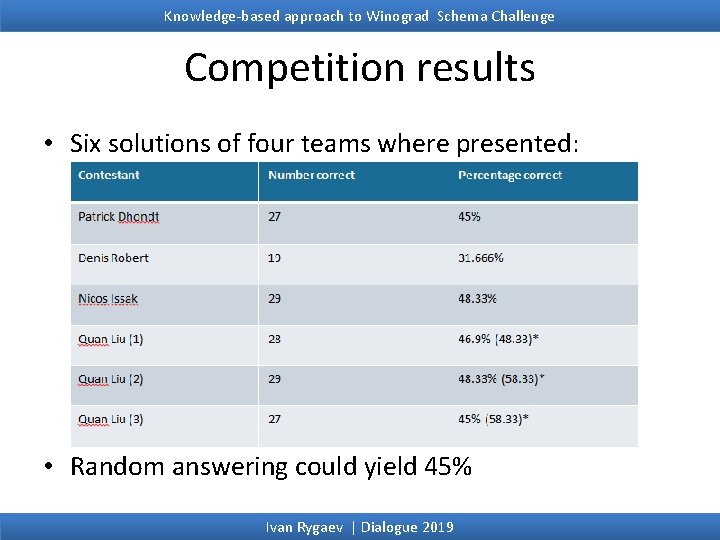
Knowledge-based approach to Winograd Schema Challenge Competition results • Six solutions of four teams where presented: • Random answering could yield 45% Ivan Rygaev | Dialogue 2019
Knowledge-based approach to Winograd Schema Challenge Competition results assessment • None of the solutions got over the 65% threshold to receive even the smaller prize • Four of the six programs showed scores around the chance level or even worse • The next test had been scheduled for AAAI-2018 (Feb), but it was cancelled – Several participants dropped out at the last minute • Text understanding by machines is an unsolved task yet Ivan Rygaev | Dialogue 2019
Knowledge-based approach to Winograd Schema Challenge Table of contents • • Winograd Schema Challenge Related work Sem. ETAP semantic analyzer Our approach to WSC Ivan Rygaev | Dialogue 2019
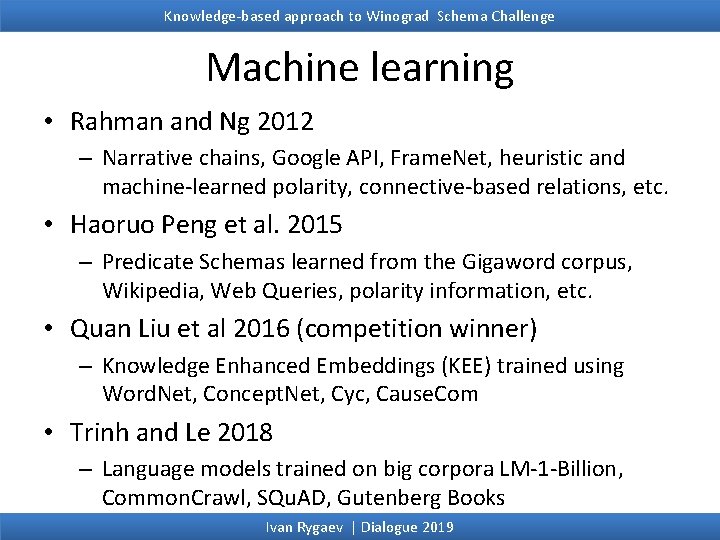
Knowledge-based approach to Winograd Schema Challenge Machine learning • Rahman and Ng 2012 – Narrative chains, Google API, Frame. Net, heuristic and machine-learned polarity, connective-based relations, etc. • Haoruo Peng et al. 2015 – Predicate Schemas learned from the Gigaword corpus, Wikipedia, Web Queries, polarity information, etc. • Quan Liu et al 2016 (competition winner) – Knowledge Enhanced Embeddings (KEE) trained using Word. Net, Concept. Net, Cyc, Cause. Com • Trinh and Le 2018 – Language models trained on big corpora LM-1 -Billion, Common. Crawl, SQu. AD, Gutenberg Books Ivan Rygaev | Dialogue 2019
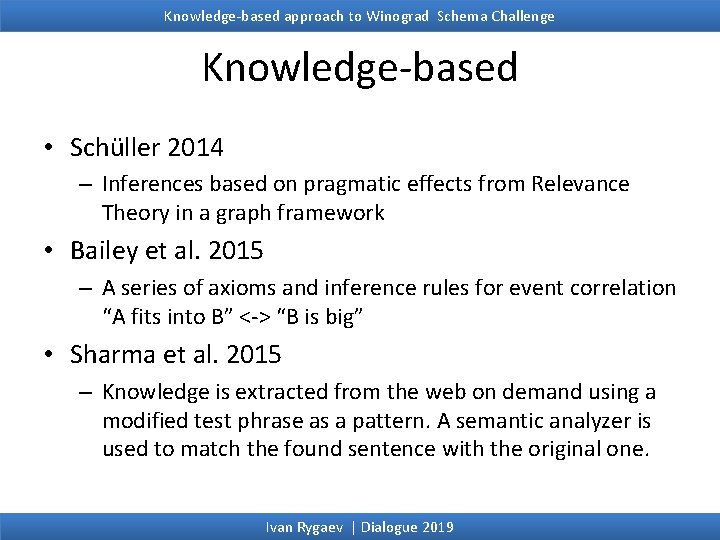
Knowledge-based approach to Winograd Schema Challenge Knowledge-based • Schüller 2014 – Inferences based on pragmatic effects from Relevance Theory in a graph framework • Bailey et al. 2015 – A series of axioms and inference rules for event correlation “A fits into B” <-> “B is big” • Sharma et al. 2015 – Knowledge is extracted from the web on demand using a modified test phrase as a pattern. A semantic analyzer is used to match the found sentence with the original one. Ivan Rygaev | Dialogue 2019
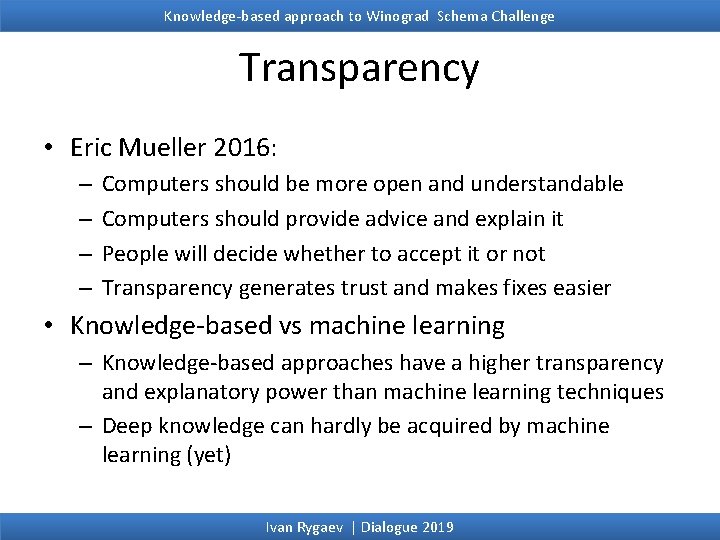
Knowledge-based approach to Winograd Schema Challenge Transparency • Eric Mueller 2016: – – Computers should be more open and understandable Computers should provide advice and explain it People will decide whether to accept it or not Transparency generates trust and makes fixes easier • Knowledge-based vs machine learning – Knowledge-based approaches have a higher transparency and explanatory power than machine learning techniques – Deep knowledge can hardly be acquired by machine learning (yet) Ivan Rygaev | Dialogue 2019
Knowledge-based approach to Winograd Schema Challenge Table of contents • • Winograd Schema Challenge Related work Sem. ETAP semantic analyzer Our approach to WSC Ivan Rygaev | Dialogue 2019
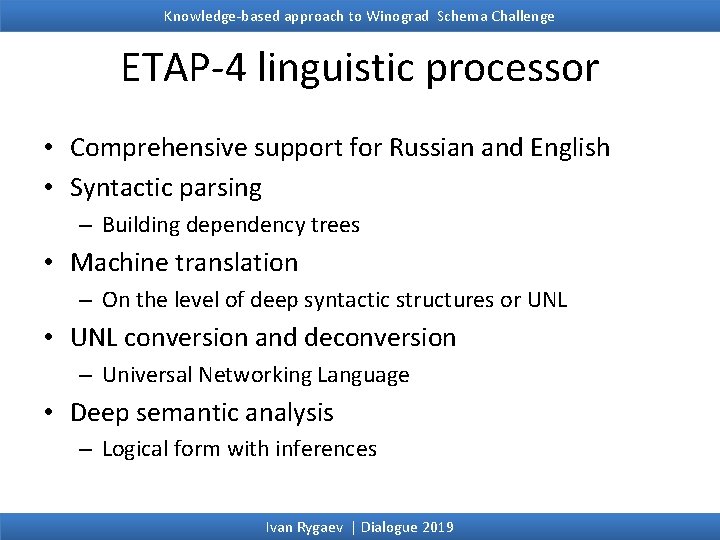
Knowledge-based approach to Winograd Schema Challenge ETAP-4 linguistic processor • Comprehensive support for Russian and English • Syntactic parsing – Building dependency trees • Machine translation – On the level of deep syntactic structures or UNL • UNL conversion and deconversion – Universal Networking Language • Deep semantic analysis – Logical form with inferences Ivan Rygaev | Dialogue 2019
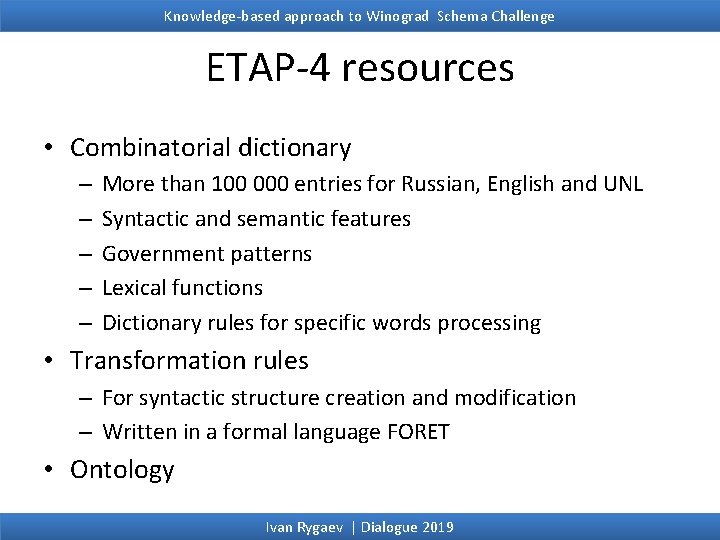
Knowledge-based approach to Winograd Schema Challenge ETAP-4 resources • Combinatorial dictionary – – – More than 100 000 entries for Russian, English and UNL Syntactic and semantic features Government patterns Lexical functions Dictionary rules for specific words processing • Transformation rules – For syntactic structure creation and modification – Written in a formal language FORET • Ontology Ivan Rygaev | Dialogue 2019
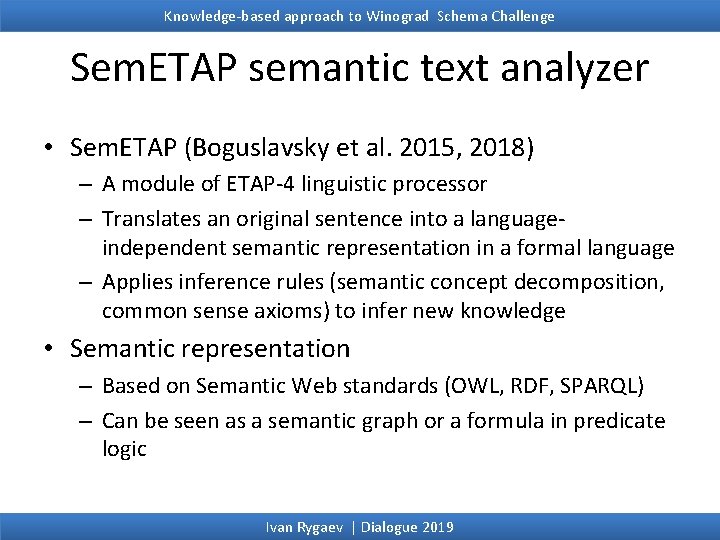
Knowledge-based approach to Winograd Schema Challenge Sem. ETAP semantic text analyzer • Sem. ETAP (Boguslavsky et al. 2015, 2018) – A module of ETAP-4 linguistic processor – Translates an original sentence into a languageindependent semantic representation in a formal language – Applies inference rules (semantic concept decomposition, common sense axioms) to infer new knowledge • Semantic representation – Based on Semantic Web standards (OWL, RDF, SPARQL) – Can be seen as a semantic graph or a formula in predicate logic Ivan Rygaev | Dialogue 2019
Knowledge-based approach to Winograd Schema Challenge Sem. ETAP resources • Linguistic modules and resources – Reused from ETAP-4 itself • Ontology • Repository of individuals • Inference rules – The depth of understanding grows with the number of inferences we can draw from the text – More inferences mean better understanding Ivan Rygaev | Dialogue 2019
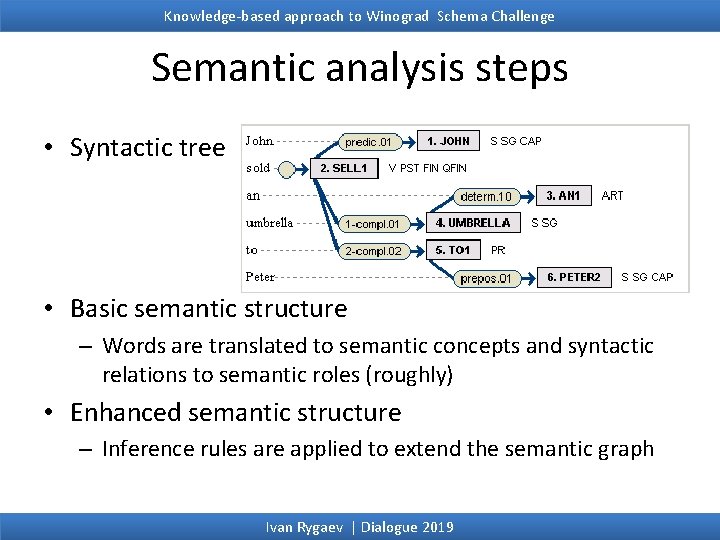
Knowledge-based approach to Winograd Schema Challenge Semantic analysis steps • Syntactic tree • Basic semantic structure – Words are translated to semantic concepts and syntactic relations to semantic roles (roughly) • Enhanced semantic structure – Inference rules are applied to extend the semantic graph Ivan Rygaev | Dialogue 2019
Knowledge-based approach to Winograd Schema Challenge Inference rules • Declarative rules – In the form of implication (if-then) • Written in Etalog formal language (Rygaev 2018) – Datalog± (semantically) compatible language – Requires minimal mathematical background – Syntax made closer to natural language • More than 400 rules at the moment – Most of them are concept decomposition rules – Similar to word definitions in an explanatory dictionary but in a formal language Ivan Rygaev | Dialogue 2019
Knowledge-based approach to Winograd Schema Challenge Event decomposition • Preconditions – Ivan bought a book from Masha -> Masha had a book • Results – Ivan bought a book from Masha -> Ivan has a book • Subevents – Ivan bought a book from Masha -> Masha gave Ivan a book • Presuppositions – Ivan does not know that Peter arrived -> Peter arrived • Participants objectives & attitudes – Ivan defeated Peter -> Good for Ivan, bad for Peter Ivan Rygaev | Dialogue 2019
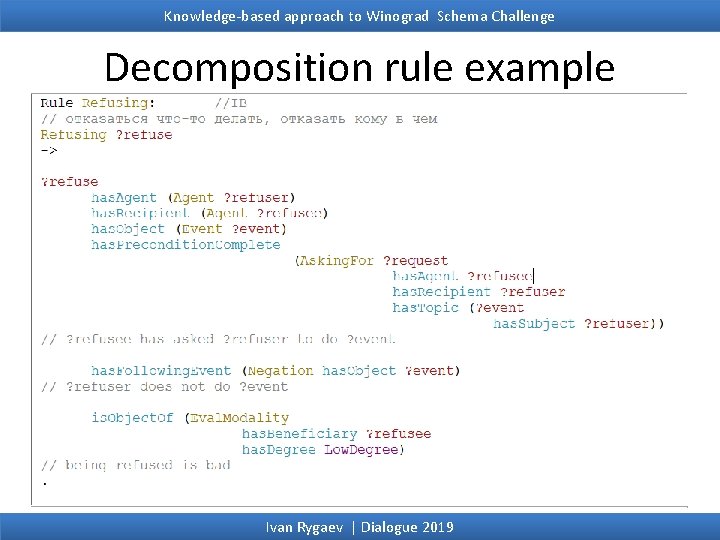
Knowledge-based approach to Winograd Schema Challenge Decomposition rule example Ivan Rygaev | Dialogue 2019
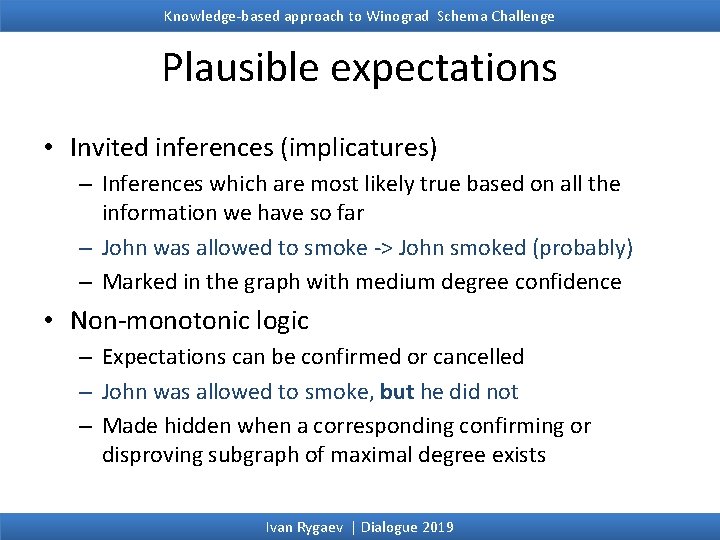
Knowledge-based approach to Winograd Schema Challenge Plausible expectations • Invited inferences (implicatures) – Inferences which are most likely true based on all the information we have so far – John was allowed to smoke -> John smoked (probably) – Marked in the graph with medium degree confidence • Non-monotonic logic – Expectations can be confirmed or cancelled – John was allowed to smoke, but he did not – Made hidden when a corresponding confirming or disproving subgraph of maximal degree exists Ivan Rygaev | Dialogue 2019
Knowledge-based approach to Winograd Schema Challenge Table of contents • • Winograd Schema Challenge Related work Sem. ETAP semantic analyzer Our approach to WSC Ivan Rygaev | Dialogue 2019
Knowledge-based approach to Winograd Schema Challenge Semantic consistency • Our approach to WSC – Build two variants of the enhanced semantic structure – one for each potential antecedent – Check which variant is more consistent • Consistency definition – Consistent variant contains the same or unifiable subgraph more than once – Two different parts of the sentence produce the same (unifiable) inference Ivan Rygaev | Dialogue 2019
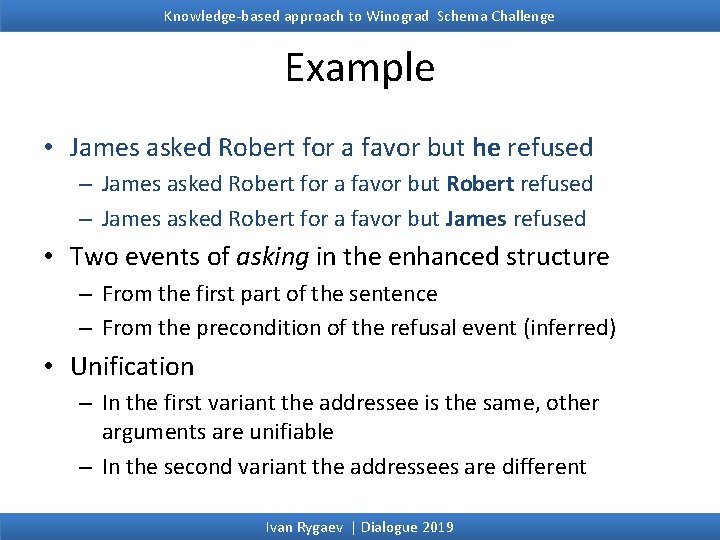
Knowledge-based approach to Winograd Schema Challenge Example • James asked Robert for a favor but he refused – James asked Robert for a favor but Robert refused – James asked Robert for a favor but James refused • Two events of asking in the enhanced structure – From the first part of the sentence – From the precondition of the refusal event (inferred) • Unification – In the first variant the addressee is the same, other arguments are unifiable – In the second variant the addressees are different Ivan Rygaev | Dialogue 2019
Knowledge-based approach to Winograd Schema Challenge Experimental results • We carried out two series of experiments: – On a development corpus of Winograd schemas – On a test corpus of Winograd schemas • Development corpus – Open WSs phrases translated into Russian – Were open to us while developing the algorithm and populating the knowledge • Test corpus – Phrases were not revealed but the lexicon was known and description for the missing part was added to the system Ivan Rygaev | Dialogue 2019
Knowledge-based approach to Winograd Schema Challenge Development corpus results • Examples: – – The perch swallowed the worm, it was hungry/tasty Peter gave Ivan a candy, because he was (not) hungry Peter knocked at Ivan’s door, but he didn’t (receive a) reply Ivan offended Peter so we defended/punished him • Results – In most phrases the antecedents were identified correctly – Explanation is understandable by humans • Conclusion – The algorithm solves WSC if accurate knowledge is given Ivan Rygaev | Dialogue 2019
Knowledge-based approach to Winograd Schema Challenge Test corpus results • Examples: – – Peter gave money to Ivan, because he was poor/rich Peter defeated Kolya because he played well/poorly John got angry at Bill, although he is kind (was not guilty) Vasya begged Ivan to stay at home but he refused/failed • Results – Only 54% of antecedents were identified correctly, which is not much but still noticeably more than the random choice – All failures were due to the incomplete knowledge • Conclusion – It is hard to explicate all details without seeing the phrases Ivan Rygaev | Dialogue 2019
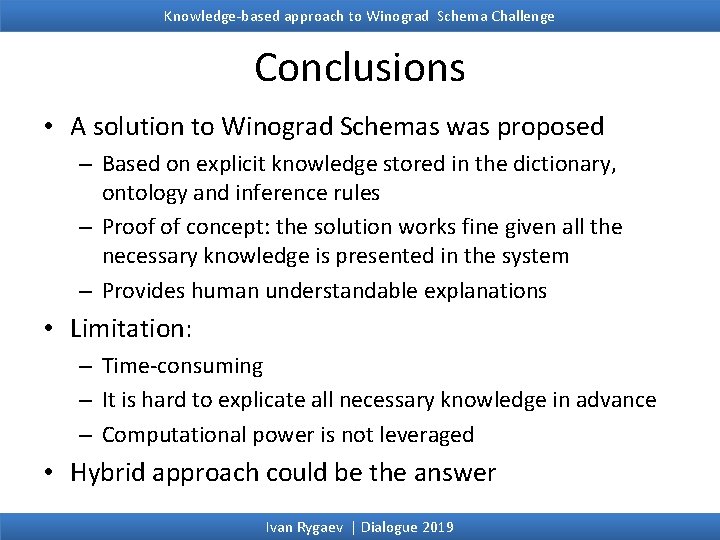
Knowledge-based approach to Winograd Schema Challenge Conclusions • A solution to Winograd Schemas was proposed – Based on explicit knowledge stored in the dictionary, ontology and inference rules – Proof of concept: the solution works fine given all the necessary knowledge is presented in the system – Provides human understandable explanations • Limitation: – Time-consuming – It is hard to explicate all necessary knowledge in advance – Computational power is not leveraged • Hybrid approach could be the answer Ivan Rygaev | Dialogue 2019
Knowledge-based approach to Winograd Schema Challenge References 1. Bailey D. , A. Harrison, Yu. Lierler, V. Lifschitz, and J. Michael. (2015), The Winograd schema challenge and reasoning about correlation. In: Working Notes of the Symposium on Logical Formalizations of Commonsense Reasoning. 2. Boguslavsky I. , V. Dikonov, L. Iomdin, A. Lazursky, V. Sizov, S. Timoshenko. (2015), Semantic Analysis and Question Answering: a System Under Development. In: Computational Linguistics and Intellectual Technologies. Papers from the Annual International Conference “Dialogue” (2015), p. 62. 3. Boguslavsky I. , Frolova T. , Iomdin L. , Lazursky A. , Rygaev I. , Timoshenko S. (2018), Semantic analysis with inference: high spots of the football match. Computational Linguistics and Intellectual Technologies: Proceedings of the International Conference “Dialogue 2018”, Moscow, May 30—June 2. 4. Haoruo Peng, Daniel Khashabi, and Dan Roth. (2015), Solving hard coreference problems. In: Proceedings of the 2015 Conference of the North American Chapter of the Association for Computational Linguistics: Human Language Technologies, pages 809– 819. 5. Levesque H. (2011), The Winograd Schema Challenge. In: AAAI Spring Symposium: Logical Formalizations of Commonsense Reasoning. 6. Mueller E. (2016), Transparent Computers: Designing Understandable Intelligent Systems. Createspace Independent Publishers. Ivan Rygaev | Dialogue 2019
Knowledge-based approach to Winograd Schema Challenge References 7. Quan Liu, Hui Jiang, Zhen-Hua Ling, Xiaodan Zhu, Si Wei, Yu Hu. (2016), Combing Context and Commonsense Knowledge Through Neural Networks for Solving. Winograd Schema Problems. ar. Xiv: 1611. 04146 v 1 [cs. AI] 13 Nov 2016. 8. Rahman A. , V. Ng. (2012), Resolving complex cases of definite pronouns: the Winograd schema challenge. In: Proceedings of the 2012 Joint Conference on Empirical Methods in Natural Language Processing and Computational Natural Language Learning, pages 777– 789. Association for Computational Linguistics. 9. Rygaev I. (2018), Etalog - a natural-looking knowledge representation formalism // Proceedings of ITa. S 2018 School and Conference (http: //itas 2018. iitp. ru/media/papers/1570472169. pdf). 10. Schu ller P. (2014), Tackling Winograd schemas by formalizing relevance theory in knowledge graphs. In: Fourteenth International Conference on the Principles of Knowledge Representation and Reasoning. 11. Sharma A. , Nguyen Ha Vo, Somak Aditya, and Chitta Baral. (2015), Towards addressing the Winograd schema challenge-building and using a semantic parser and a knowledge hunting module. In IJCAI, pages 1319– 1325. 12. Trieu H. Trinh, Quoc V. Le. (2018), A Simple Method for Commonsense Reasoning. ar. Xiv: 1806. 02847 v 1 [cs. AI] 7 Jun 2018 Ivan Rygaev | Dialogue 2019
Knowledge-based approach to Winograd Schema Challenge Thank you for your attention! Questions? Ask now or send an email to irygaev@gmail. com Ivan Rygaev | Dialogue 2019
- Slides: 37