
KnowledgeBased Agents Chapter 7 1 7 3 Some
Knowledge-Based Agents Chapter 7. 1 -7. 3 Some material adopted from notes by Andreas Geyer-Schulz and Chuck Dyer
Big Idea • Drawing reasonable conclusions from a set of data (observations, beliefs, etc. ) seems key to intelligence • Logic is a powerful and well developed approach to this and highly regarded by people • Logic is also a strong formal system that we can programs computers to use • We can solve some AI problems by representing them in logic and applying standard proof techniques to generate solutions
Inference in People • People can do logical inference, but are not very good at it • Reasoning with negation and disjunction seems to be particularly difficult • But, people seem to employ many kinds of reasoning strategies, most of which are neither complete nor sound 3
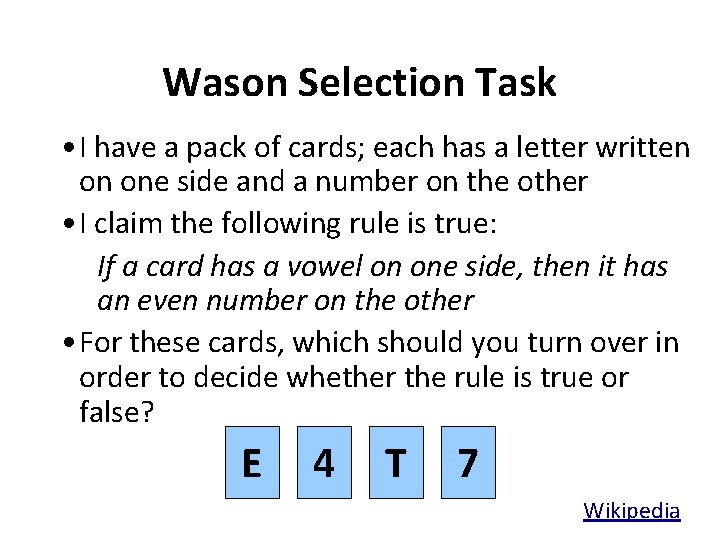
Wason Selection Task • I have a pack of cards; each has a letter written on one side and a number on the other • I claim the following rule is true: If a card has a vowel on one side, then it has an even number on the other • For these cards, which should you turn over in order to decide whether the rule is true or false? E 4 T 7 Wikipedia
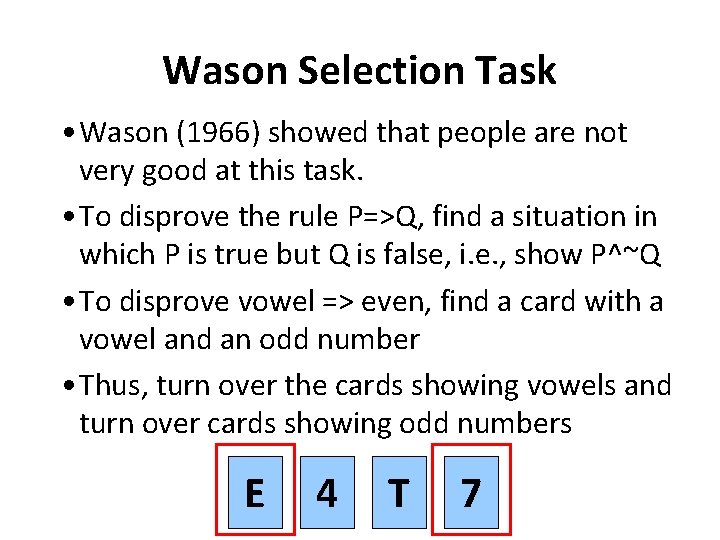
Wason Selection Task • Wason (1966) showed that people are not very good at this task. • To disprove the rule P=>Q, find a situation in which P is true but Q is false, i. e. , show P^~Q • To disprove vowel => even, find a card with a vowel and an odd number • Thus, turn over the cards showing vowels and turn over cards showing odd numbers E 4 T 7
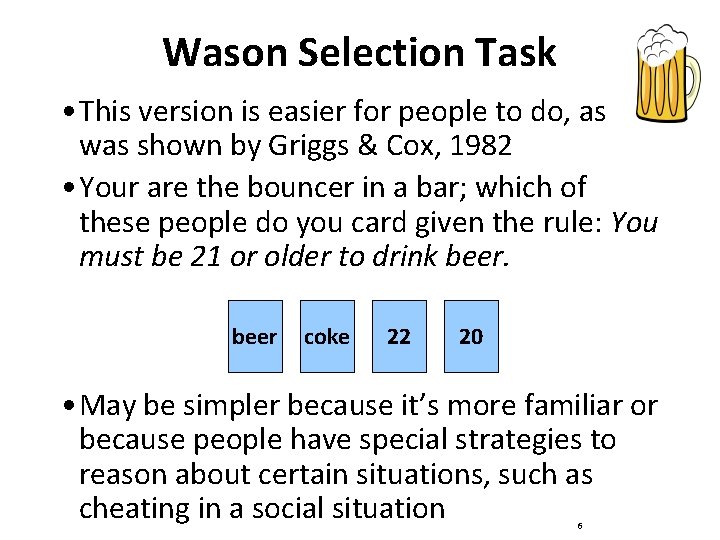
Wason Selection Task • This version is easier for people to do, as was shown by Griggs & Cox, 1982 • Your are the bouncer in a bar; which of these people do you card given the rule: You must be 21 or older to drink beer coke 22 20 • May be simpler because it’s more familiar or because people have special strategies to reason about certain situations, such as cheating in a social situation 6
Negation in Natural Language • We often model the meaning of natural language sentences as a logic statements • This maps these into equivalent statements – All elephants are gray – No elephant are not gray • Double negation is common in informal language: that won’t do you no good • But what does this mean: we cannot underestimate the importance of logic
Logic as a Methodology Even if people don’t use formal logical reasoning for solving a problem, logic might be a good approach for AI for a number of reasons – Airplanes don’t need to flap their wings – Logic may be a good implementation strategy – Solution in a formal system can offer other benefits, e. g. , letting us prove properties of the approach • See neats vs. scruffies
Knowledge-based agents • Knowledge-based agents have a knowledge base (KB) and an inference system • A KB is a set of representations of facts believed true • Each individual representation is called a sentence • Sentences are expressed in a knowledge representation language • The agent operates as follows: 1. It TELLs the KB what it perceives 2. It ASKs the KB what action it should perform 3. It performs the chosen action
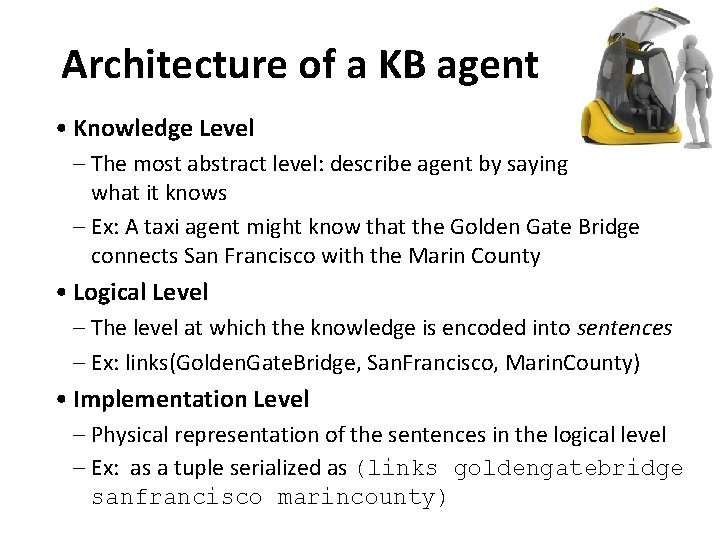
Architecture of a KB agent • Knowledge Level – The most abstract level: describe agent by saying what it knows – Ex: A taxi agent might know that the Golden Gate Bridge connects San Francisco with the Marin County • Logical Level – The level at which the knowledge is encoded into sentences – Ex: links(Golden. Gate. Bridge, San. Francisco, Marin. County) • Implementation Level – Physical representation of the sentences in the logical level – Ex: as a tuple serialized as (links goldengatebridge sanfrancisco marincounty)
Wumpus World environment • Based on Hunt the Wumpus computer game • Agent explores a cave of rooms connected by passageways • Lurking in a room is the Wumpus, a beast that eats any agent that enters its room • Some rooms have bottomless pits that trap any agent that wanders into the room • Somewhere is a heap of gold in a room • Goal is to collect gold and exit w/o being eaten by Wumpus
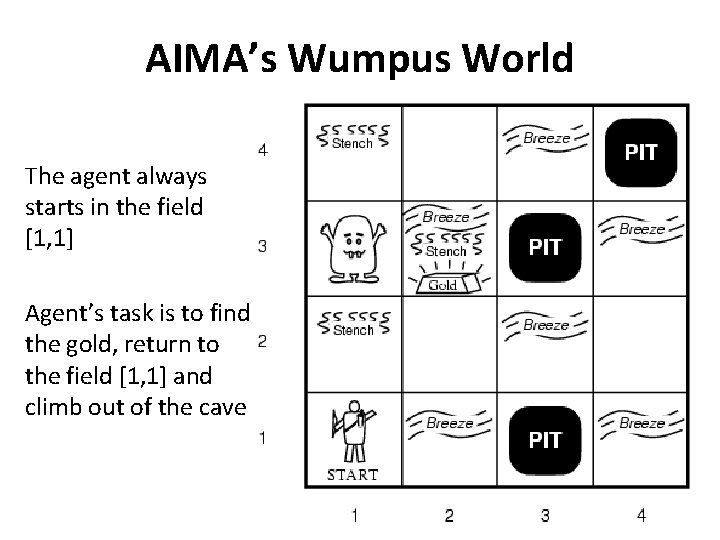
AIMA’s Wumpus World The agent always starts in the field [1, 1] Agent’s task is to find the gold, return to the field [1, 1] and climb out of the cave
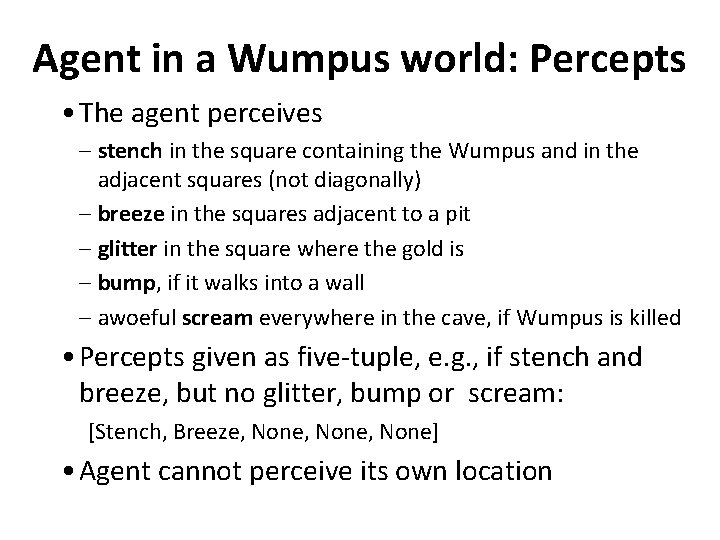
Agent in a Wumpus world: Percepts • The agent perceives – stench in the square containing the Wumpus and in the adjacent squares (not diagonally) – breeze in the squares adjacent to a pit – glitter in the square where the gold is – bump, if it walks into a wall – awoeful scream everywhere in the cave, if Wumpus is killed • Percepts given as five-tuple, e. g. , if stench and breeze, but no glitter, bump or scream: [Stench, Breeze, None, None] • Agent cannot perceive its own location
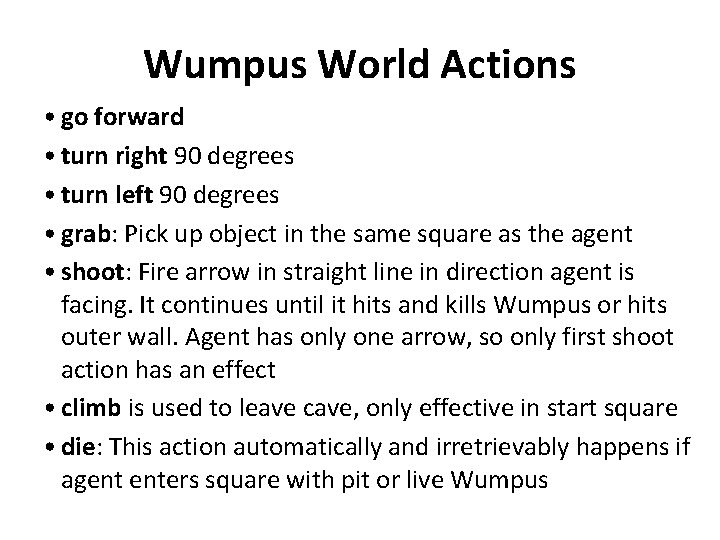
Wumpus World Actions • go forward • turn right 90 degrees • turn left 90 degrees • grab: Pick up object in the same square as the agent • shoot: Fire arrow in straight line in direction agent is facing. It continues until it hits and kills Wumpus or hits outer wall. Agent has only one arrow, so only first shoot action has an effect • climb is used to leave cave, only effective in start square • die: This action automatically and irretrievably happens if agent enters square with pit or live Wumpus
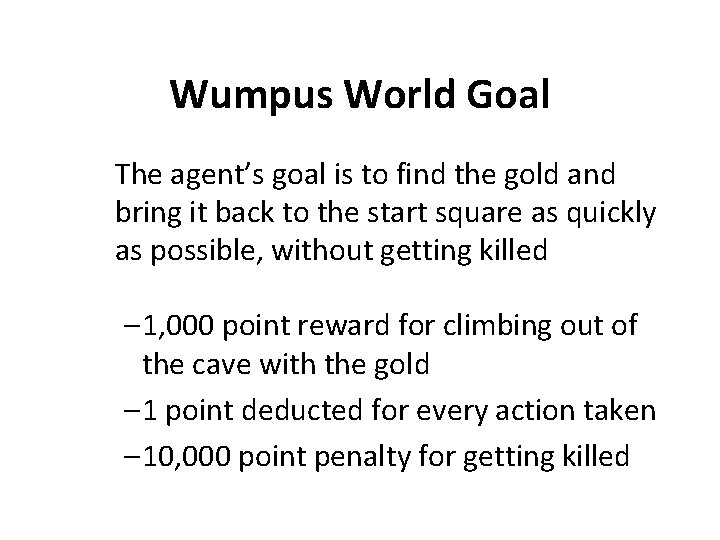
Wumpus World Goal The agent’s goal is to find the gold and bring it back to the start square as quickly as possible, without getting killed – 1, 000 point reward for climbing out of the cave with the gold – 1 point deducted for every action taken – 10, 000 point penalty for getting killed
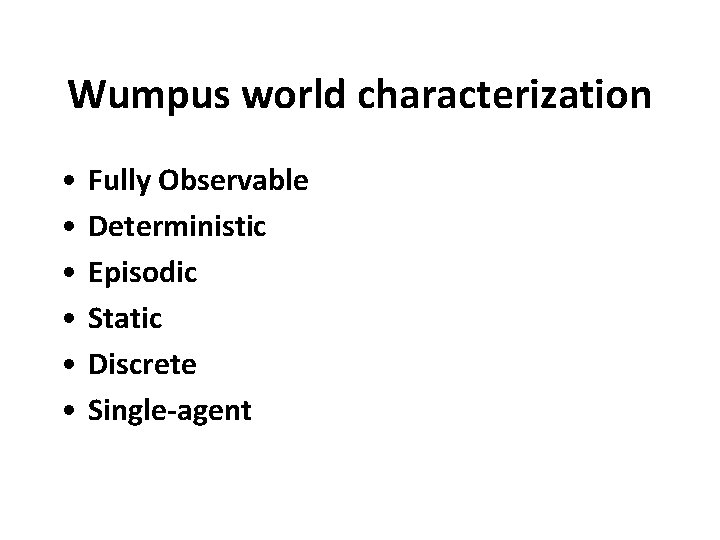
Wumpus world characterization • • • Fully Observable Deterministic Episodic Static Discrete Single-agent
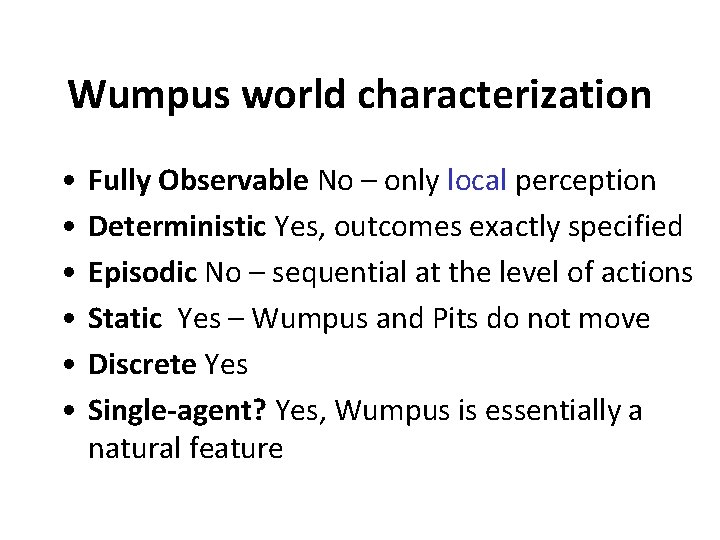
Wumpus world characterization • • • Fully Observable No – only local perception Deterministic Yes, outcomes exactly specified Episodic No – sequential at the level of actions Static Yes – Wumpus and Pits do not move Discrete Yes Single-agent? Yes, Wumpus is essentially a natural feature
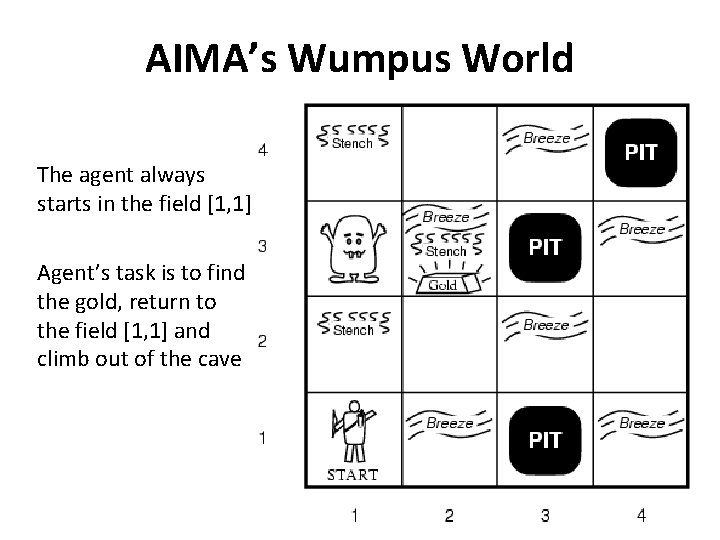
AIMA’s Wumpus World The agent always starts in the field [1, 1] Agent’s task is to find the gold, return to the field [1, 1] and climb out of the cave
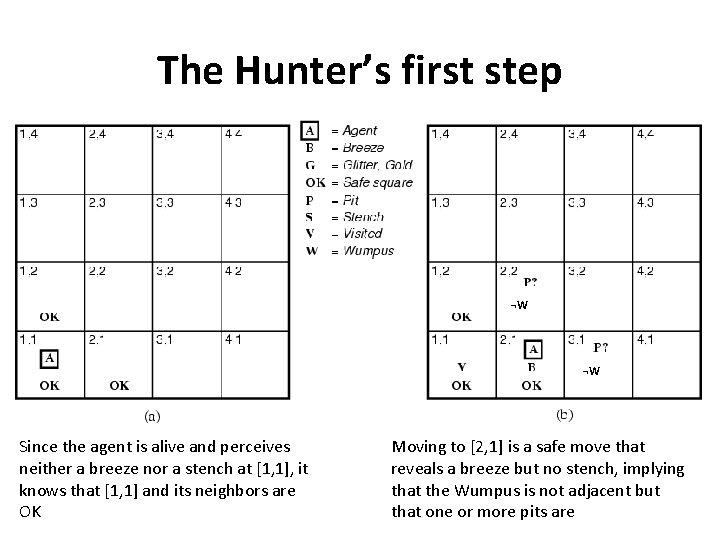
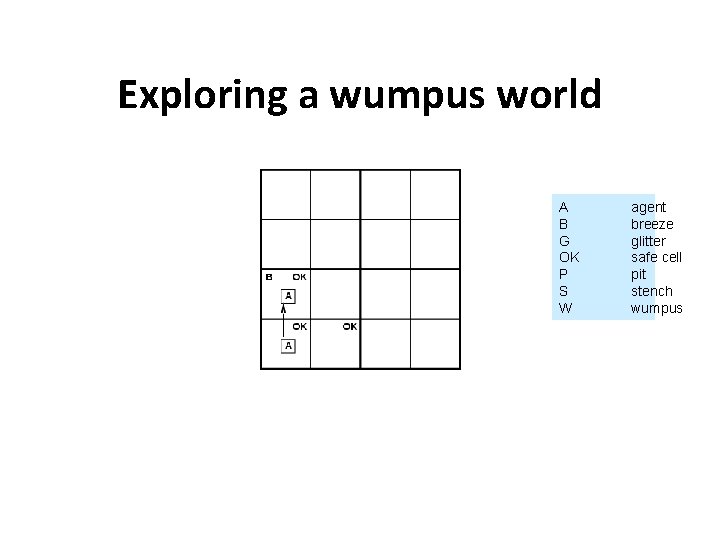
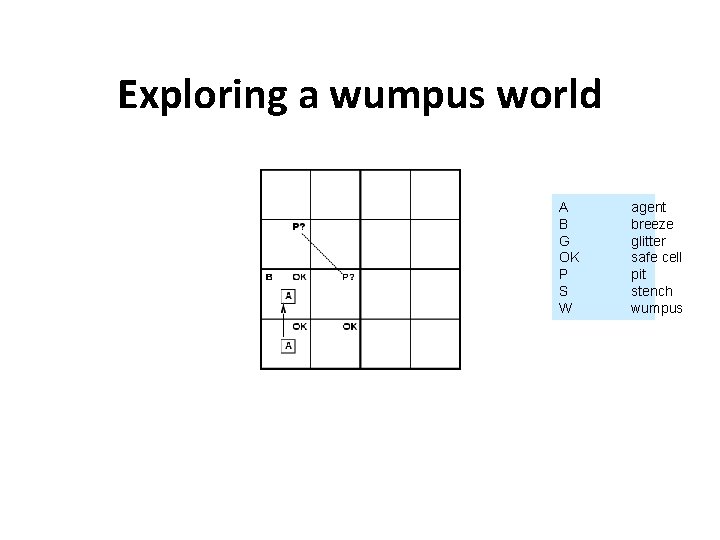
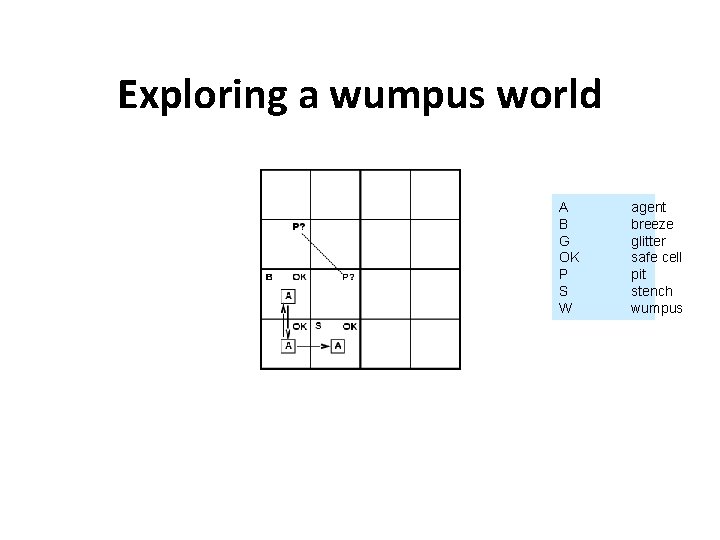
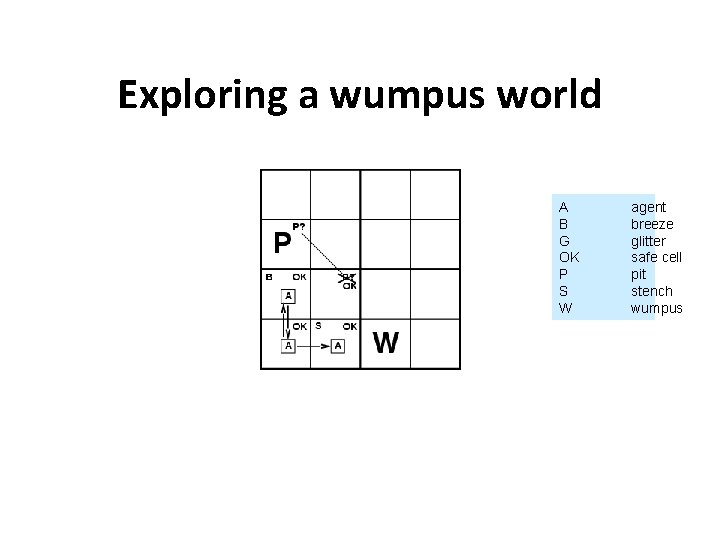
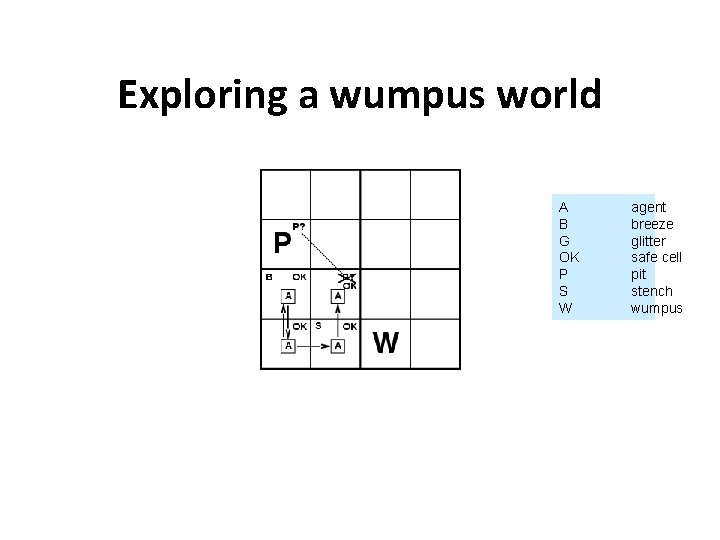
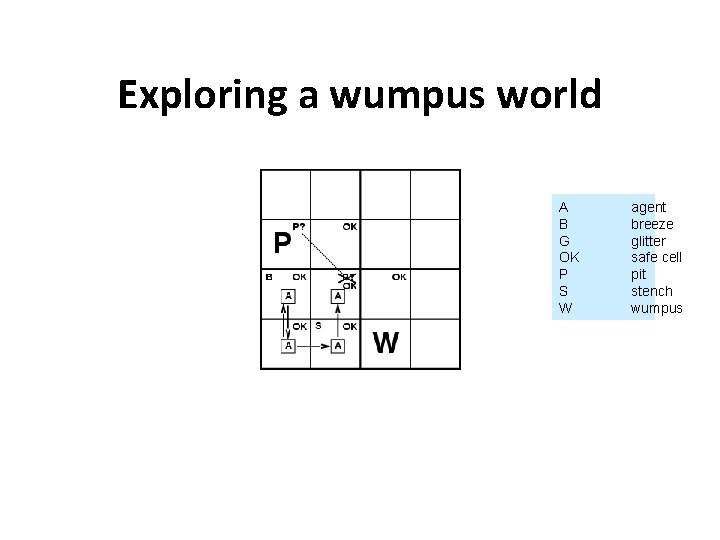
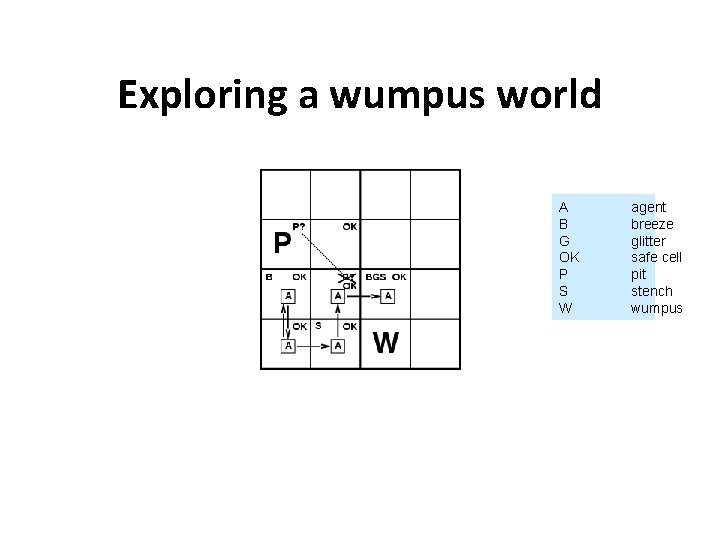
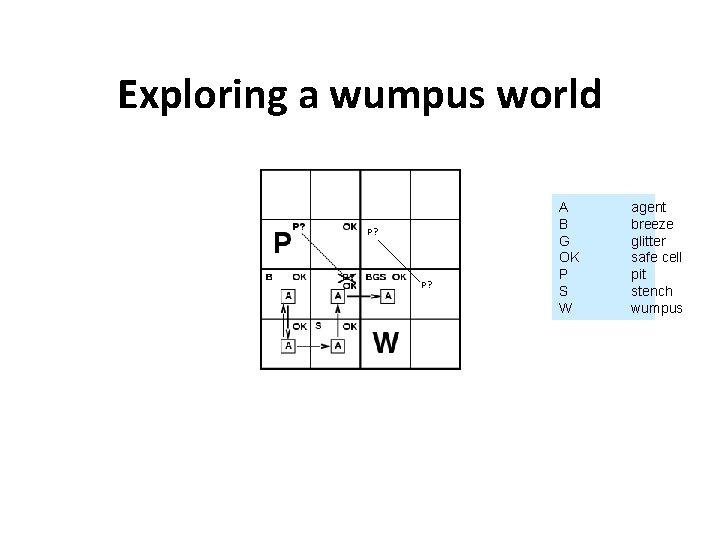
The Hunter’s first step ¬W ¬W Since the agent is alive and perceives neither a breeze nor a stench at [1, 1], it knows that [1, 1] and its neighbors are OK Moving to [2, 1] is a safe move that reveals a breeze but no stench, implying that the Wumpus is not adjacent but that one or more pits are
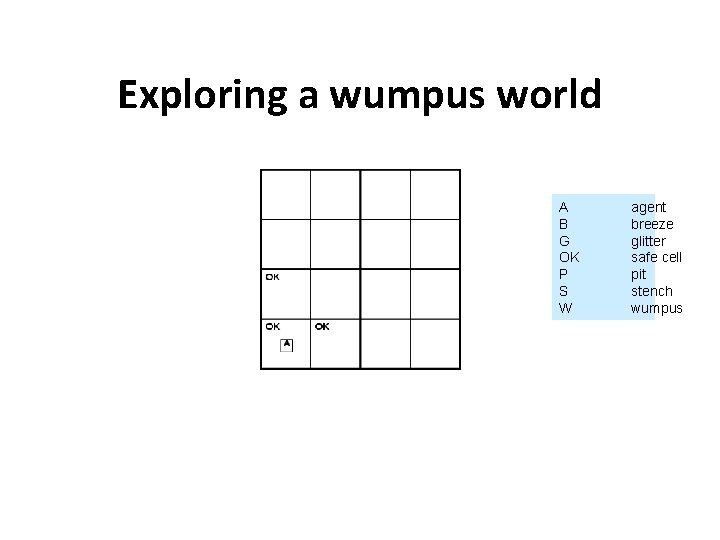
Exploring a wumpus world A B G OK P S W agent breeze glitter safe cell pit stench wumpus
Exploring a wumpus world A B G OK P S W agent breeze glitter safe cell pit stench wumpus
Exploring a wumpus world A B G OK P S W agent breeze glitter safe cell pit stench wumpus
Exploring a wumpus world A B G OK P S W agent breeze glitter safe cell pit stench wumpus
Exploring a wumpus world A B G OK P S W agent breeze glitter safe cell pit stench wumpus
Exploring a wumpus world A B G OK P S W agent breeze glitter safe cell pit stench wumpus
Exploring a wumpus world A B G OK P S W agent breeze glitter safe cell pit stench wumpus
Exploring a wumpus world A B G OK P S W agent breeze glitter safe cell pit stench wumpus
Exploring a wumpus world P? A B G OK P S W agent breeze glitter safe cell pit stench wumpus
Wumpus World games online • AIMA code – Python – Lisp • http: //scv. bu. edu/cgi-bin/wcl – Web-based version you can play • http: //codenautics. com/wumpus/ - Mac version
Logic in general • Logics are formal languages for representing information such that conclusions can be drawn • Syntax defines the sentences in the language • Semantics define the "meaning" of sentences – i. e. , define truth of a sentence in a world E. g. , the language of arithmetic • x+2 ≥ y is a sentence; x 2+y > {} is not a sentence • x+2 ≥ y is true iff the number x+2 is no less than the number y • x+2 ≥ y is true in a world where x = 7, y = 1 • x+2 ≥ y is false in a world where x = 0, y = 6 • x+1> x is true for all numbers x
Entailment • Entailment means that one thing follows from another: • KB ╞ α • Knowledge base KB entails sentence α iff α is true in all possible worlds where KB is true – E. g. , the KB containing “UMBC won” and “JHU won” entails “Either UMBC won or JHU won” – E. g. , x+y = 4 entails 4 = x+y – Entailment is a relationship between sentences (i. e. , syntax) that is based on semantics
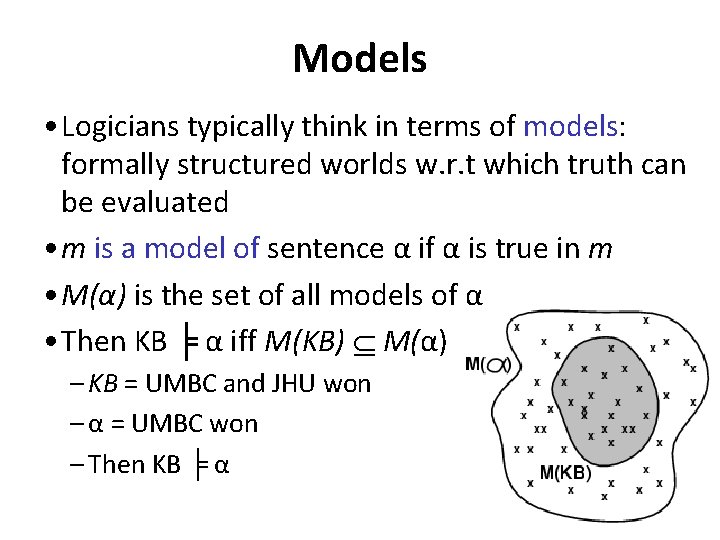
Models • Logicians typically think in terms of models: formally structured worlds w. r. t which truth can be evaluated • m is a model of sentence α if α is true in m • M(α) is the set of all models of α • Then KB ╞ α iff M(KB) M(α) – KB = UMBC and JHU won – α = UMBC won – Then KB ╞ α
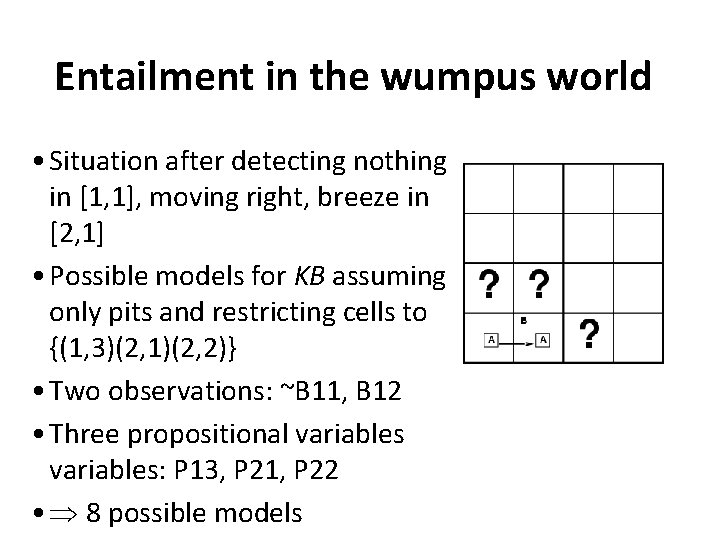
Entailment in the wumpus world • Situation after detecting nothing in [1, 1], moving right, breeze in [2, 1] • Possible models for KB assuming only pits and restricting cells to {(1, 3)(2, 1)(2, 2)} • Two observations: ~B 11, B 12 • Three propositional variables: P 13, P 21, P 22 • 8 possible models
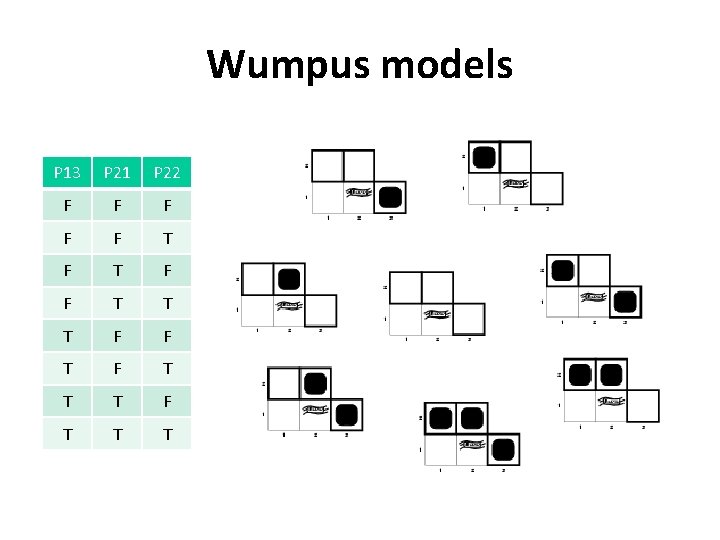
Wumpus models P 13 P 21 P 22 F F F T T T F F T T T
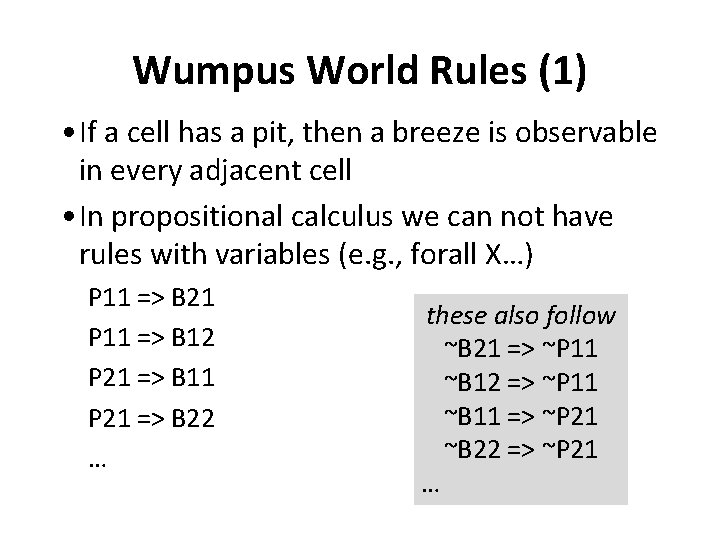
Wumpus World Rules (1) • If a cell has a pit, then a breeze is observable in every adjacent cell • In propositional calculus we can not have rules with variables (e. g. , forall X…) P 11 => B 21 P 11 => B 12 P 21 => B 11 P 21 => B 22 … these also follow ~B 21 => ~P 11 ~B 12 => ~P 11 ~B 11 => ~P 21 ~B 22 => ~P 21 …
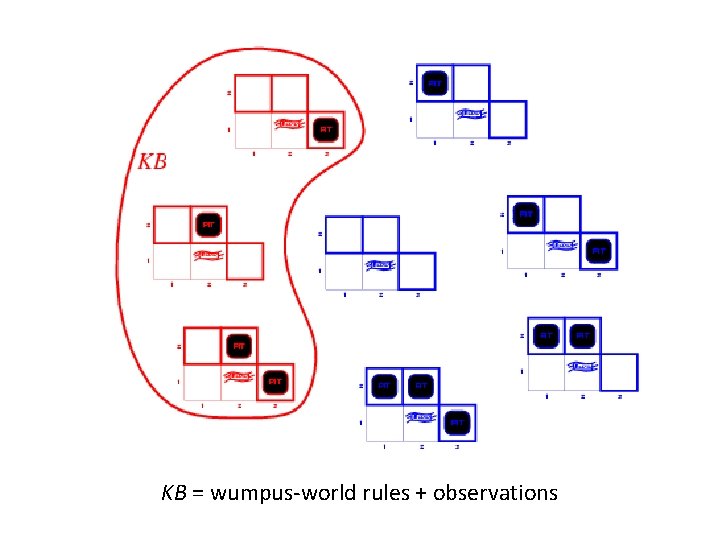
Wumpus models KB = wumpus-world rules + observations
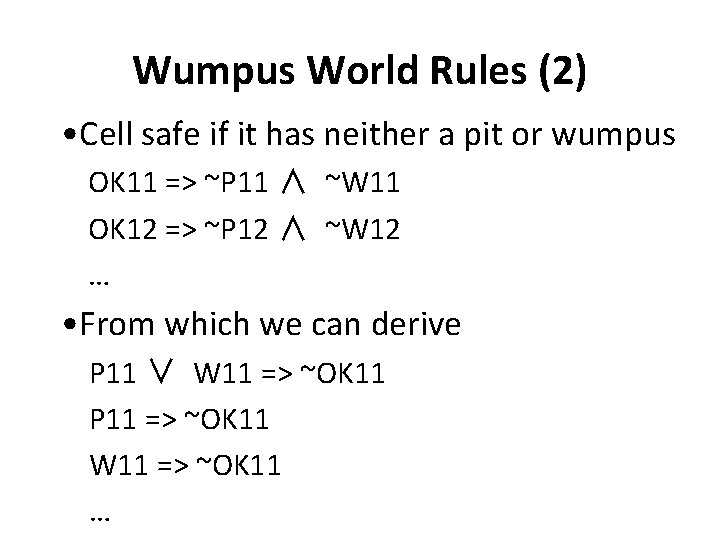
Wumpus World Rules (2) • Cell safe if it has neither a pit or wumpus OK 11 => ~P 11 ∧ ~W 11 OK 12 => ~P 12 ∧ ~W 12 … • From which we can derive P 11 ∨ W 11 => ~OK 11 P 11 => ~OK 11 W 11 => ~OK 11 …
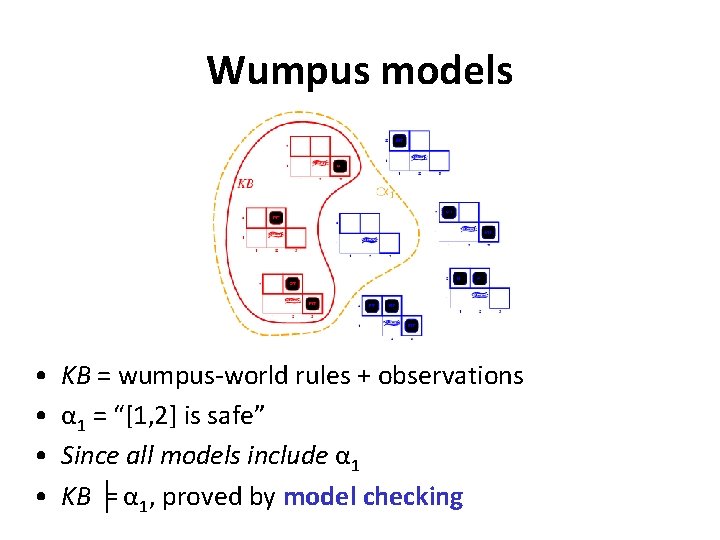
Wumpus models • • KB = wumpus-world rules + observations α 1 = “[1, 2] is safe” Since all models include α 1 KB ╞ α 1, proved by model checking
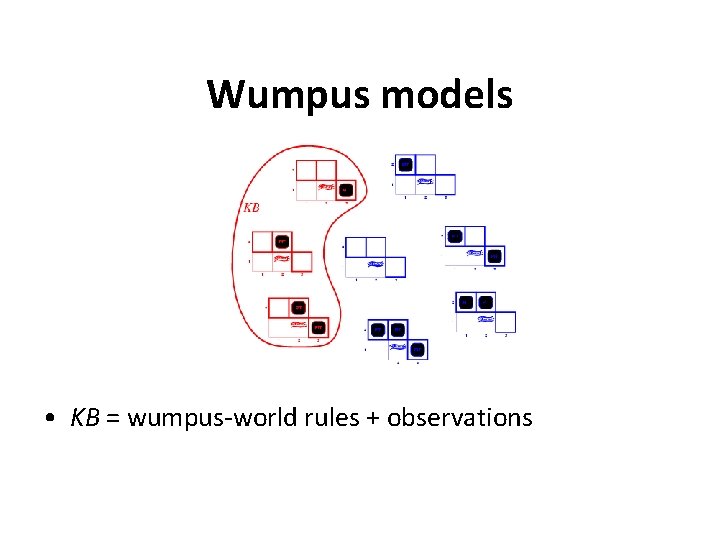
Wumpus models • KB = wumpus-world rules + observations
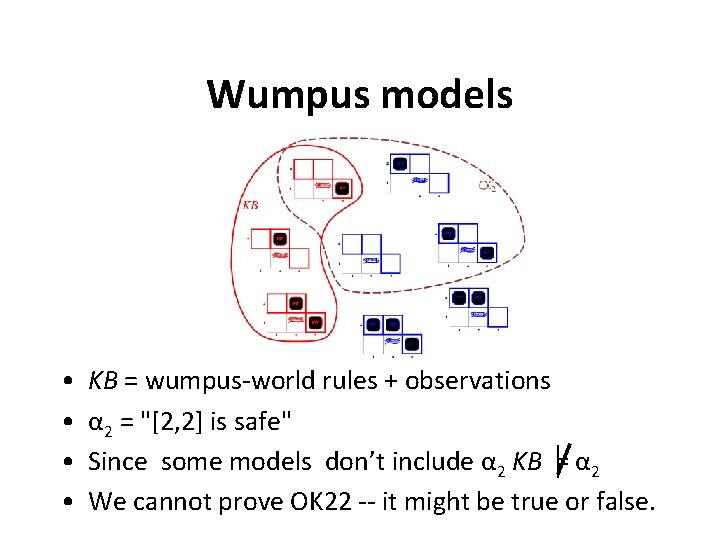
Wumpus models • • KB = wumpus-world rules + observations α 2 = "[2, 2] is safe" Since some models don’t include α 2 KB ╞ α 2 We cannot prove OK 22 -- it might be true or false.
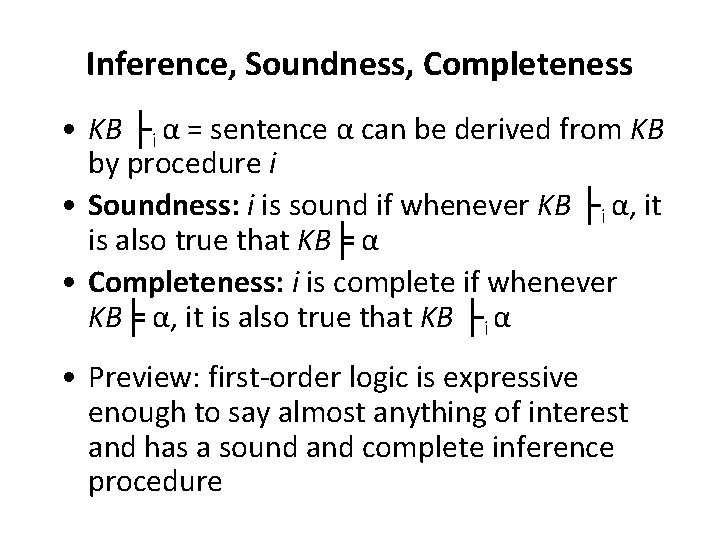
Inference, Soundness, Completeness • KB ├i α = sentence α can be derived from KB by procedure i • Soundness: i is sound if whenever KB ├i α, it is also true that KB╞ α • Completeness: i is complete if whenever KB╞ α, it is also true that KB ├i α • Preview: first-order logic is expressive enough to say almost anything of interest and has a sound and complete inference procedure
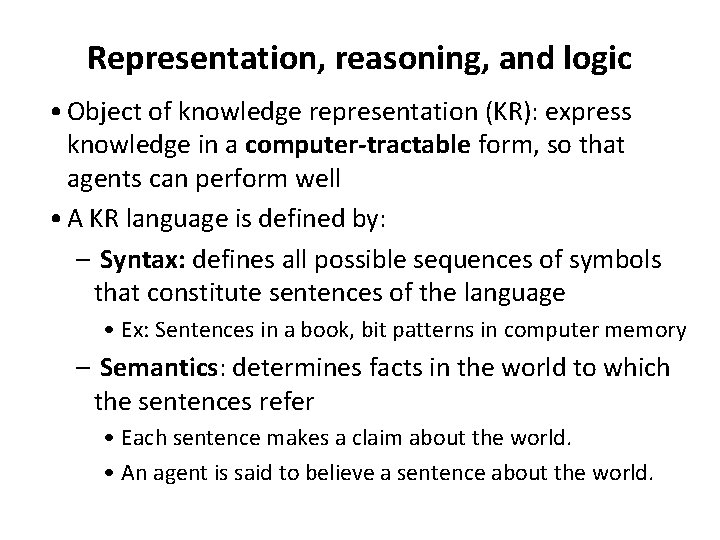
Representation, reasoning, and logic • Object of knowledge representation (KR): express knowledge in a computer-tractable form, so that agents can perform well • A KR language is defined by: – Syntax: defines all possible sequences of symbols that constitute sentences of the language • Ex: Sentences in a book, bit patterns in computer memory – Semantics: determines facts in the world to which the sentences refer • Each sentence makes a claim about the world. • An agent is said to believe a sentence about the world.
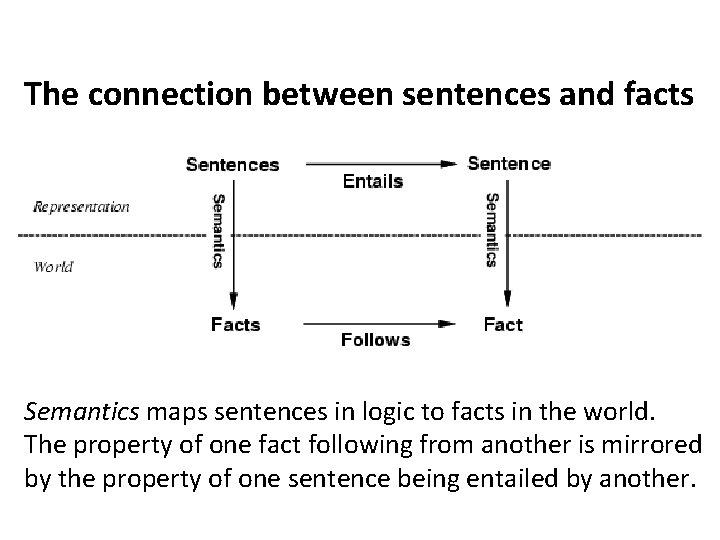
The connection between sentences and facts Semantics maps sentences in logic to facts in the world. The property of one fact following from another is mirrored by the property of one sentence being entailed by another.
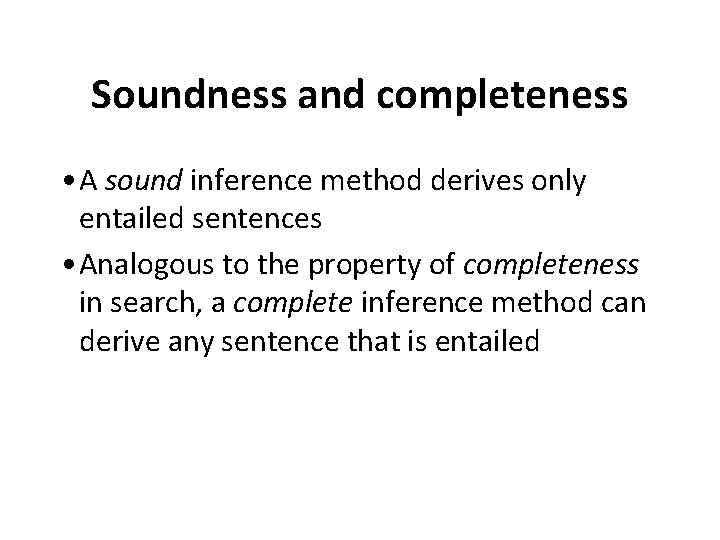
Soundness and completeness • A sound inference method derives only entailed sentences • Analogous to the property of completeness in search, a complete inference method can derive any sentence that is entailed
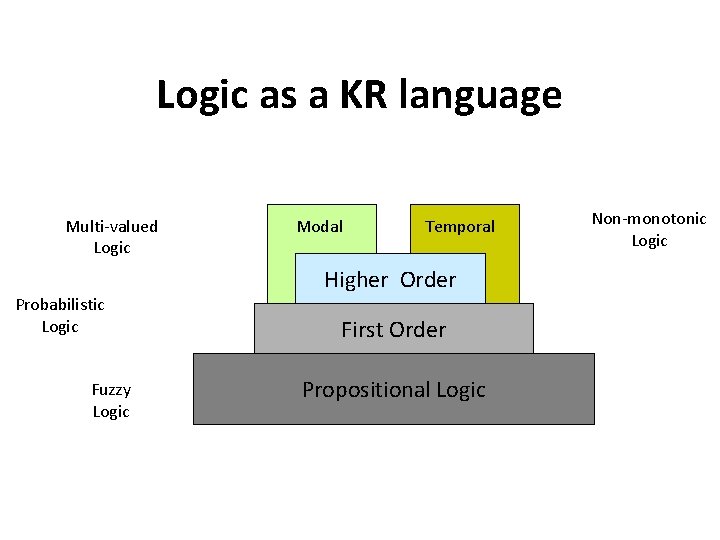
Logic as a KR language Multi-valued Logic Probabilistic Logic Fuzzy Logic Modal Temporal Higher Order First Order Propositional Logic Non-monotonic Logic
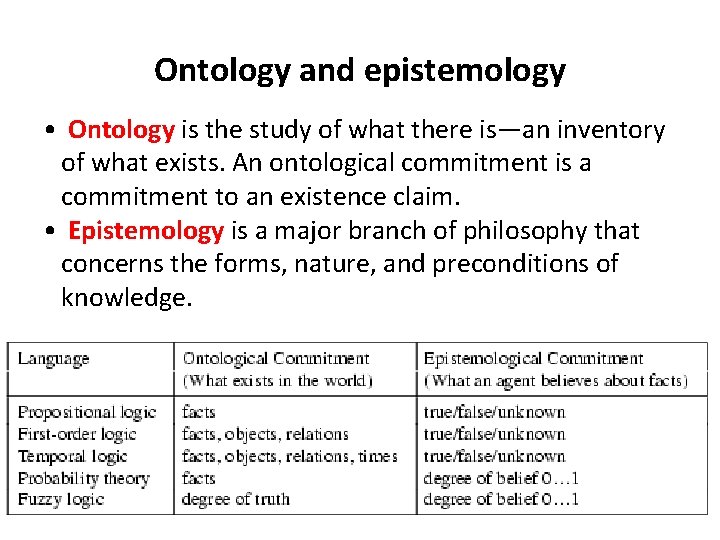
Ontology and epistemology • Ontology is the study of what there is—an inventory of what exists. An ontological commitment is a commitment to an existence claim. • Epistemology is a major branch of philosophy that concerns the forms, nature, and preconditions of knowledge.
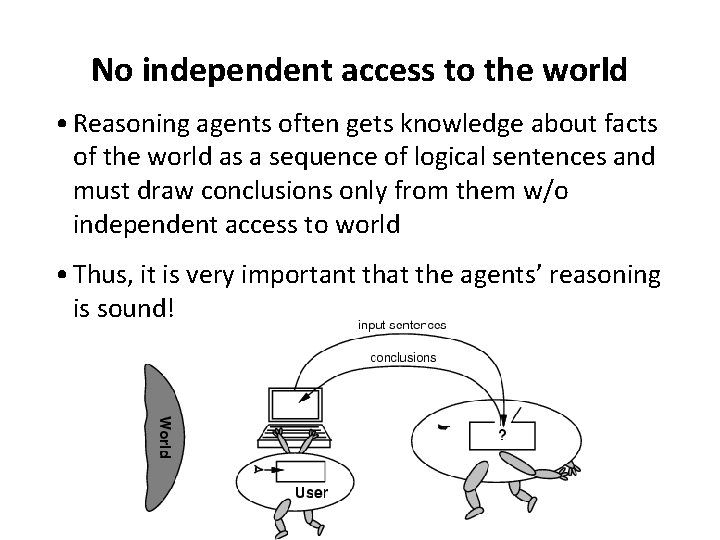
No independent access to the world • Reasoning agents often gets knowledge about facts of the world as a sequence of logical sentences and must draw conclusions only from them w/o independent access to world • Thus, it is very important that the agents’ reasoning is sound!
Summary • Intelligent agents need knowledge about the world for making good decisions • Agent’s knowledge stored in a knowledge base (KB) as sentences in a knowledge representation (KR) language • A knowledge-based agent needs a KB and an inference mechanism. It operates by storing sentences in its KB, inferring new sentences and using them to deduce which actions to take • A representation language is defined by its syntax and semantics, which specify structure of sentences and how they relate to facts of the world • The interpretation of a sentence is fact to which it refers. If the fact is part of the actual world, then the sentence is true
- Slides: 48