
Knowledge Structures Building the Perfect Object Dr David
Knowledge Structures Building the Perfect Object Dr. David A Ferrucci -- Logic Programming and AI Lecture Notes
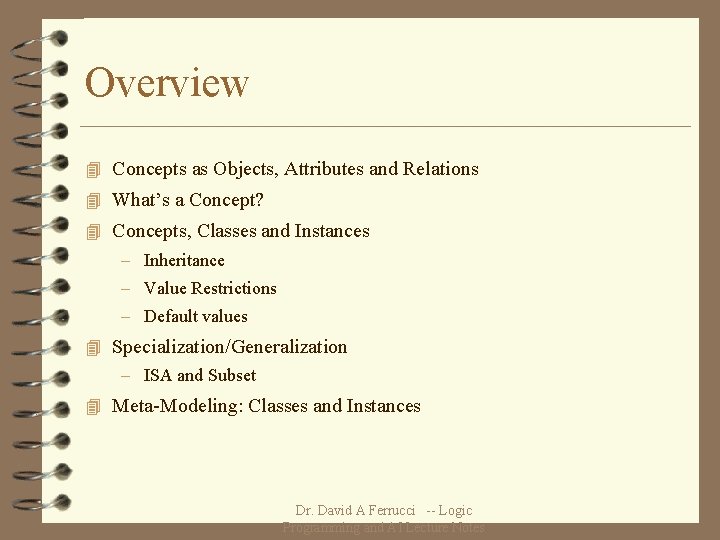
Overview 4 Concepts as Objects, Attributes and Relations 4 What’s a Concept? 4 Concepts, Classes and Instances – Inheritance – Value Restrictions – Default values 4 Specialization/Generalization – ISA and Subset 4 Meta-Modeling: Classes and Instances Dr. David A Ferrucci -- Logic Programming and AI Lecture Notes
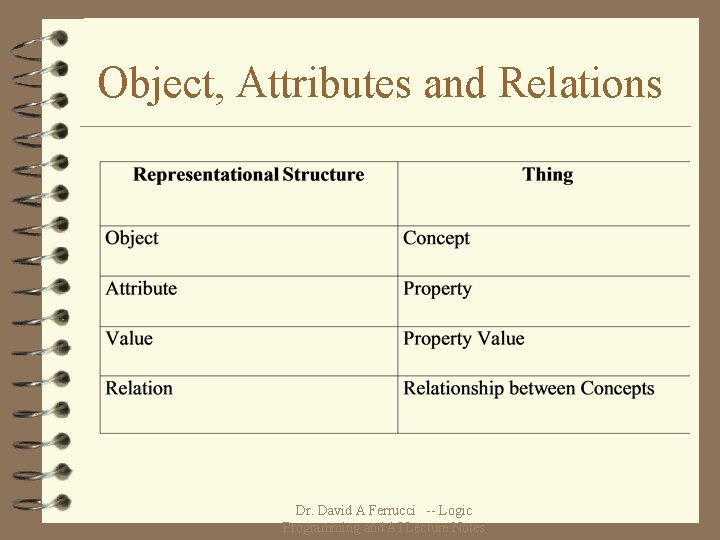
Object, Attributes and Relations Dr. David A Ferrucci -- Logic Programming and AI Lecture Notes
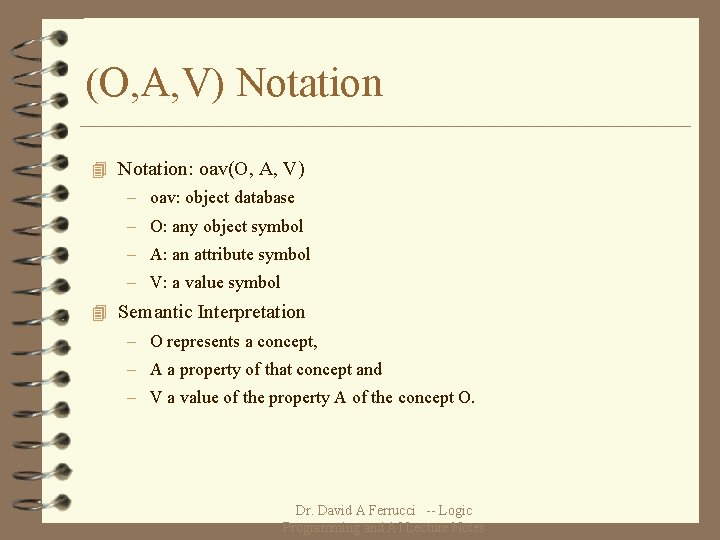
(O, A, V) Notation 4 Notation: oav(O, A, V) – oav: object database – O: any object symbol – A: an attribute symbol – V: a value symbol 4 Semantic Interpretation – O represents a concept, – A a property of that concept and – V a value of the property A of the concept O. Dr. David A Ferrucci -- Logic Programming and AI Lecture Notes
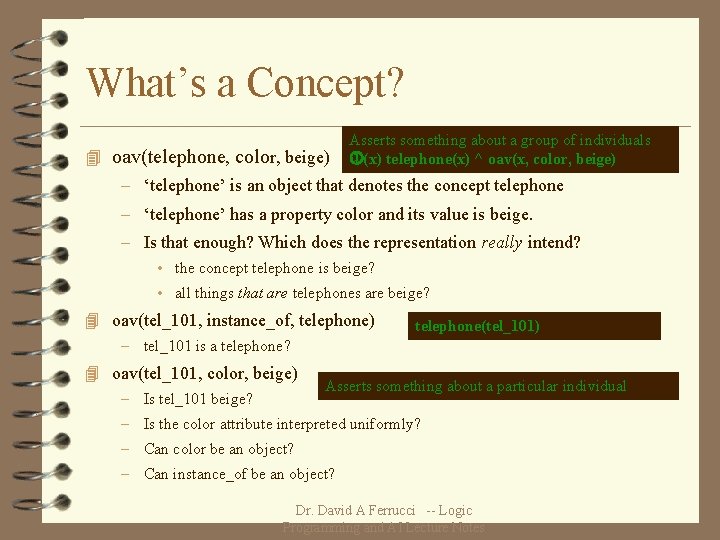
What’s a Concept? 4 oav(telephone, color, beige) Asserts something about a group of individuals (x) telephone(x) ^ oav(x, color, beige) – ‘telephone’ is an object that denotes the concept telephone – ‘telephone’ has a property color and its value is beige. – Is that enough? Which does the representation really intend? • the concept telephone is beige? • all things that are telephones are beige? 4 oav(tel_101, instance_of, telephone) telephone(tel_101) – tel_101 is a telephone? 4 oav(tel_101, color, beige) – Is tel_101 beige? Asserts something about a particular individual – Is the color attribute interpreted uniformly? – Can color be an object? – Can instance_of be an object? Dr. David A Ferrucci -- Logic Programming and AI Lecture Notes
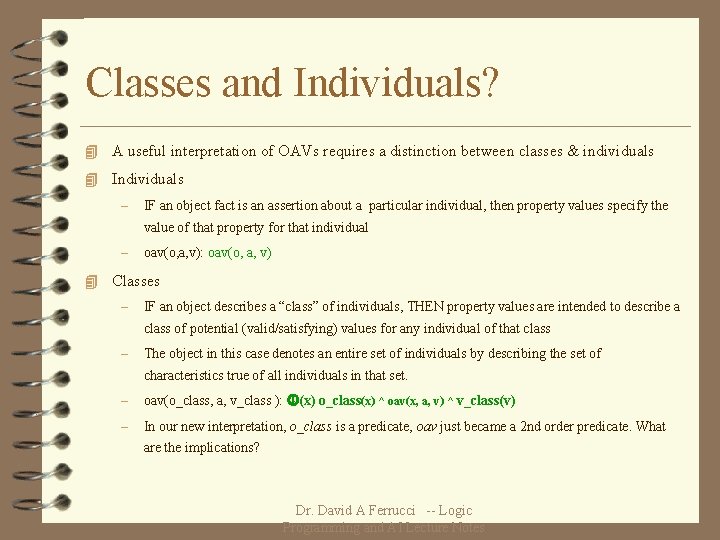
Classes and Individuals? 4 A useful interpretation of OAVs requires a distinction between classes & individuals 4 Individuals – IF an object fact is an assertion about a particular individual, then property values specify the value of that property for that individual – oav(o, a, v): oav(o, a, v) 4 Classes – IF an object describes a “class” of individuals, THEN property values are intended to describe a class of potential (valid/satisfying) values for any individual of that class – The object in this case denotes an entire set of individuals by describing the set of characteristics true of all individuals in that set. – oav(o_class, a, v_class ): (x) o_class(x) ^ oav(x, a, v) ^ v_class(v) – In our new interpretation, o_class is a predicate, oav just became a 2 nd order predicate. What are the implications? Dr. David A Ferrucci -- Logic Programming and AI Lecture Notes
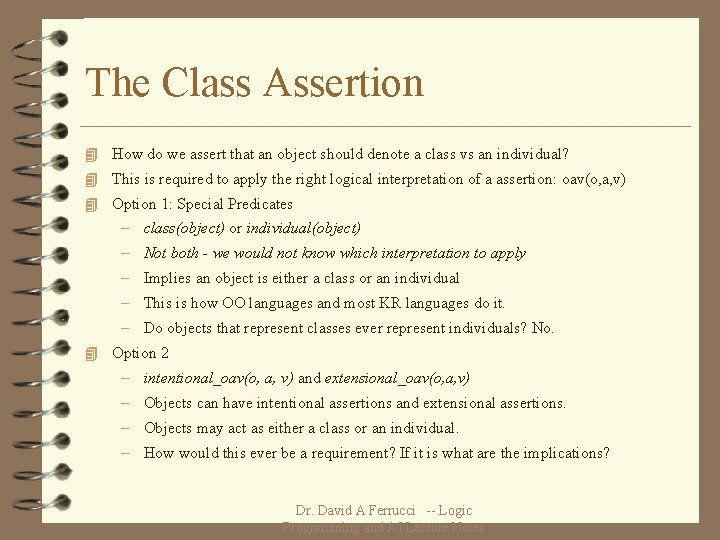
The Class Assertion 4 How do we assert that an object should denote a class vs an individual? 4 This is required to apply the right logical interpretation of a assertion: oav(o, a, v) 4 Option 1: Special Predicates – class(object) or individual(object) – Not both - we would not know which interpretation to apply – Implies an object is either a class or an individual – This is how OO languages and most KR languages do it. – Do objects that represent classes ever represent individuals? No. 4 Option 2 – intentional_oav(o, a, v) and extensional_oav(o, a, v) – Objects can have intentional assertions and extensional assertions. – Objects may act as either a class or an individual. – How would this ever be a requirement? If it is what are the implications? Dr. David A Ferrucci -- Logic Programming and AI Lecture Notes
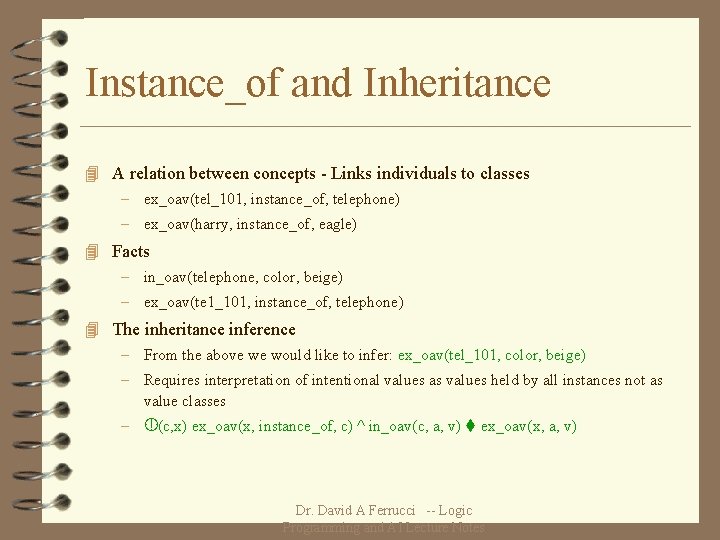
Instance_of and Inheritance 4 A relation between concepts - Links individuals to classes – ex_oav(tel_101, instance_of, telephone) – ex_oav(harry, instance_of, eagle) 4 Facts – in_oav(telephone, color, beige) – ex_oav(te 1_101, instance_of, telephone) 4 The inheritance inference – From the above we would like to infer: ex_oav(tel_101, color, beige) – Requires interpretation of intentional values as values held by all instances not as value classes – (c, x) ex_oav(x, instance_of, c) ^ in_oav(c, a, v) ex_oav(x, a, v) Dr. David A Ferrucci -- Logic Programming and AI Lecture Notes
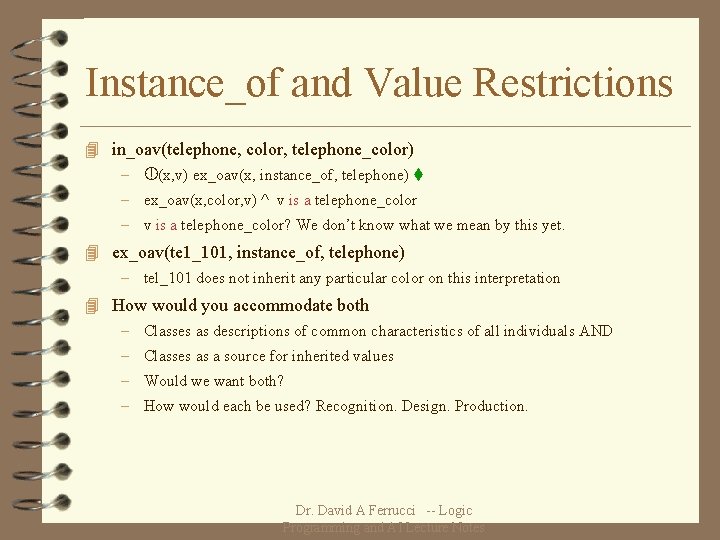
Instance_of and Value Restrictions 4 in_oav(telephone, color, telephone_color) – (x, v) ex_oav(x, instance_of, telephone) – ex_oav(x, color, v) ^ v is a telephone_color – v is a telephone_color? We don’t know what we mean by this yet. 4 ex_oav(te 1_101, instance_of, telephone) – tel_101 does not inherit any particular color on this interpretation 4 How would you accommodate both – Classes as descriptions of common characteristics of all individuals AND – Classes as a source for inherited values – Would we want both? – How would each be used? Recognition. Design. Production. Dr. David A Ferrucci -- Logic Programming and AI Lecture Notes
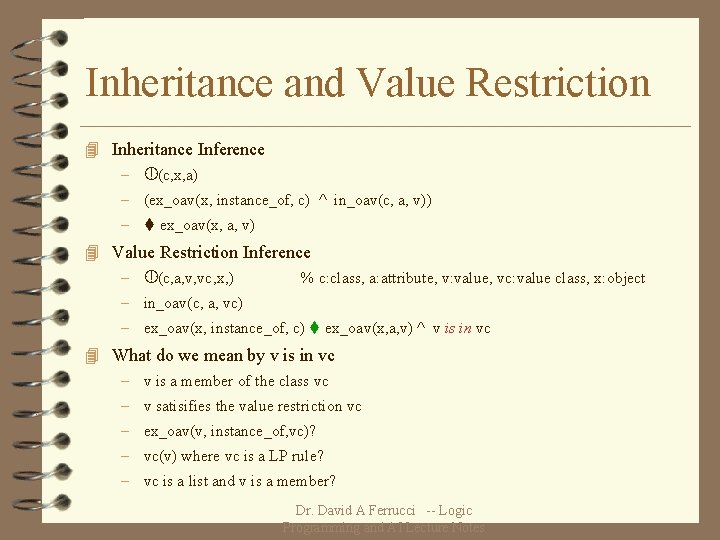
Inheritance and Value Restriction 4 Inheritance Inference – (c, x, a) – (ex_oav(x, instance_of, c) ^ in_oav(c, a, v)) – ex_oav(x, a, v) 4 Value Restriction Inference – (c, a, v, vc, x, ) % c: class, a: attribute, v: value, vc: value class, x: object – in_oav(c, a, vc) – ex_oav(x, instance_of, c) ex_oav(x, a, v) ^ v is in vc 4 What do we mean by v is in vc – v is a member of the class vc – v satisifies the value restriction vc – ex_oav(v, instance_of, vc)? – vc(v) where vc is a LP rule? – vc is a list and v is a member? Dr. David A Ferrucci -- Logic Programming and AI Lecture Notes
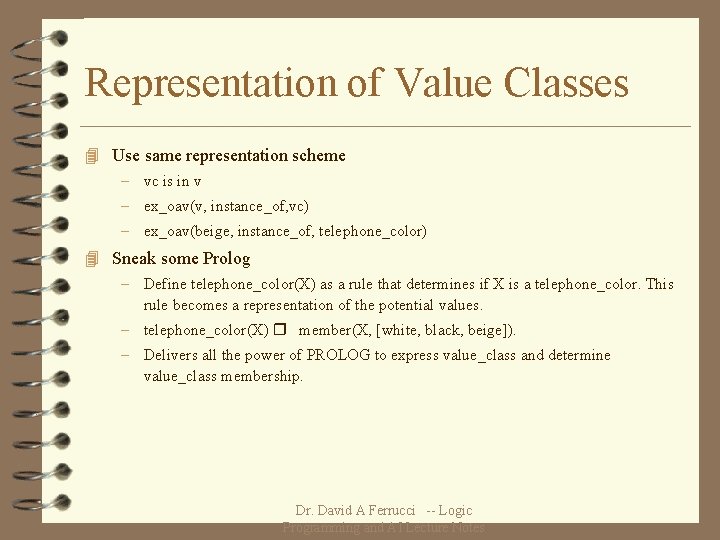
Representation of Value Classes 4 Use same representation scheme – vc is in v – ex_oav(v, instance_of, vc) – ex_oav(beige, instance_of, telephone_color) 4 Sneak some Prolog – Define telephone_color(X) as a rule that determines if X is a telephone_color. This rule becomes a representation of the potential values. – telephone_color(X) member(X, [white, black, beige]). – Delivers all the power of PROLOG to express value_class and determine value_class membership. Dr. David A Ferrucci -- Logic Programming and AI Lecture Notes
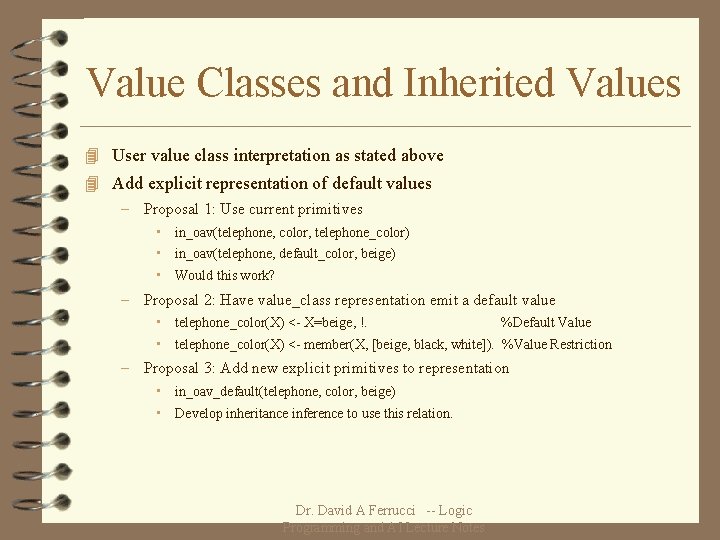
Value Classes and Inherited Values 4 User value class interpretation as stated above 4 Add explicit representation of default values – Proposal 1: Use current primitives • in_oav(telephone, color, telephone_color) • in_oav(telephone, default_color, beige) • Would this work? – Proposal 2: Have value_class representation emit a default value • telephone_color(X) <- X=beige, !. %Default Value • telephone_color(X) <- member(X, [beige, black, white]). %Value Restriction – Proposal 3: Add new explicit primitives to representation • in_oav_default(telephone, color, beige) • Develop inheritance inference to use this relation. Dr. David A Ferrucci -- Logic Programming and AI Lecture Notes
Programming Workshop 0 Implement what an object-based KR language. Included the following features: – – – Object, Attribute and Values Getters and Setters Class and Instances Inheritance and Default Values Implement both proposals Value Restriction Dr. David A Ferrucci -- Logic Programming and AI Lecture Notes
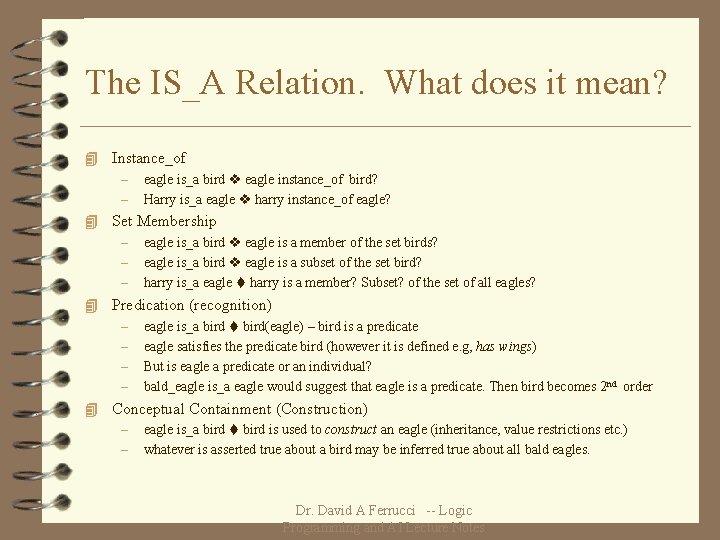
The IS_A Relation. What does it mean? 4 Instance_of – eagle is_a bird eagle instance_of bird? – Harry is_a eagle harry instance_of eagle? 4 Set Membership – eagle is_a bird eagle is a member of the set birds? – eagle is_a bird eagle is a subset of the set bird? – harry is_a eagle harry is a member? Subset? of the set of all eagles? 4 Predication (recognition) – eagle is_a bird(eagle) – bird is a predicate – eagle satisfies the predicate bird (however it is defined e. g, has wings) – But is eagle a predicate or an individual? – bald_eagle is_a eagle would suggest that eagle is a predicate. Then bird becomes 2 nd order 4 Conceptual Containment (Construction) – eagle is_a bird is used to construct an eagle (inheritance, value restrictions etc. ) – whatever is asserted true about a bird may be inferred true about all bald eagles. Dr. David A Ferrucci -- Logic Programming and AI Lecture Notes
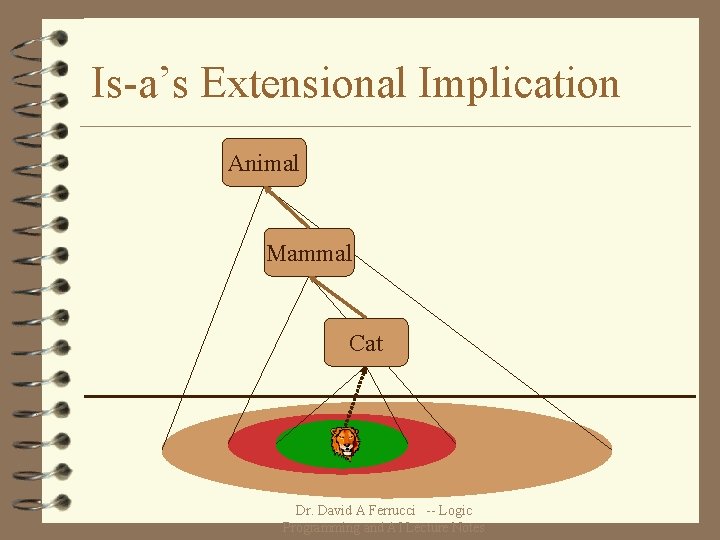
Is-a’s Extensional Implication Animal Mammal Cat Dr. David A Ferrucci -- Logic Programming and AI Lecture Notes
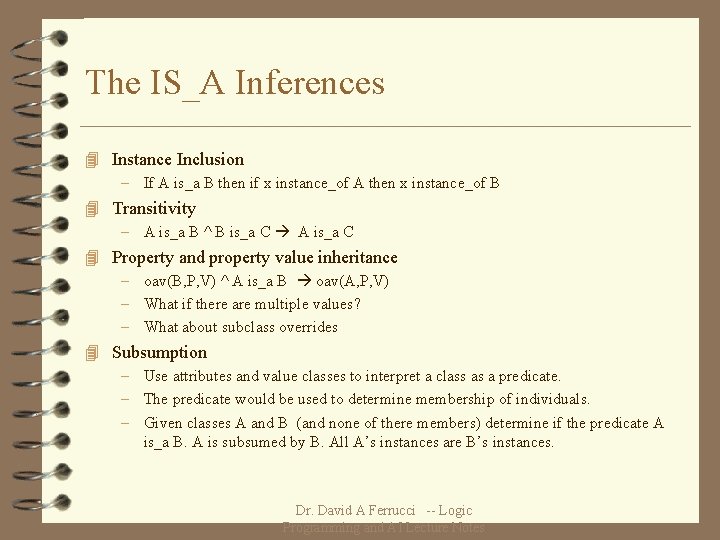
The IS_A Inferences 4 Instance Inclusion – If A is_a B then if x instance_of A then x instance_of B 4 Transitivity – A is_a B ^ B is_a C A is_a C 4 Property and property value inheritance – oav(B, P, V) ^ A is_a B oav(A, P, V) – What if there are multiple values? – What about subclass overrides 4 Subsumption – Use attributes and value classes to interpret a class as a predicate. – The predicate would be used to determine membership of individuals. – Given classes A and B (and none of there members) determine if the predicate A is_a B. A is subsumed by B. All A’s instances are B’s instances. Dr. David A Ferrucci -- Logic Programming and AI Lecture Notes
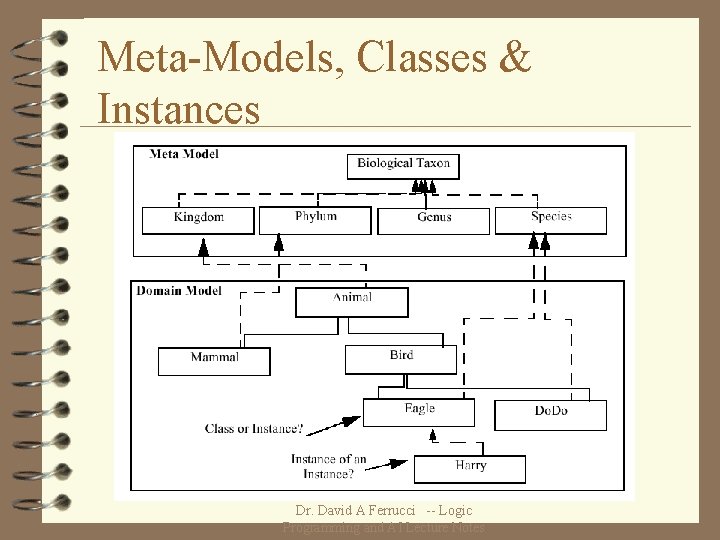
Meta-Models, Classes & Instances Dr. David A Ferrucci -- Logic Programming and AI Lecture Notes
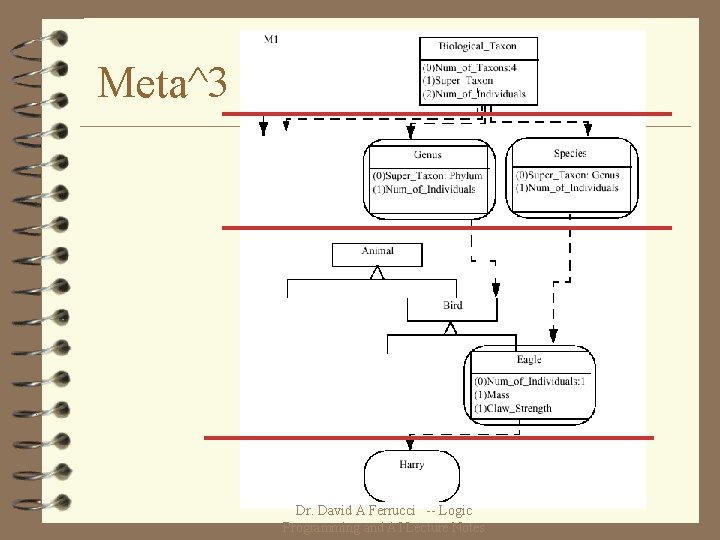
Meta^3 Dr. David A Ferrucci -- Logic Programming and AI Lecture Notes
Programming Project 4 Implement an object-based representation language to everything in workshop 0 plus: – – Default Value Overrides The is_a relation and its inferences Multiple Values Inheritance over layered models (model and meta model) Dr. David A Ferrucci -- Logic Programming and AI Lecture Notes
The End An OO modeling system represents a fairly complex default-logic. Do you know the semantics of your OO system? Dr. David A Ferrucci -- Logic Programming and AI Lecture Notes
- Slides: 20