
Knowledge Representation Outline Output Knowledge representation Decision tables
Knowledge Representation
Outline: Output - Knowledge representation § Decision tables § Decision trees § Decision rules § Rules involving relations § Instance-based representation § witten&eibe Prototypes, Clusters 2
Output: representing structural patterns § Many different ways of representing patterns § Decision trees, rules, instance-based, … § Also called “knowledge” representation § Representation determines inference method § Understanding the output is the key to understanding the underlying learning methods § Different types of output for different learning problems (e. g. classification, regression, …) witten&eibe 3
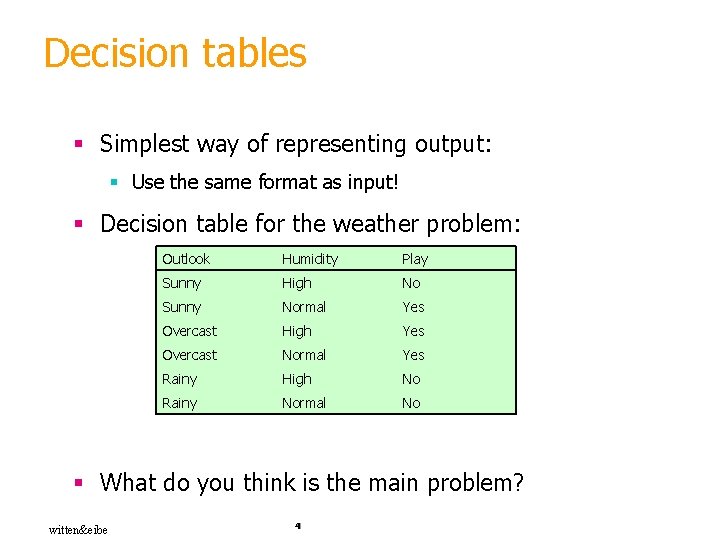
Decision tables § Simplest way of representing output: § Use the same format as input! § Decision table for the weather problem: Outlook Humidity Play Sunny High No Sunny Normal Yes Overcast High Yes Overcast Normal Yes Rainy High No Rainy Normal No § What do you think is the main problem? witten&eibe 4
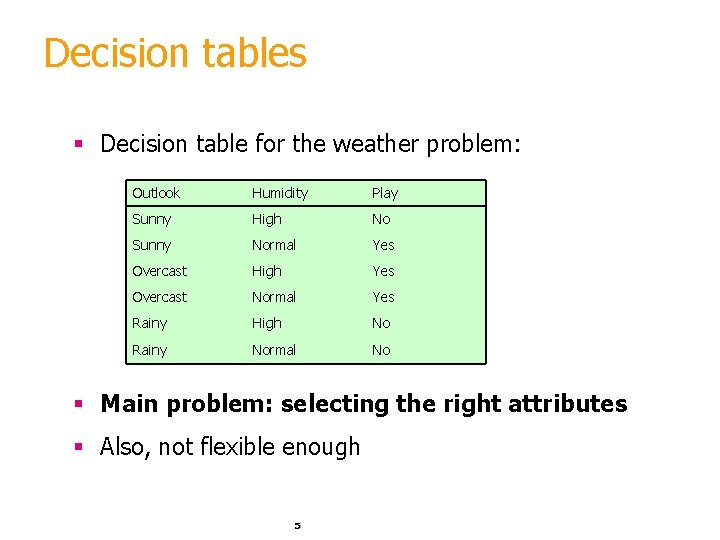
Decision tables § Decision table for the weather problem: Outlook Humidity Play Sunny High No Sunny Normal Yes Overcast High Yes Overcast Normal Yes Rainy High No Rainy Normal No § Main problem: selecting the right attributes § Also, not flexible enough 5

Decision trees, 1 § “Divide-and-conquer” approach produces tree § Nodes involve testing a particular attribute § Usually, attribute value is compared to constant § Other possibilities: § Comparing values of two attributes § Using a function of one or more attributes § Leaves assign classification, set of classifications, or probability distribution to instances § Unknown instance is routed down the tree witten&eibe 6
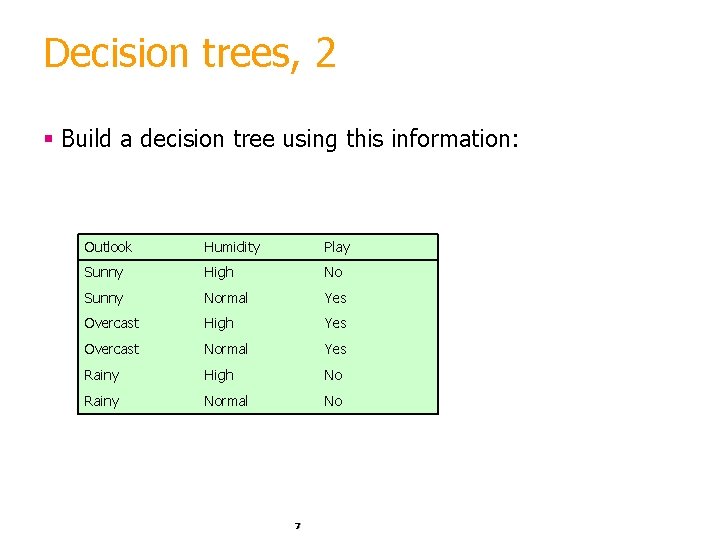
Decision trees, 2 § Build a decision tree using this information: Outlook Humidity Play Sunny High No Sunny Normal Yes Overcast High Yes Overcast Normal Yes Rainy High No Rainy Normal No 7

Decision trees, 3 Outlook sunny overcast Humidity high normal No Yes 8 rain No
Nominal and numeric attributes § Nominal: number of children usually equal to number values attribute won’t get tested more than once § Other possibility: division into two subsets § Numeric: test whether value is greater or less than constant attribute may get tested several times § Other possibility: three-way split (or multi-way split) § Integer: less than, equal to, greater than § Real: below, within, above witten&eibe 9
Missing values § Does absence of value have some significance? § Yes “missing” is a separate value § No “missing” must be treated in a special way § Solution A: assign instance to most popular branch § Solution B: split instance into pieces § Pieces receive weight according to fraction of training instances that go down each branch § Classifications from leave nodes are combined using the weights that have percolated to them witten&eibe 10
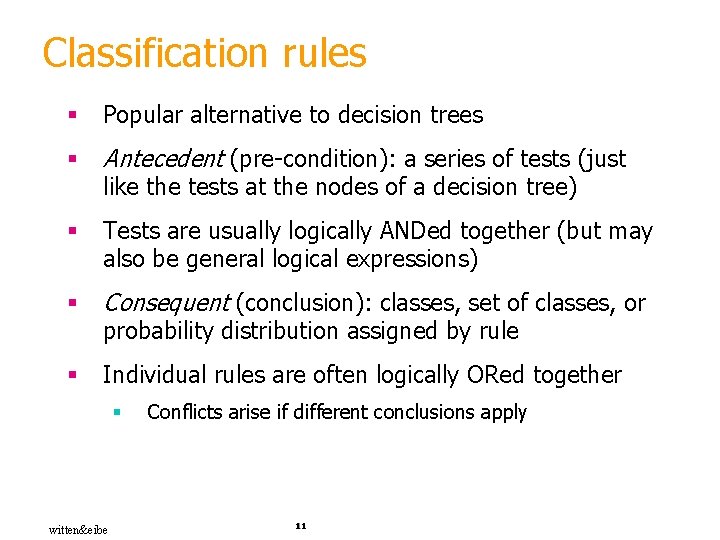
Classification rules § Popular alternative to decision trees § Antecedent (pre-condition): a series of tests (just § Tests are usually logically ANDed together (but may also be general logical expressions) § Consequent (conclusion): classes, set of classes, or § Individual rules are often logically ORed together like the tests at the nodes of a decision tree) probability distribution assigned by rule § witten&eibe Conflicts arise if different conclusions apply 11
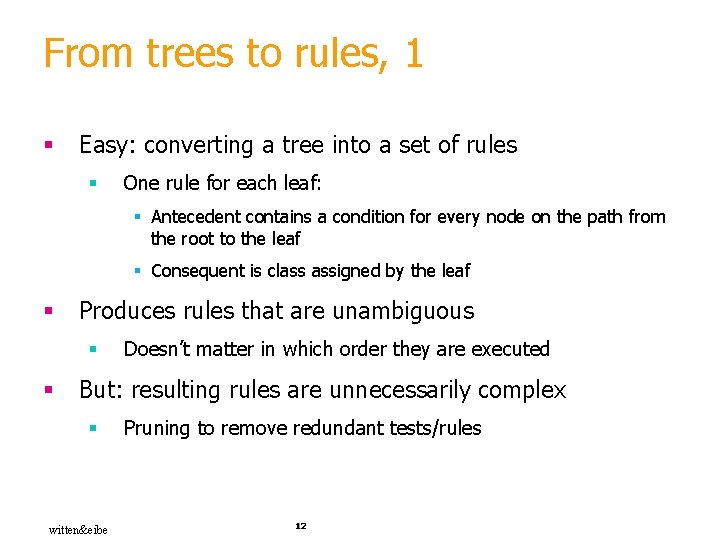
From trees to rules, 1 § Easy: converting a tree into a set of rules § One rule for each leaf: § Antecedent contains a condition for every node on the path from the root to the leaf § Consequent is class assigned by the leaf § Produces rules that are unambiguous § § Doesn’t matter in which order they are executed But: resulting rules are unnecessarily complex § witten&eibe Pruning to remove redundant tests/rules 12
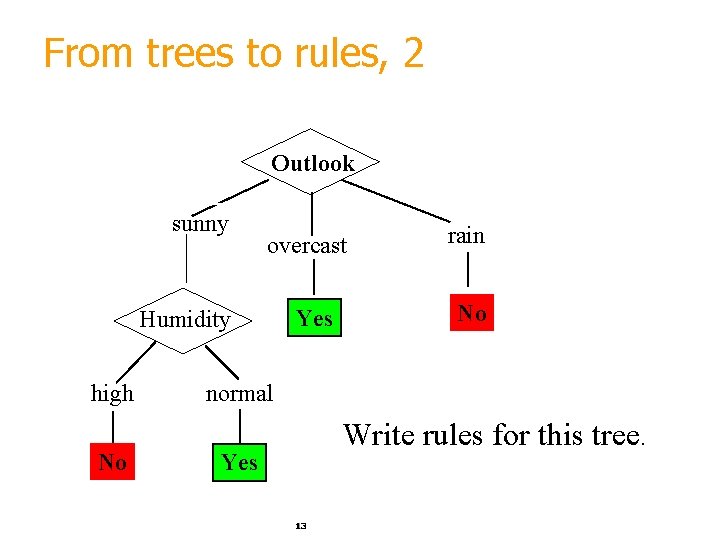
From trees to rules, 2 Outlook sunny overcast Humidity high No Yes rain No normal Write rules for this tree. Yes 13
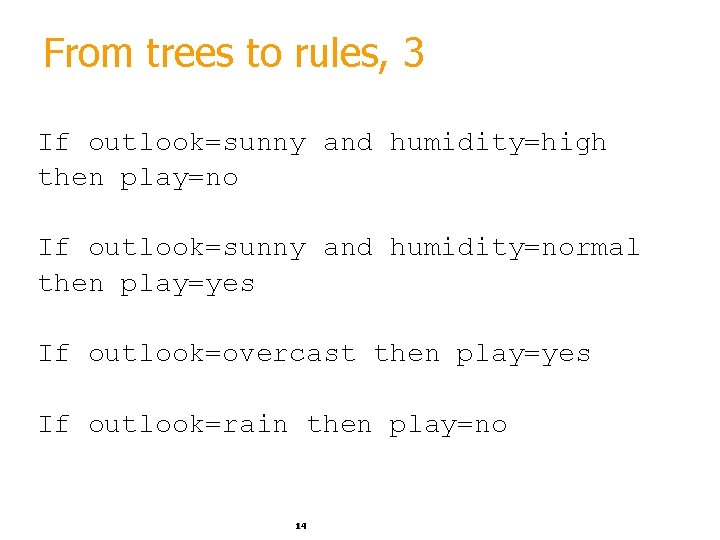
From trees to rules, 3 If outlook=sunny and humidity=high then play=no If outlook=sunny and humidity=normal then play=yes If outlook=overcast then play=yes If outlook=rain then play=no 14
From rules to trees § More difficult: transforming a rule set into a tree § Tree cannot easily express disjunction between rules § Example: rules which test different attributes If a and b then x If c and d then x § Symmetry needs to be broken § Corresponding tree contains identical subtrees ( “replicated subtree problem”) witten&eibe 15
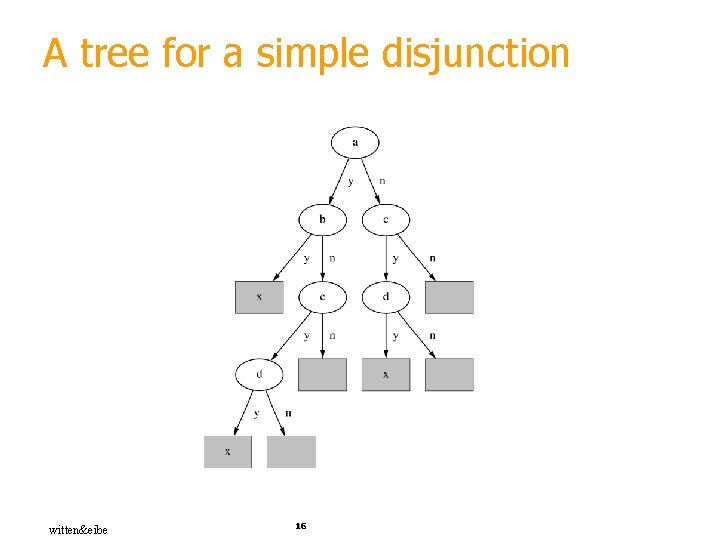
A tree for a simple disjunction witten&eibe 16
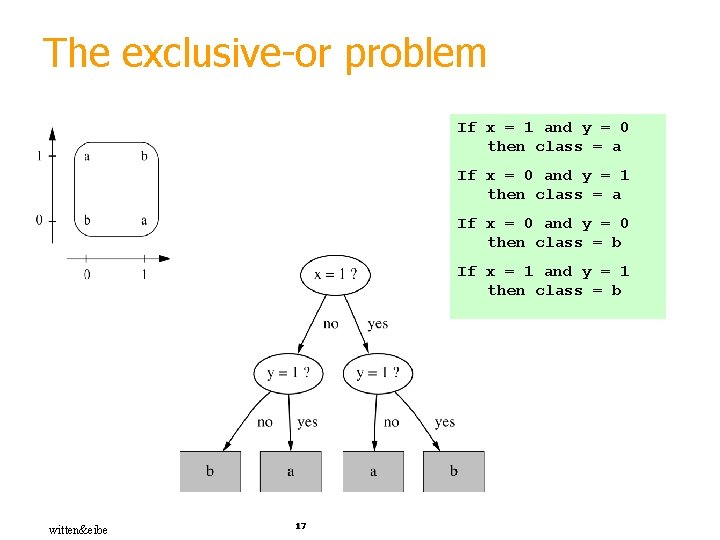
The exclusive-or problem If x = 1 and y = 0 then class = a If x = 0 and y = 1 then class = a If x = 0 and y = 0 then class = b If x = 1 and y = 1 then class = b witten&eibe 17
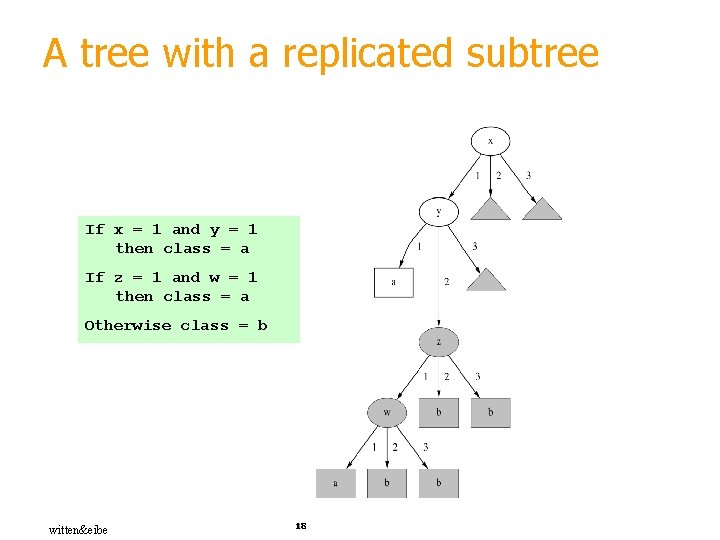
A tree with a replicated subtree If x = 1 and y = 1 then class = a If z = 1 and w = 1 then class = a Otherwise class = b witten&eibe 18
“Nuggets” of knowledge § Are rules independent pieces of knowledge? (It seems easy to add a rule to an existing rule base. ) § Problem: ignores how rules are executed § Two ways of executing a rule set: § Ordered set of rules (“decision list”) § Order is important for interpretation § Unordered set of rules § Rules may overlap and lead to different conclusions for the same instance witten&eibe 19
Interpreting rules § § What if two or more rules conflict? § Give no conclusion at all? § Go with rule that is most popular on training data? § … What if no rule applies to a test instance? § Give no conclusion at all? § Go with class that is most frequent in training data? § … witten&eibe 20
Special case: boolean class § Assumption: if instance does not belong to class “yes”, it belongs to class “no” § Trick: only learn rules for class “yes” and use default rule for “no” If x = 1 and y = 1 then class = a If z = 1 and w = 1 then class = a Otherwise class = b § Order of rules is not important. No conflicts! § Rule can be written in disjunctive normal form witten&eibe 21
Rules involving relations § So far: all rules involved comparing an attribute-value to a constant (e. g. temperature < 45) § These rules are called “propositional” because they have the same expressive power as propositional logic § What if problem involves relationships between examples (e. g. family tree problem from above)? § Can’t be expressed with propositional rules § More expressive representation required witten&eibe 22
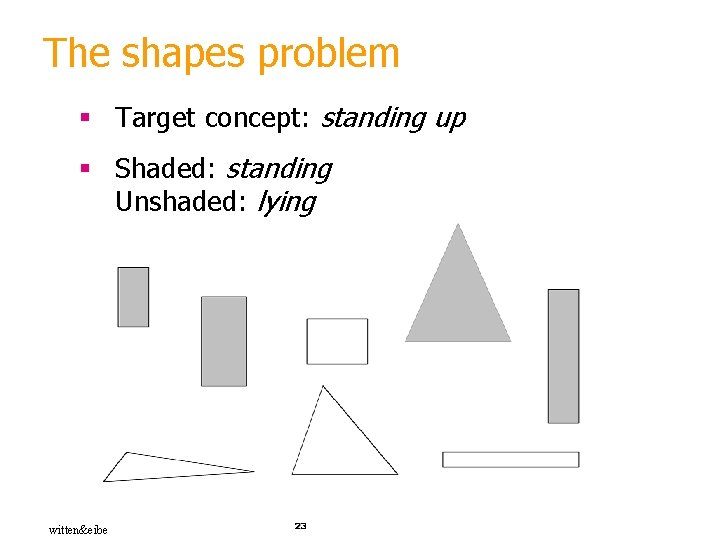
The shapes problem § Target concept: standing up § Shaded: standing Unshaded: lying witten&eibe 23
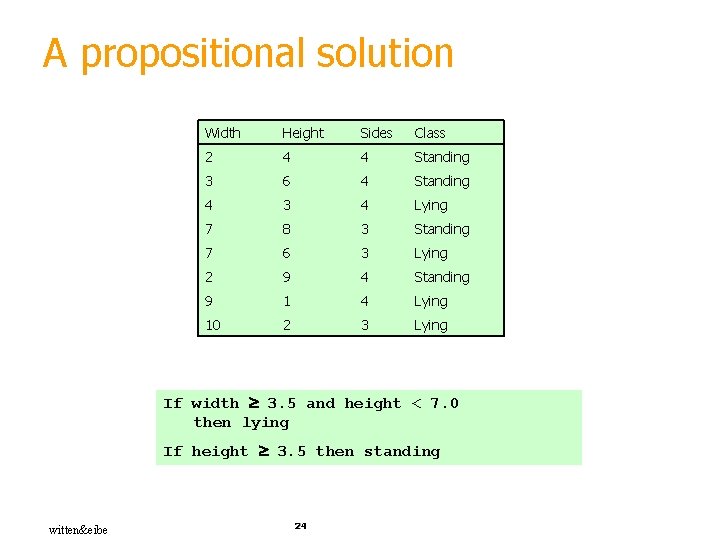
A propositional solution Width Height Sides Class 2 4 4 Standing 3 6 4 Standing 4 3 4 Lying 7 8 3 Standing 7 6 3 Lying 2 9 4 Standing 9 1 4 Lying 10 2 3 Lying If width 3. 5 and height < 7. 0 then lying If height 3. 5 then standing witten&eibe 24
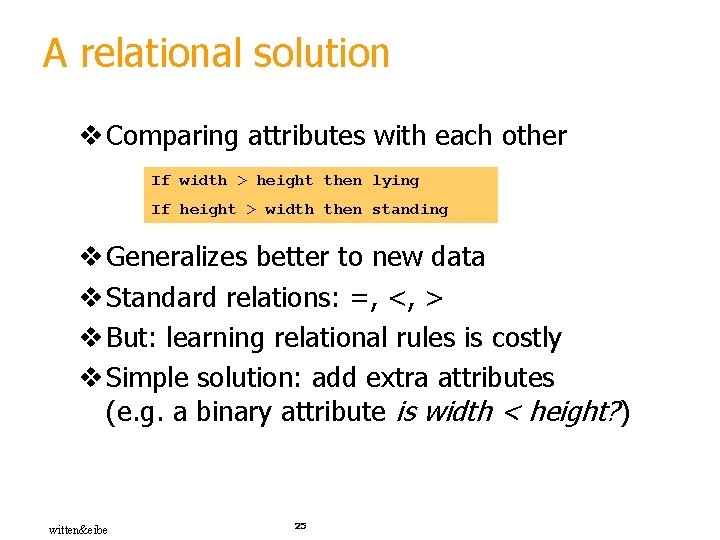
A relational solution v Comparing attributes with each other If width > height then lying If height > width then standing v Generalizes better to new data v Standard relations: =, <, > v But: learning relational rules is costly v Simple solution: add extra attributes (e. g. a binary attribute is width < height? ) witten&eibe 25
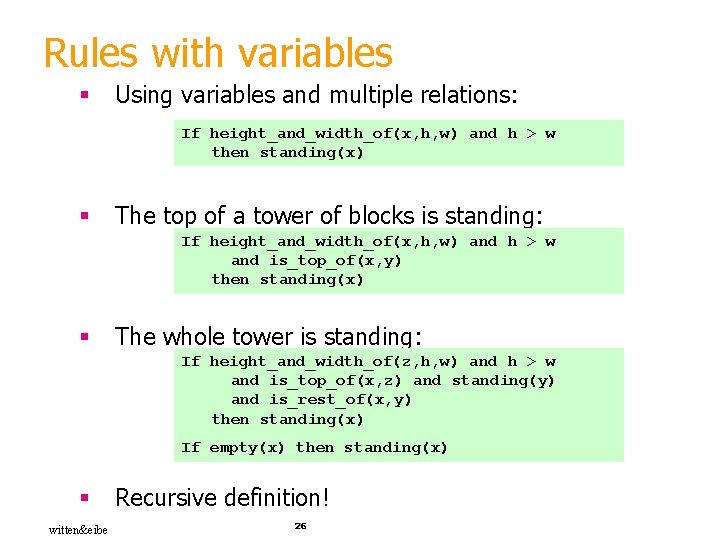
Rules with variables § Using variables and multiple relations: If height_and_width_of(x, h, w) and h > w then standing(x) § The top of a tower of blocks is standing: If height_and_width_of(x, h, w) and h > w and is_top_of(x, y) then standing(x) § The whole tower is standing: If height_and_width_of(z, h, w) and h > w and is_top_of(x, z) and standing(y) and is_rest_of(x, y) then standing(x) If empty(x) then standing(x) § witten&eibe Recursive definition! 26
Inductive logic programming § Recursive definition can be seen as logic program § Techniques for learning logic programs stem from the area of “inductive logic programming” (ILP) § But: recursive definitions are hard to learn § Also: few practical problems require recursion § Thus: many ILP techniques are restricted to non-recursive definitions to make learning easier witten&eibe 27
Instance-based representation § Simplest form of learning: rote learning § Training instances are searched for instance that most closely resembles new instance § The instances themselves represent the knowledge § Also called instance-based learning § Similarity function defines what’s “learned” § Instance-based learning is lazy learning § Methods: k-nearest-neighbor, … witten&eibe 28
The distance function § Simplest case: one numeric attribute § Distance is the difference between the two attribute values involved (or a function thereof) § Several numeric attributes: normally, Euclidean distance is used and attributes are normalized § Nominal attributes: distance is set to 1 if values are different, 0 if they are equal § Are all attributes equally important? § Weighting the attributes might be necessary witten&eibe 29
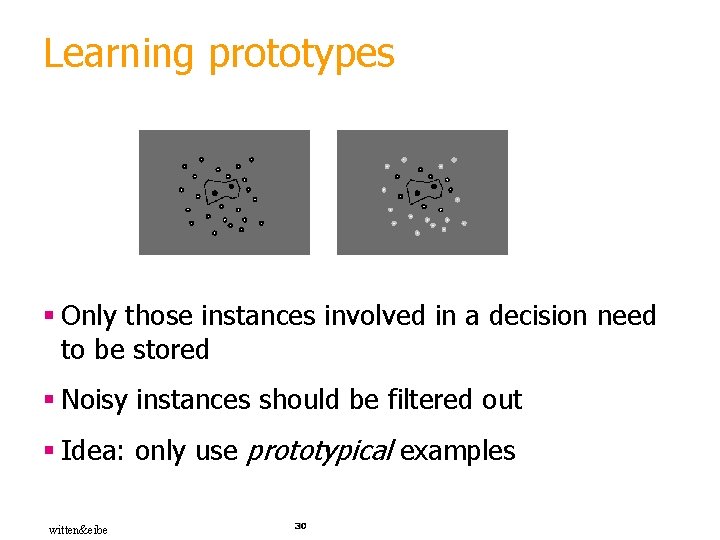
Learning prototypes § Only those instances involved in a decision need to be stored § Noisy instances should be filtered out § Idea: only use prototypical examples witten&eibe 30
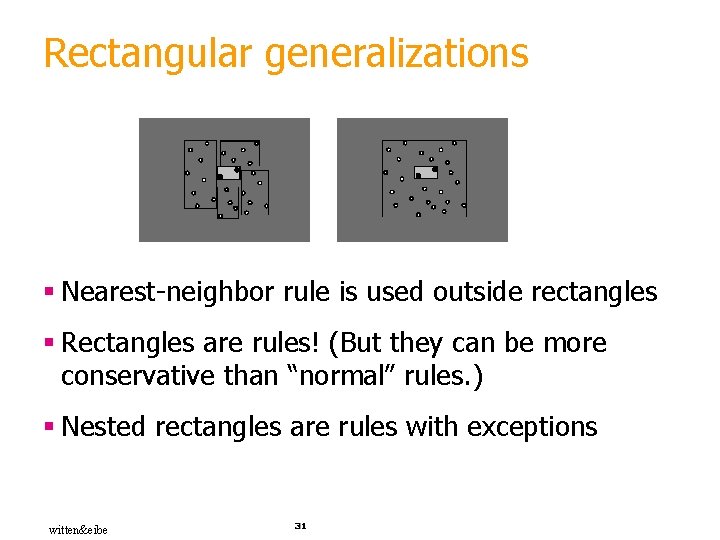
Rectangular generalizations § Nearest-neighbor rule is used outside rectangles § Rectangles are rules! (But they can be more conservative than “normal” rules. ) § Nested rectangles are rules with exceptions witten&eibe 31
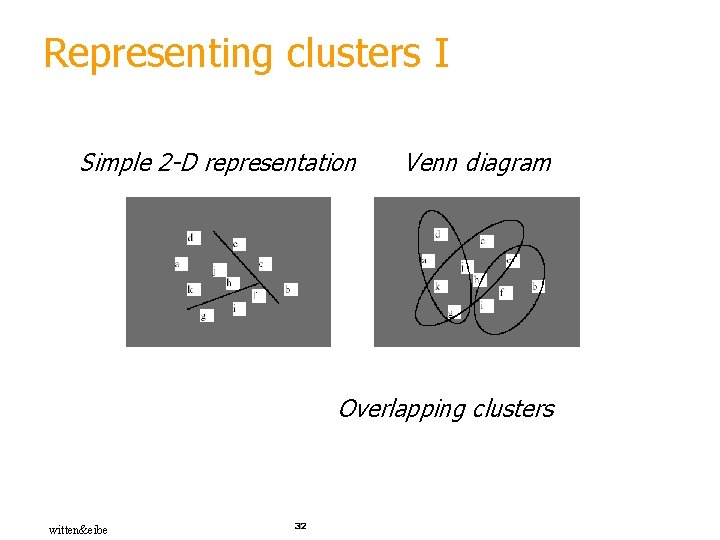
Representing clusters I Simple 2 -D representation Venn diagram Overlapping clusters witten&eibe 32
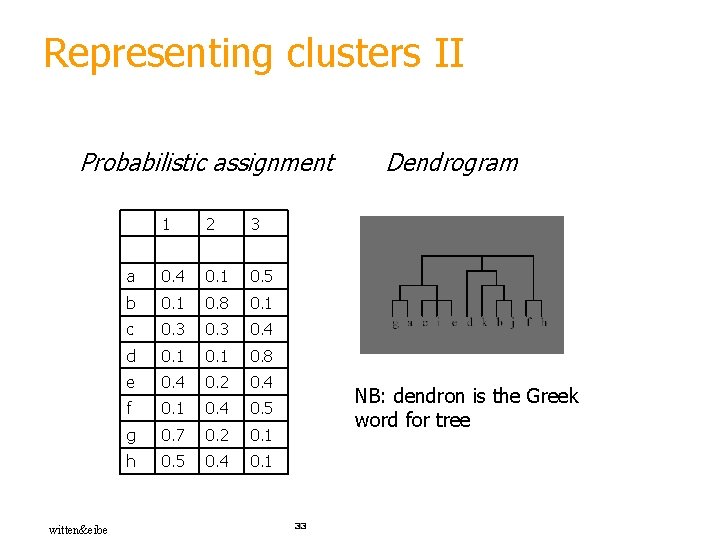
Representing clusters II Probabilistic assignment witten&eibe 1 2 3 a 0. 4 0. 1 0. 5 b 0. 1 0. 8 0. 1 c 0. 3 0. 4 d 0. 1 0. 8 e 0. 4 0. 2 0. 4 f 0. 1 0. 4 0. 5 g 0. 7 0. 2 0. 1 h 0. 5 0. 4 0. 1 Dendrogram NB: dendron is the Greek word for tree 33
Summary § Trees § Rules § Relational representation § Instance-based representation 34
- Slides: 34