
Knowledge Representation II Inference in Propositional Logic CSE
![Inference 2: Resolution [Robinson 1965] { (p ), ( p ) } |-R (](https://slidetodoc.com/presentation_image_h2/8f81def85cf7d59ff238d245a0adf86c/image-11.jpg "Inference 2: Resolution [Robinson 1965] { (p ), ( p ) } |-R (")
![Inference 4: DPLL (Enumeration of Partial Models) [Davis, Putnam, Loveland & Logemann 1962] Version](https://slidetodoc.com/presentation_image_h2/8f81def85cf7d59ff238d245a0adf86c/image-14.jpg "Inference 4: DPLL (Enumeration of Partial Models) [Davis, Putnam, Loveland & Logemann 1962] Version")
- Slides: 33
Knowledge Representation II (Inference in Propositional Logic) CSE 473 © Daniel S. Weld
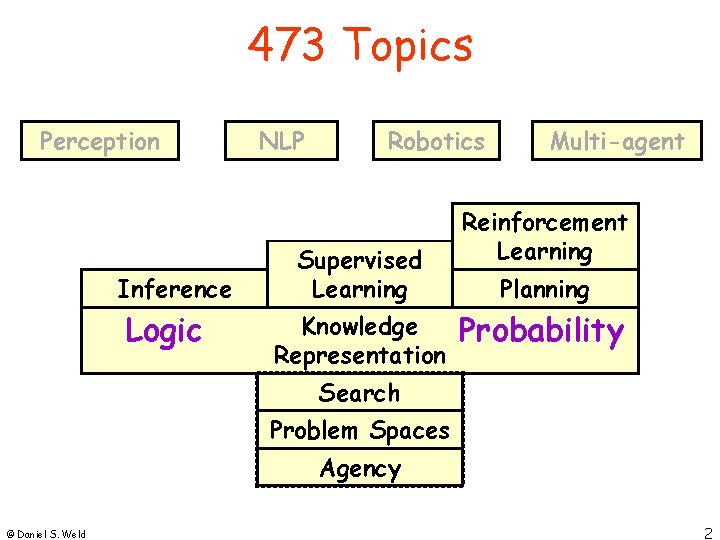
473 Topics Perception Inference Logic NLP Robotics Supervised Learning Knowledge Representation Multi-agent Reinforcement Learning Planning Probability Search Problem Spaces Agency © Daniel S. Weld 2
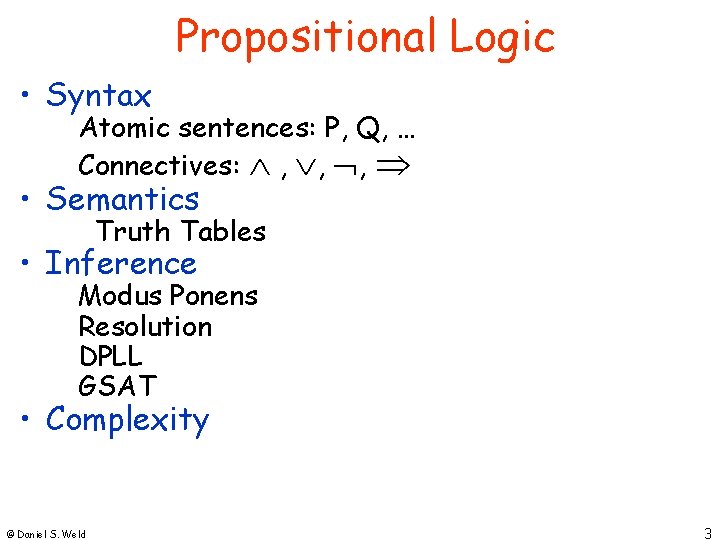
Propositional Logic • Syntax Atomic sentences: P, Q, … Connectives: , , , • Semantics Truth Tables • Inference Modus Ponens Resolution DPLL GSAT • Complexity © Daniel S. Weld 3
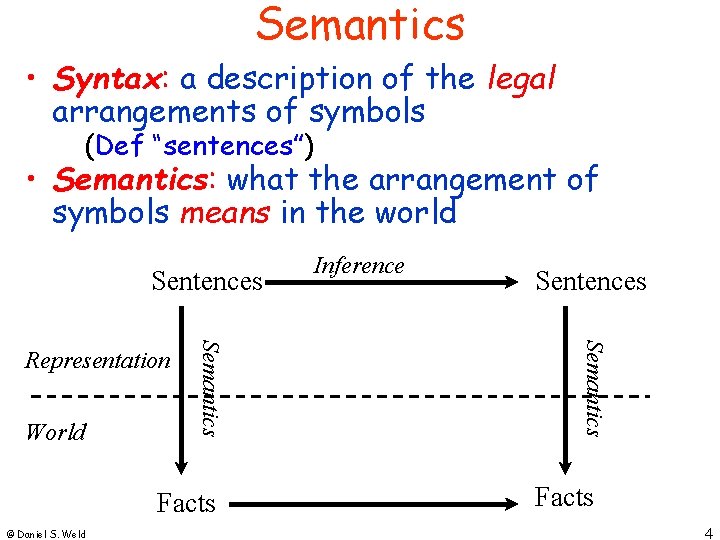
Semantics • Syntax: a description of the legal arrangements of symbols (Def “sentences”) • Semantics: what the arrangement of symbols means in the world Sentences Facts © Daniel S. Weld Sentences Semantics World Semantics Representation Inference Facts 4
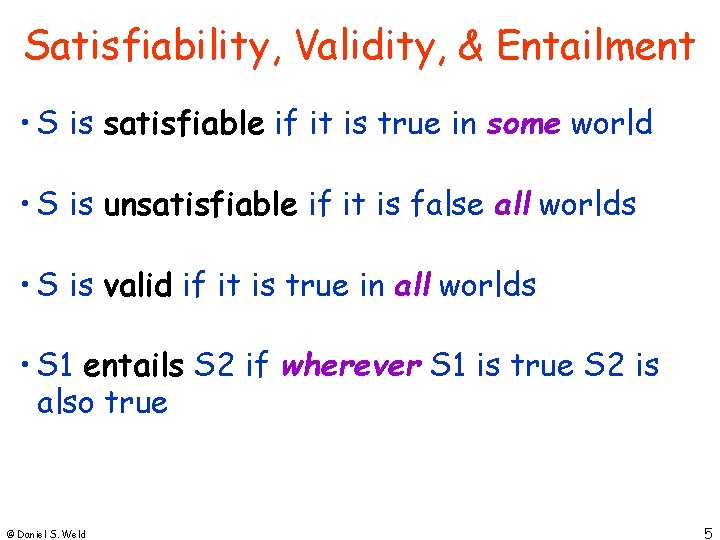
Satisfiability, Validity, & Entailment • S is satisfiable if it is true in some world • S is unsatisfiable if it is false all worlds • S is valid if it is true in all worlds • S 1 entails S 2 if wherever S 1 is true S 2 is also true © Daniel S. Weld 5
Today • Inference Algorithms As search Systematic & stochastic • Themes Expressivity vs. Tractability © Daniel S. Weld 6
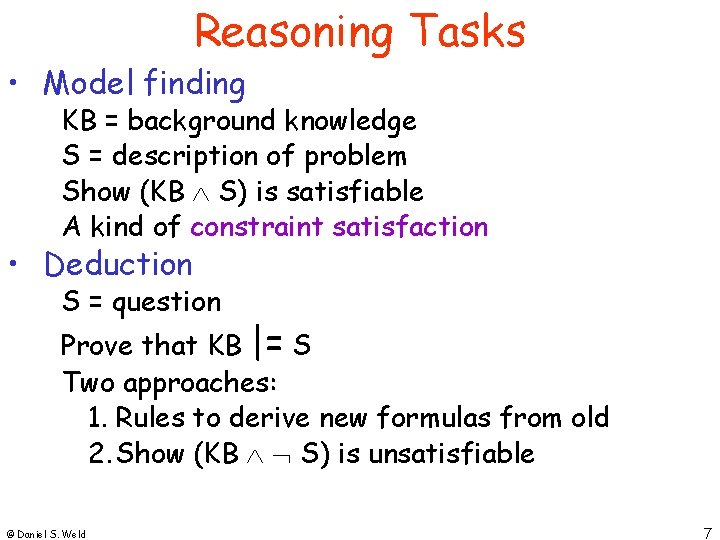
Reasoning Tasks • Model finding KB = background knowledge S = description of problem Show (KB S) is satisfiable A kind of constraint satisfaction • Deduction S = question Prove that KB |= S Two approaches: 1. Rules to derive new formulas from old 2. Show (KB S) is unsatisfiable © Daniel S. Weld 7
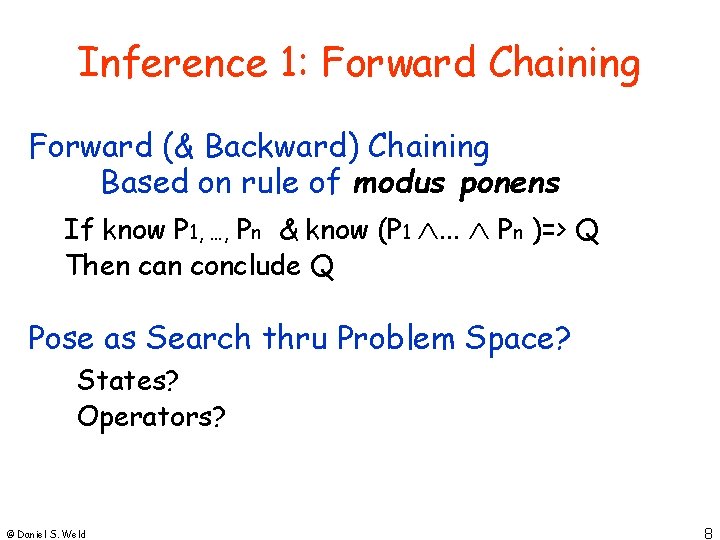
Inference 1: Forward Chaining Forward (& Backward) Chaining Based on rule of modus ponens If know P 1, …, Pn & know (P 1 . . . Pn )=> Q Then can conclude Q Pose as Search thru Problem Space? States? Operators? © Daniel S. Weld 8
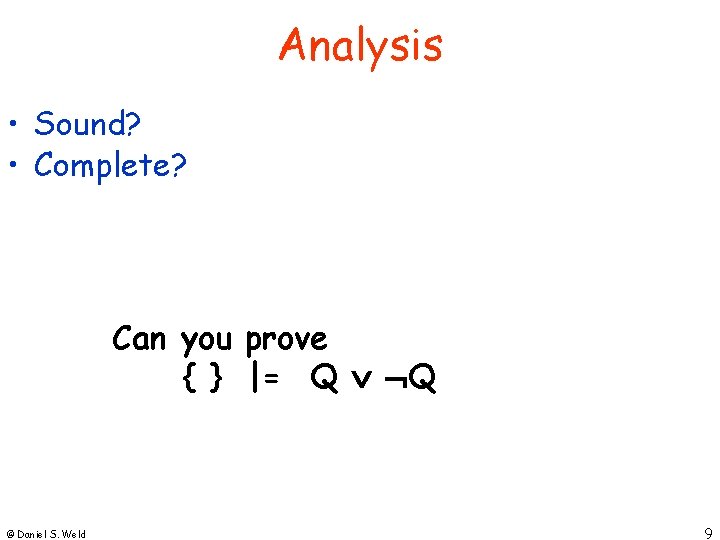
Analysis • Sound? • Complete? Can you prove { } |= Q Q © Daniel S. Weld 9
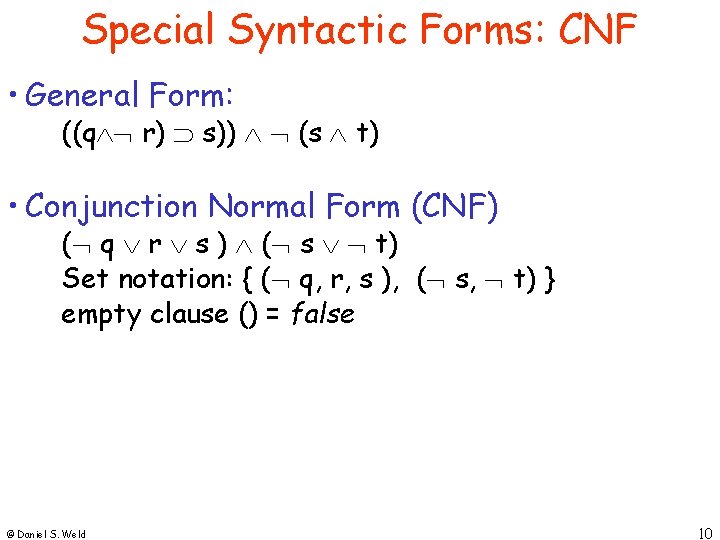
Special Syntactic Forms: CNF • General Form: ((q r) s)) (s t) • Conjunction Normal Form (CNF) ( q r s ) ( s t) Set notation: { ( q, r, s ), ( s, t) } empty clause () = false © Daniel S. Weld 10
Inference 2: Resolution [Robinson 1965] { (p ), ( p ) } |-R ( ) Correctness If S 1 |-R S 2 then S 1 |= S 2 Refutation Completeness: If S is unsatisfiable then S |-R () © Daniel S. Weld 11
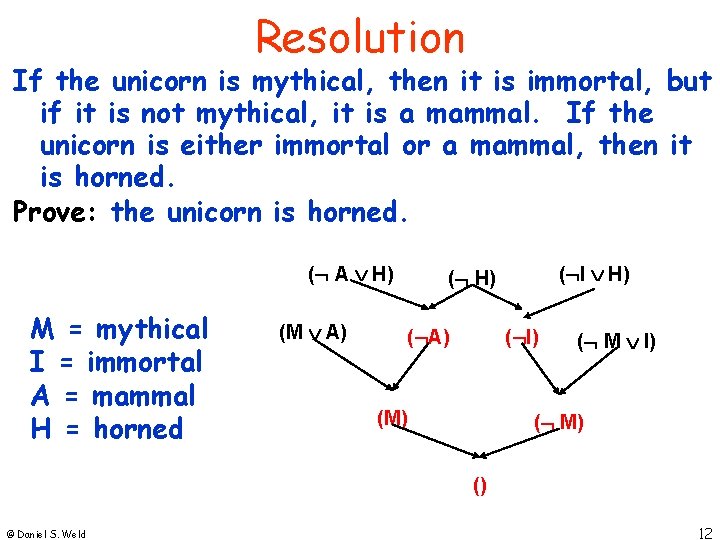
Resolution If the unicorn is mythical, then it is immortal, but if it is not mythical, it is a mammal. If the unicorn is either immortal or a mammal, then it is horned. Prove: the unicorn is horned. ( A H) M = mythical I = immortal A = mammal H = horned (M A) ( I H) ( A) ( I) (M) ( M I) ( M) () © Daniel S. Weld 12
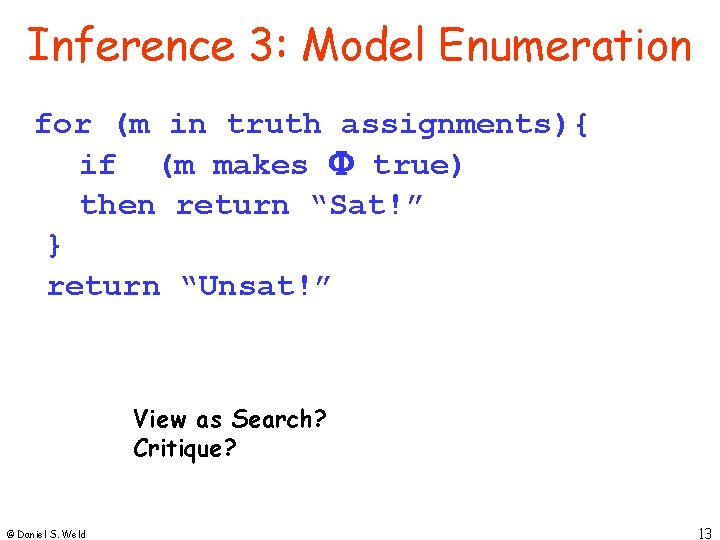
Inference 3: Model Enumeration for (m in truth assignments){ if (m makes true) then return “Sat!” } return “Unsat!” View as Search? Critique? © Daniel S. Weld 13
Inference 4: DPLL (Enumeration of Partial Models) [Davis, Putnam, Loveland & Logemann 1962] Version 1 dpll_1(pa){ if (pa makes F false) return false; if (pa makes F true) return true; choose P in F; if (dpll_1(pa U {P=0})) return true; return dpll_1(pa U {P=1}); } Returns true if F is satisfiable, false otherwise © Daniel S. Weld 14
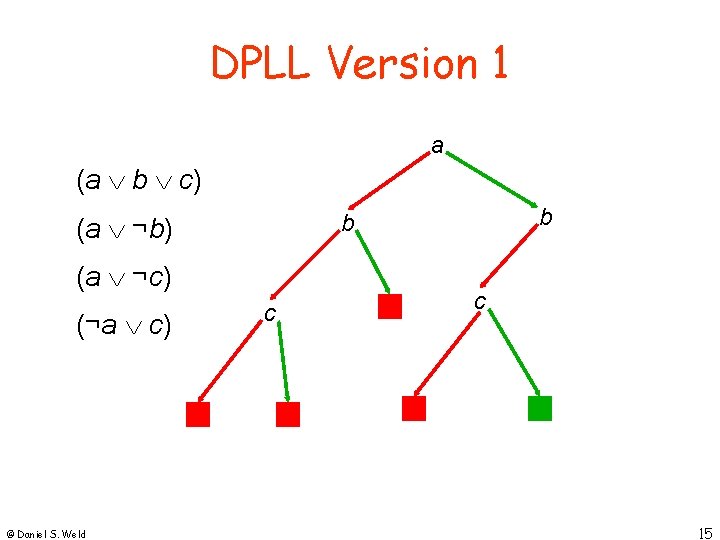
DPLL Version 1 a (a b c) (a ¬c) (¬a c) © Daniel S. Weld b b (a ¬b) c c 15
DPLL as Search • Search Space? • Algorithm? © Daniel S. Weld 16
Improving DPLL © Daniel S. Weld 17
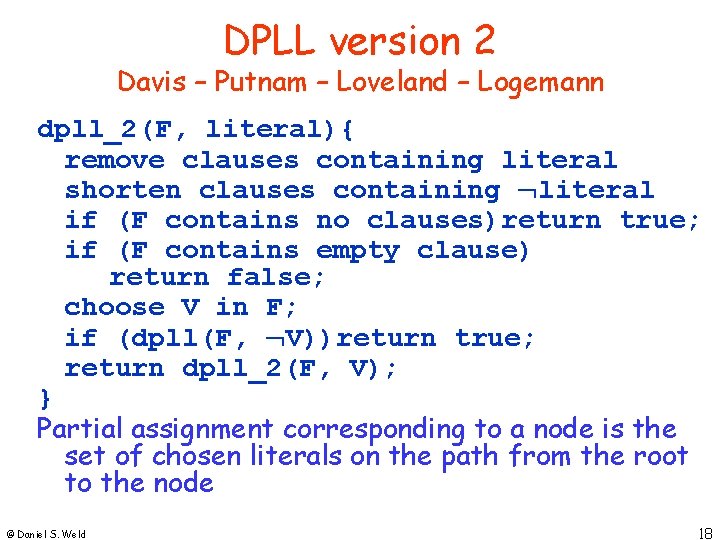
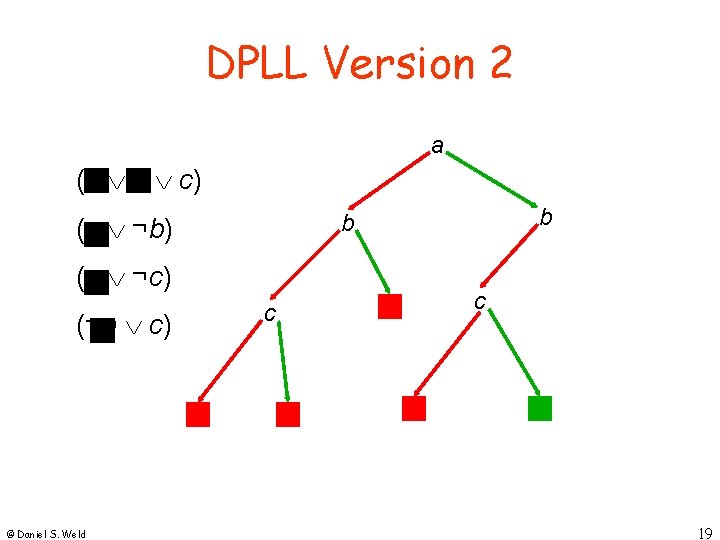
DPLL version 2 Davis – Putnam – Loveland – Logemann dpll_2(F, literal){ remove clauses containing literal shorten clauses containing literal if (F contains no clauses)return true; if (F contains empty clause) return false; choose V in F; if (dpll(F, V))return true; return dpll_2(F, V); } Partial assignment corresponding to a node is the set of chosen literals on the path from the root to the node © Daniel S. Weld 18
DPLL Version 2 a (a b c) (a ¬c) (¬a c) © Daniel S. Weld b b (a ¬b) c c 19
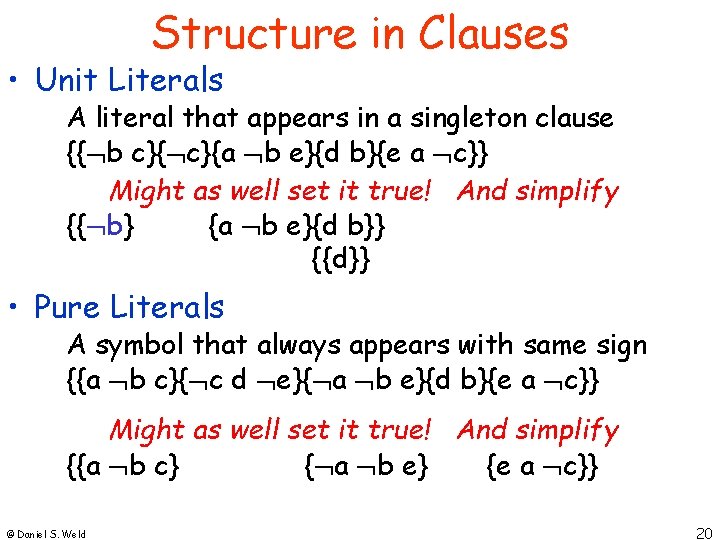
Structure in Clauses • Unit Literals A literal that appears in a singleton clause {{ b c}{a b e}{d b}{e a c}} Might as well set it true! And simplify {{ b} {a b e}{d b}} {{d}} • Pure Literals A symbol that always appears with same sign {{a b c}{ c d e}{ a b e}{d b}{e a c}} Might as well set it true! And simplify {{a b c} { a b e} {e a c}} © Daniel S. Weld 20
Further Improvements May view this as adding constraint propagation techniques into play © Daniel S. Weld 21
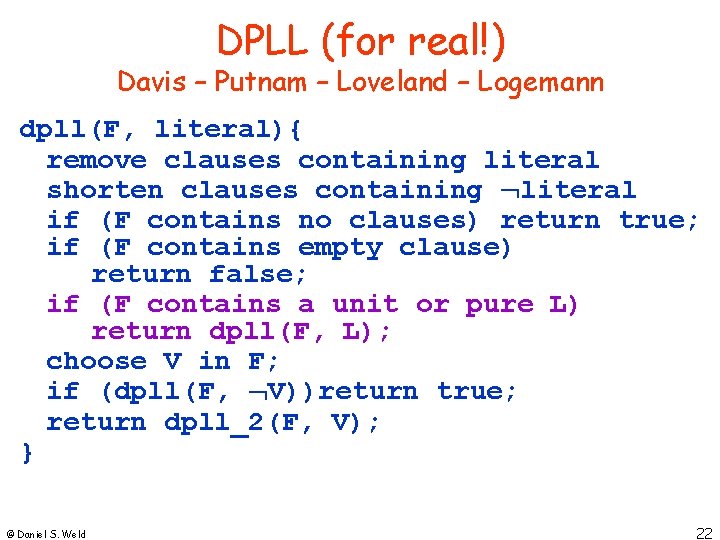
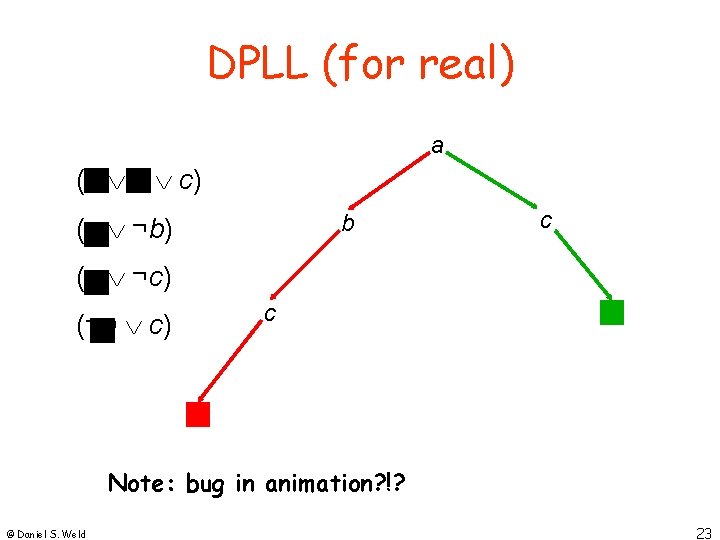
DPLL (for real!) Davis – Putnam – Loveland – Logemann dpll(F, literal){ remove clauses containing literal shorten clauses containing literal if (F contains no clauses) return true; if (F contains empty clause) return false; if (F contains a unit or pure L) return dpll(F, L); choose V in F; if (dpll(F, V))return true; return dpll_2(F, V); } © Daniel S. Weld 22
DPLL (for real) a (a b c) b (a ¬b) c (a ¬c) (¬a c) c Note: bug in animation? !? © Daniel S. Weld 23
Heuristic Search in DPLL • Heuristics are used in DPLL to select a (nonunit, non-pure) proposition for branching • Idea: identify a most constrained variable Likely to create many unit clauses • MOM’s heuristic: Most occurrences in clauses of minimum length © Daniel S. Weld 25
Success of DPLL • • 1962 – DPLL invented 1992 – 300 propositions 1997 – 600 propositions (satz) Additional techniques: Learning conflict clauses at backtrack points Randomized restarts 2002 (z. Chaff) 1, 000 propositions – encodings of hardware verification problems © Daniel S. Weld 26
Horn Theories • Recall the special case of Horn clauses: { ( q r s ), ( s t) } { ((q r) s ), ((s t) false) } • Many problems naturally take the form of such if/then rules If (fever) AND (vomiting) then FLU • Unit propagation is refutation complete for Horn theories Good implementation – linear time! © Daniel S. Weld 29
Walk. Sat • Local search over space of complete truth assignments With probability P: flip any variable in any unsatisfied clause With probability (1 -P): flip best variable in any unsat clause • Like fixed-temperature simulated annealing • SAT encodings of N-Queens, scheduling • Best algorithm for random K-SAT Best DPLL: 700 variables Walksat: 100, 000 variables © Daniel S. Weld 30
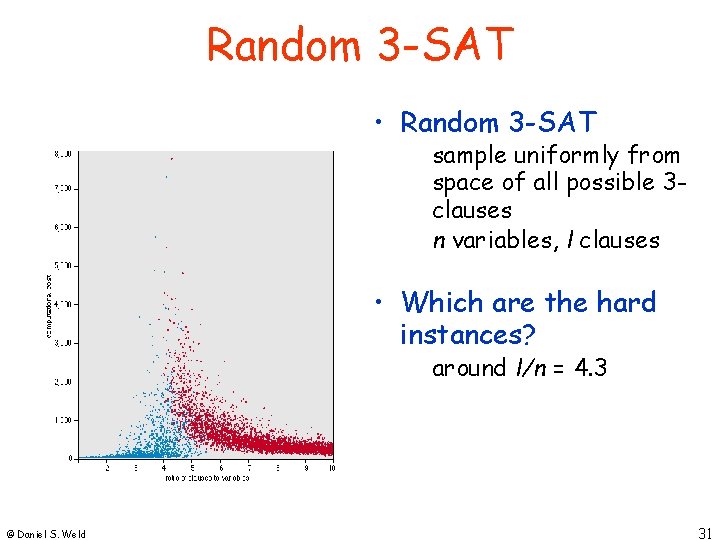
Random 3 -SAT • Random 3 -SAT sample uniformly from space of all possible 3 clauses n variables, l clauses • Which are the hard instances? around l/n = 4. 3 © Daniel S. Weld 31
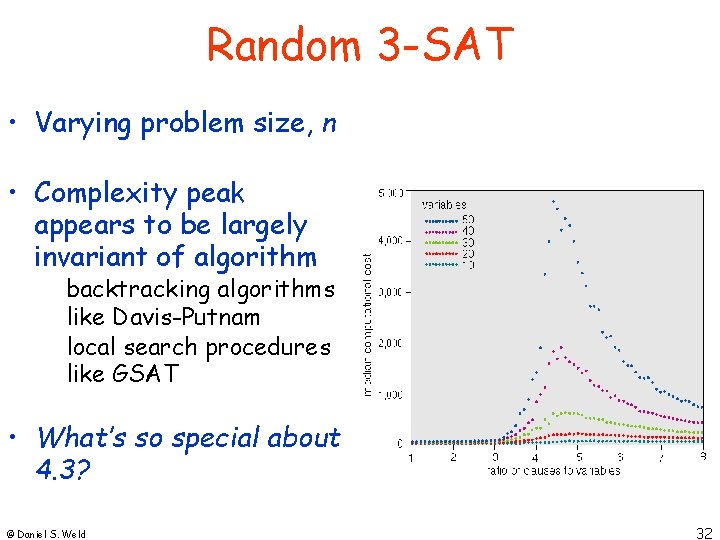
Random 3 -SAT • Varying problem size, n • Complexity peak appears to be largely invariant of algorithm backtracking algorithms like Davis-Putnam local search procedures like GSAT • What’s so special about 4. 3? © Daniel S. Weld 32
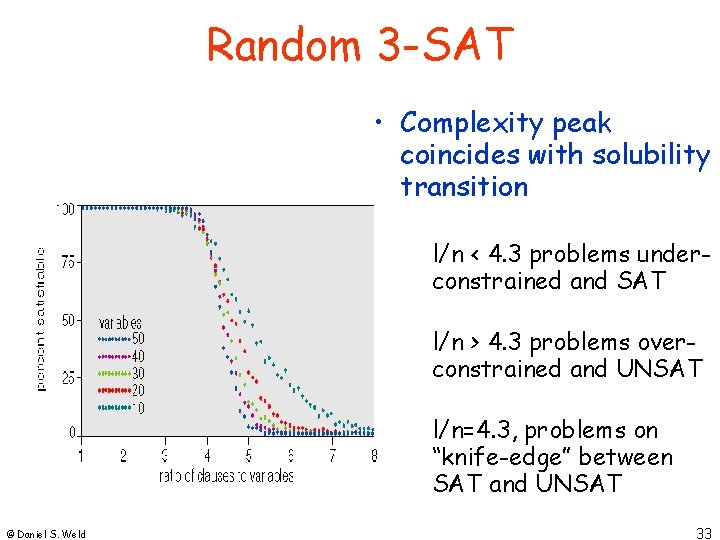
Random 3 -SAT • Complexity peak coincides with solubility transition l/n < 4. 3 problems underconstrained and SAT l/n > 4. 3 problems overconstrained and UNSAT l/n=4. 3, problems on “knife-edge” between SAT and UNSAT © Daniel S. Weld 33
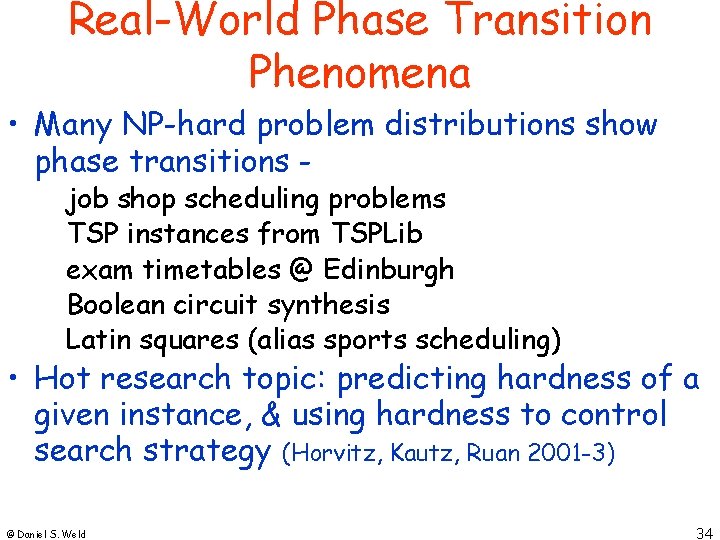
Real-World Phase Transition Phenomena • Many NP-hard problem distributions show phase transitions job shop scheduling problems TSP instances from TSPLib exam timetables @ Edinburgh Boolean circuit synthesis Latin squares (alias sports scheduling) • Hot research topic: predicting hardness of a given instance, & using hardness to control search strategy (Horvitz, Kautz, Ruan 2001 -3) © Daniel S. Weld 34
Summary: Algorithms • • • Forward Chaining Resolution Model Enumeration of Partial Models (DPLL) Walksat © Daniel S. Weld 35
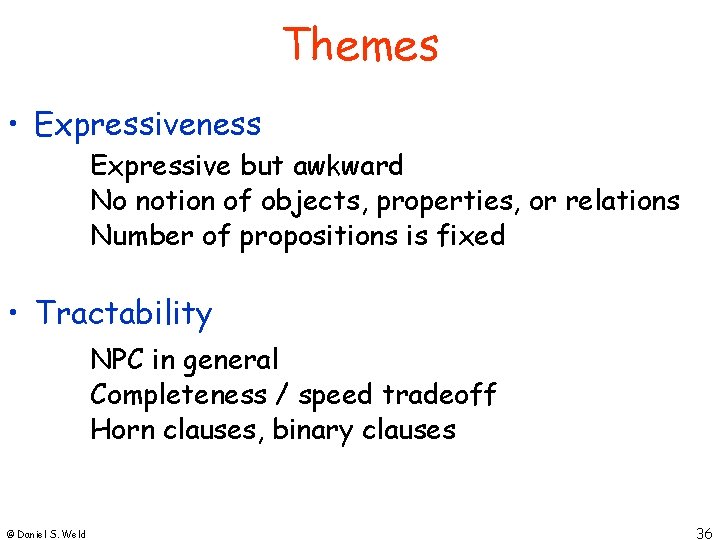
Themes • Expressiveness Expressive but awkward No notion of objects, properties, or relations Number of propositions is fixed • Tractability NPC in general Completeness / speed tradeoff Horn clauses, binary clauses © Daniel S. Weld 36