
Knowledge Representation for Question Answering Deborah L Mc
Knowledge Representation for Question Answering Deborah L. Mc. Guinness Knowledge Systems Laboratory Stanford University 3/25/03
Overview There are many ways to potentially improve answering systems § Partial KR&R impact spectrum § Full-fledged KR (KB for content; KR tools for evolution and maintenance e. g. , HPKB, RKF, …) § “Lighter” KR - Markup of source information (e. g. , DAML, OWL, …) - Query expansion using ontologies (e. g. , Find. UR, enhanced TAP, …) - Structured Query (and answer pattern) language Take home message – KR can be applied to many areas of the question answering task, it can be used incrementally in partnership with other areas, and is ready for prime time use. 2 3/25/03
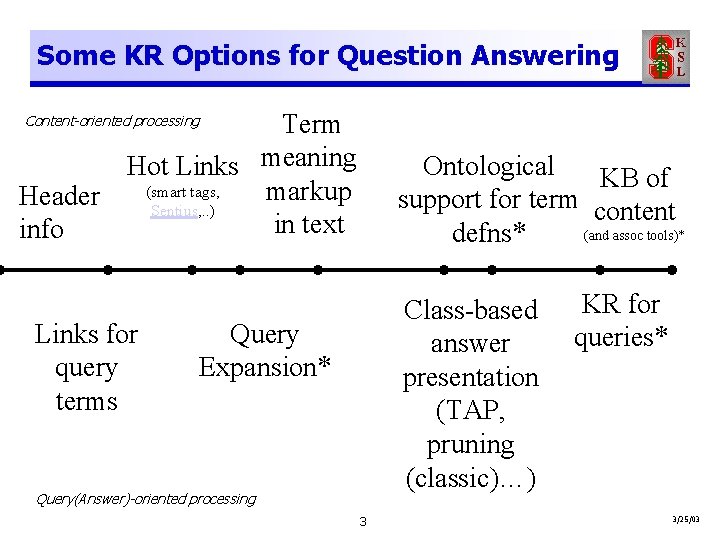
Some KR Options for Question Answering Term Hot Links meaning (smart tags, markup Header Sentius, . . ) in text info Content-oriented processing Links for query terms Ontological KB of support for term content (and assoc tools)* defns* Class-based answer presentation (TAP, pruning (classic)…) Query Expansion* Query(Answer)-oriented processing 3 KR for queries* 3/25/03
Mainstream KR: A few example programs • DARPA Rapid Knowledge Formation (RKF) § Goal: allow distributed teams of subject matter experts to quickly and easily build, maintain, and use knowledge bases without need for specialized training. § Stanford Knowledge Systems Lab focus - Creating, Maintaining, and Integrating Understandable Knowledge Bases § Next PI meeting – May 13 -15 • DARPA High Performance Knowledge Base (HPKB) § Predecessor to RKF § Goal: advance the technology of how computers acquire, represent and manipulate knowledge § KSL built tools to build, analyze, manipulate, store KBs and led large Knowledge building effort for evaluation tests. 4 3/25/03
Programs cont. • ARDA’s Advanced Question & Answering for Intelligence (AQUAINT) § Goal – Advance QA against structured and unstructured info § KSL focus – ontology building support and tools (diagnostics, evolution, extraction, general reasoning (JTP), temporal reasoning, explanation, querying (DQL), partitioning, …) • ARDA’s Novel Intelligence for Massive Data (NIMD) § Goal – Avoid strategic surprise by helping analysts be more effective (focus attention on critical information and help analyze/prune/refine/explain/reuse/…) 5 3/25/03
KR&R • Rich expressive languages for encoding information (FOL-based languages) • Large hand-coded knowledge bases (e. g. , HPKB, Cyc kb, RKF kb…) • Semi-automatically generated kbs • Question answering ranging from lookup, keyword retrieval, reasoning from general principles • Integrated with deep and special purpose reasoners (snark, jtp, qualitative reasoning, …) • Extensive environmental support (Chimaera, Shaken, Kraken, KA, Inference Web. . ) • Interest from outside Vulcan, NI, 6 3/25/03
Chimaera: Ontology Environment Tool An interactive web-based tool aimed at supporting: • Ontology analysis (correctness, completeness, style, …) • Merging of ontological terms from varied sources • Maintaining ontologies over time • Validation of input • Features: multiple I/O languages, loading and merging into multiple namespaces, collaborative distributed environment support, integrated browsing/editing environment, extensible diagnostic rule language • Used in commercial and academic environments, basis of some commercial re-implementations (Ontobuilder/Ontoserver, …) • Available as a hosted service from www-ksl-svc. stanford. edu • Information: www. ksl. stanford. edu/software/chimaera 7 3/25/03

Inference Web (w/Pinheiro da Silva) Motivated by trust and reuse needs, IW provides a solution for explaining reasoning/retrieval tasks by storing, exchanging, combining, annotating, filtering, segmenting, comparing and rendering proofs and proof fragments provided by reasoners. u u Portable proof specification as an interlingua for proof interchange u Proof browser for displaying IW proofs (possibly from multiple retrieval/inference engines) and for supporting follow-up questions u Registry agents to record information used in proofs (e. g. , sources, provenance information, reasoners, rules, etc. ) Used with JTP, DQL Server, Wine agent, … ready for external users. http: //www. ksl. stanford. edu/software/iw/ 8 3/25/03
Moving to lighter options 9 3/25/03
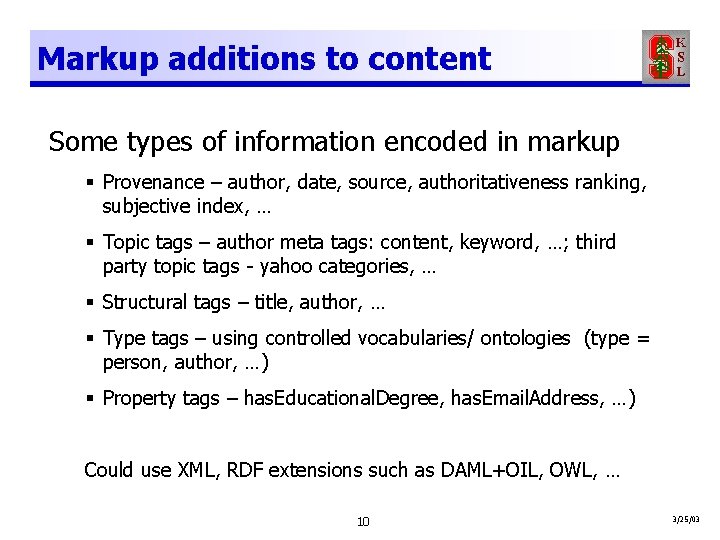
Markup additions to content Some types of information encoded in markup § Provenance – author, date, source, authoritativeness ranking, subjective index, … § Topic tags – author meta tags: content, keyword, …; third party topic tags - yahoo categories, … § Structural tags – title, author, … § Type tags – using controlled vocabularies/ ontologies (type = person, author, …) § Property tags – has. Educational. Degree, has. Email. Address, …) Could use XML, RDF extensions such as DAML+OIL, OWL, … 10 3/25/03
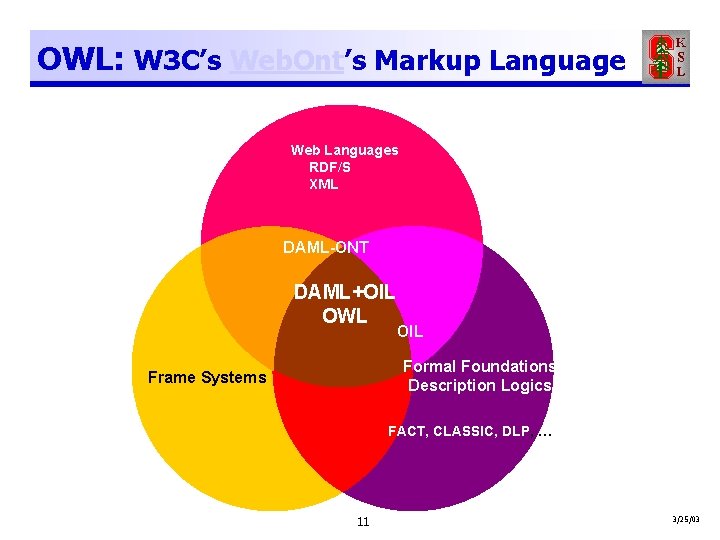
OWL: W 3 C’s Web. Ont’s Markup Language Web Languages RDF/S XML DAML-ONT DAML+OIL OWL OIL Formal Foundations Description Logics Frame Systems FACT, CLASSIC, DLP, … 11 3/25/03
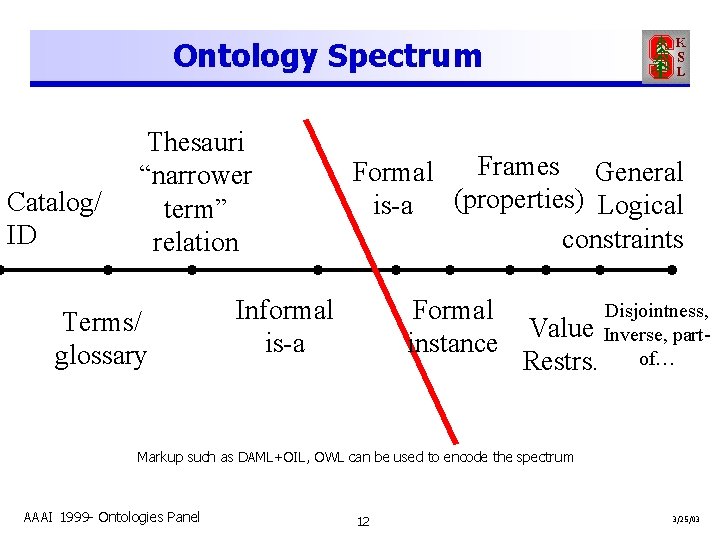
Ontology Spectrum Catalog/ ID Thesauri “narrower term” relation Terms/ glossary Frames General Formal is-a (properties) Logical constraints Informal is-a Formal instance Disjointness, Value Inverse, part. Restrs. of… Markup such as DAML+OIL, OWL can be used to encode the spectrum AAAI 1999 - Ontologies Panel 12 3/25/03
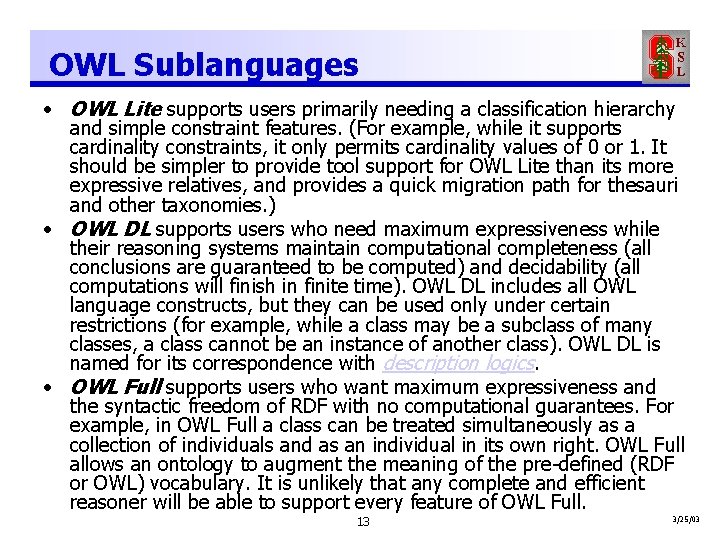
OWL Sublanguages • OWL Lite supports users primarily needing a classification hierarchy and simple constraint features. (For example, while it supports cardinality constraints, it only permits cardinality values of 0 or 1. It should be simpler to provide tool support for OWL Lite than its more expressive relatives, and provides a quick migration path for thesauri and other taxonomies. ) • OWL DL supports users who need maximum expressiveness while their reasoning systems maintain computational completeness (all conclusions are guaranteed to be computed) and decidability (all computations will finish in finite time). OWL DL includes all OWL language constructs, but they can be used only under certain restrictions (for example, while a class may be a subclass of many classes, a class cannot be an instance of another class). OWL DL is named for its correspondence with description logics. • OWL Full supports users who want maximum expressiveness and the syntactic freedom of RDF with no computational guarantees. For example, in OWL Full a class can be treated simultaneously as a collection of individuals and as an individual in its own right. OWL Full allows an ontology to augment the meaning of the pre-defined (RDF or OWL) vocabulary. It is unlikely that any complete and efficient reasoner will be able to support every feature of OWL Full. 13 3/25/03
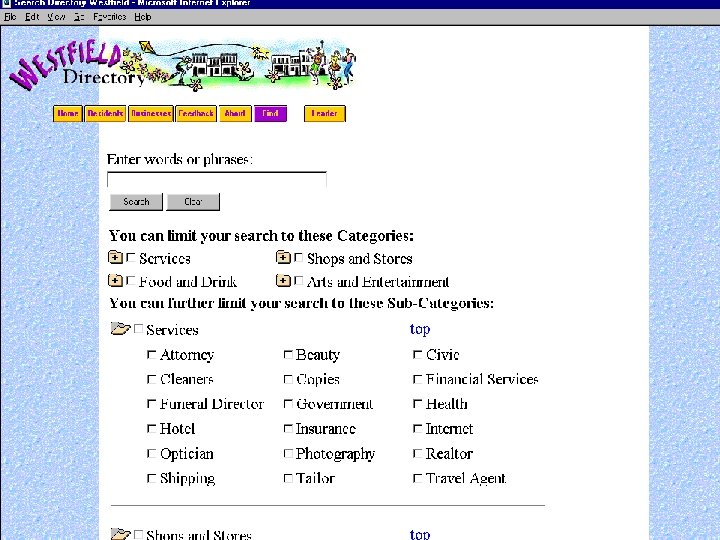
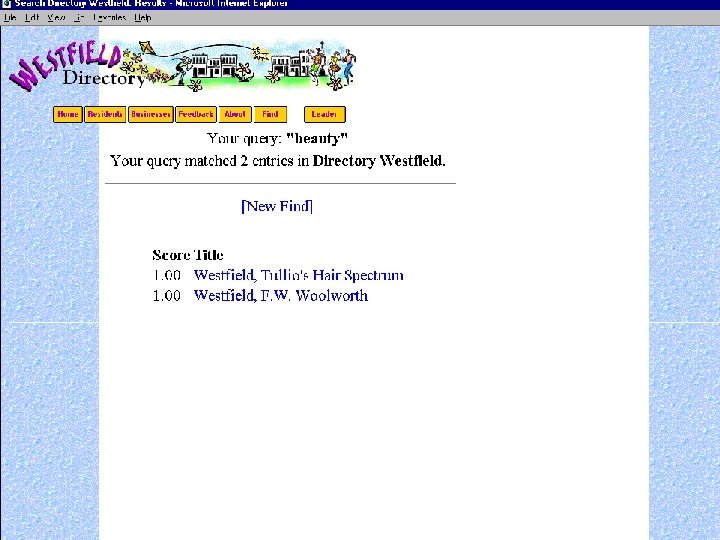
One option with simple taxonomies: Query Expansion Under some conditions, free text queries may be adequate with small enhancements. Consider Find. UR’s conditions: - web pages with few words - constrained domain - unconstrained query interface 14 3/25/03
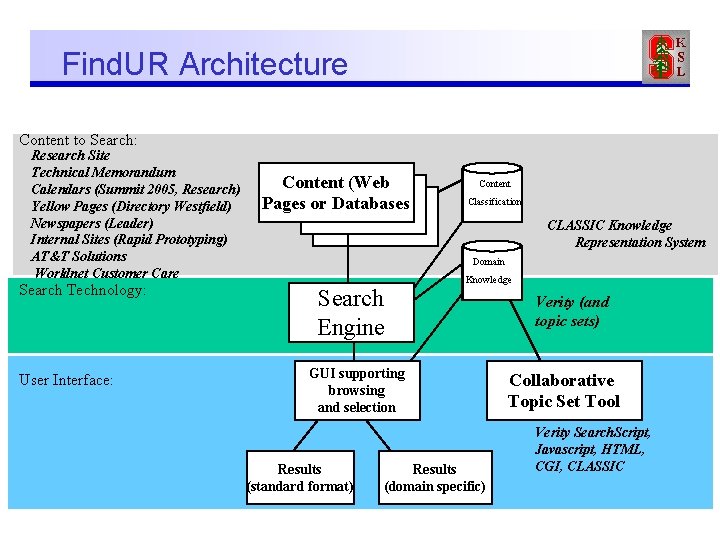
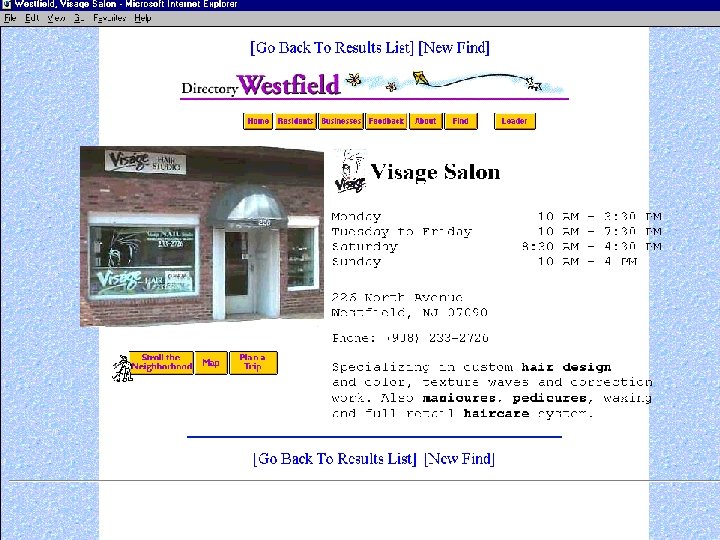
Find. UR Architecture Content to Search: Research Site Technical Memorandum Calendars (Summit 2005, Research) Yellow Pages (Directory Westfield) Newspapers (Leader) Internal Sites (Rapid Prototyping) AT&T Solutions Worldnet Customer Care Search Technology: User Interface: Content (Web Pages or Databases Content Classification CLASSIC Knowledge Representation System Search Engine Domain Knowledge GUI supporting browsing and selection Results (standard format) Results (domain specific) Verity (and topic sets) Collaborative Topic Set Tool Verity Search. Script, Javascript, HTML, CGI, CLASSIC
One option with simple KBs: TAP Activity-based search (w/Mc. Cool, Guha, Fikes) Under some conditions, free text queries may benefit contextual dynamic additions to answers Augment standard (Google) retrieval with information based on type of search term if recognized - properties related to concept (similar to jeeves follow-up yesterday) - retrieve data from known sources 19 3/25/03
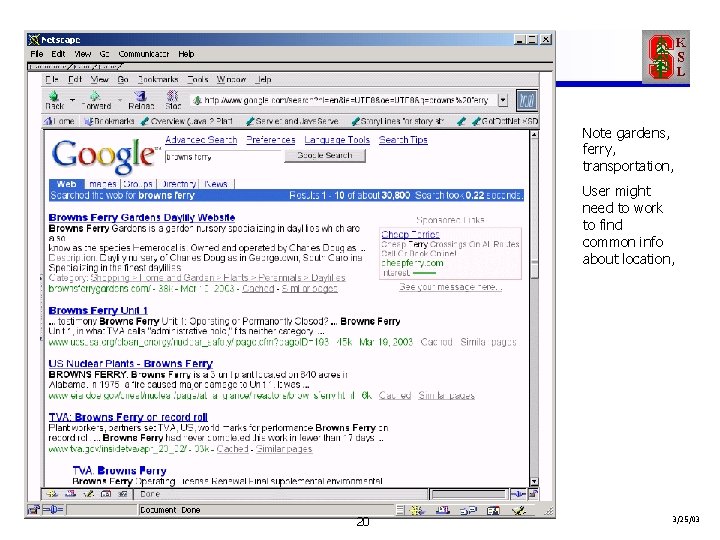
Note gardens, ferry, transportation, User might need to work to find common info about location, 20 3/25/03
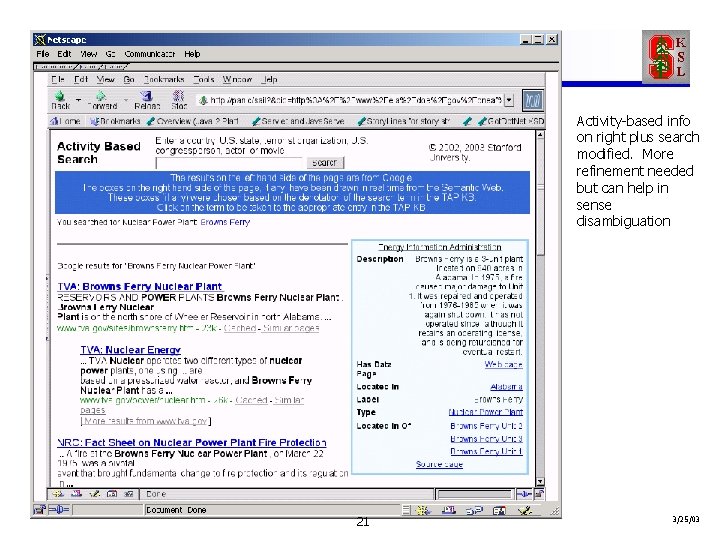
Activity-based info on right plus search modified. More refinement needed but can help in sense disambiguation 21 3/25/03
Query Language • Pattern Matching Languages may be used to specify portions of information to return from structured data sources. • Can be viewed as pruning languages (Asking Queries about Frames – KR ’ 96) • Can be viewed as query-answering dialogues (DQL 2003) • Use a formal language to specify semantic relationships between queries, query answer, and knowledge base 22 3/25/03
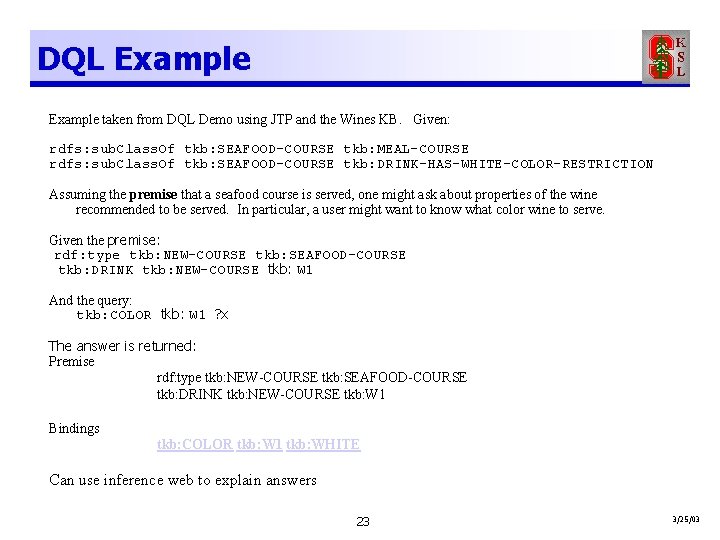
DQL Example taken from DQL Demo using JTP and the Wines KB. Given: rdfs: sub. Class. Of tkb: SEAFOOD-COURSE tkb: MEAL-COURSE rdfs: sub. Class. Of tkb: SEAFOOD-COURSE tkb: DRINK-HAS-WHITE-COLOR-RESTRICTION Assuming the premise that a seafood course is served, one might ask about properties of the wine recommended to be served. In particular, a user might want to know what color wine to serve. Given the premise: rdf: type tkb: NEW-COURSE tkb: SEAFOOD-COURSE tkb: DRINK tkb: NEW-COURSE tkb: W 1 And the query: tkb: COLOR tkb: W 1 ? x The answer is returned: Premise rdf: type tkb: NEW-COURSE tkb: SEAFOOD-COURSE tkb: DRINK tkb: NEW-COURSE tkb: W 1 Bindings tkb: COLOR tkb: W 1 tkb: WHITE Can use inference web to explain answers 23 3/25/03
Conclusion KR can be used to add intelligence to question answering tasks at many levels: • Handcrafted KBs and queries can be used built and maintained with tool assistance • Lighter weight KR can be used effectively exploiting simple taxonomies, limited frame information, limited or extensive markup, etc. • Can be used in combination with other approaches (e. g. , AQUA here) • Languages, tools, methodologies are available for non-KR experts to use 24 3/25/03
Discussion Position Papers: -Ontologies come of age – http: //www. ksl. stanford. edu/people/dlm/papers/ontologies-come-of-age-abstract. html -Description Logics emerge from Ivory Towers http: //www. ksl. stanford. edu/people/dlm/papers/dls-emerge-abstract. html Languages, Environments, Software: -OWL - http: //www. w 3. org/TR/owl-features/ , http: //www. w 3. org/TR/owl-guide/ -Inference Web - http: //www. ksl. stanford. edu/software/iw/ -Chimaera - http: //www. ksl. stanford. edu/software/chimaera/ -Find. UR - http: //www. research. att. com/people/~dlm/findur/ -TAP – http: //tap. stanford. edu/ -DQL - http: //www. ksl. stanford. edu/projects/dql/ 25 3/25/03
- Slides: 25