
Knowledge recap Look at the picture and consider

- Slides: 19
Knowledge recap Look at the picture and consider the following questions. 1. Why does a robin puff out it’s chest? 2. In Psychology, what does the term ‘nature’ refer to? How might ‘nature’ explain why the Robin puffs his chest? 3. In Psychology, what does the term ‘nurture’ refer to? How might ‘nurture’ explain why the Robin puffs his chest? Stretch and challenge – Can you link the behaviour of this robin to human behaviour? Extra stretch – How could you explain why humans show such behaviours today?
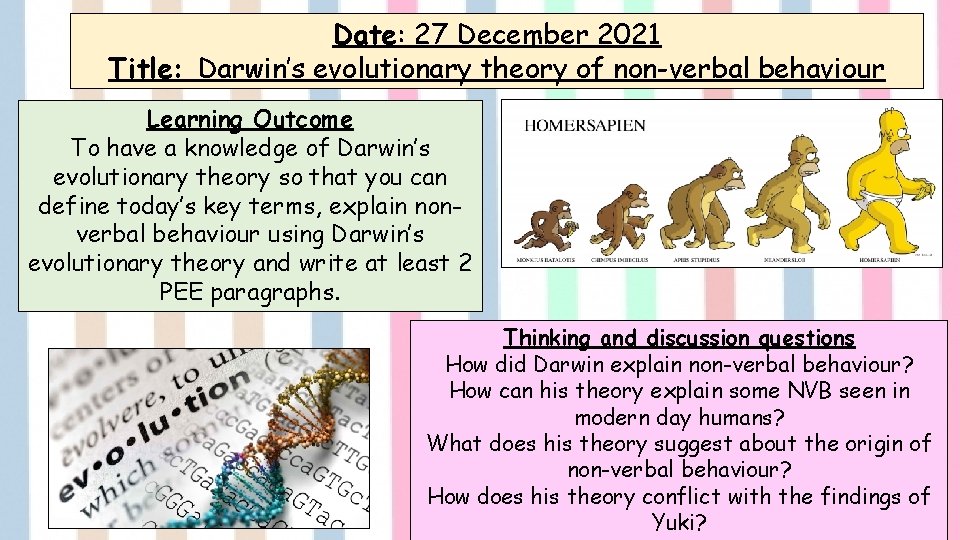
Date: 27 December 2021 Title: Darwin’s evolutionary theory of non-verbal behaviour Learning Outcome To have a knowledge of Darwin’s evolutionary theory so that you can define today’s key terms, explain nonverbal behaviour using Darwin’s evolutionary theory and write at least 2 PEE paragraphs. Thinking and discussion questions How did Darwin explain non-verbal behaviour? How can his theory explain some NVB seen in modern day humans? What does his theory suggest about the origin of non-verbal behaviour? How does his theory conflict with the findings of Yuki?
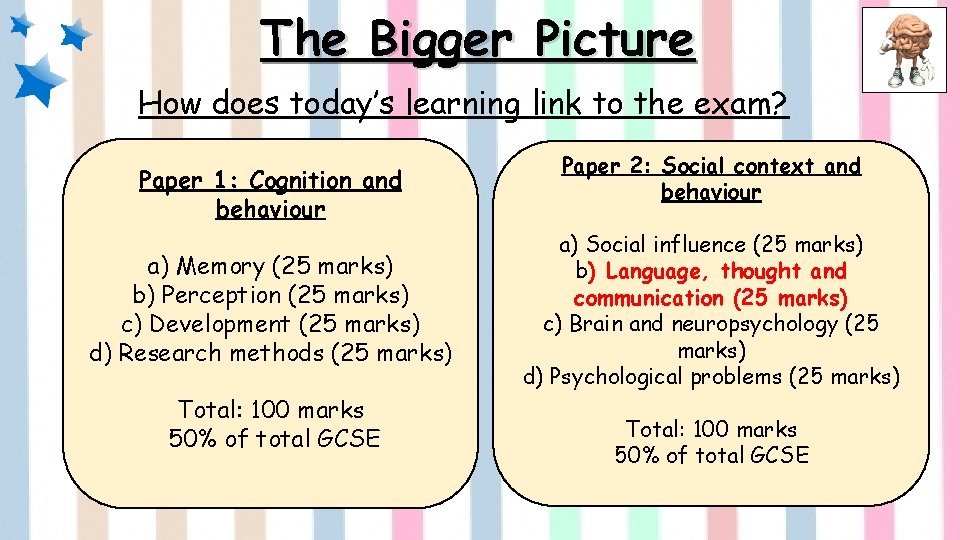
The Bigger Picture How does today’s learning link to the exam? Paper 1: Cognition and behaviour a) Memory (25 marks) b) Perception (25 marks) c) Development (25 marks) d) Research methods (25 marks) Total: 100 marks 50% of total GCSE Paper 2: Social context and behaviour a) Social influence (25 marks) b) Language, thought and communication (25 marks) c) Brain and neuropsychology (25 marks) d) Psychological problems (25 marks) Total: 100 marks 50% of total GCSE
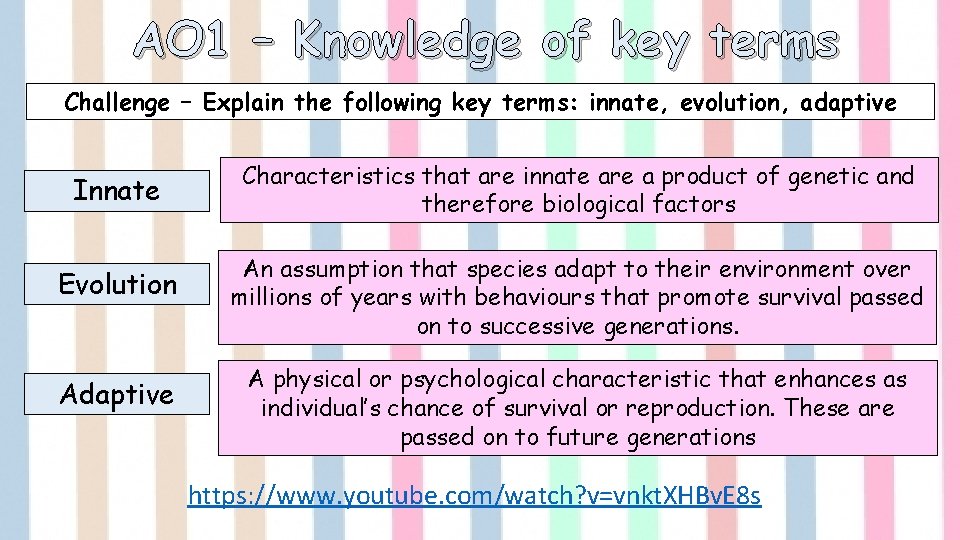
AO 1 – Knowledge of key terms Challenge – Explain the following key terms: innate, evolution, adaptive Innate Evolution Adaptive Characteristics that are innate are a product of genetic and therefore biological factors An assumption that species adapt to their environment over millions of years with behaviours that promote survival passed on to successive generations. A physical or psychological characteristic that enhances as individual’s chance of survival or reproduction. These are passed on to future generations https: //www. youtube. com/watch? v=vnkt. XHBv. E 8 s
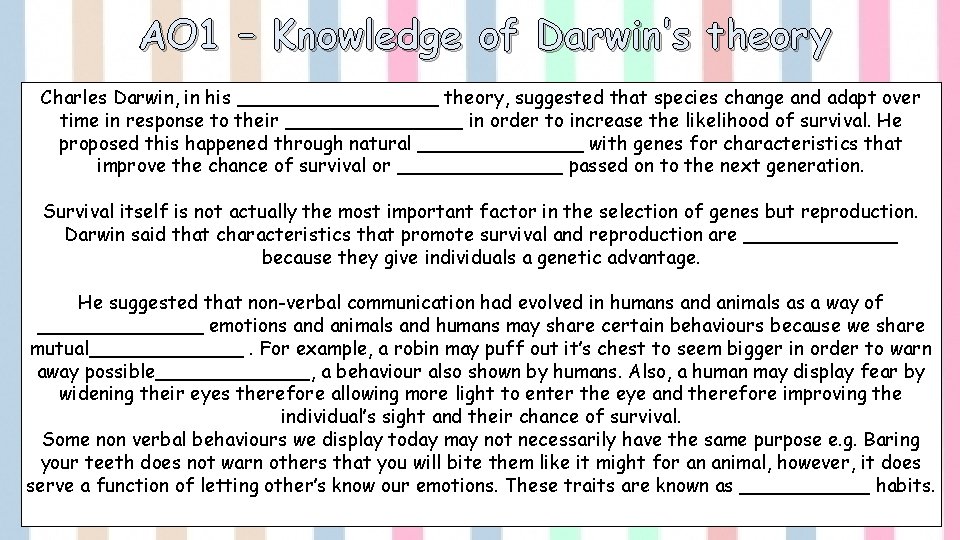
AO 1 – Knowledge of Darwin’s theory Charles Darwin, in his _________ theory, suggested that species change and adapt over time in response to their ________ in order to increase the likelihood of survival. He proposed this happened through natural _______ with genes for characteristics that improve the chance of survival or _______ passed on to the next generation. Survival itself is not actually the most important factor in the selection of genes but reproduction. Darwin said that characteristics that promote survival and reproduction are _______ because they give individuals a genetic advantage. He suggested that non-verbal communication had evolved in humans and animals as a way of _______ emotions and animals and humans may share certain behaviours because we share mutual_______. For example, a robin may puff out it’s chest to seem bigger in order to warn away possible_______, a behaviour also shown by humans. Also, a human may display fear by widening their eyes therefore allowing more light to enter the eye and therefore improving the individual’s sight and their chance of survival. Some non verbal behaviours we display today may not necessarily have the same purpose e. g. Baring your teeth does not warn others that you will bite them like it might for an animal, however, it does serve a function of letting other’s know our emotions. These traits are known as ______ habits.
AO 1 – Knowledge of Darwin’s theory Charles Darwin, in his evolutionary theory, suggested that species change and adapt over time in response to their environment in order to increase the likelihood of survival. He proposed this happened through natural selection with genes for characteristics that improve the chance of survival or reproduction passed on to the next generation. Survival itself is not actually the most important factor in the selection of genes but reproduction. Darwin said that characteristics that promote survival and reproduction are adaptive because they give individuals a genetic advantage. He suggested that non-verbal communication had evolved in humans and animals as a way of expressing emotions and animals and humans may share certain behaviours because we share mutual ancestors. For example, a robin may puff out it’s chest to seem bigger in order to warn away possible predators, a behaviour also shown by humans. Also, a human may display fear by widening their eyes therefore allowing more light to enter the eye and therefore improving the individual’s sight and their chance of survival. Some non verbal behaviours we display today may not necessarily have the same purpose e. g. Baring your teeth does not warn others that you will bite them like it might for an animal, however, it does serve a function of letting other’s know our emotions. These traits are known as serviceable habits.
Thinking and discussion questions How did Darwin explain non-verbal behaviour? (AO 1) How can his theory explain some NVB seen in modern day humans? (AO 2) What does his theory suggest about the origin of non-verbal behaviour? (AO 3) How does his theory conflict with the findings of Yuki? (AO 3)
2 minute warning This is your two minute warning! You have two minutes to revise the material we have covered so far this lesson ready for an AO 1 test. Evolution, innate, adaptive, serviceable habits.
Knowledge review Define the term adaptive
Knowledge review What are serviceable habits?
Knowledge review Give an example of a serviceable habit
Knowledge review Give an example of an adaptive behaviour
Knowledge review What is evolution?
Knowledge review Who is the main psychologist associated with this theory?
Knowledge review Does theory fall on the nature or the nurture side of the debate?
AO 2: Application of knowledge Complete the AO 2 activity on your worksheet Daniel is in the social area at lunchtime when he sees a large crowd gathering, one of his friends tells him that two boys are about the have a fight. When Daniel looks over he sees one boy with his chest puffed out, baring his teeth whilst the other boy appears scared because his eyes are opened really wide. Use your knowledge of Darwin’s evolutionary theory to explain Daniel’s observation (4 marks) Have you : q Explained Darwin’s theory? q Referred to the behaviour of both boys? q. Explained why the behaviour of both boys may be evolutionary?
AO 3: Evaluation of Darwin’s theory https: //www. youtube. com/watch? v=q Co 3 w. SGYRb. Q P One weakness of Darwin’s theory is that it cannot explain why there are cultural differences in non-verbal behaviour. E For example, . . . If non-verbal behaviour were, as Darwin suggested, genetically determined then. . . E This is an issue as theory fails to explain all non-verbal communication. What does this tell us about the origins of nonverbal behaviour? Is it influenced by nature or nurture? What does this mean for Darwin’s theory? Use the video to complete the PEE paragraph
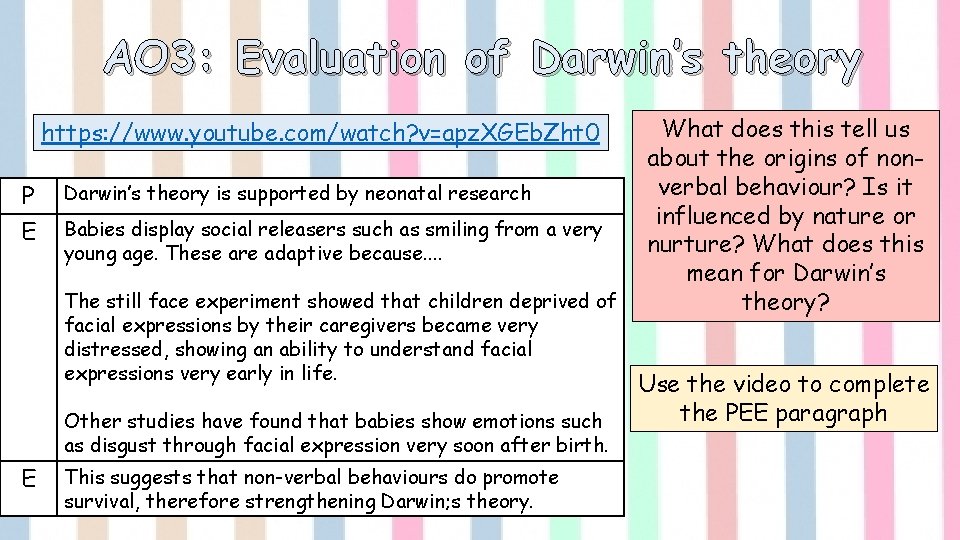
AO 3: Evaluation of Darwin’s theory https: //www. youtube. com/watch? v=apz. XGEb. Zht 0 P E Darwin’s theory is supported by neonatal research Babies display social releasers such as smiling from a very young age. These are adaptive because. . The still face experiment showed that children deprived of facial expressions by their caregivers became very distressed, showing an ability to understand facial expressions very early in life. Other studies have found that babies show emotions such as disgust through facial expression very soon after birth. E This suggests that non-verbal behaviours do promote survival, therefore strengthening Darwin; s theory. What does this tell us about the origins of nonverbal behaviour? Is it influenced by nature or nurture? What does this mean for Darwin’s theory? Use the video to complete the PEE paragraph
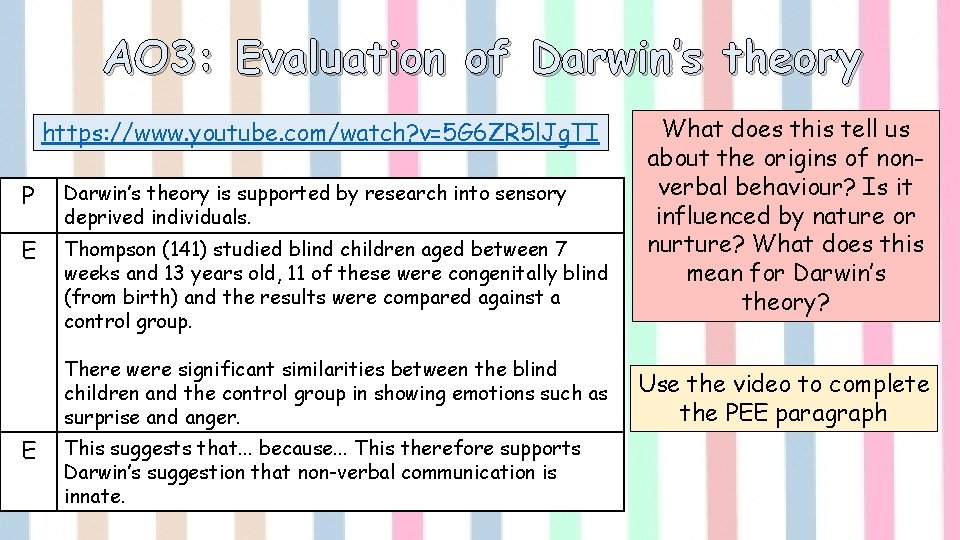
AO 3: Evaluation of Darwin’s theory https: //www. youtube. com/watch? v=5 G 6 ZR 5 l. Jg. TI P Darwin’s theory is supported by research into sensory deprived individuals. E Thompson (141) studied blind children aged between 7 weeks and 13 years old, 11 of these were congenitally blind (from birth) and the results were compared against a control group. There were significant similarities between the blind children and the control group in showing emotions such as surprise and anger. E This suggests that. . . because. . . This therefore supports Darwin’s suggestion that non-verbal communication is innate. What does this tell us about the origins of nonverbal behaviour? Is it influenced by nature or nurture? What does this mean for Darwin’s theory? Use the video to complete the PEE paragraph