
Knowledge processes n Data information knowledge n These



- Slides: 24
Knowledge processes n
Data, information, knowledge n These words don’t mean the same n We use different tools in work with each type of knowing
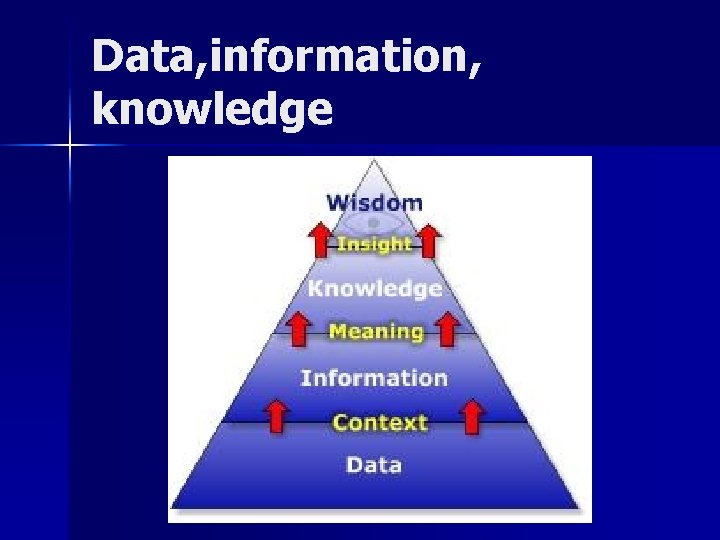
Data, information, knowledge
Data n n We can sensually monitor them Objective facts/symbols (not dependent on our consciousness) Quantificable (speed, capacity, costs) Quality of information process is not dependent on amount of accessible data
Information § n n n Information: data that are processed to be useful; provides answers to "who", "what", "where", and "when" questions Data with specific meaning Related to needs of user Contain specific purpose Subjective character Value of information
Knowledge § § application of data and information; Information in interaction with our – – n n § Experience Mental models and processes Relationships Values and principles Applied in action Knowledge management IS/IT answers "how" questions
Wisdom n n n accumulated knowledge of life gives us real understanding asks questions to which there is no (easily-achievable) answer resides as much in the heart as in the mind Can’t be described by words
Explicit and tacit knowledge Two forms of knowledge n Explicit k. – can be expressed by var. Means n – Transferable – Expressable by data
Explicit and tacit knowledge Tacit k. – (implicit) highly personal, cannot be easily expressed n Interaction of expl. k. and intuition, experience, skills, ment. models etc. n Examples n Dimensions (individual-organization) n Example with waitress n
n Try to identify utmost examples of tacit and explicit knowledge in the univerity ambient
Tacit knowledge n „We know more than we can say“
Conversion Change of form of information n Results in origination of new information n
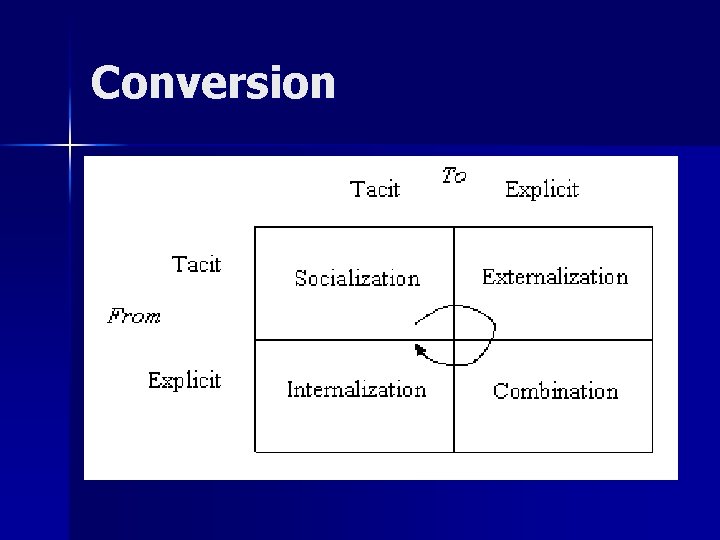
Conversion
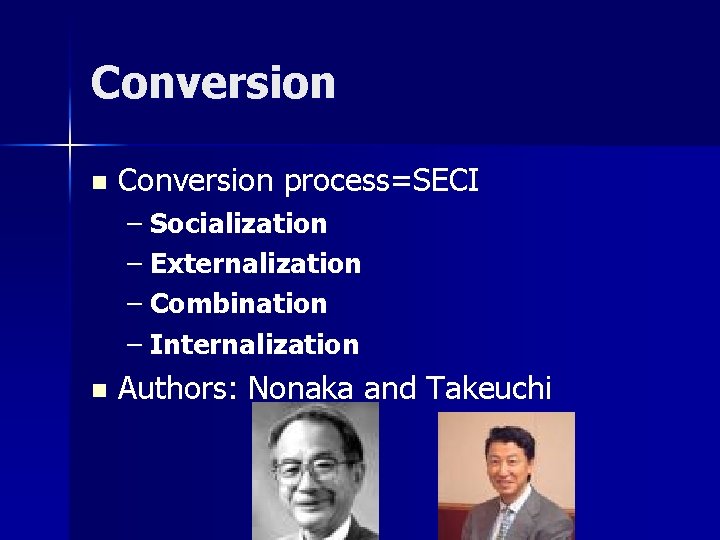
Conversion n Conversion process=SECI – Socialization – Externalization – Combination – Internalization n Authors: Nonaka and Takeuchi
Sharing tacit knowledge Narrating stories (analogies, symbols) n Apprenticeship (long-term, binding) n Communities of practices n
Knowledge market Every information exchange in org. n Vital for every org. n Physical and virtual space n
Knowledge market Vendors n Buyers n Mediators n Price of knowledge n Role of confidence n Why are info. provided for free n
Knowledge market n Knowledge market signals – Inform, how and where to get concrete information – Formal (status, education) – Informal (communities, informal knowledge networks)
n Which information can be sold and bought (and for what price) in academic sphere?
Disfunctional knowledge market When. . . n It’s hard to find a vendor n It’s hard to attain him n It’s hard to evaluate the quality of information in advance n
Supporting knowledge market in organization Verbal and institutional support n Tools to evaluate knowledge n Motivation n Space organization n Accent on reusing kn. n
Analysis of physical place n n n n Purpose(s) of the place Information from the place itself Exceptionality of place in knowledge sharing Accordance of purpose and disposition of the place Atmosphere of place as incentive of informal knowledge exchange Groups of people attracted by the place and correspondence or concurrence in their needs Suggestions how to optimize the place in order to foster knowledge exchange