
Knowledge Organiser Year 9 Term 1 Name Tutor

![Key points to learn 1. Energy stores [J] Chemical energy 9. Work done [J]](https://slidetodoc.com/presentation_image/4f41262ccaf57636293a04bac01f7164/image-15.jpg "Key points to learn 1. Energy stores [J] Chemical energy 9. Work done [J]")


- Slides: 40
Knowledge Organiser Year 9 Term 1 Name Tutor Group
Knowledge Organiser This knowledge organiser booklet contains the knowledge organisers you need for all your subjects for this term. Please make sure you bring it to school with you every day. You will use it in class and much of your homework well be set on it. In lessons you will be asked to learn a small amount of the knowledge organiser – you will do this by self-quizzing. The next lesson your starter will be linked to what you have learnt. How to self-quiz In a lesson you will be told which bit of the knowledge organiser you will learn. When you do your independent study: 1. Write the date in your independent study book and underline. 2. Write the name of the subject that you are learning and underline. 3. Look at the section you have been asked to learn for a few minutes. Maybe read it out loud. 4. Close the knowledge organiser so that you cannot see the page. 5. Write down as much as you can remember in black pen. 6. Look back at the knowledge organiser. 7. Check what you wrote and write in the things you forgot or correct the bits you got wrong in a red pen. You might want to do this line by line or in bigger chunks but this cycle of Read Close Write Check has been found to be the best way to help you learn all the facts and concepts that you need to know. Each night you will work on all the subjects from that day. This should take about 10 minutes per subject. It should fill at least one page in your independent study book with no gaps. Your tutor will check your homework in the morning so make sure your exercise book is in your bag with your knowledge organiser and your pencil case.
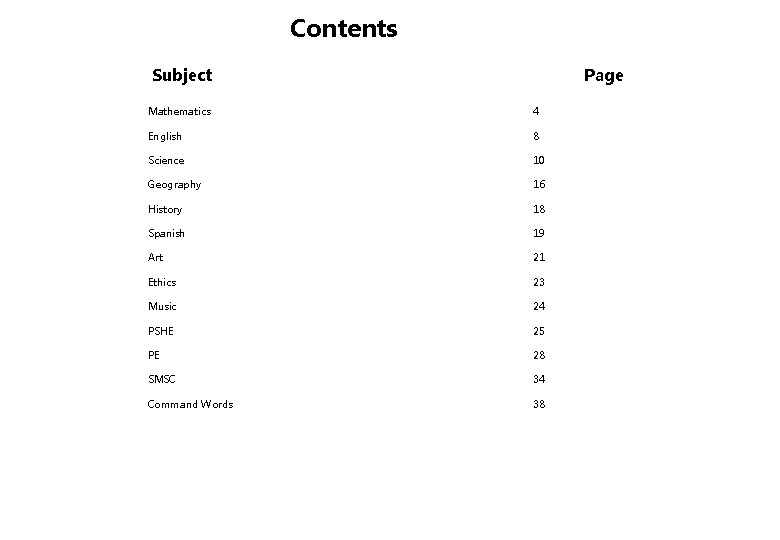
Contents Subject Page Mathematics 4 English 8 Science 10 Geography 16 History 18 Spanish 19 Art 21 Ethics 23 Music 24 PSHE 25 PE 28 SMSC 34 Command Words 38
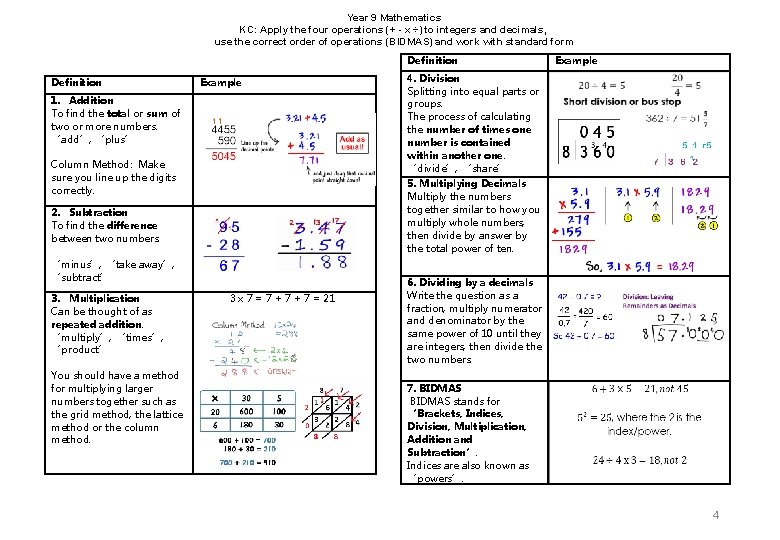
Year 9 Mathematics KC: Apply the four operations (+ - x ÷) to integers and decimals, use the correct order of operations (BIDMAS) and work with standard form Definition Example 1. Addition To find the total or sum of two or more numbers. ‘add’, ‘plus’ Column Method: Make sure you line up the digits correctly. 2. Subtraction To find the difference between two numbers. ‘minus’, ‘take away’, ‘subtract’ 3. Multiplication Can be thought of as repeated addition. ‘multiply’, ‘times’, ‘product’ You should have a method for multiplying larger numbers together such as the grid method, the lattice method or the column method. 3 x 7 = 7 + 7 = 21 Definition Example 4. Division Splitting into equal parts or groups. The process of calculating the number of times one number is contained within another one. ‘divide’, ‘share’ 5. Multiplying Decimals Multiply the numbers together similar to how you multiply whole numbers, then divide by answer by the total power of ten. 6. Dividing by a decimals Write the question as a fraction, multiply numerator and denominator by the same power of 10 until they are integers, then divide the two numbers. 7. BIDMAS stands for ‘Brackets, Indices, Division, Multiplication, Addition and Subtraction’. Indices are also known as ‘powers’. 4
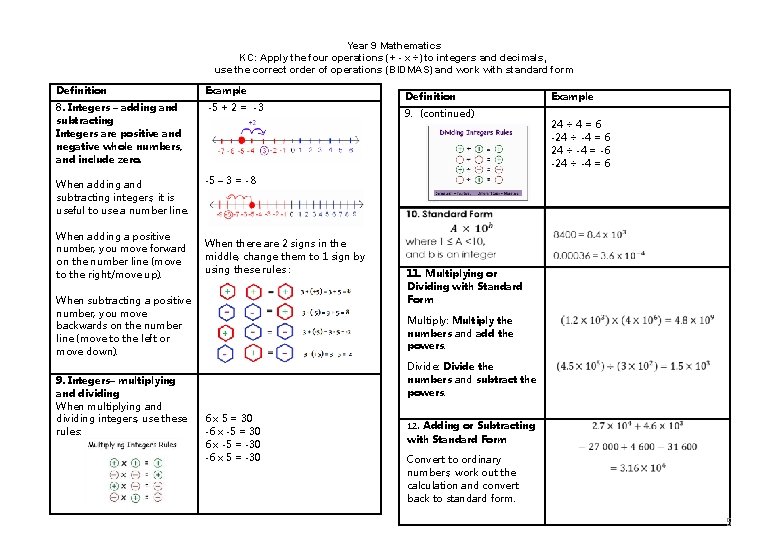
Year 9 Mathematics KC: Apply the four operations (+ - x ÷) to integers and decimals, use the correct order of operations (BIDMAS) and work with standard form Definition Example 8. Integers – adding and subtracting Integers are positive and negative whole numbers, and include zero. -5 + 2 = -3 When adding and subtracting integers, it is useful to use a number line. -5 – 3 = -8 When adding a positive number, you move forward on the number line (move to the right/move up). When subtracting a positive number, you move backwards on the number line (move to the left or move down). 9. Integers– multiplying and dividing When multiplying and dividing integers, use these rules: Definition 9. (continued) When there are 2 signs in the middle, change them to 1 sign by using these rules : 24 ÷ 4 = 6 -24 ÷ -4 = 6 24 ÷ -4 = -6 -24 ÷ -4 = 6 11. Multiplying or Dividing with Standard Form Multiply: Multiply the numbers and add the powers. Divide: Divide the numbers and subtract the powers. 6 x 5 = 30 -6 x -5 = 30 6 x -5 = -30 -6 x 5 = -30 Example 12. Adding or Subtracting with Standard Form Convert to ordinary numbers, work out the calculation and convert back to standard form. 5
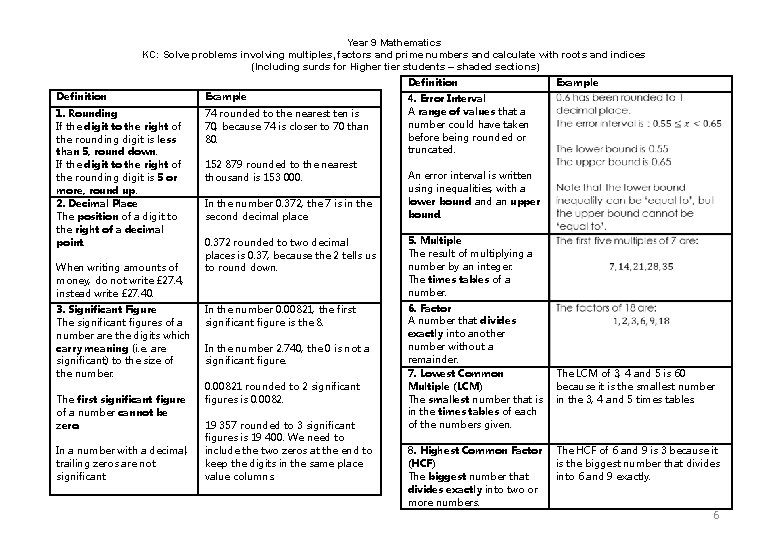
Year 9 Mathematics KC: Solve problems involving multiples, factors and prime numbers and calculate with roots and indices (Including surds for Higher tier students – shaded sections) Definition Example 1. Rounding If the digit to the right of the rounding digit is less than 5, round down. If the digit to the right of the rounding digit is 5 or more, round up. 2. Decimal Place The position of a digit to the right of a decimal point. When writing amounts of money, do not write £ 27. 4, instead write £ 27. 40. 74 rounded to the nearest ten is 70, because 74 is closer to 70 than 80. 152 879 rounded to the nearest thousand is 153 000. 3. Significant Figure The significant figures of a number are the digits which carry meaning (i. e. are significant) to the size of the number. The first significant figure of a number cannot be zero. In a number with a decimal, trailing zeros are not significant. In the number 0. 00821, the first significant figure is the 8. In the number 2. 740, the 0 is not a significant figure. 0. 00821 rounded to 2 significant figures is 0. 0082. 19 357 rounded to 3 significant figures is 19 400. We need to include the two zeros at the end to keep the digits in the same place value columns. In the number 0. 372, the 7 is in the second decimal place. 0. 372 rounded to two decimal places is 0. 37, because the 2 tells us to round down. Example 4. Error Interval A range of values that a number could have taken before being rounded or truncated. An error interval is written using inequalities, with a lower bound an upper bound. 5. Multiple The result of multiplying a number by an integer. The times tables of a number. 6. Factor A number that divides exactly into another number without a remainder. 7. Lowest Common Multiple (LCM) The smallest number that is in the times tables of each of the numbers given. 8. Highest Common Factor (HCF) The biggest number that divides exactly into two or more numbers. The LCM of 3, 4 and 5 is 60 because it is the smallest number in the 3, 4 and 5 times tables. The HCF of 6 and 9 is 3 because it is the biggest number that divides into 6 and 9 exactly. 6
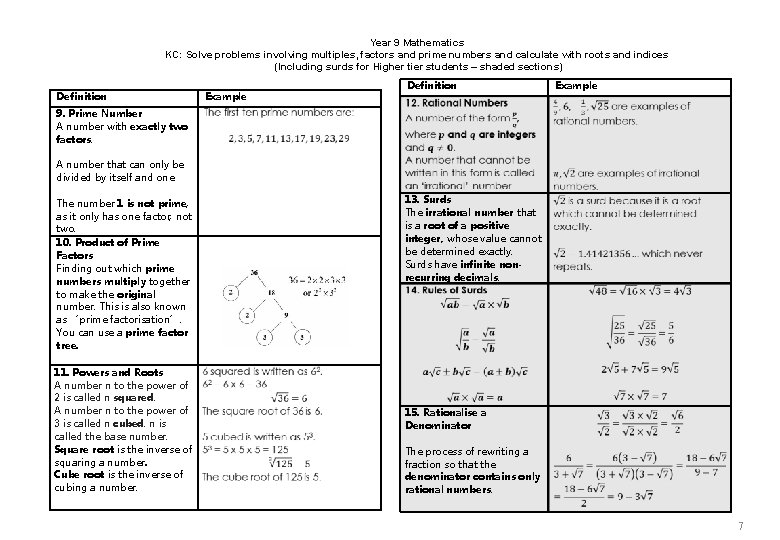
Year 9 Mathematics KC: Solve problems involving multiples, factors and prime numbers and calculate with roots and indices (Including surds for Higher tier students – shaded sections) Definition 9. Prime Number A number with exactly two factors. A number that can only be divided by itself and one. The number 1 is not prime, as it only has one factor, not two. 10. Product of Prime Factors Finding out which prime numbers multiply together to make the original number. This is also known as ‘prime factorisation’. You can use a prime factor tree. 11. Powers and Roots A number n to the power of 2 is called n squared. A number n to the power of 3 is called n cubed. n is called the base number. Square root is the inverse of squaring a number. Cube root is the inverse of cubing a number. Example Definition Example 13. Surds The irrational number that is a root of a positive integer, whose value cannot be determined exactly. Surds have infinite nonrecurring decimals. 15. Rationalise a Denominator The process of rewriting a fraction so that the denominator contains only rational numbers. 7
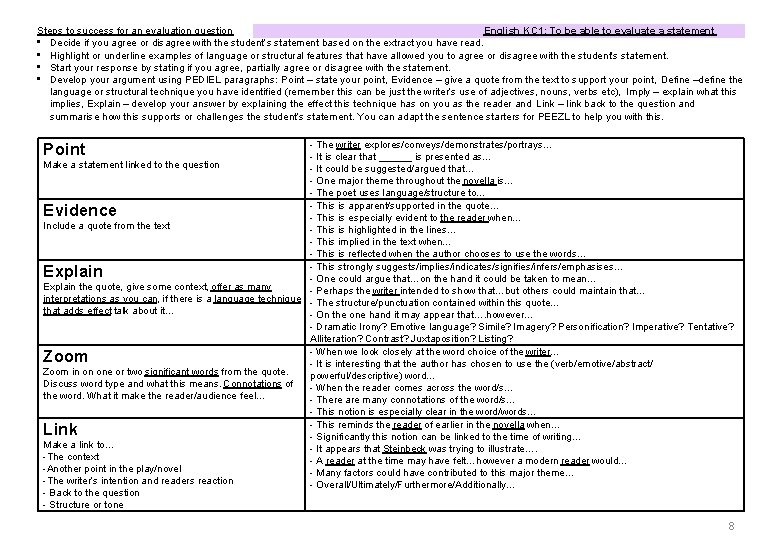
English KC 1: To be able to evaluate a statement Steps to success for an evaluation question • Decide if you agree or disagree with the student’s statement based on the extract you have read. • Highlight or underline examples of language or structural features that have allowed you to agree or disagree with the student's statement. • Start your response by stating if you agree, partially agree or disagree with the statement. • Develop your argument using PEDIEL paragraphs: Point – state your point, Evidence – give a quote from the text to support your point, Define –define the language or structural technique you have identified (remember this can be just the writer’s use of adjectives, nouns, verbs etc), Imply – explain what this implies, Explain – develop your answer by explaining the effect this technique has on you as the reader and Link – link back to the question and summarise how this supports or challenges the student’s statement. You can adapt the sentence starters for PEEZL to help you with this. - The writer explores/conveys/demonstrates/portrays… - It is clear that ______ is presented as… Make a statement linked to the question - It could be suggested/argued that… - One major theme throughout the novella is… - The poet uses language/structure to… - This is apparent/supported in the quote… - This is especially evident to the reader when… Include a quote from the text - This is highlighted in the lines… - This implied in the text when… - This is reflected when the author chooses to use the words… - This strongly suggests/implies/indicates/signifies/infers/emphasises… - One could argue that…on the hand it could be taken to mean… Explain the quote, give some context, offer as many - Perhaps the writer intended to show that…but others could maintain that… interpretations as you can, if there is a language technique - The structure/punctuation contained within this quote… that adds effect talk about it… - On the one hand it may appear that…. however… - Dramatic Irony? Emotive language? Simile? Imagery? Personification? Imperative? Tentative? Alliteration? Contrast? Juxtaposition? Listing? - When we look closely at the word choice of the writer… - It is interesting that the author has chosen to use the (verb/emotive/abstract/ Zoom in on one or two significant words from the quote. powerful/descriptive) word… Discuss word type and what this means. Connotations of - When the reader comes across the word/s… the word. What it make the reader/audience feel… - There are many connotations of the word/s… - This notion is especially clear in the word/words… - This reminds the reader of earlier in the novella when… - Significantly this notion can be linked to the time of writing… Make a link to… - It appears that Steinbeck was trying to illustrate…. -The context - A reader at the time may have felt…however a modern reader would… -Another point in the play/novel - Many factors could have contributed to this major theme… -The writer’s intention and readers reaction - Overall/Ultimately/Furthermore/Additionally… - Back to the question - Structure or tone Point Evidence Explain Zoom Link 8
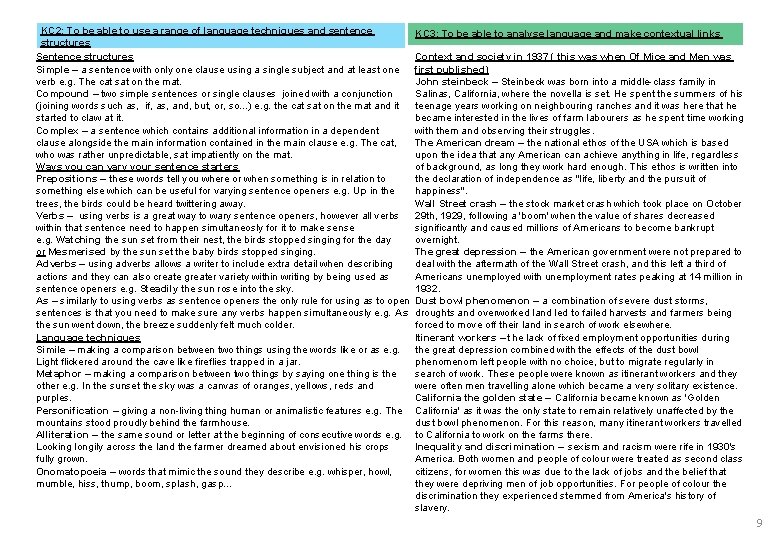
KC 2: To be able to use a range of language techniques and sentence KC 3: To be able to analyse language and make contextual links structures Sentence structures Context and society in 1937 ( this was when Of Mice and Men was Simple – a sentence with only one clause using a single subject and at least one first published) verb e. g. The cat sat on the mat. John steinbeck – Steinbeck was born into a middle-class family in Compound – two simple sentences or single clauses joined with a conjunction Salinas, California, where the novella is set. He spent the summers of his (joining words such as, if, as, and, but, or, so. . . ) e. g. the cat sat on the mat and it teenage years working on neighbouring ranches and it was here that he started to claw at it. became interested in the lives of farm labourers as he spent time working Complex – a sentence which contains additional information in a dependent with them and observing their struggles. clause alongside the main information contained in the main clause e. g. The cat, The American dream – the national ethos of the USA which is based who was rather unpredictable, sat impatiently on the mat. upon the idea that any American achieve anything in life, regardless Ways you can vary your sentence starters of background, as long they work hard enough. This ethos is written into Prepositions – these words tell you where or when something is in relation to the declaration of independence as "life, liberty and the pursuit of something else which can be useful for varying sentence openers e. g. Up in the happiness". trees, the birds could be heard twittering away. Wall Street crash – the stock market crash which took place on October Verbs – using verbs is a great way to wary sentence openers, however all verbs 29 th, 1929, following a 'boom' when the value of shares decreased within that sentence need to happen simultaneosly for it to make sense significantly and caused millions of Americans to become bankrupt e. g. Watching the sun set from their nest, the birds stopped singing for the day overnight. or Mesmerised by the sun set the baby birds stopped singing. The great depression – the American government were not prepared to Adverbs – using adverbs allows a writer to include extra detail when describing deal with the aftermath of the Wall Street crash, and this left a third of actions and they can also create greater variety within writing by being used as Americans unemployed with unemployment rates peaking at 14 million in sentence openers e. g. Steadily the sun rose into the sky. 1932. As – similarly to using verbs as sentence openers the only rule for using as to open Dust bowl phenomenon – a combination of severe dust storms, sentences is that you need to make sure any verbs happen simultaneously e. g. As droughts and overworked land led to failed harvests and farmers being the sun went down, the breeze suddenly felt much colder. forced to move off their land in search of work elsewhere. Language techniques Itinerant workers – the lack of fixed employment opportunities during Simile – making a comparison between two things using the words like or as e. g. the great depression combined with the effects of the dust bowl Light flickered around the cave like fireflies trapped in a jar. phenom left people with no choice, but to migrate regularly in Metaphor – making a comparison between two things by saying one thing is the search of work. These people were known as itinerant workers and they other e. g. In the sunset the sky was a canvas of oranges, yellows, reds and were often men travelling alone which became a very solitary existence. purples. California the golden state – California became known as 'Golden Personification – giving a non-living thing human or animalistic features e. g. The California' as it was the only state to remain relatively unaffected by the mountains stood proudly behind the farmhouse. dust bowl phenomenon. For this reason, many itinerant workers travelled Alliteration – the same sound or letter at the beginning of consecutive words e. g. to California to work on the farms there. Looking longily across the land the farmer dreamed about envisioned his crops Inequality and discrimination – sexism and racism were rife in 1930's fully grown. America. Both women and people of colour were treated as second class Onomatopoeia – words that mimic the sound they describe e. g. whisper, howl, citizens, for women this was due to the lack of jobs and the belief that mumble, hiss, thump, boom, splash, gasp. . . they were depriving men of job opportunities. For people of colour the discrimination they experienced stemmed from America's history of slavery. 9
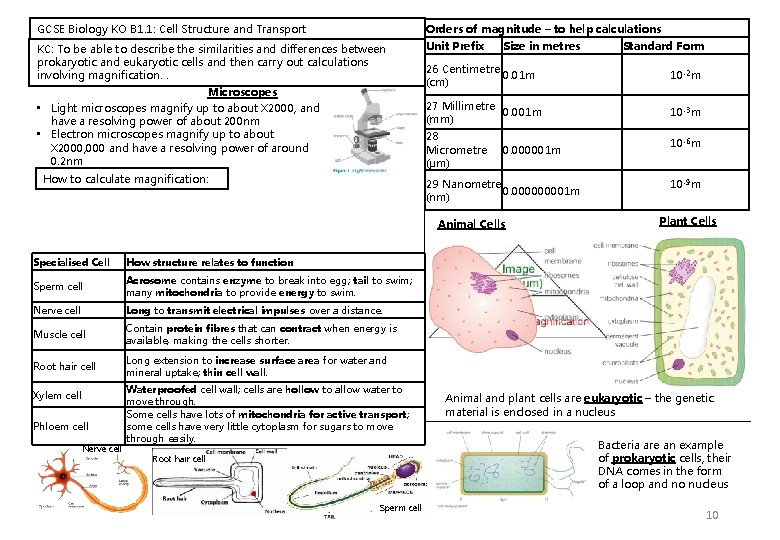
GCSE Biology KO B 1. 1: Cell Structure and Transport Orders of magnitude – to help calculations KC: To be able to describe the similarities and differences between prokaryotic and eukaryotic cells and then carry out calculations involving magnification. . Unit Prefix Microscopes • Light microscopes magnify up to about X 2000, and have a resolving power of about 200 nm • Electron microscopes magnify up to about X 2000, 000 and have a resolving power of around 0. 2 nm 10 -2 m 27 Millimetre 0. 001 m (mm) 10 -3 m 0. 000001 m 29 Nanometre 0. 00001 m (nm) Animal Cells Specialised Cell How structure relates to function Sperm cell Acrosome contains enzyme to break into egg; tail to swim; many mitochondria to provide energy to swim. Nerve cell Long to transmit electrical impulses over a distance. Muscle cell Contain protein fibres that can contract when energy is available, making the cells shorter. Root hair cell Long extension to increase surface area for water and mineral uptake; thin cell wall. Xylem cell Phloem cell Nerve cell Waterproofed cell wall; cells are hollow to allow water to move through. Some cells have lots of mitochondria for active transport; some cells have very little cytoplasm for sugars to move through easily. Root hair cell Sperm cell Standard Form 26 Centimetre 0. 01 m (cm) 28 Micrometre (μm) How to calculate magnification: Size in metres 10 -6 m 10 -9 m Plant Cells Animal and plant cells are eukaryotic – the genetic material is enclosed in a nucleus Bacteria are an example of prokaryotic cells, their DNA comes in the form of a loop and no nucleus 10
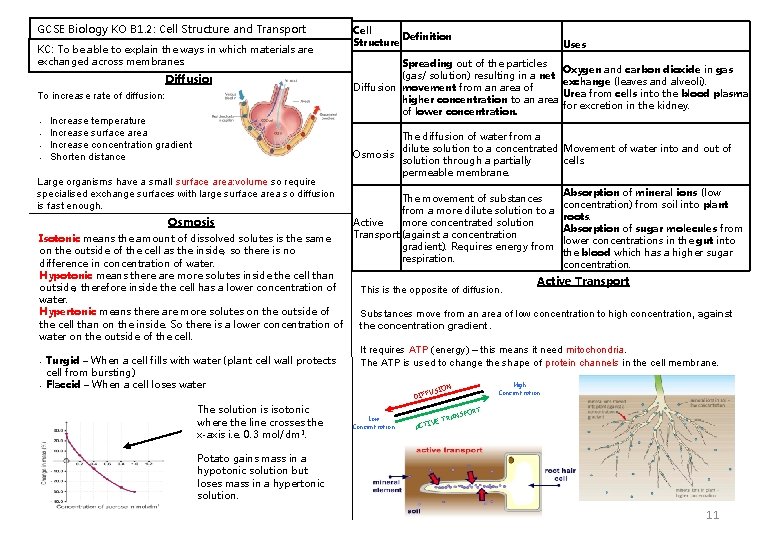
GCSE Biology KO B 1. 2: Cell Structure and Transport KC: To be able to explain the ways in which materials are exchanged across membranes. Diffusion To increase rate of diffusion: • • Increase temperature Increase surface area Increase concentration gradient Shorten distance Large organisms have a small surface area: volume so require specialised exchange surfaces with large surface area so diffusion is fast enough. Osmosis Isotonic means the amount of dissolved solutes is the same on the outside of the cell as the inside, so there is no difference in concentration of water. Hypotonic means there are more solutes inside the cell than outside, therefore inside the cell has a lower concentration of water. Hypertonic means there are more solutes on the outside of the cell than on the inside. So there is a lower concentration of water on the outside of the cell. • • Turgid – When a cell fills with water (plant cell wall protects cell from bursting) Flaccid – When a cell loses water The solution is isotonic where the line crosses the x-axis i. e. 0. 3 mol/dm 3. Cell Definition Structure Uses Spreading out of the particles Oxygen and carbon dioxide in gas (gas/ solution) resulting in a net exchange (leaves and alveoli). Diffusion movement from an area of Urea from cells into the blood plasma higher concentration to an area for excretion in the kidney. of lower concentration. The diffusion of water from a dilute solution to a concentrated Movement of water into and out of Osmosis solution through a partially cells. permeable membrane. The movement of substances from a more dilute solution to a Active more concentrated solution Transport (against a concentration gradient). Requires energy from respiration. This is the opposite of diffusion. Absorption of mineral ions (low concentration) from soil into plant roots. Absorption of sugar molecules from lower concentrations in the gut into the blood which has a higher sugar concentration. Active Transport Substances move from an area of low concentration to high concentration , against the concentration gradient. It requires ATP (energy) – this means it need mitochondria. The ATP is used to change the shape of protein channels in the cell membrane. High Concentration ON USI DIFF Low Concentration NSP A E TR IV ACT ORT Potato gains mass in a hypotonic solution but loses mass in a hypertonic solution. 11
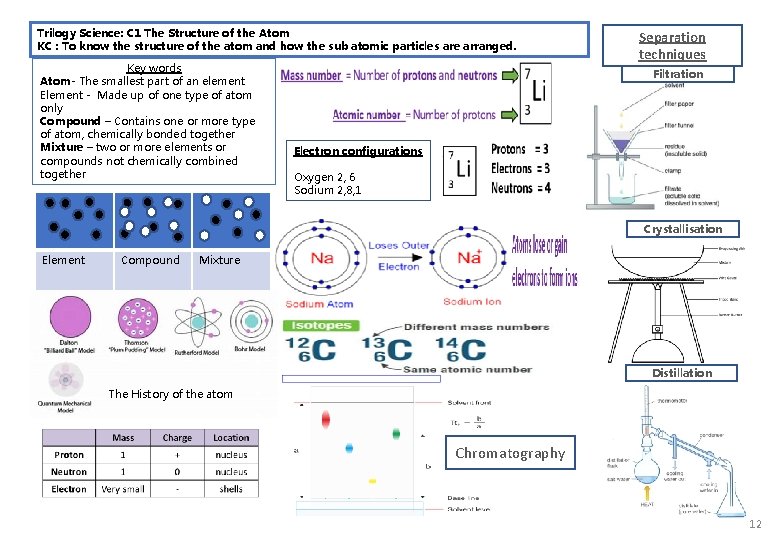
Trilogy Science: C 1 The Structure of the Atom KC : To know the structure of the atom and how the sub atomic particles are arranged. Key words Atom- The smallest part of an element Element - Made up of one type of atom only Compound – Contains one or more type of atom, chemically bonded together Mixture – two or more elements or compounds not chemically combined together Separation techniques Filtration Electron configurations Oxygen 2, 6 Sodium 2, 8, 1 Crystallisation Element Compound Mixture Distillation The History of the atom Chromatography 12
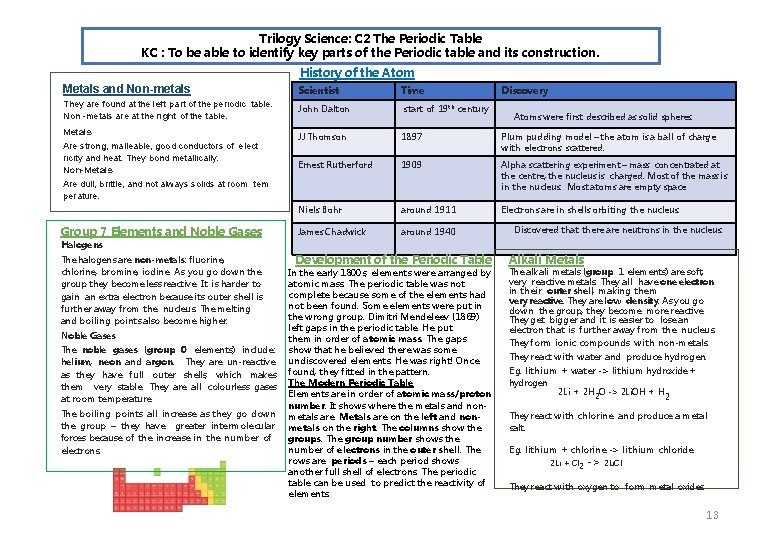
Trilogy Science: C 2 The Periodic Table KC : To be able to identify key parts of the Periodic table and its construction. History of the Atom Metals and Non-metals Scientist Time They are found at the left part of the periodic table. Non -metals are at the right of the table. John Dalton start of 19 th century Metals JJ Thomson 1897 Plum pudding model – the atom is a ball of charge with electrons scattered. Ernest Rutherford 1909 Alpha scattering experiment – mass concentrated at the centre; the nucleus is charged. Most of the mass is in the nucleus. Most atoms are empty space. Niels Bohr around 1911 Electrons are in shells orbiting the nucleus. James Chadwick around 1940 Are strong, malleable, good conductors of elect ricity and heat. They bond metallically. Non-Metals Are dull, brittle, and not always solids at room tem perature. Group 7 Elements and Noble Gases Discovery Atoms were first described as solid spheres. Discovered that there are neutrons in the nucleus. Halogens The halogens are non-metals: fluorine, chlorine, bromine, iodine. As you go down the group they become less reactive. It is harder to gain an extra electron because its outer shell is further away from the nucleus. The melting and boiling points also become higher. Noble Gases The noble gases (group 0 elements) include: helium, neon and argon. They are un-reactive as they have full outer shells, which makes them very stable. They are all colourless gases at room temperature. The boiling points all increase as they go down the group – they have greater intermolecular forces because of the increase in the number of electrons. Development of the Periodic Table In the early 1800 s, elements were arranged by atomic mass. The periodic table was not complete because some of the elements had not been found. Some elements were put in the wrong group. Dimitri Mendeleev (1869) left gaps in the periodic table. He put them in order of atomic mass. The gaps show that he believed there was some undiscovered elements. He was right! Once found, they fitted in the pattern. The Modern Periodic Table Elements are in order of atomic mass/proton number. It shows where the metals and nonmetals are. Metals are on the left and nonmetals on the right. The columns show the groups. The group number shows the number of electrons in the outer shell. The rows are periods – each period shows another full shell of electrons. The periodic table can be used to predict the reactivity of elements. Alkali Metals The alkali metals (group 1 elements) are soft, very reactive metals. They all have one electron in their outer shell, making them very reactive. They are low density. As you go down the group, they become more reactive. They get bigger and it is easier to lose an electron that is further away from the nucleus. They form ionic compounds with non-metals. They react with water and produce hydrogen. E. g. lithium + water -> lithium hydroxide + hydrogen 2 Li + 2 H 2 O -> 2 Li. OH + H 2 They react with chlorine and produce a metal salt. E. g. lithium + chlorine -> lithium chloride 2 Li + Cl 2 -> 2 Li. Cl They react with oxygen to form metal oxides. 13
Key points to learn 1. Energy stores [J] Chemical energy 9. Work done [J] Kinetic energy Gravitational potential energy [J] [N] [m] Transferred during chemical reactions eg fuels, foods, or in batteries All moving objects have it. 3. Kinetic energy k. e = 0. 5 x mass x (speed)2 [J] Ek = ½ x m x v 2 [J] [kg] [m/s] Stored in an object lifted up. 4 Gravitational potential g. p. e = mass x g x height energy [J] Ep = m x g x h [J] [kg] [N/kg] [m] Show energy transfers eg for a 10. Energy torch lamp: flow diagram Chemical Light + Heat Energy cannot be created or destroyed. It can only be transferred usefully, stored or dissipated. Wasted energy, usually spread 12. Dissipated to the surroundings as heat. energy [J] The extension of a spring is 13. Energy stored in a springy object 5. Elastic potential e. p. e = 0. 5 x spring x (extension)2 constant energy E = ½ x k x e e [J] 2 [J] [N/m] 6. Energy can be Heating (thermal energy transferred by… always flows from hot to cold objects) An electrical current flowing A force moving an object 7. Useful energy [J] 8. Wasted energy [J] Energy transferred to the place and in the form we need it. Not useful. Eventually transferred to surroundings When a force moves an object. Work done = Force x distance W = F x s moved Elastic potential energy 2. Chemical energy [J] Equal to the energy transferred. 11. Conserva tion of energy proportional to the force on it. Hooke’s Law and The gradient k, the of this graph spring is known as constant k, the spring constant. 14. Efficiency 15. Power Energy [J] transferred in 1 second. [W] Power [W] = Energy [J] time [s] 16. Wasted Total power in – useful power out power [W] Science - Physics Trilogy P 1 Conservation and dissipation of energy Key Competency To be able to work out the energy stored in a moving object or in an object when it is lifted or stretched and can calculate the efficiency of a machine. Key Practicals None for this module Maths skills You should be able to recall, use and rearrange all the equations on this page except number 5. g is Earth’s acceleration due to gravity. It has a constant value of approximately 9. 8 m/s 2 You need to remember the units for each quantity. They are in [ ] next to Maths skills equations. You should be able to calculate the gradient of a Force – extension graph. Worked example What is the kinetic energy of a 800 kg car moving at 15 m/s? K. E = 0. 5 x mass x (speed)2 K. E = 0. 5 x 800 x 152 = 0. 5 x 800 x 225 = 90 000 J 14
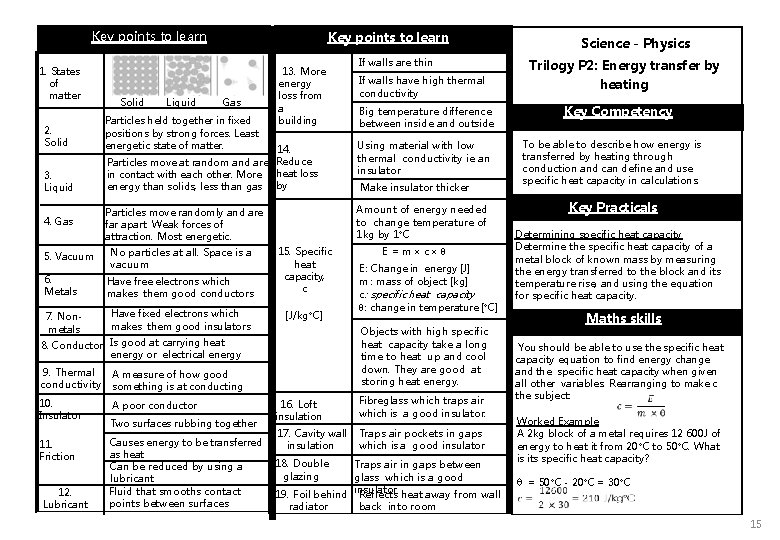
Key points to learn 1. States of matter 2. Solid 3. Liquid 4. Gas 5. Vacuum 6. Metals 7. Nonmetals Solid Liquid Key points to learn Gas Particles held together in fixed positions by strong forces. Least energetic state of matter. 13. More energy loss from a building Amount of energy needed to change temperature of 1 kg by 1 C Have free electrons which makes them good conductors Have fixed electrons which makes them good insulators [J/kg C] 9. Thermal conductivity A measure of how good something is at conducting 10. Insulator A poor conductor 12. Lubricant Two surfaces rubbing together Make insulator thicker E = m c E: Change in energy [J] m : mass of object [kg] c: specific heat capacity : change in temperature [ C] Objects with high specific heat capacity take a long time to heat up and cool down. They are good at storing heat energy. 16. Loft insulation heating Key Competency Big temperature difference between inside and outside Particles move randomly and are far apart. Weak forces of attraction. Most energetic. 15. Specific heat capacity, c Trilogy P 2: Energy transfer by If walls have high thermal conductivity Using material with low thermal conductivity ie an insulator 8. Conductor Is good at carrying heat energy or electrical energy 11. Friction If walls are thin 14. Particles move at random and are Reduce in contact with each other. More heat loss energy than solids, less than gas by No particles at all. Space is a vacuum Science - Physics Fibreglass which traps air which is a good insulator. 17. Cavity wall Traps air pockets in gaps Causes energy to be transferred insulation which is a good insulator as heat 18. Double Traps air in gaps between Can be reduced by using a glazing glass which is a good lubricant Fluid that smooths contact 19. Foil behind insulator Reflects heat away from wall points between surfaces radiator back into room To be able to describe how energy is transferred by heating through conduction and can define and use specific heat capacity in calculations. Key Practicals Determining specific heat capacity Determine the specific heat capacity of a metal block of known mass by measuring the energy transferred to the block and its temperature rise, and using the equation for specific heat capacity. Maths skills You should be able to use the specific heat capacity equation to find energy change and the specific heat capacity when given all other variables. Rearranging to make c the subject: Worked Example A 2 kg block of a metal requires 12 600 J of energy to heat it from 20 C to 50 C. What is its specific heat capacity? = 50 C - 20 C = 30 C 15
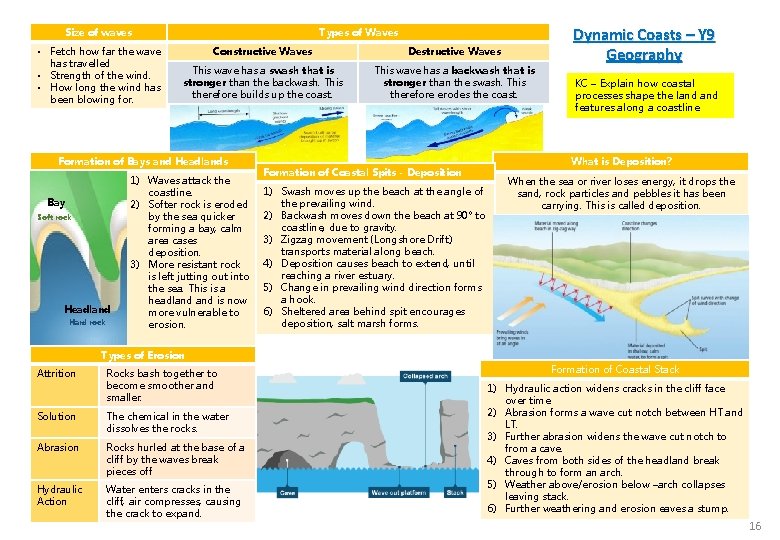
Size of waves • Fetch how far the wave has travelled • Strength of the wind. • How long the wind has been blowing for. Types of Waves Constructive Waves Destructive Waves This wave has a swash that is stronger than the backwash. This therefore builds up the coast. This wave has a backwash that is stronger than the swash. This therefore erodes the coast. Formation of Bays and Headlands Bay Soft rock Headland Hard rock 1) Waves attack the coastline. 2) Softer rock is eroded by the sea quicker forming a bay, calm area cases deposition. 3) More resistant rock is left jutting out into the sea. This is a headland is now more vulnerable to erosion. Dynamic Coasts – Y 9 Geography KC – Explain how coastal processes shape the land features along a coastline. What is Deposition? Formation of Coastal Spits - Deposition 1) Swash moves up the beach at the angle of the prevailing wind. 2) Backwash moves down the beach at 90° to coastline, due to gravity. 3) Zigzag movement (Longshore Drift) transports material along beach. 4) Deposition causes beach to extend, until reaching a river estuary. 5) Change in prevailing wind direction forms a hook. 6) Sheltered area behind spit encourages deposition, salt marsh forms. When the sea or river loses energy, it drops the sand, rock particles and pebbles it has been carrying. This is called deposition. Types of Erosion Attrition Rocks bash together to become smoother and smaller. Solution The chemical in the water dissolves the rocks. Abrasion Rocks hurled at the base of a cliff by the waves break pieces off Hydraulic Action Water enters cracks in the cliff, air compresses, causing the crack to expand. Formation of Coastal Stack 1) Hydraulic action widens cracks in the cliff face over time. 2) Abrasion forms a wave cut notch between HT and LT. 3) Further abrasion widens the wave cut notch to from a cave. 4) Caves from both sides of the headland break through to form an arch. 5) Weather above/erosion below –arch collapses leaving stack. 6) Further weathering and erosion eaves a stump. 16
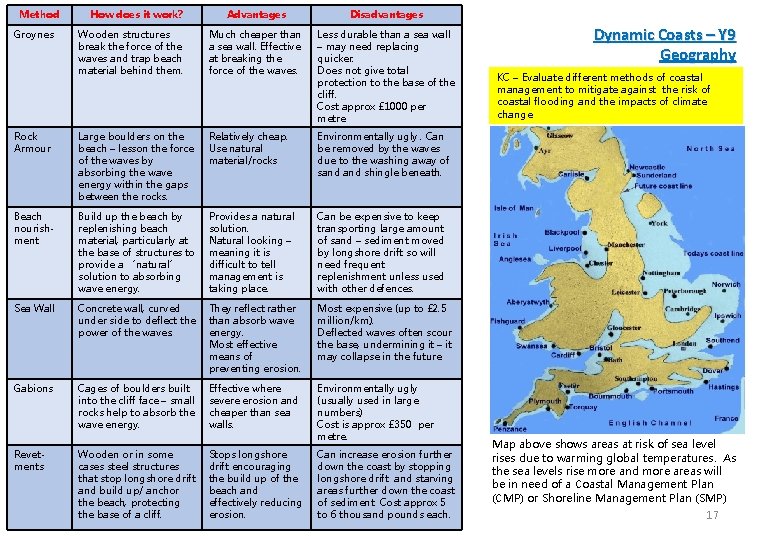
Method Advantages Disadvantages Wooden structures break the force of the waves and trap beach material behind them. Much cheaper than a sea wall. Effective at breaking the force of the waves. Less durable than a sea wall – may need replacing quicker. Does not give total protection to the base of the cliff. Cost approx £ 1000 per metre Rock Armour Large boulders on the beach – lesson the force of the waves by absorbing the wave energy within the gaps between the rocks. Relatively cheap. Use natural material/rocks Environmentally ugly. Can be removed by the waves due to the washing away of sand shingle beneath. Beach nourishment Build up the beach by replenishing beach material, particularly at the base of structures to provide a ‘natural’ solution to absorbing wave energy. Provides a natural solution. Natural looking – meaning it is difficult to tell management is taking place. Can be expensive to keep transporting large amount of sand – sediment moved by longshore drift so will need frequent replenishment unless used with other defences. Sea Wall Concrete wall, curved They reflect rather under side to deflect the than absorb wave power of the waves. energy. Most effective means of preventing erosion. Most expensive (up to £ 2. 5 million/km). Deflected waves often scour the base, undermining it – it may collapse in the future. Gabions Cages of boulders built into the cliff face – small rocks help to absorb the wave energy. Effective where severe erosion and cheaper than sea walls. Environmentally ugly (usually used in large numbers) Cost is approx £ 350 per metre. Revetments Wooden or in some cases steel structures that stop longshore drift and build up/ anchor the beach, protecting the base of a cliff. Stops longshore drift encouraging the build up of the beach and effectively reducing erosion. Can increase erosion further down the coast by stopping longshore drift and starving areas further down the coast of sediment. Cost approx 5 to 6 thousand pounds each. Groynes How does it work? Dynamic Coasts – Y 9 Geography KC – Evaluate different methods of coastal management to mitigate against the risk of coastal flooding and the impacts of climate change. Map above shows areas at risk of sea level rises due to warming global temperatures. As the sea levels rise more and more areas will be in need of a Coastal Management Plan (CMP) or Shoreline Management Plan (SMP) 17
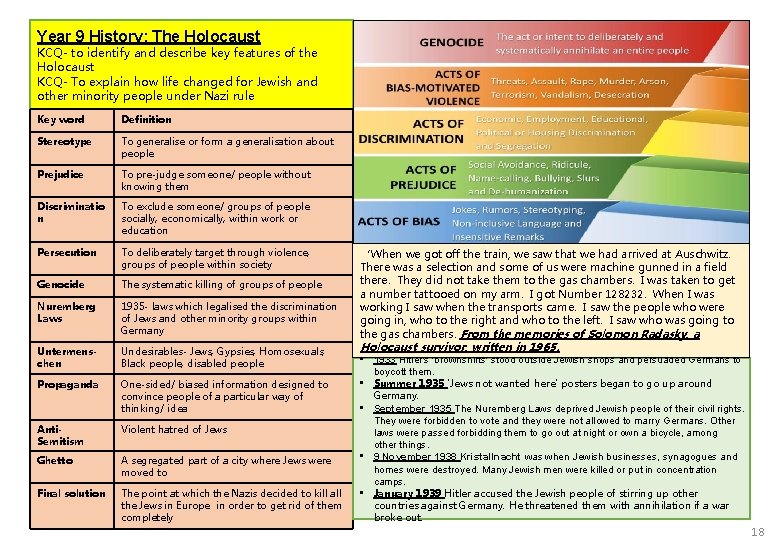
Year 9 History: The Holocaust KCQ- to identify and describe key features of the Holocaust KCQ- To explain how life changed for Jewish and other minority people under Nazi rule Key word Definition Stereotype To generalise or form a generalisation about people Prejudice To pre-judge someone/ people without knowing them Discriminatio n To exclude someone/ groups of people socially, economically, within work or education Persecution To deliberately target through violence, groups of people within society Genocide The systematic killing of groups of people Nuremberg Laws 1935 - laws which legalised the discrimination of Jews and other minority groups within Germany Untermenschen Undesirables- Jews, Gypsies, Homosexuals, Black people, disabled people Propaganda One-sided/ biased information designed to convince people of a particular way of thinking/ idea Anti. Semitism Violent hatred of Jews Ghetto A segregated part of a city where Jews were moved to Final solution The point at which the Nazis decided to kill all the Jews in Europe in order to get rid of them completely ‘When we got off the train, we saw that we had arrived at Auschwitz. There was a selection and some of us were machine gunned in a field there. They did not take them to the gas chambers. I was taken to get a number tattooed on my arm. I got Number 128232. When I was working I saw when the transports came. I saw the people who were going in, who to the right and who to the left. I saw who was going to the gas chambers. From the memories of Solomon Radasky, a Holocaust survivor, written in 1965. • 1933 Hitler's 'brownshirts' stood outside Jewish shops and persuaded Germans to boycott them. • Summer 1935 'Jews not wanted here' posters began to go up around Germany. • September 1935 The Nuremberg Laws deprived Jewish people of their civil rights. They were forbidden to vote and they were not allowed to marry Germans. Other laws were passed forbidding them to go out at night or own a bicycle, among other things. • 9 November 1938 Kristallnacht was when Jewish businesses, synagogues and homes were destroyed. Many Jewish men were killed or put in concentration camps. • January 1939 Hitler accused the Jewish people of stirring up other countries against Germany. He threatened them with annihilation if a war broke out. 18
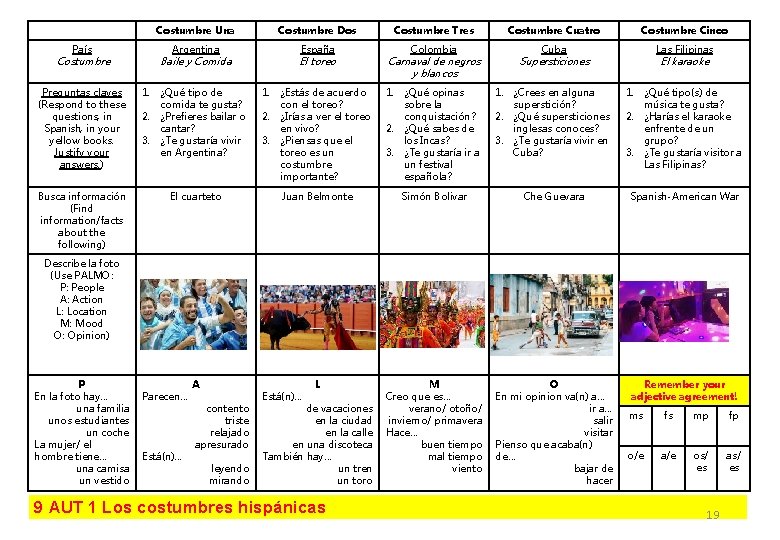
Costumbre Una País Costumbre Argentina Costumbre Dos España Costumbre Tres Colombia Costumbre Cuatro Costumbre Cinco Baile y Comida El toreo Carnaval de negros y blancos Supersticiones Cuba Las Filipinas Preguntas claves (Respond to these questions, in Spanish, in your yellow books. Justify your answers. ) 1. ¿Qué tipo de comida te gusta? 2. ¿Prefieres bailar o cantar? 3. ¿Te gustaría vivir en Argentina? 1. ¿Estás de acuerdo con el toreo? 2. ¿Irías a ver el toreo en vivo? 3. ¿Piensas que el toreo es un costumbre importante? 1. ¿Qué opinas sobre la conquistación? 2. ¿Qué sabes de los Incas? 3. ¿Te gustaría ir a un festival española? 1. ¿Crees en alguna superstición? 2. ¿Qué supersticiones inglesas conoces? 3. ¿Te gustaría vivir en Cuba? 1. ¿Qué tipo(s) de música te gusta? 2. ¿Harías el karaoke enfrente de un grupo? 3. ¿Te gustaría visitor a Las Filipinas? Busca información (Find information/facts about the following) El cuarteto Juan Belmonte Simón Bolivar Che Guevara Spanish-American War L M Creo que es… verano/ otoño/ invierno/ primavera Hace… buen tiempo mal tiempo viento O En mi opinion va(n) a… ir a… salir visitar Pienso que acaba(n) de… bajar de hacer Remember your adjective agreement! El karaoke Describe la foto (Use PALMO: P: People A: Action L: Location M: Mood O: Opinion) P En la foto hay… una familia unos estudiantes un coche La mujer/ el hombre tiene… una camisa un vestido Parecen… Está(n)… A contento triste relajado apresurado leyendo mirando Está(n)… de vacaciones en la ciudad en la calle en una discoteca También hay… un tren un toro 9 AUT 1 Los costumbres hispánicas ms fs mp fp o/e a/e os/ es as/ es 19
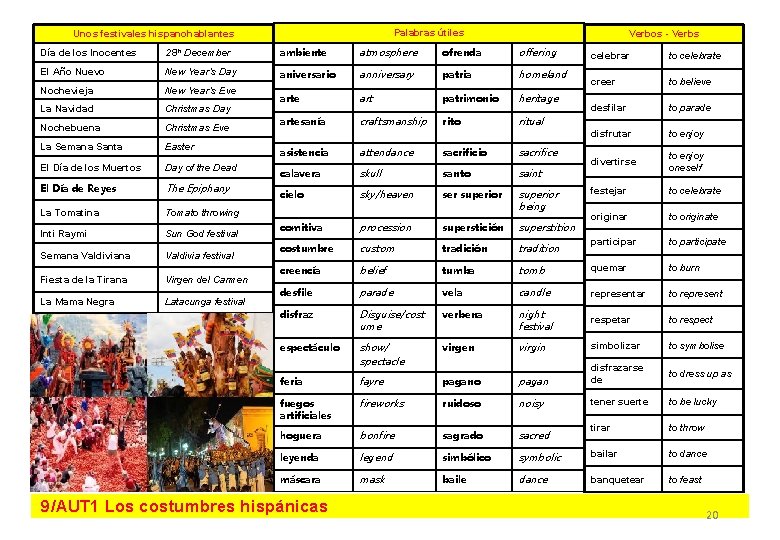
Palabras útiles Unos festivales hispanohablantes Verbos - Verbs Día de los Inocentes 28 th December ambiente atmosphere ofrenda offering El Año Nuevo New Year’s Day aniversario anniversary patria homeland Nochevieja New Year’s Eve La Navidad Christmas Day arte art patrimonio heritage Nochebuena Christmas Eve artesanía craftsmanship rito ritual La Semana Santa Easter asistencia attendance sacrificio sacrifice El Día de los Muertos Day of the Dead calavera skull santo saint El Día de Reyes The Epiphany cielo sky/heaven ser superior La Tomatina Tomato throwing superior being comitiva procession superstición superstition costumbre custom tradición creencía belief desfile Inti Raymi Sun God festival Semana Valdiviana Valdivia festival Fiesta de la Tirana Virgen del Carmen La Mama Negra Latacunga festival celebrar to celebrate creer to believe desfilar to parade disfrutar to enjoy divertirse to enjoy oneself festejar to celebrate originar to originate tradition participar to participate tumba tomb quemar to burn parade vela candle representar to represent disfraz Disguise/cost ume verbena night festival respetar to respectáculo show/ spectacle virgen virgin simbolizar to symbolise feria fayre pagano pagan disfrazarse de to dress up as fuegos artificiales fireworks ruidoso noisy tener suerte to be lucky hoguera bonfire sagrado sacred tirar to throw leyenda legend simbólico symbolic bailar to dance máscara mask baile dance banquetear to feast 9/AUT 1 Los costumbres hispánicas 20
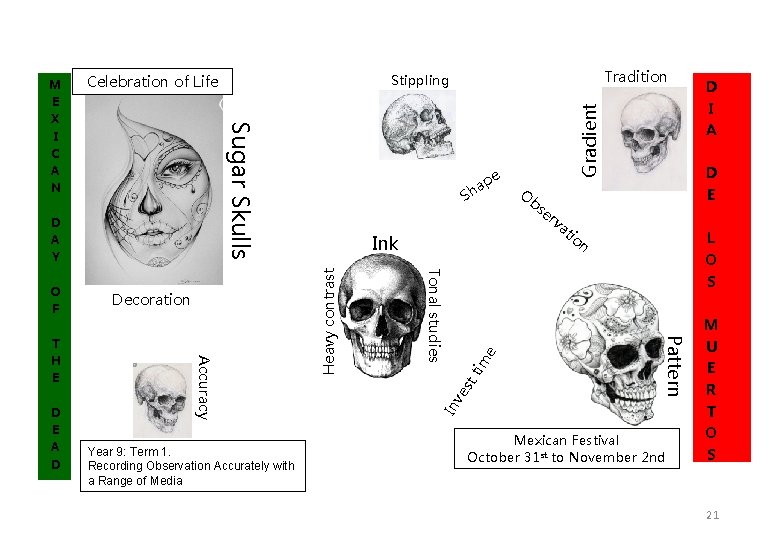
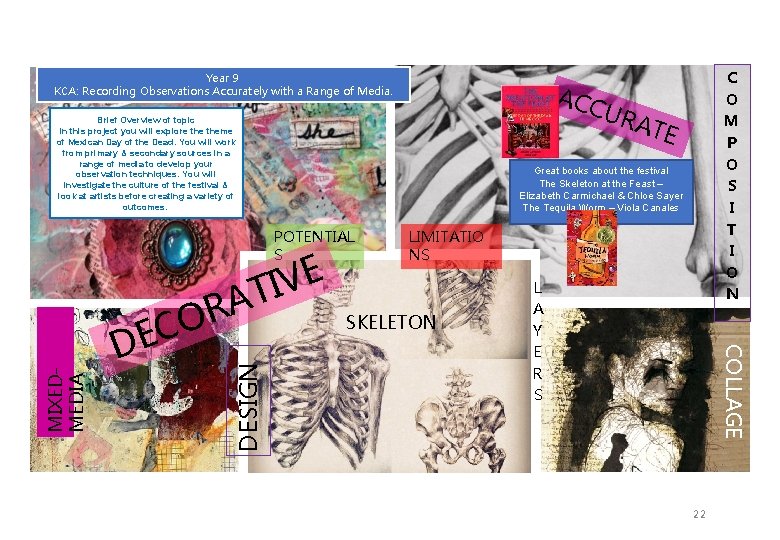
Tradition Sugar Skulls e ve st tim bs er va tio n In Heavy contrast Ink O Pattern Year 9: Term 1. Recording Observation Accurately with a Range of Media S Tonal studies Decoration e p ha Gradient Stippling Celebration of Life Accuracy M E X I C A N D A Y O F T H E D E A D Mexican Festival October 31 st to November 2 nd D I A D E L O S M U E R T O S 21
Year 9 KCA: Recording Observations Accurately with a Range of Media. ACC URA TE Brief Overview of topic In this project you will explore theme of Mexican Day of the Dead. You will work from primary & secondary sources in a range of media to develop your observation techniques. You will investigate the culture of the festival & look at artists before creating a variety of outcomes. Great books about the festival The Skeleton at the Feast – Elizabeth Carmichael & Chloe Sayer The Tequila Worm – Viola Canales POTENTIAL S E V I AT DESIGN MIXEDMEDIA D LIMITATIO NS SKELETON L A Y E R S COLLAGE R O EC C O M P O S I T I O N 22
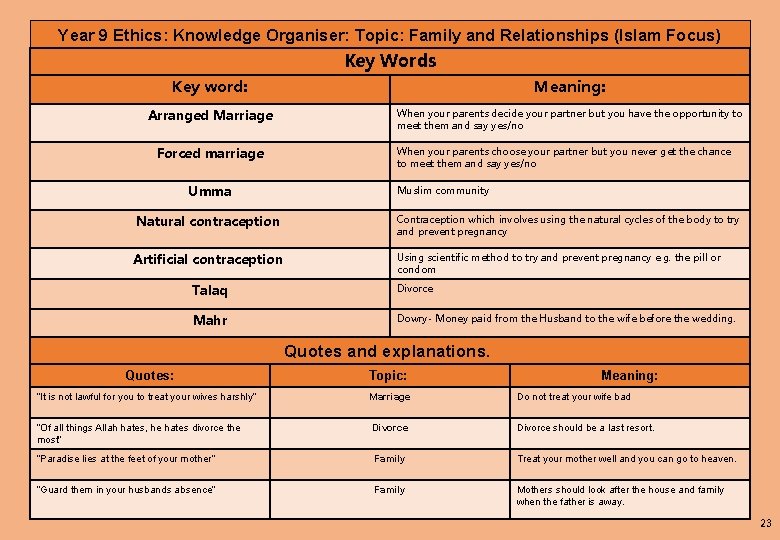
Year 9 Ethics: Knowledge Organiser: Topic: Family and Relationships (Islam Focus) Key Words Key word: Meaning: Arranged Marriage When your parents decide your partner but you have the opportunity to meet them and say yes/no Forced marriage When your parents choose your partner but you never get the chance to meet them and say yes/no Umma Muslim community Natural contraception Contraception which involves using the natural cycles of the body to try and prevent pregnancy Artificial contraception Using scientific method to try and prevent pregnancy e. g. the pill or condom Talaq Divorce Mahr Dowry- Money paid from the Husband to the wife before the wedding. Quotes and explanations. Quotes: Topic: Meaning: “It is not lawful for you to treat your wives harshly” Marriage Do not treat your wife bad “Of all things Allah hates, he hates divorce the most” Divorce should be a last resort. “Paradise lies at the feet of your mother” Family Treat your mother well and you can go to heaven. “Guard them in your husbands absence” Family Mothers should look after the house and family when the father is away. 23
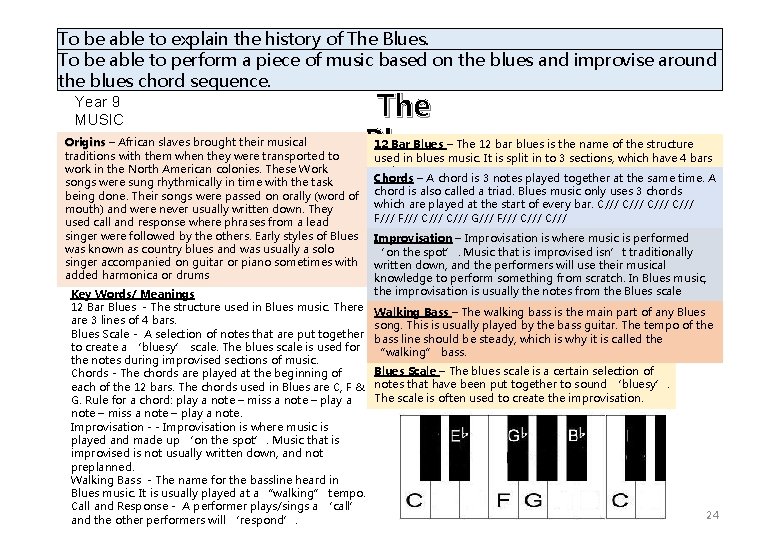
To be able to explain the history of The Blues. To be able to perform a piece of music based on the blues and improvise around the blues chord sequence. Year 9 MUSIC Origins – African slaves brought their musical Origins traditions with them when they were transported to work in the North American colonies. These Work songs were sung rhythmically in time with the task being done. Their songs were passed on orally (word of mouth) and were never usually written down. They used call and response where phrases from a lead singer were followed by the others. Early styles of Blues was known as country blues and was usually a solo singer accompanied on guitar or piano sometimes with added harmonica or drums The Blues Key Words/ Meanings 12 Bar Blues - The structure used in Blues music. There are 3 lines of 4 bars. Blues Scale - A selection of notes that are put together to create a ‘bluesy’ scale. The blues scale is used for the notes during improvised sections of music. Chords - The chords are played at the beginning of each of the 12 bars. The chords used in Blues are C, F & G. Rule for a chord: play a note – miss a note – play a note. Improvisation - - Improvisation is where music is played and made up ‘on the spot’. Music that is improvised is not usually written down, and not preplanned. Walking Bass - The name for the bassline heard in Blues music. It is usually played at a “walking” tempo. Call and Response - A performer plays/sings a ‘call’ and the other performers will ‘respond’. 12 Bar Blues – The 12 bar blues is the name of the structure used in blues music. It is split in to 3 sections, which have 4 bars each. Chords – A chord is 3 notes played together at the same time. A chord is also called a triad. Blues music only uses 3 chords which are played at the start of every bar. C/// F/// C/// G/// F/// C/// Improvisation – Improvisation is where music is performed ‘on the spot’. Music that is improvised isn’t traditionally written down, and the performers will use their musical knowledge to perform something from scratch. In Blues music, the improvisation is usually the notes from the Blues scale Walking Bass – The walking bass is the main part of any Blues song. This is usually played by the bass guitar. The tempo of the bass line should be steady, which is why it is called the “walking” bass. Blues Scale – The blues scale is a certain selection of notes that have been put together to sound ‘bluesy’. The scale is often used to create the improvisation. 24
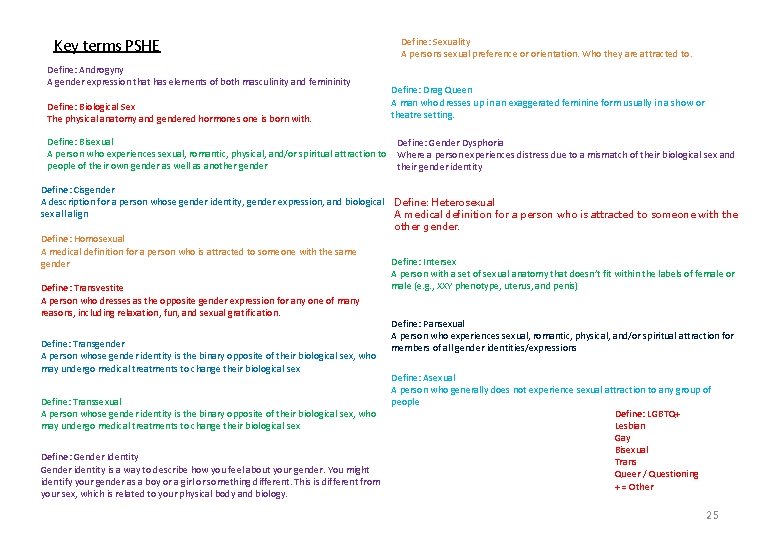
Key terms PSHE Define: Androgyny A gender expression that has elements of both masculinity and femininity Define: Biological Sex The physical anatomy and gendered hormones one is born with. Define: Sexuality A persons sexual preference or orientation. Who they are attracted to. Define: Drag Queen A man who dresses up in an exaggerated feminine form usually in a show or theatre setting. Define: Bisexual Define: Gender Dysphoria A person who experiences sexual, romantic, physical, and/or spiritual attraction to Where a person experiences distress due to a mismatch of their biological sex and people of their own gender as well as another gender their gender identity. Define: Cisgender A description for a person whose gender identity, gender expression, and biological Define: Heterosexual sex all align A medical definition for a person who is attracted to someone with the other gender. Define: Homosexual A medical definition for a person who is attracted to someone with the same Define: Intersex gender. A person with a set of sexual anatomy that doesn’t fit within the labels of female or male (e. g. , XXY phenotype, uterus, and penis) Define: Transvestite A person who dresses as the opposite gender expression for any one of many reasons, including relaxation, fun, and sexual gratification. Define: Pansexual A person who experiences sexual, romantic, physical, and/or spiritual attraction for Define: Transgender members of all gender identities/expressions A person whose gender identity is the binary opposite of their biological sex, who may undergo medical treatments to change their biological sex Define: Asexual A person who generally does not experience sexual attraction to any group of Define: Transsexual people Define: LGBTQ+ A person whose gender identity is the binary opposite of their biological sex, who Lesbian may undergo medical treatments to change their biological sex Gay Bisexual Define: Gender Identity Trans Gender identity is a way to describe how you feel about your gender. You might Queer / Questioning identify your gender as a boy or a girl or something different. This is different from + = Other your sex, which is related to your physical body and biology. 25
Important legal changes that have affected LGBTQ+ people in the UK • 2000: Government lifts the ban on lesbians and gay men serving in the Armed Forces. • 2001: Age of consent for gay/bi men is lowered to 16. • 2002: Equal rights are granted to same-sex couples applying for adoption. • 2003: Repeal of Section 28 -Section 28 was a law that made it illegal to talk positively about homosexuality in schools. • 2003: A new law comes into force protecting LGBT people from discrimination at work. Until 2003 employers could discriminate against LGBT people by not hiring them or not promoting them, just because of their sexual orientation or gender identity. • 2004: Civil Partnership Act is passed. • 2004: Gender Recognition Act is passed -This Act allowed trans people to change their legal gender. This means that they can get a new birth certificate that reflects who they really are, which helps for future legal processes like marriage. • 2007: It becomes illegal to discriminate against people because of their sexual orientation or gender identity when providing them with goods or services. • 2008: The Criminal Justice and Immigration Act makes ‘incitement to homophobic hatred’ a crime. • 2009: A new law gives better legal recognition to same-sex parents. • 2013: The Marriage (Same-Sex Couples) Act is passed. Trans Teens and Children If a child is under 18 and thought to have gender dysphoria, they'll usually be referred to a specialist child and adolescent Gender Identity Clinic (GIC). Treatment is arranged with a multi-disciplinary team (MDT). This is a group may include specialists such as mental health professionals and paediatric endocrinologists. Most treatments offered at this stage are psychological, rather than medical or surgical. If the child is diagnosed with gender dysphoria and they've reached puberty, they could be treated with gonadotrophin-releasing hormone (Gn. RH) analogues. These are synthetic hormones that suppress the hormones naturally produced by the body. They also suppress puberty and can help delay potentially distressing physical changes caused by the body becoming even more like that of the biological sex, until they're old enough for other treatment options. The effects of treatment with Gn. RH analogues are considered to be fully reversible, so treatment can usually be stopped at any time. Teenagers who are 17 years of age or older may be seen in an adult gender clinic. They are entitled to consent to their own treatment and follow the standard adult protocols. Gender Reassignment surgery will not be considered until a person has reached 18 years of age. 26
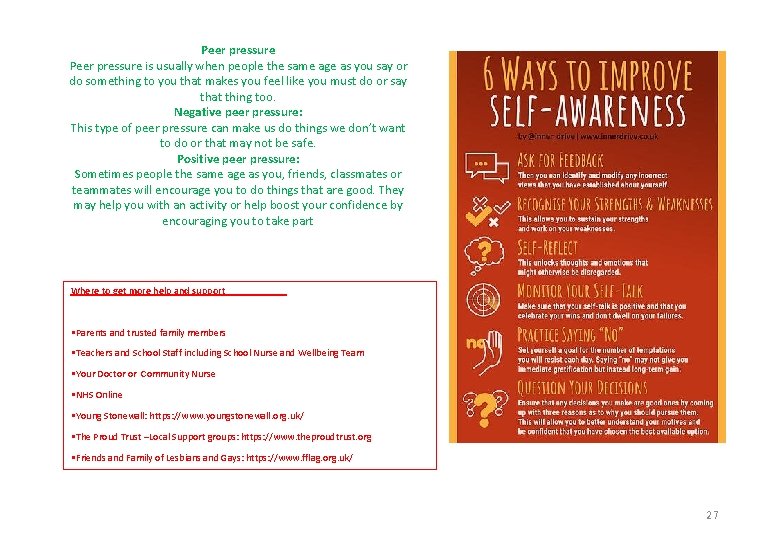
Peer pressure is usually when people the same age as you say or do something to you that makes you feel like you must do or say that thing too. Negative peer pressure: This type of peer pressure can make us do things we don’t want to do or that may not be safe. Positive peer pressure: Sometimes people the same age as you, friends, classmates or teammates will encourage you to do things that are good. They may help you with an activity or help boost your confidence by encouraging you to take part Where to get more help and support • Parents and trusted family members • Teachers and School Staff including School Nurse and Wellbeing Team • Your Doctor or Community Nurse • NHS Online • Young Stonewall: https: //www. youngstonewall. org. uk/ • The Proud Trust –Local Support groups: https: //www. theproudtrust. org • Friends and Family of Lesbians and Gays: https: //www. fflag. org. uk/ 27
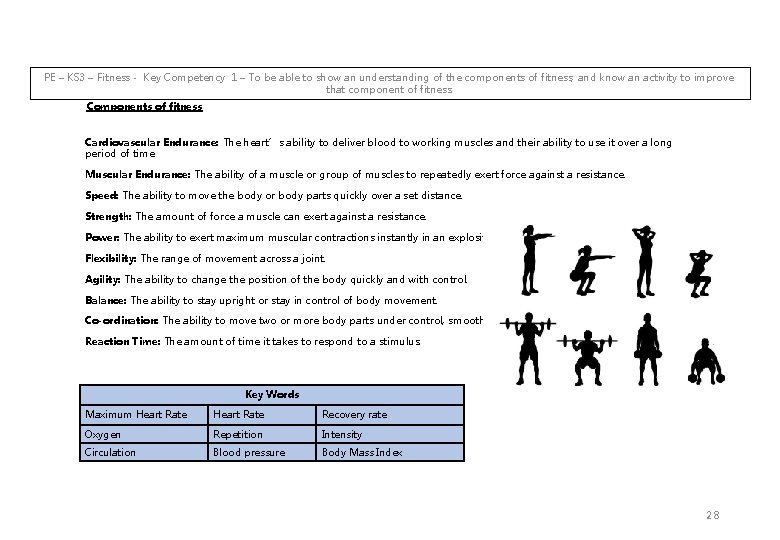
PE – KS 3 – Fitness - Key Competency 1 – To be able to show an understanding of the components of fitness, and know an activity to improve that component of fitness. Components of fitness Cardiovascular Endurance: The heart’s ability to deliver blood to working muscles and their ability to use it over a long period of time. Muscular Endurance: The ability of a muscle or group of muscles to repeatedly exert force against a resistance. Speed: The ability to move the body or body parts quickly over a set distance. Strength: The amount of force a muscle can exert against a resistance. Power: The ability to exert maximum muscular contractions instantly in an explosive burst of movements. Flexibility: The range of movement across a joint. Agility: The ability to change the position of the body quickly and with control. Balance: The ability to stay upright or stay in control of body movement. Co-ordination: The ability to move two or more body parts under control, smoothly and efficiently. Reaction Time: The amount of time it takes to respond to a stimulus. Key Words Maximum Heart Rate Recovery rate Oxygen Repetition Intensity Circulation Blood pressure Body Mass Index 28
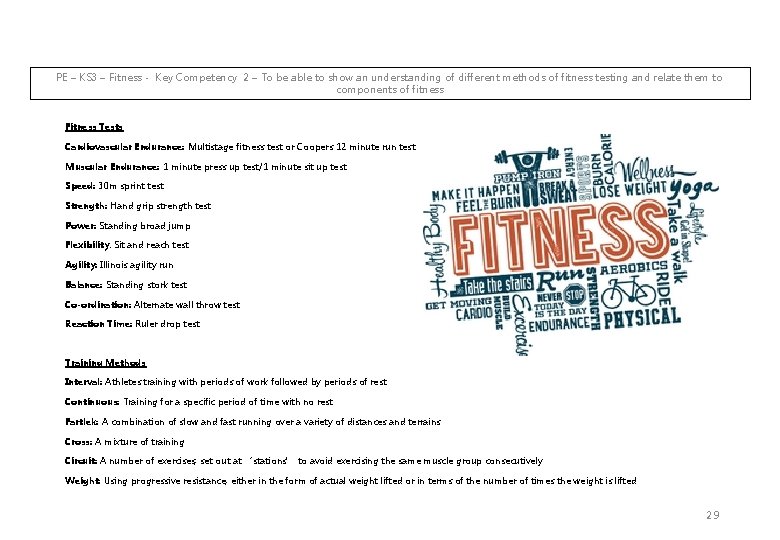
PE – KS 3 – Fitness - Key Competency 2 – To be able to show an understanding of different methods of fitness testing and relate them to components of fitness Fitness Tests Cardiovascular Endurance: Multistage fitness test or Coopers 12 minute run test Muscular Endurance: 1 minute press up test/1 minute sit up test Speed: 30 m sprint test Strength: Hand grip strength test Power: Standing broad jump Flexibility: Sit and reach test Agility: Illinois agility run Balance: Standing stork test Co-ordination: Alternate wall throw test Reaction Time: Ruler drop test Training Methods Interval: Athletes training with periods of work followed by periods of rest Continuous: Training for a specific period of time with no rest Fartlek: A combination of slow and fast running over a variety of distances and terrains Cross: A mixture of training Circuit: A number of exercises, set out at ‘stations’ to avoid exercising the same muscle group consecutively Weight: Using progressive resistance, either in the form of actual weight lifted or in terms of the number of times the weight is lifted 29
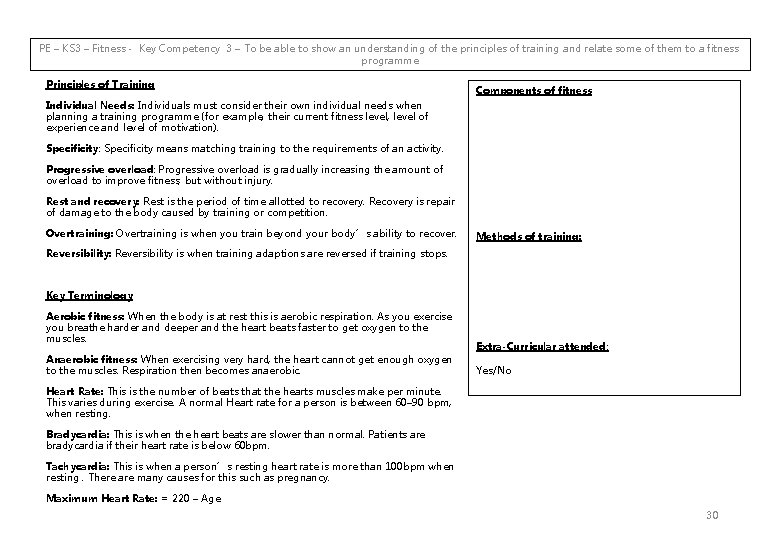
PE – KS 3 – Fitness - Key Competency 3 – To be able to show an understanding of the principles of training and relate some of them to a fitness programme Principles of Training Components of fitness Individual Needs: Individuals must consider their own individual needs when planning a training programme (for example, their current fitness level, level of experience and level of motivation). Specificity: Specificity means matching training to the requirements of an activity. Progressive overload: Progressive overload is gradually increasing the amount of overload to improve fitness, but without injury. Rest and recovery: Rest is the period of time allotted to recovery. Recovery is repair of damage to the body caused by training or competition. Overtraining: Overtraining is when you train beyond your body’s ability to recover. Methods of training: Reversibility: Reversibility is when training adaptions are reversed if training stops. Key Terminology Aerobic fitness: When the body is at rest this is aerobic respiration. As you exercise you breathe harder and deeper and the heart beats faster to get oxygen to the muscles. Anaerobic fitness: When exercising very hard, the heart cannot get enough oxygen to the muscles. Respiration then becomes anaerobic. Extra-Curricular attended: Yes/No Heart Rate: This is the number of beats that the hearts muscles make per minute. This varies during exercise. A normal Heart rate for a person is between 60– 90 bpm, when resting. Bradycardia: This is when the heart beats are slower than normal. Patients are bradycardia if their heart rate is below 60 bpm. Tachycardia: This is when a person’s resting heart rate is more than 100 bpm when resting. There are many causes for this such as pregnancy. Maximum Heart Rate: = 220 – Age 30
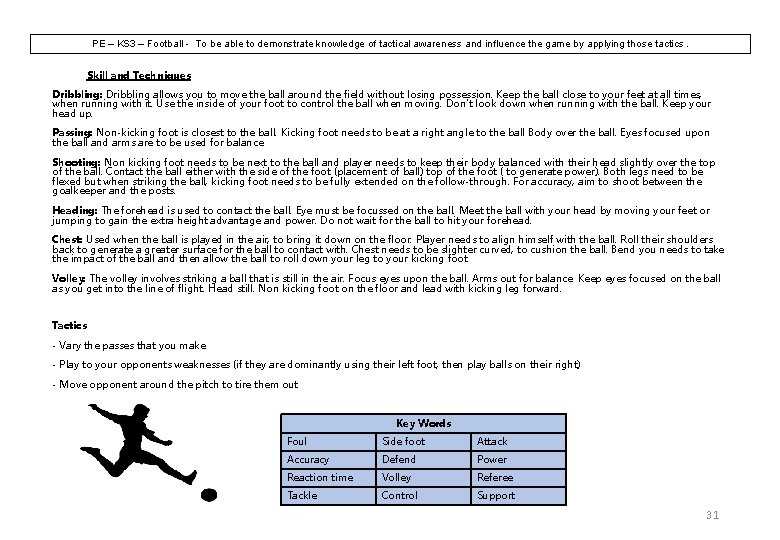
PE – KS 3 – Football - To be able to demonstrate knowledge of tactical awareness and influence the game by applying those tactics. Skill and Techniques Dribbling: Dribbling allows you to move the ball around the field without losing possession. Keep the ball close to your feet at all times, when running with it. Use the inside of your foot to control the ball when moving. Don't look down when running with the ball. Keep your head up. Passing: Non-kicking foot is closest to the ball. Kicking foot needs to be at a right angle to the ball Body over the ball. Eyes focused upon the ball and arms are to be used for balance. Shooting: Non kicking foot needs to be next to the ball and player needs to keep their body balanced with their head slightly over the top of the ball. Contact the ball either with the side of the foot (placement of ball) top of the foot ( to generate power). Both legs need to be flexed but when striking the ball, kicking foot needs to be fully extended on the follow-through. For accuracy, aim to shoot between the goalkeeper and the posts. Heading: The forehead is used to contact the ball. Eye must be focussed on the ball. Meet the ball with your head by moving your feet or jumping to gain the extra height advantage and power. Do not wait for the ball to hit your forehead. Chest: Used when the ball is played in the air, to bring it down on the floor. Player needs to align himself with the ball. Roll their shoulders back to generate a greater surface for the ball to contact with. Chest needs to be slighter curved, to cushion the ball. Bend you needs to take the impact of the ball and then allow the ball to roll down your leg to your kicking foot. Volley: The volley involves striking a ball that is still in the air. Focus eyes upon the ball. Arms out for balance. Keep eyes focused on the ball as you get into the line of flight. Head still. Non kicking foot on the floor and lead with kicking leg forward. Tactics - Vary the passes that you make - Play to your opponents weaknesses (if they are dominantly using their left foot, then play balls on their right) - Move opponent around the pitch to tire them out Key Words Foul Side foot Attack Accuracy Defend Power Reaction time Volley Referee Tackle Control Support 31
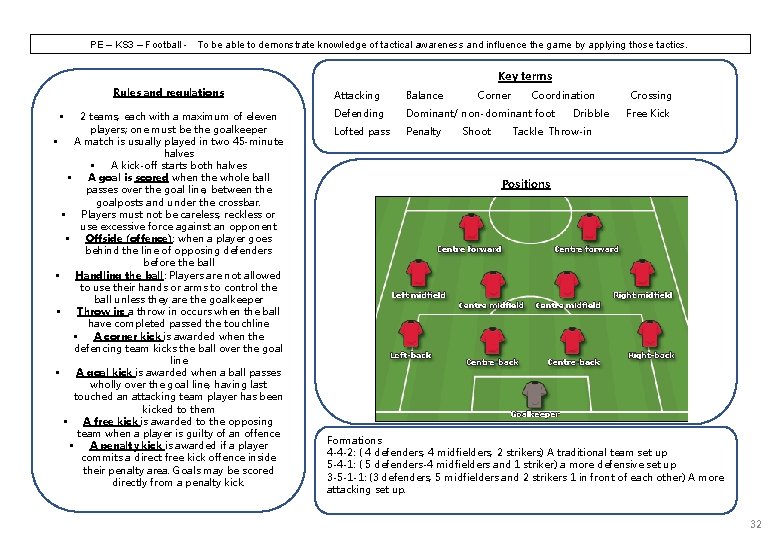
PE – KS 3 – Football - To be able to demonstrate knowledge of tactical awareness and influence the game by applying those tactics. Key terms Rules and regulations Attacking Balance 2 teams, each with a maximum of eleven players; one must be the goalkeeper § A match is usually played in two 45 -minute halves § A kick-off starts both halves § A goal is scored when the whole ball passes over the goal line, between the goalposts and under the crossbar. § Players must not be careless, reckless or use excessive force against an opponent § Offside (offence): when a player goes behind the line of opposing defenders before the ball § Handling the ball: Players are not allowed to use their hands or arms to control the ball unless they are the goalkeeper § Throw in: a throw in occurs when the ball have completed passed the touchline § A corner kick is awarded when the defencing team kicks the ball over the goal line § A goal kick is awarded when a ball passes wholly over the goal line, having last touched an attacking team player has been kicked to them § A free kick is awarded to the opposing team when a player is guilty of an offence § A penalty kick is awarded if a player commits a direct free kick offence inside their penalty area. Goals may be scored directly from a penalty kick. Defending Dominant/ non-dominant foot Dribble Free Kick Lofted pass Penalty Shoot Tackle Throw-in § Corner Coordination Crossing Positions Formations 4 -4 -2: ( 4 defenders, 4 midfielders, 2 strikers) A traditional team set up 5 -4 -1: ( 5 defenders-4 midfielders and 1 striker) a more defensive set up 3 -5 -1 -1: (3 defenders, 5 midfielders and 2 strikers 1 in front of each other) A more attacking set up. 32
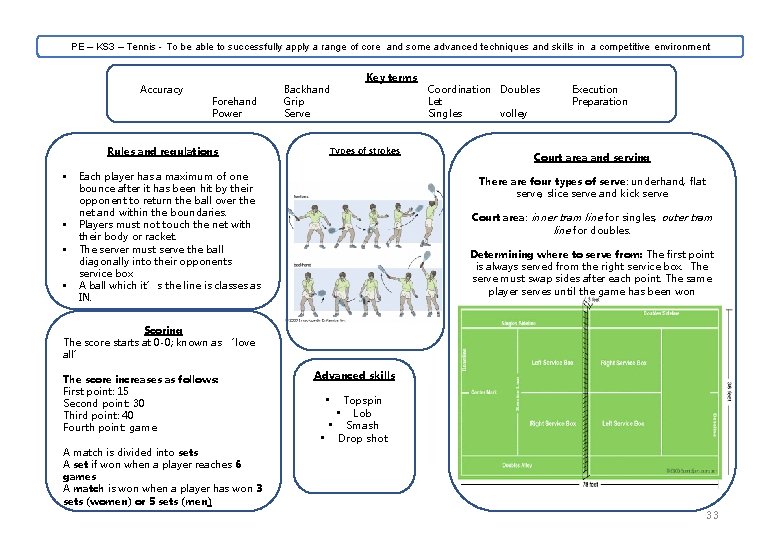
PE – KS 3 – Tennis - To be able to successfully apply a range of core and some advanced techniques and skills in a competitive environment PE – KS 3 – Tennis - To be able to successfully apply a range of core and some advanced techniques and skills in a competitive Accuracy Forehand Power Types of strokes Rules and regulations § § Key terms Backhand Grip Serve Each player has a maximum of one bounce after it has been hit by their opponent to return the ball over the net and within the boundaries. Players must not touch the net with their body or racket. The server must serve the ball diagonally into their opponents service box A ball which it’s the line is classes as IN. Coordination Doubles Let Singles volley Execution Preparation Court area and serving There are four types of serve: underhand, flat serve, slice serve and kick serve Court area: inner tram line for singles, outer tram line for doubles. Determining where to serve from: The first point is always served from the right service box. The serve must swap sides after each point. The same player serves until the game has been won Scoring The score starts at 0 -0; known as ‘love all’ The score increases as follows: First point: 15 Second point: 30 Third point: 40 Fourth point: game A match is divided into sets A set if won when a player reaches 6 games A match is won when a player has won 3 sets (women) or 5 sets (men) Advanced skills Topspin Lob • Smash • Drop shot • • 33
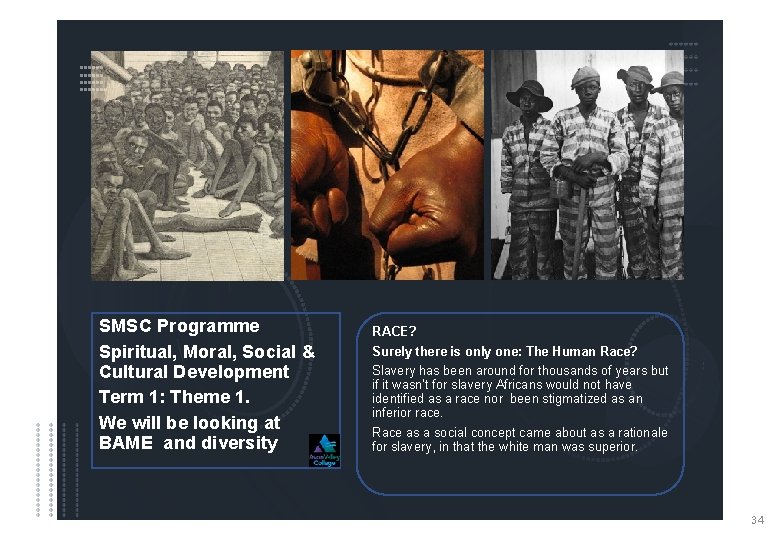
SMSC Programme Spiritual, Moral, Social & Cultural Development Term 1: Theme 1. We will be looking at BAME and diversity RACE? Surely there is only one: The Human Race? Slavery has been around for thousands of years but if it wasn’t for slavery Africans would not have identified as a race nor been stigmatized as an inferior race. Race as a social concept came about as a rationale for slavery, in that the white man was superior. 34
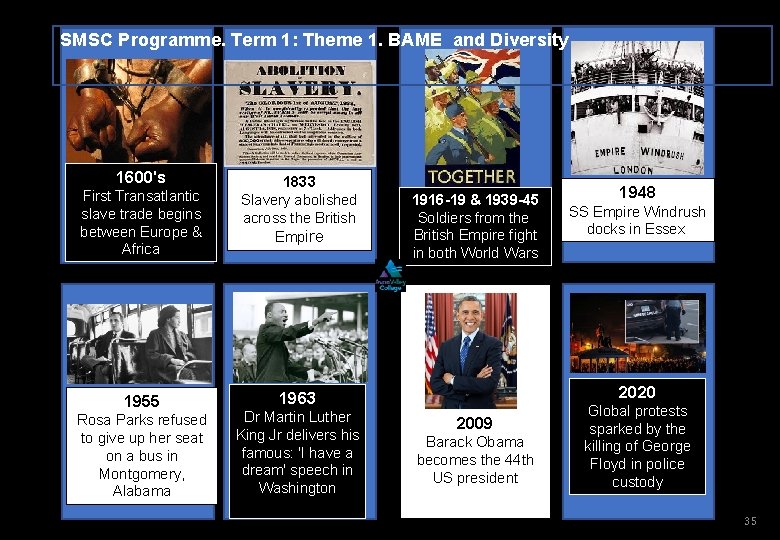
SMSC Programme. Term 1: Theme 1. BAME and Diversity 1600's First Transatlantic slave trade begins between Europe & Africa 1955 Rosa Parks refused to give up her seat on a bus in Montgomery, Alabama 1833 Slavery abolished across the British Empire 1916 -19 & 1939 -45 Soldiers from the British Empire fight in both World Wars SS Empire Windrush docks in Essex 2020 1963 Dr Martin Luther King Jr delivers his famous: 'I have a dream' speech in Washington 1948 2009 Barack Obama becomes the 44 th US president Global protests sparked by the killing of George Floyd in police custody 35
“Black is beautiful, black is excellent, black is pain, black is joy” “It’s working twice as hard as the people you know you’re better than cause you need to do double what they do so you can level them” “If he’s black he’s probably armed, you see him and shoot. ” “Black is being guilty until proven that you’re innocent. ” “You don’t know the truth about your race cause they erasing it. ” 36
COMMITTED TO STAMPING OUT RACISM 37 37
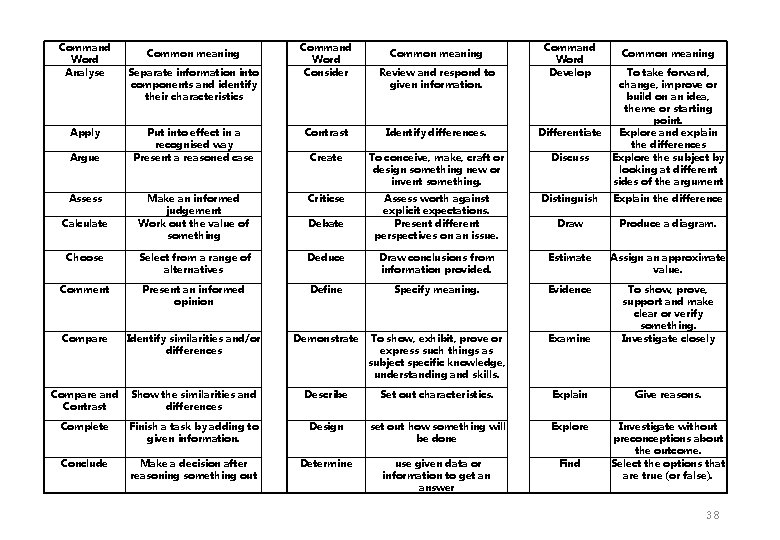
Command Word Analyse Apply Common meaning Separate information into components and identify their characteristics Command Word Consider Common meaning Review and respond to given information. Command Word Develop Common meaning To take forward, change, improve or build on an idea, theme or starting point. Explore and explain the differences Explore the subject by looking at different sides of the argument Put into effect in a recognised way Present a reasoned case Contrast Identify differences. Differentiate Create To conceive, make, craft or design something new or invent something. Discuss Make an informed judgement Work out the value of something Criticse Assess worth against explicit expectations. Present different perspectives on an issue. Distinguish Explain the difference Draw Produce a diagram. Choose Select from a range of alternatives Deduce Draw conclusions from information provided. Estimate Assign an approximate value. Comment Present an informed opinion Define Specify meaning. Evidence Compare Identify similarities and/or differences Demonstrate To show, exhibit, prove or express such things as subject specific knowledge, understanding and skills. Examine To show, prove, support and make clear or verify something. Investigate closely Describe Set out characteristics. Explain Give reasons. Investigate without preconceptions about the outcome. Select the options that are true (or false). Argue Assess Calculate Debate Compare and Show the similarities and Contrast differences Complete Finish a task by adding to given information. Design set out how something will be done Explore Conclude Make a decision after reasoning something out Determine use given data or information to get an answer Find 38
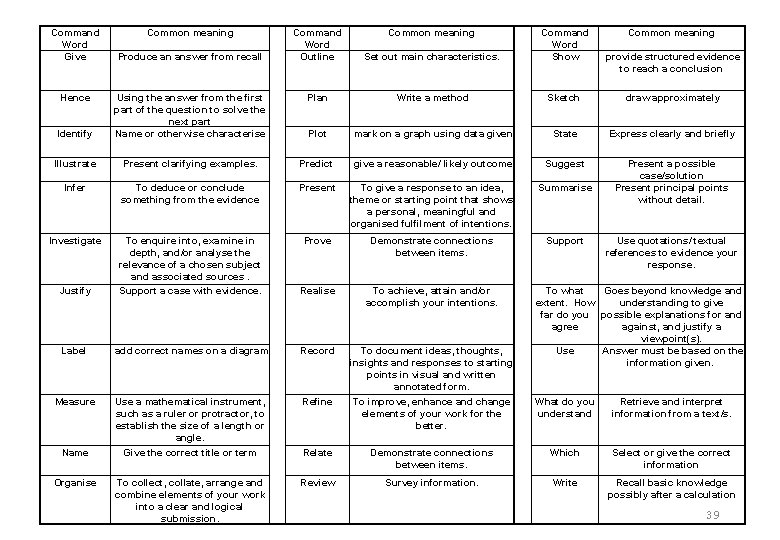
Command Word Give Set out main characteristics. Command Word Show Plan Write a method Sketch draw approximately Identify Using the answer from the first part of the question to solve the next part Name or otherwise characterise Plot mark on a graph using data given State Express clearly and briefly Illustrate Present clarifying examples. Predict give a reasonable/ likely outcome Suggest Infer To deduce or conclude something from the evidence Present To give a response to an idea, theme or starting point that shows a personal, meaningful and organised fulfilment of intentions. Summarise Present a possible case/solution Present principal points without detail. Investigate Prove Demonstrate connections between items. Support Justify To enquire into, examine in depth, and/or analyse the relevance of a chosen subject and associated sources. Support a case with evidence. Realise To achieve, attain and/or accomplish your intentions. Label add correct names on a diagram Record Measure Use a mathematical instrument, such as a ruler or protractor, to establish the size of a length or angle. Give the correct title or term Refine To document ideas, thoughts, insights and responses to starting points in visual and written annotated form. To improve, enhance and change elements of your work for the better. Relate Demonstrate connections between items. To collect, collate, arrange and combine elements of your work into a clear and logical submission. Review Survey information. Name Organise Produce an answer from recall Common meaning Command Word Outline Hence Common meaning provide structured evidence to reach a conclusion Use quotations/ textual references to evidence your response. To what Goes beyond knowledge and extent. How understanding to give far do you possible explanations for and agree against, and justify a viewpoint(s). Use Answer must be based on the information given. What do you understand Retrieve and interpret information from a text/s. Which Select or give the correct information Write Recall basic knowledge possibly after a calculation 39