
Knowledge Organiser Weimar and Nazi Germany 1918 39

- Slides: 4
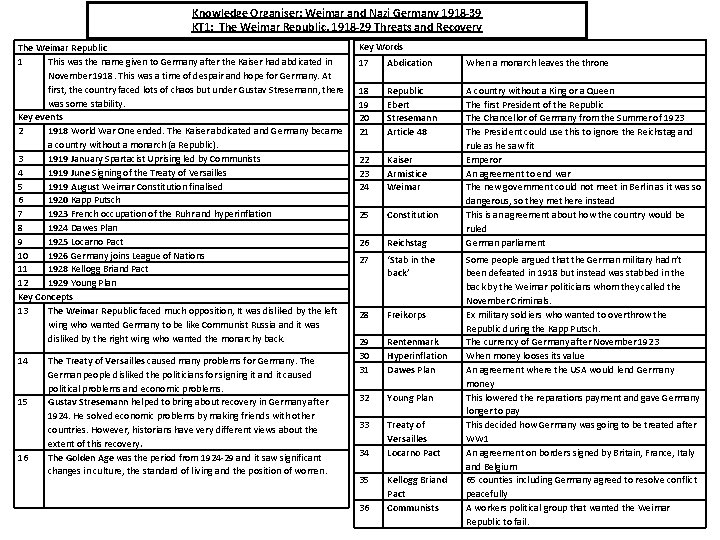
Knowledge Organiser: Weimar and Nazi Germany 1918 -39 KT 1: The Weimar Republic, 1918 -29 Threats and Recovery The Weimar Republic 1 This was the name given to Germany after the Kaiser had abdicated in November 1918. This was a time of despair and hope for Germany. At first, the country faced lots of chaos but under Gustav Stresemann, there was some stability. Key events 2 1918 World War One ended. The Kaiser abdicated and Germany became a country without a monarch (a Republic). 3 1919 January Spartacist Uprising led by Communists 4 1919 June Signing of the Treaty of Versailles 5 1919 August Weimar Constitution finalised 6 1920 Kapp Putsch 7 1923 French occupation of the Ruhr and hyperinflation 8 1924 Dawes Plan 9 1925 Locarno Pact 10 1926 Germany joins League of Nations 11 1928 Kellogg Briand Pact 12 1929 Young Plan Key Concepts 13 The Weimar Republic faced much opposition, It was disliked by the left wing who wanted Germany to be like Communist Russia and it was disliked by the right wing who wanted the monarchy back. 14 15 16 The Treaty of Versailles caused many problems for Germany. The German people disliked the politicians for signing it and it caused political problems and economic problems. Gustav Stresemann helped to bring about recovery in Germany after 1924. He solved economic problems by making friends with other countries. However, historians have very different views about the extent of this recovery. The Golden Age was the period from 1924 -29 and it saw significant changes in culture, the standard of living and the position of women. Key Words 17 Abdication When a monarch leaves the throne 18 19 20 21 Republic Ebert Stresemann Article 48 22 23 24 Kaiser Armistice Weimar 25 Constitution 26 Reichstag A country without a King or a Queen The first President of the Republic The Chancellor of Germany from the Summer of 1923 The President could use this to ignore the Reichstag and rule as he saw fit Emperor An agreement to end war The new government could not meet in Berlin as it was so dangerous, so they met here instead This is an agreement about how the country would be ruled German parliament 27 ‘Stab in the back’ 28 Freikorps 29 30 31 Rentenmark Hyperinflation Dawes Plan 32 Young Plan 33 Treaty of Versailles Locarno Pact 34 35 36 Kellogg Briand Pact Communists Some people argued that the German military hadn’t been defeated in 1918 but instead was stabbed in the back by the Weimar politicians whom they called the November Criminals. Ex military soldiers who wanted to overthrow the Republic during the Kapp Putsch. The currency of Germany after November 1923 When money looses its value An agreement where the USA would lend Germany money This lowered the reparations payment and gave Germany longer to pay This decided how Germany was going to be treated after WW 1 An agreement on borders signed by Britain, France, Italy and Belgium 65 counties including Germany agreed to resolve conflict peacefully A workers political group that wanted the Weimar Republic to fail.
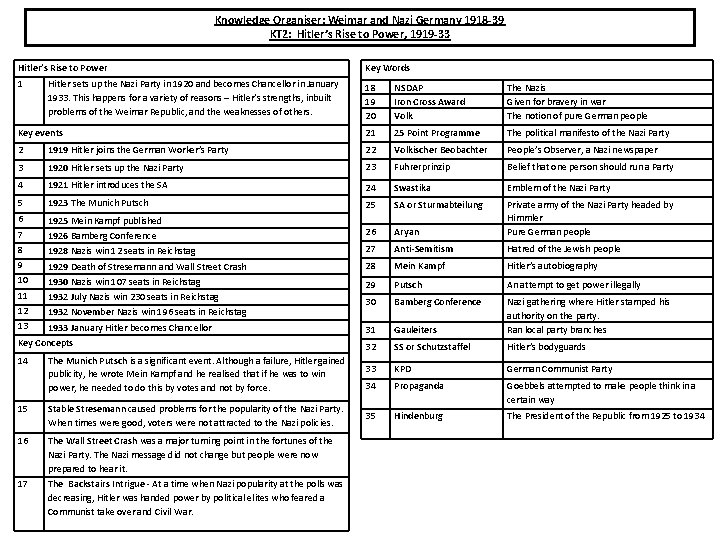
Knowledge Organiser: Weimar and Nazi Germany 1918 -39 KT 2: Hitler’s Rise to Power, 1919 -33 Hitler’s Rise to Power Key Words 1 18 19 20 NSDAP Iron Cross Award Volk The Nazis Given for bravery in war The notion of pure German people Key events 21 25 Point Programme The political manifesto of the Nazi Party 2 1919 Hitler joins the German Worker’s Party 22 Volkischer Beobachter People’s Observer, a Nazi newspaper 3 1920 Hitler sets up the Nazi Party 23 Fuhrerprinzip Belief that one person should run a Party 4 1921 Hitler introduces the SA 24 Swastika Emblem of the Nazi Party 5 1923 The Munich Putsch 25 SA or Sturmabteilung 6 1925 Mein Kampf published 7 1926 Bamberg Conference 26 Aryan Private army of the Nazi Party headed by Himmler Pure German people 8 1928 Nazis win 12 seats in Reichstag 27 Anti-Semitism Hatred of the Jewish people 9 1929 Death of Stresemann and Wall Street Crash 28 Mein Kampf Hitler’s autobiography 10 1930 Nazis win 107 seats in Reichstag 11 1932 July Nazis win 230 seats in Reichstag 29 Putsch An attempt to get power illegally 12 1932 November Nazis win 196 seats in Reichstag 30 Bamberg Conference 13 1933 January Hitler becomes Chancellor 31 Gauleiters Nazi gathering where Hitler stamped his authority on the party. Ran local party branches Hitler sets up the Nazi Party in 1920 and becomes Chancellor in January 1933. This happens for a variety of reasons – Hitler’s strengths, inbuilt problems of the Weimar Republic, and the weaknesses of others. Key Concepts 32 SS or Schutzstaffel Hitler’s bodyguards The Munich Putsch is a significant event. Although a failure, Hitler gained publicity, he wrote Mein Kampf and he realised that if he was to win power, he needed to do this by votes and not by force. 33 KPD German Communist Party 34 Propaganda 15 Stable Stresemann caused problems for the popularity of the Nazi Party. When times were good, voters were not attracted to the Nazi policies. Goebbels attempted to make people think in a certain way 35 Hindenburg The President of the Republic from 1925 to 1934 16 The Wall Street Crash was a major turning point in the fortunes of the Nazi Party. The Nazi message did not change but people were now prepared to hear it. 17 The Backstairs Intrigue - At a time when Nazi popularity at the polls was decreasing, Hitler was handed power by political elites who feared a Communist take over and Civil War. 14
Knowledge Organiser: Weimar and Nazi Germany 1918 -39 KT 3: Nazi Control and Dictatorship Key Words 1 15 This was a time when Hitler formed a legal dictatorship and put in place methods of propaganda and censorship to persuade and encourage all Germany people to support Nazi ideals. Key events 16 17 Marinus van der Lubbe Enabling Act Gleichschaltung The Reichstag Fire was blamed on this Communist Set up to replace Trade Unions Gave the Nazis full power for the next 4 years Hitler’s attempt to bring German society into line with Nazi philosophy 2 1933 January Hitler becomes Chancellor 3 1933 February Reichstag Fire 4 1933 March Nazis win 288 seats 19 German Labour Front (DAF) Dachau 5 1933 March Enabling Act passed 20 Centralisation 6 1933 July Nazis become the only legal party in Germany 7 1934 June Night of the Long Knives 21 Purge Germany had been divided into districts called Lander. Now Germany was run from Belin alone To get rid of opposition 8 1934 August President Hindenburg dies 22 Gestapo Secret police headed by Goering. 9 1934 August Hitler combines the post of Chancellor and President and becomes Fuhrer 23 Removal on internal and external opposition 10 1934 August German army swears allegiance to Hitler 24 Night of the Long Knives Sicherheitsdienst (SD) 11 1938 Over the course of the year, Hitler removes 16 army generals from their positions 25 Concordat Key Concepts 12 13 14 Removal – From 1933 to 1934, Hitler removed all opposition and established himself as Fuhrer. Control – There was an attempt to control and influence attitudes. This was done by propaganda and terror. Opposition – The youth and the churches opposed the regime. 18 26 27 28 First concentration camp The intelligence body of the Nazi Party In July 1933 the Pope agreed to stay out of political matters if the Nazis did not interfere with Catholic affairs Eidelweiss Pirates and Groups who apposed the Hitler Youth Swing Youth Confessional Church Followed traditional German Protestantism and refused to allow the Nazification of religion. Led by Pastor Martin Niemoller Mit Brennender Sorge The Pope wrote to priests in Germany about his (With Burning concerns over the Nazi attempts to control religion Concern)
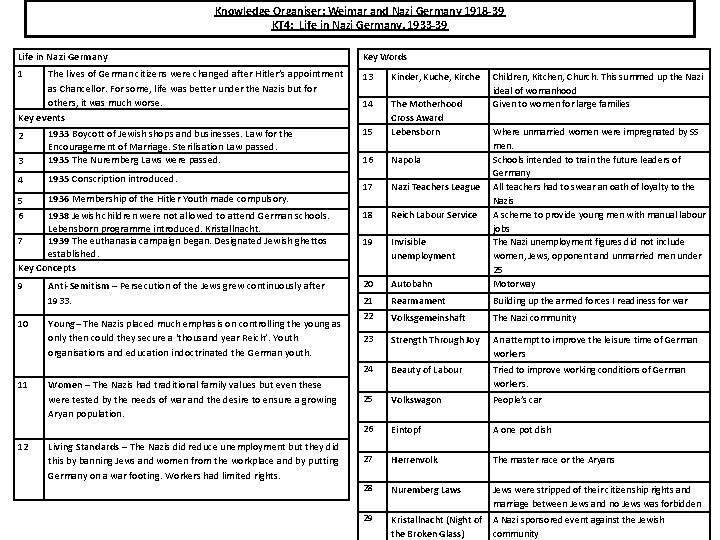
Knowledge Organiser: Weimar and Nazi Germany 1918 -39 KT 4: Life in Nazi Germany, 1933 -39 Life in Nazi Germany Key Words 1 13 Kinder, Kuche, Kirche 14 15 The Motherhood Cross Award Lebensborn 16 Napola 17 Nazi Teachers League 1938 Jewish children were not allowed to attend German schools. Lebensborn programme introduced. Kristallnacht. 7 1939 The euthanasia campaign began. Designated Jewish ghettos established. Key Concepts 18 Reich Labour Service 19 Invisible unemployment 9 20 Autobahn Where unmarried women were impregnated by SS men. Schools intended to train the future leaders of Germany All teachers had to swear an oath of loyalty to the Nazis A scheme to provide young men with manual labour jobs The Nazi unemployment figures did not include women, Jews, opponent and unmarried men under 25 Motorway 21 Rearmament Building up the armed forces I readiness for war 22 Volksgemeinshaft The Nazi community 23 Strength Through Joy An attempt to improve the leisure time of German workers 24 Beauty of Labour Tried to improve working conditions of German workers. 25 Volkswagon People’s car 26 Eintopf A one pot dish 27 Herrenvolk The master race or the Aryans 28 Nuremberg Laws Jews were stripped of their citizenship rights and marriage between Jews and no Jews was forbidden 29 Kristallnacht (Night of the Broken Glass) A Nazi sponsored event against the Jewish community The lives of German citizens were changed after Hitler’s appointment as Chancellor. For some, life was better under the Nazis but for others, it was much worse. Key events 3 1933 Boycott of Jewish shops and businesses. Law for the Encouragement of Marriage. Sterilisation Law passed. 1935 The Nuremberg Laws were passed. 4 1935 Conscription introduced. 5 6 1936 Membership of the Hitler Youth made compulsory. 2 10 11 12 Anti-Semitism – Persecution of the Jews grew continuously after 1933. Young– The Nazis placed much emphasis on controlling the young as only then could they secure a ‘thousand year Reich’. Youth organisations and education indoctrinated the German youth. Women – The Nazis had traditional family values but even these were tested by the needs of war and the desire to ensure a growing Aryan population. Living Standards – The Nazis did reduce unemployment but they did this by banning Jews and women from the workplace and by putting Germany on a war footing. Workers had limited rights. Children, Kitchen, Church. This summed up the Nazi ideal of womanhood Given to women for large families