Knowledge Organiser The scenes Context Key quotations King

- Slides: 1
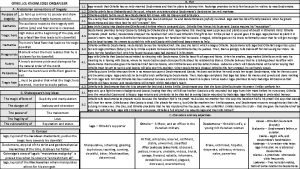
Knowledge Organiser The scenes Context Key quotations King James I. Previously known as King James VI of Scotland, he had recently ascended to the English throne – and Shakespeare sought to impress him by addressing his interests, such as kingship and witchcraft. King James had a deep interest in the supernatural and had also recently survived the Gunpowder Plot to kill him. He was therefore anxious about threats to his power from witchcraft and other potential assassins. The play also complimented the king’s ancestry (Banquo, a noble character, was named after one of James’ ancestors). 1. 1 1. 2 The three witches meet on the heath ‘Fair is foul, and foul is fair’ Macbeth and Banquo are praised as brave and loyal warriors ‘Like valour’s minion carved out his passage’ ‘O valiant cousin! Worthy gentleman!’ 1. 3 Macbeth and Banquo meet the witches who reveal the first set of prophecies 1. 4 Macbeth meets King Duncan and is told that the King will visit him at his own castle ‘So foul and fair a day I have not seen’ ‘All hail Macbeth that shalt be King hereafter’ ‘If good, why do I yield to that suggestion’ ‘Stars, hide your fires, Let not light see my black and deep desires’ ‘It is a peerless kinsman’ (Duncan praises Macbeth) 1. 5 Lady Macbeth receives Macbeth’s letter and begins her manipulation of her husband 1. 6 1. 7 Duncan arrives at Macbeth’s castle ‘thy nature, It is too full o’th’milk of human kindness’ ‘Come, you spirits, that tend on mortal thoughts, unsex me here’ ‘look like th’innocent flower, but be the serpent underneath’ ‘See, see, our honoured hostess!’ Dramatic irony! Macbeth’s soliloquy. Macbeth tells Lady Macbeth he will not commit regicide – but she persuades him to go ahead with the murder Banquo and Macbeth discuss the witches. Macbeth sees a vision of a dagger ‘I have no spur to prick the sides of my intent, but only vaulting ambition’ ‘Was the hope drunk wherein you dressed yourself? ’ ‘screw your courage to the sticking place, and we’ll not fail’ ‘Is this a dagger I see before me, the handle toward my hand? ’ ‘I go, and it is done; the bell invites me’ Macbeth murders King Duncan and begins to experience guilt. Lady Macbeth manipulates him and questions his courage Macduff finds Duncan’s body. Macbeth and Lady Macbeth pretend to be shocked ‘Methought I heard a voice cry, ‘Sleep no more, Macbeth does murder sleep’’ ‘Will all great Neptune’s ocean wash this blood clean from my hand? ’ ‘My hands are of your colour, but I shame to wear a heart so white. ’ ‘Where we are, there’s daggers in men’s smiles’ (Donalbain suspects that the murderer is amongst them, and that people cannot be trusted) 2. 4 Macduff suspects that Malcolm and Donalbain are responsible, meaning Macbeth will be King ‘’’Then ‘tis most like the sovereignty will fall upon Macbeth’ (Rosse) Themes 3. 1 Macbeth is anxious about Banquo and plans to murder him and his son, Fleance ‘It is concluded. Banquo, thy soul’s flight / If it find heaven, must find it tonight’ Macbeth’s rhyming couplet conveys his shift to decisiveness and ruthlessness. The Supernatural 3. 2 Macbeth tells Lady Macbeth about his guilt and hints at his plan for Banquo and Fleance ‘O, full of scorpions is my mind, dear wife!’ ‘Come, seeling (blinding) night, scarf up the tender eye of the pitiful day’ The supernatural interacts with key characters in different ways: witchcraft exposes Macbeth’s inner evil and directs him to certain deeds; Lady M appeals to the supernatural to possess her and instill power within her; Banquo resists the witches’ prophecies, refusing to submit to the supernatural. 3. 3 Banquo is murdered, but Fleance escapes! ‘We have lost best half of our affair. ’ Fleance lives an so the witches’ prophecy about him becoming King might still come true. Gender, masculinity and femininity Lady Macbeth challenges expectations about what it means to be a woman (be submissive, bear children, lack ambition) and challenges the masculinity of male characters (Macbeth, when he doesn’t want to commit regicide; Macduff when he flees to England). The play poses the question of what it means to be man (ruthless ambition and violence, or loyalty and honour? ) and what it means to be a woman (passivity or ambition? ). 3. 4 Macbeth learns of Fleance’s escape and then sees Banquo’s ghost at the banquet The witches meet with Hecate, the Goddess of witches ‘now I am cabined, cribbed, confined, bound in to saucy doubts and fears’ ‘It will have blood they say – blood will have blood. Stones have been known to move and trees to speak’ ‘And you all know, security (over-confidence) is mortals’ chiefest enemy’ Hecate thinks that Macbeth is trying to beat fate – so she plans his downfall. Fate versus Free Will It is unclear how much control Macbeth has over his own fate. The witches’ prophecies may be self-fulfilling as Macbeth’s own ambition takes over and he seeks to make the prophecies a reality. Loyalty and Trust versus Betrayal and Revenge Macbeth’s loyalties are conflicted between his comradeship for Duncan and Banquo and his loyalty to his wife. He makes the fatal decision to trust the witches’ prophecies, and so chooses to betray Duncan. Lennox hints that he believes Macbeth committed the murder The witches summon three apparitions, each telling another prophecy to Macbeth ‘How it did grieve Macbeth’ He is being ironic, suggesting that Macbeth put on an act of grief when Duncan died. ‘none of woman born shall harm Macbeth’ ‘From this moment, the very firstlings of my heart shall be the firstlings of my hand’ Appearance versus Reality From the very first scene (‘Fair is foul…’), things are not what they seem. The natural order of the world cannot be trusted. People are deceitful (the Macbeths pretend to be welcoming and then angry at Duncan’s murder); the supernatural interferes with the natural world; people experience visions (daggers, blood and ghosts). 4. 2 Macbeth has Macduff’s wife and children murdered ‘Why then, alas, do I put up that womanly defence, to say I have done no harm? ’ Lady Macduff serves as contrast to Lady M, embracing her femininity and kindness. Disorder and inversion of the natural order The play subverts natural orders: Macbeth disrupts the natural succession of royalty; Lady M breaks gender norms; the supernatural imposes on the natural world; Macbeth and Lady M struggle with inner turmoil and conflicts. 4. 3 Macduff learns of his family’s murder. He and Malcolm vow revenge on Macbeth Malcolm: ‘Dispute it like a man’ Take revenge by fighting Macbeth Macduff: ‘I shall do so, but I must also feel it as a man’ His emotion contrasts with M. 5. 1 Lady Macbeth sleepwalks. She is weakened by guilt ‘Out damned spot!’ ‘What’s done cannot be undone. To bed, to bed’ 5. 2 Malcolm and his English army approach ‘Those he commands move only in command, nothing in love’ M is not respected 5. 3 Macbeth mocks his servant for being scared of the approaching army ‘Thou lily-livered boy’ A lily is a white flower ‘Put mine armour on […] Pull’t off, I say’ Macbeth shows indecision and panic 5. 4 5. 5 Great Birnam wood moves Lady Macbeth dies; Macbeth becomes cynical and callous about his own life ‘Let every soldier hew (cut) him down a bough (branch)’ ‘’Out, out, brief candle’ ‘I ‘gin to be weary of the sun’ He is tired with life. He now has nothing to lose. 5. 6 Malcolm and Macduff prepare to attack 5. 7 Macbeth kills Young Siward ‘Make all our trumpets speak; give them all breath / Those clamorous harbingers of death’ Rhyming couplet conveys decisive power Young Siward: ‘Thou liest, abhorred tyrant’ Contrast to ‘valiant cousin…’ 5. 8 Macbeth chooses to fight to the death and is slain by Macduff ‘Turn, hell-hound, turn!’ ‘Macduff was from his mother’s womb untimely ripped’ ‘I will not yield to kiss the ground before young Malcolm’s feet’ 5. 9 Malcolm is crowned king ‘Malcolm: ‘this dead butcher and his fiend-like queen’ Their tragic legacy is decided 2. 1 2. 2 2. 3 3. 5 3. 6 4. 1 nd Motifs a symbols Paradox; Chiasmus; things aren’t what they seem Shakespeare wrote the play around 1606, and uses it to explore a number of ideas and issues from that time… The Great Chain of Being. In Jacobean times, people believed that all life was part of a strict hierarchy, with God at the top. Kings were thought to have been appointed by ‘divine right’ (selected by God) and therefore higher than the rest of mankind. To challenge one’s position – and to challenge the King – was an affront to God and would create great chaos. The role of women. Society was ‘patriarchal’ (led by men). Women were said to be lower than men in The Great Chain of Being. A woman’s role in Jacobean times was clearly defined. They were expected to marry, to bear children and be subservient to men. Women who challenged this concept were sometimes labelled as witches and ostracised from society, or worse… The Gunpowder Plot. In 1605, a group of rebels, including Guy Fawkes, attempted regicide by plotting to blow up Parliament. Shakespeare shows how those who commit regicide will be tormented by guilt and ultimately meet a tragic end. Witches and the Supernatural. There was real superstition and anxiety about the evils of witchcraft, in the lower classes and in royalty. King James had previously written a book called ‘Demonology’ which was a study of the evils of magic. He also asked Parliament to pass an anti-witchcraft law, which he then used to execute a number of witches in the North Berwick Witch Trials. Character Summaries The character of MACBETH represents bravery, ambition, betrayal and guilt. The witches’ prophecies transform him from a loyal warrior to a morally weakened and psychotic tyrant. The character of BANQUO symbolises nobility, loyalty and trust. Through his loyalty and rejection of the prophecies, he is a foil to the character of Macbeth (a contrast). The character of LADY MACBETH represents ambition, cunning, manipulation and guilt. She is a rebel, challenging the submissive role of women and the divine right of kings. THE WITCHES represent the supernatural, evil and equivocation. The witches’ prophecies never give the full answer (they ‘equivocate’) and therefore tempt Macbeth towards his tragic end. The character of KING DUNCAN symbolises nobility, dignity and trust THE MACDUFFS symbolise family, loyalty and vengeance A compliment to royalty, he is respected and trusting – but then betrayed. The Macduffs serve as a contrast to the Macbeths: they are loyal; they are a loving family; Macduff is the noble warrior when he kills Macbeth. Shakespeare’s use of METER and FORM Iambic Pentameter and Blank verse Most of the play (particularly noble and powerful characters) is written in iambic pentameter and blank verse (not rhyming) ba-DUM, ba-DUM. This controlled meter conveys power and authority. Trochaic tetrameter A rhythmic pattern that consist of four ‘trochees’ per line: DUM-da, DUM-da. The Witches speak in this verse, making it sound like eerie chanting. “DOUble, TOIL and TROUble / Fire BURN and CAULdron Bubble” Prose Soliloquy Blood Dark & Light Animals Storms Children Remember – each character is constructed by the writer for a purpose This means normal speech without a set rhythm. Shakespeare uses it to show a lack of power and authority (the drunk Porter, Lady M’s attendants, the Murderers) and also a loss of formality or control (Macbeth’s letter to Lady M; Lady M sleepwalking). A speech to oneself – but overheard by the audience, allowing them to understand the character’s inner thoughts, like Macbeth in Act 1. 7. The structure of a TRAGEDY Macbeth is a ‘tragic hero’ Hamartia (tragic flaw) Macbeth’s hamartia is his “vaulting ambition” which ultimately leads to his tragic downfall. Hubris (excessive pride and confidence) Macbeth is instilled with excessive confidence when the witches tell him that ‘none of woman born shall harm Macbeth’. Peripeteia (a turning point) For example, when Macbeth realises that ‘I am in blood / Stepp'd in so far, that, should I wade no more, / Returning were as tedious as go o’er’ Anagnorisis (crucial discovery) An example is Macbeth realising that he is not invincible: ‘Macduff was from his mother’s womb untimely ripped’ Catharsis (a cleansing of anxiety) This occurs for the audience at the end of the play when Macbeth is killed: justice is done and a moral balance is restored. Also…. Shakespeare uses CIRCULAR STRUCTURE The play starts and ends on a battlefield, with Macbeth showing great courage and violence. However, by the end, he has no loyalty, no comrades and dies alone. This is part of his tragedy.