
Knowledge Organiser Inheritance Key Terms Definitions Nucleus Controls
- Slides: 2
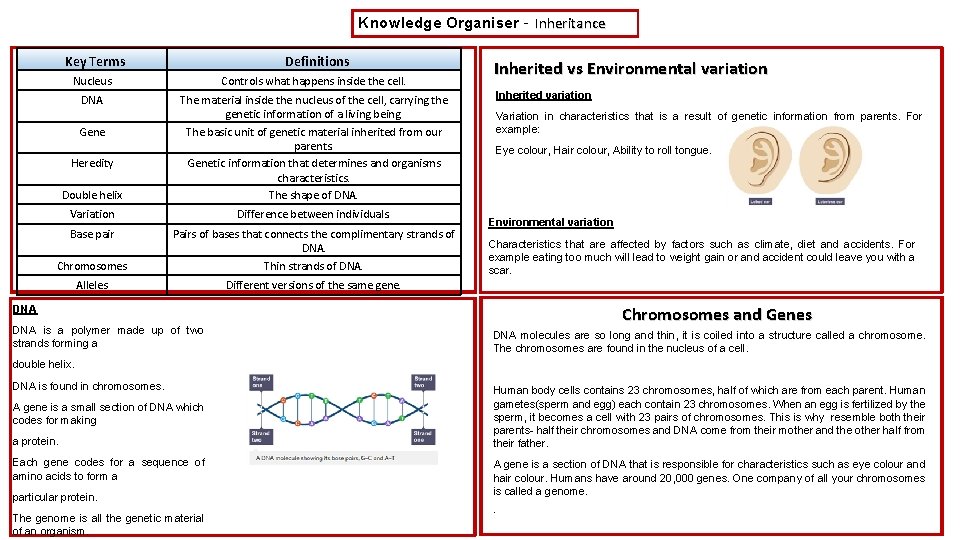
Knowledge Organiser – Inheritance Key Terms Definitions Nucleus Controls what happens inside the cell. DNA Double helix The material inside the nucleus of the cell, carrying the genetic information of a living being. The basic unit of genetic material inherited from our parents. Genetic information that determines and organisms characteristics. The shape of DNA. Variation Difference between individuals. Base pair Chromosomes Pairs of bases that connects the complimentary strands of DNA. Thin strands of DNA. Alleles Different versions of the same gene. Gene Heredity Inherited vs Environmental variation Inherited variation Variation in characteristics that is a result of genetic information from parents. For example: Eye colour, Hair colour, Ability to roll tongue. Environmental variation Characteristics that are affected by factors such as climate, diet and accidents. For example eating too much will lead to weight gain or and accident could leave you with a scar. Chromosomes and Genes DNA is a polymer made up of two strands forming a DNA molecules are so long and thin, it is coiled into a structure called a chromosome. The chromosomes are found in the nucleus of a cell. double helix. DNA is found in chromosomes. A gene is a small section of DNA which codes for making a protein. Each gene codes for a sequence of amino acids to form a particular protein. The genome is all the genetic material of an organism. Human body cells contains 23 chromosomes, half of which are from each parent. Human gametes(sperm and egg) each contain 23 chromosomes. When an egg is fertilized by the sperm, it becomes a cell with 23 pairs of chromosomes. This is why resemble both their parents- half their chromosomes and DNA come from their mother and the other half from their father. A gene is a section of DNA that is responsible for characteristics such as eye colour and hair colour. Humans have around 20, 000 genes. One company of all your chromosomes is called a genome. .
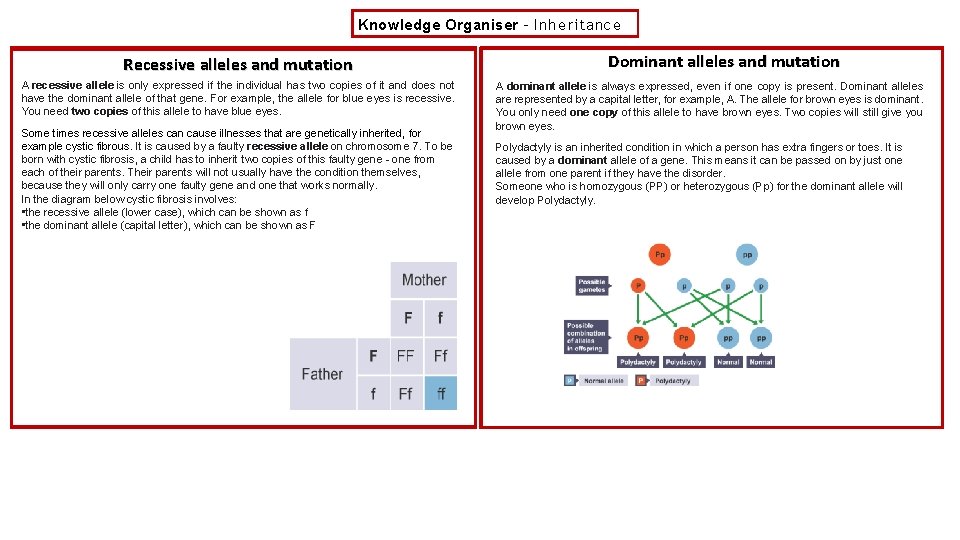
Knowledge Organiser – Inheritance Recessive alleles and mutation A recessive allele is only expressed if the individual has two copies of it and does not have the dominant allele of that gene. For example, the allele for blue eyes is recessive. You need two copies of this allele to have blue eyes. Some times recessive alleles can cause illnesses that are genetically inherited, for example cystic fibrous. It is caused by a faulty recessive allele on chromosome 7. To be born with cystic fibrosis, a child has to inherit two copies of this faulty gene - one from each of their parents. Their parents will not usually have the condition themselves, because they will only carry one faulty gene and one that works normally. In the diagram below cystic fibrosis involves: • the recessive allele (lower case), which can be shown as f • the dominant allele (capital letter), which can be shown as F Dominant alleles and mutation A dominant allele is always expressed, even if one copy is present. Dominant alleles are represented by a capital letter, for example, A. The allele for brown eyes is dominant. You only need one copy of this allele to have brown eyes. Two copies will still give you brown eyes. Polydactyly is an inherited condition in which a person has extra fingers or toes. It is caused by a dominant allele of a gene. This means it can be passed on by just one allele from one parent if they have the disorder. Someone who is homozygous (PP) or heterozygous (Pp) for the dominant allele will develop Polydactyly.