
Knowledge Organiser Evolution Natural selection There is variation
- Slides: 2
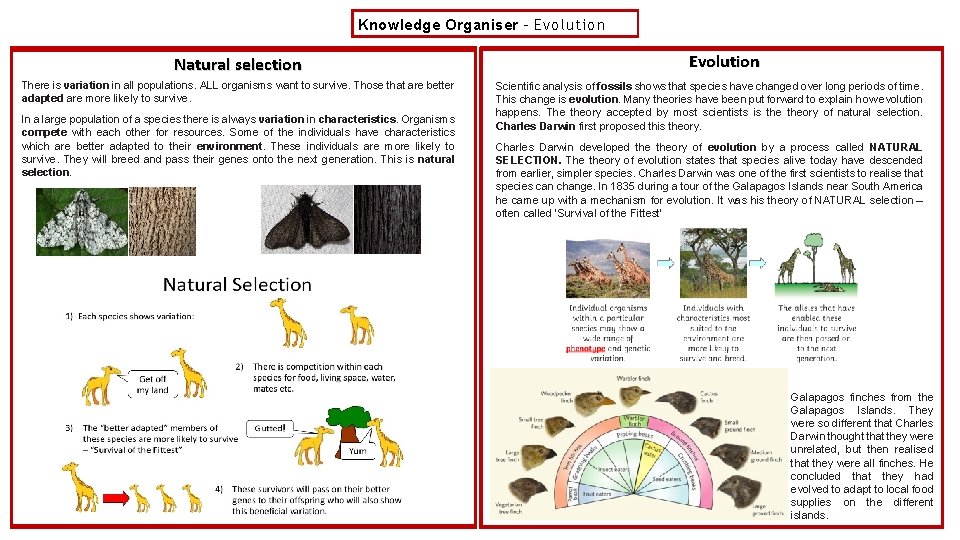
Knowledge Organiser – Evolution Natural selection There is variation in all populations. ALL organisms want to survive. Those that are better adapted are more likely to survive. In a large population of a species there is always variation in characteristics. Organisms compete with each other for resources. Some of the individuals have characteristics which are better adapted to their environment. These individuals are more likely to survive. They will breed and pass their genes onto the next generation. This is natural selection. Evolution Scientific analysis of fossils shows that species have changed over long periods of time. This change is evolution. Many theories have been put forward to explain how evolution happens. The theory accepted by most scientists is theory of natural selection. Charles Darwin first proposed this theory. Charles Darwin developed theory of evolution by a process called NATURAL SELECTION. The theory of evolution states that species alive today have descended from earlier, simpler species. Charles Darwin was one of the first scientists to realise that species can change. In 1835 during a tour of the Galapagos Islands near South America he came up with a mechanism for evolution. It was his theory of NATURAL selection – often called ‘Survival of the Fittest’ Galapagos finches from the Galapagos Islands. They were so different that Charles Darwin thought that they were unrelated, but then realised that they were all finches. He concluded that they had evolved to adapt to local food supplies on the different islands.
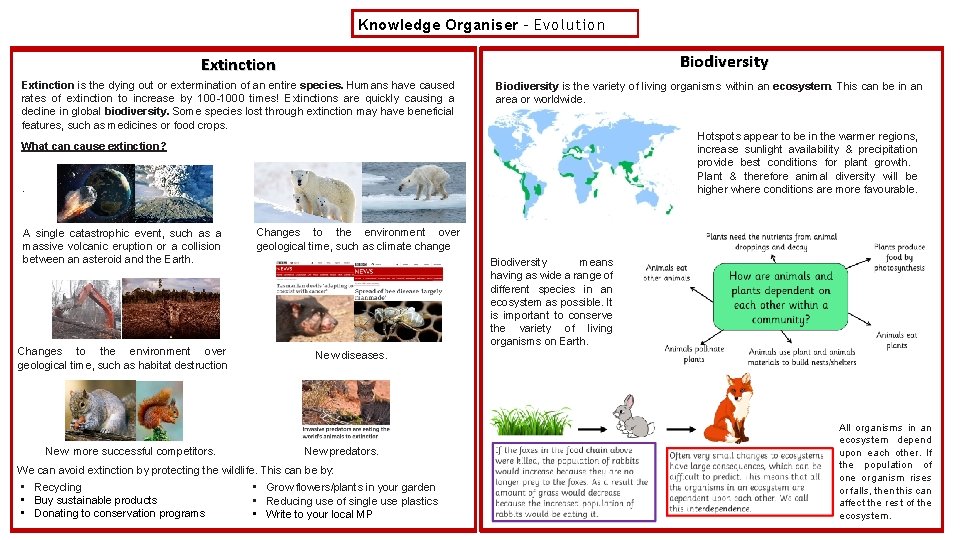
Knowledge Organiser – Evolution Biodiversity Extinction is the dying out or extermination of an entire species. Humans have caused rates of extinction to increase by 100 -1000 times! Extinctions are quickly causing a decline in global biodiversity. Some species lost through extinction may have beneficial features, such as medicines or food crops. Biodiversity is the variety of living organisms within an ecosystem. This can be in an area or worldwide. Hotspots appear to be in the warmer regions, increase sunlight availability & precipitation provide best conditions for plant growth. Plant & therefore animal diversity will be higher where conditions are more favourable. What can cause extinction? . A single catastrophic event, such as a massive volcanic eruption or a collision between an asteroid and the Earth. Changes to the environment over geological time, such as habitat destruction New more successful competitors. Changes to the environment over geological time, such as climate change Biodiversity means having as wide a range of different species in an ecosystem as possible. It is important to conserve the variety of living organisms on Earth. New diseases. New predators. We can avoid extinction by protecting the wildlife. This can be by: • Recycling • Buy sustainable products • Donating to conservation programs • Grow flowers/plants in your garden • Reducing use of single use plastics • Write to your local MP All organisms in an ecosystem depend upon each other. If the population of one organism rises or falls, then this can affect the rest of the ecosystem.