
Knowledge Organiser English Language Paper 2 Writers Viewpoints
- Slides: 2
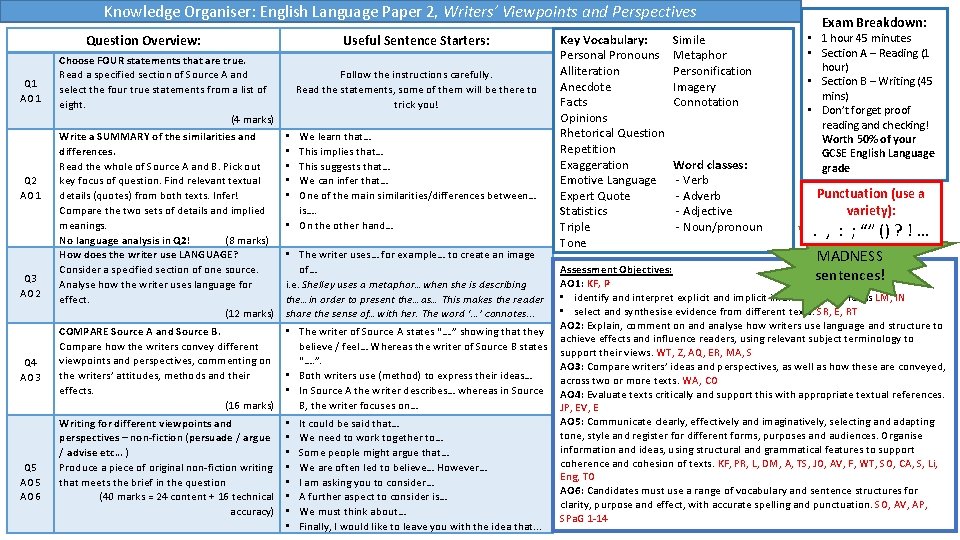
Knowledge Organiser: English Language Paper 2, Writers’ Viewpoints and Perspectives Question Overview: Q 1 AO 1 Q 2 AO 1 Q 3 AO 2 Q 4 AO 3 Q 5 AO 6 Useful Sentence Starters: Choose FOUR statements that are true. Read a specified section of Source A and select the four true statements from a list of eight. (4 marks) Follow the instructions carefully. Read the statements, some of them will be there to trick you! Write a SUMMARY of the similarities and differences. Read the whole of Source A and B. Pick out key focus of question. Find relevant textual details (quotes) from both texts. Infer! Compare the two sets of details and implied meanings. No language analysis in Q 2! (8 marks) How does the writer use LANGUAGE? Consider a specified section of one source. Analyse how the writer uses language for effect. (12 marks) • • • We learn that… This implies that… This suggests that… We can infer that… One of the main similarities/differences between… is…. • On the other hand… Writing for different viewpoints and perspectives – non-fiction (persuade / argue / advise etc… ) Produce a piece of original non-fiction writing that meets the brief in the question (40 marks = 24 content + 16 technical accuracy) • • • The writer uses… for example… to create an image of… i. e. Shelley uses a metaphor…when she is describing the…in order to present the…as… This makes the reader share the sense of…with her. The word ‘. . . ’ connotes. . . COMPARE Source A and Source B. • The writer of Source A states “…. ” showing that they Compare how the writers convey different believe / feel… Whereas the writer of Source B states viewpoints and perspectives, commenting on “…. ”. the writers’ attitudes, methods and their • Both writers use (method) to express their ideas… effects. • In Source A the writer describes… whereas in Source (16 marks) B, the writer focuses on… It could be said that… We need to work together to… Some people might argue that… We are often led to believe… However… I am asking you to consider… A further aspect to consider is… We must think about… Finally, I would like to leave you with the idea that. . . Key Vocabulary: Personal Pronouns Alliteration Anecdote Facts Opinions Rhetorical Question Repetition Exaggeration Emotive Language Expert Quote Statistics Triple Tone Simile Metaphor Personification Imagery Connotation Word classes: - Verb - Adverb - Adjective - Noun/pronoun Exam Breakdown: • 1 hour 45 minutes • Section A – Reading (1 hour) • Section B – Writing (45 mins) • Don’t forget proof reading and checking! Worth 50% of your GCSE English Language grade Punctuation (use a variety): . , : ; “” () ? ! … MADNESS Assessment Objectives: sentences! AO 1: KF, P • identify and interpret explicit and implicit information and ideas LM, IN • select and synthesise evidence from different texts. SR, E, RT AO 2: Explain, comment on and analyse how writers use language and structure to achieve effects and influence readers, using relevant subject terminology to support their views. WT, Z, AQ, ER, MA, S AO 3: Compare writers’ ideas and perspectives, as well as how these are conveyed, across two or more texts. WA, CO AO 4: Evaluate texts critically and support this with appropriate textual references. JP, EV, E AO 5: Communicate clearly, effectively and imaginatively, selecting and adapting tone, style and register for different forms, purposes and audiences. Organise information and ideas, using structural and grammatical features to support coherence and cohesion of texts. KF, PR, L, DM, A, TS, JO, AV, F, WT, SO, CA, S, Li, Eng, TO AO 6: Candidates must use a range of vocabulary and sentence structures for clarity, purpose and effect, with accurate spelling and punctuation. SO, AV, AP, SPa. G 1 -14
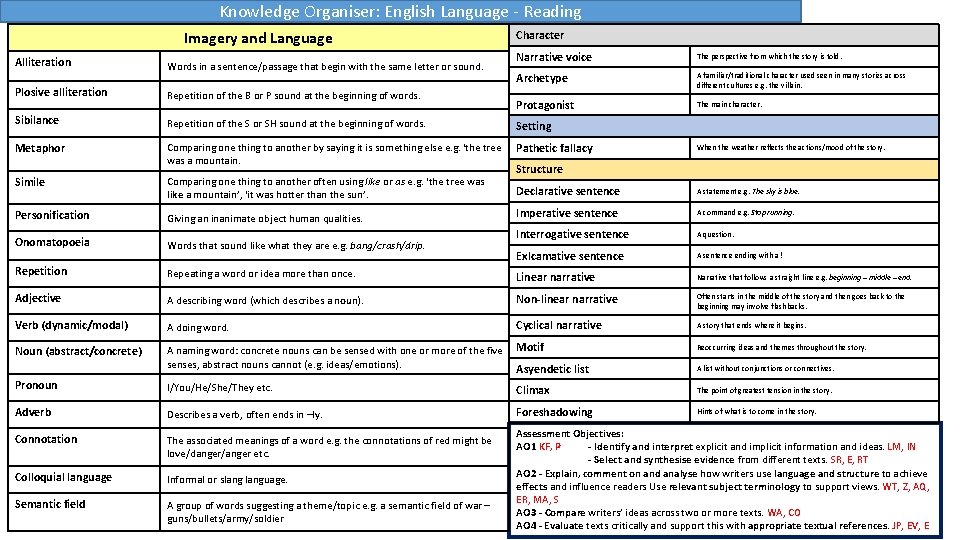
Knowledge Organiser: English Language - Reading Imagery and Language Alliteration Plosive alliteration Words in a sentence/passage that begin with the same letter or sound. Repetition of the B or P sound at the beginning of words. Character Narrative voice The perspective from which the story is told. Archetype A familiar/traditional character used seen in many stories across different cultures e. g. the villain. Protagonist The main character. Sibilance Repetition of the S or SH sound at the beginning of words. Setting Metaphor Comparing one thing to another by saying it is something else e. g. ‘the tree was a mountain. Pathetic fallacy Simile Comparing one thing to another often using like or as e. g. ‘the tree was like a mountain’, ‘it was hotter than the sun’. Personification Giving an inanimate object human qualities. Onomatopoeia Words that sound like what they are e. g. bang/crash/drip. When the weather reflects the actions/mood of the story. Structure Declarative sentence A statement e. g. The sky is blue. Imperative sentence A command e. g. Stop running. Interrogative sentence A question. Exlcamative sentence A sentence ending with a ! Repetition Repeating a word or idea more than once. Linear narrative Narrative that follows a straight line e. g. beginning – middle – end. Adjective A describing word (which describes a noun). Non-linear narrative Often starts in the middle of the story and then goes back to the beginning may involve flashbacks. Verb (dynamic/modal) A doing word. Cyclical narrative A story that ends where it begins. Noun (abstract/concrete) A naming word: concrete nouns can be sensed with one or more of the five senses, abstract nouns cannot (e. g. ideas/emotions). Motif Reoccurring ideas and themes throughout the story. Asyendetic list A list without conjunctions or connectives. Pronoun I/You/He/She/They etc. Climax The point of greatest tension in the story. Adverb Describes a verb, often ends in –ly. Foreshadowing Hints of what is to come in the story. Connotation The associated meanings of a word e. g. the connotations of red might be love/danger/anger etc. Colloquial language Informal or slanguage. Semantic field A group of words suggesting a theme/topic e. g. a semantic field of war – guns/bullets/army/soldier Assessment Objectives: AO 1 KF, P - Identify and interpret explicit and implicit information and ideas. LM, IN - Select and synthesise evidence from different texts. SR, E, RT AO 2 - Explain, comment on and analyse how writers use language and structure to achieve effects and influence readers Use relevant subject terminology to support views. WT, Z, AQ, ER, MA, S AO 3 - Compare writers’ ideas across two or more texts. WA, CO AO 4 - Evaluate texts critically and support this with appropriate textual references. JP, EV, E