
Knowledge Organiser Electricity Current Voltage and Resistance Key
- Slides: 2
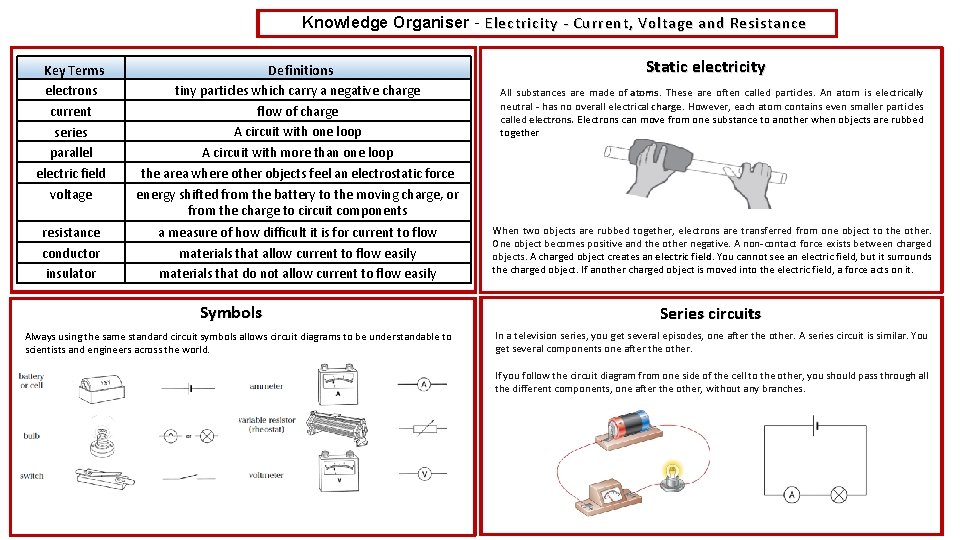
Knowledge Organiser – Electricity - Current, Voltage and Resistance Key Terms electrons current series parallel electric field voltage resistance conductor insulator Definitions tiny particles which carry a negative charge flow of charge A circuit with one loop Static electricity All substances are made of atoms. These are often called particles. An atom is electrically neutral - has no overall electrical charge. However, each atom contains even smaller particles called electrons. Electrons can move from one substance to another when objects are rubbed together A circuit with more than one loop the area where other objects feel an electrostatic force energy shifted from the battery to the moving charge, or from the charge to circuit components a measure of how difficult it is for current to flow materials that allow current to flow easily materials that do not allow current to flow easily Symbols Always using the same standard circuit symbols allows circuit diagrams to be understandable to scientists and engineers across the world. When two objects are rubbed together, electrons are transferred from one object to the other. One object becomes positive and the other negative. A non-contact force exists between charged objects. A charged object creates an electric field. You cannot see an electric field, but it surrounds the charged object. If another charged object is moved into the electric field, a force acts on it. Series circuits In a television series, you get several episodes, one after the other. A series circuit is similar. You get several components one after the other. If you follow the circuit diagram from one side of the cell to the other, you should pass through all the different components, one after the other, without any branches.
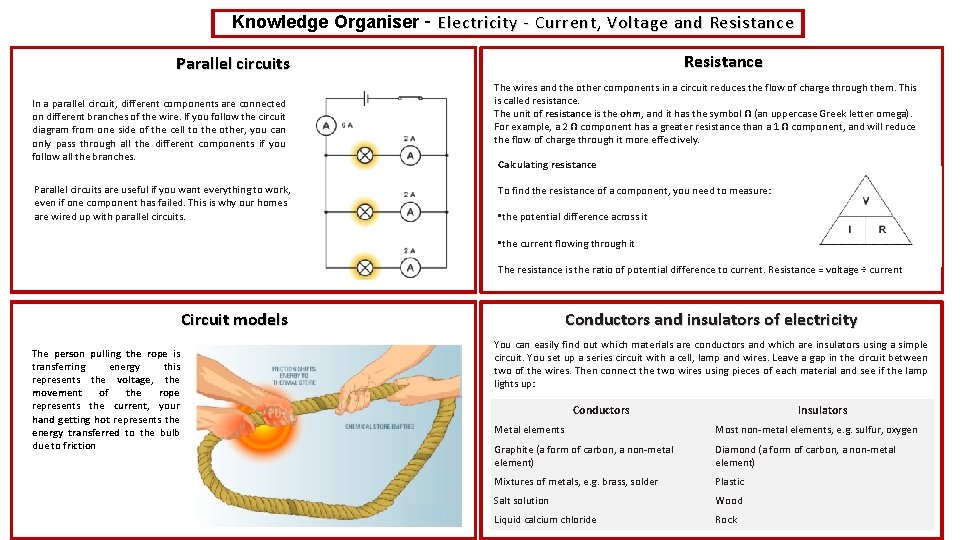
Knowledge Organiser – Electricity - Current, Voltage and Resistance Parallel circuits In a parallel circuit, different components are connected on different branches of the wire. If you follow the circuit diagram from one side of the cell to the other, you can only pass through all the different components if you follow all the branches. Parallel circuits are useful if you want everything to work, even if one component has failed. This is why our homes are wired up with parallel circuits. The wires and the other components in a circuit reduces the flow of charge through them. This is called resistance. The unit of resistance is the ohm, and it has the symbol Ω (an uppercase Greek letter omega). For example, a 2 Ω component has a greater resistance than a 1 Ω component, and will reduce the flow of charge through it more effectively. Calculating resistance To find the resistance of a component, you need to measure: • the potential difference across it • the current flowing through it The resistance is the ratio of potential difference to current. Resistance = voltage ÷ current Conductors and insulators of electricity Circuit models The person pulling the rope is transferring energy this represents the voltage, the movement of the rope represents the current, your hand getting hot represents the energy transferred to the bulb due to friction You can easily find out which materials are conductors and which are insulators using a simple circuit. You set up a series circuit with a cell, lamp and wires. Leave a gap in the circuit between two of the wires. Then connect the two wires using pieces of each material and see if the lamp lights up: Conductors Insulators Metal elements Most non-metal elements, e. g. sulfur, oxygen Graphite (a form of carbon, a non-metal element) Diamond (a form of carbon, a non-metal element) Mixtures of metals, e. g. brass, solder Plastic Salt solution Wood Liquid calcium chloride Rock