
Knowledge Organiser B 3 Infection and response Viral
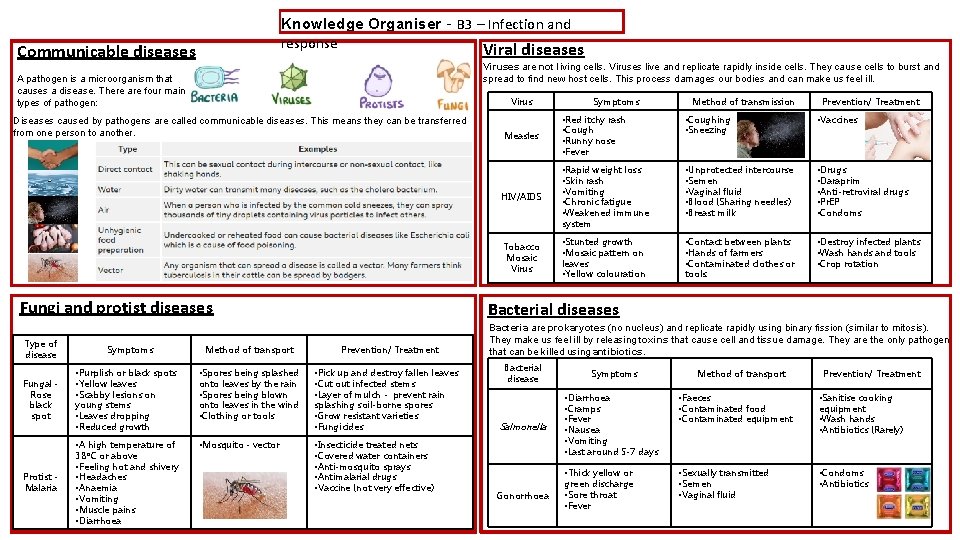
Knowledge Organiser – B 3 – Infection and response Viral diseases Communicable diseases Viruses are not living cells. Viruses live and replicate rapidly inside cells. They cause cells to burst and spread to find new host cells. This process damages our bodies and can make us feel ill. A pathogen is a microorganism that causes a disease. There are four main types of pathogen: Virus Diseases caused by pathogens are called communicable diseases. This means they can be transferred from one person to another. Measles HIV/AIDS Symptoms Fungi and protist diseases Type of disease Fungal Rose black spot Symptoms • Purplish or black spots • Yellow leaves • Scabby lesions on young stems • Leaves dropping • Reduced growth • A high temperature of Protist Malaria 38⁰C or above • Feeling hot and shivery • Headaches • Anaemia • Vomiting • Muscle pains • Diarrhoea Method of transport • Spores being splashed onto leaves by the rain • Spores being blown onto leaves in the wind • Clothing or tools • Mosquito - vector Prevention/ Treatment • Red itchy rash • Cough • Runny nose • Fever • Coughing • Sneezing • Vaccines • Rapid weight loss • Skin rash • Vomiting • Chronic fatigue • Weakened immune • Unprotected intercourse • Semen • Vaginal fluid • Blood (Sharing needles) • Breast milk • Drugs • Daraprim • Anti-retroviral drugs • Pr. EP • Condoms • Stunted growth • Mosaic pattern on • Contact between plants • Hands of farmers • Contaminated clothes or • Destroy infected plants • Wash hands and tools • Crop rotation system Tobacco Mosaic Virus Method of transmission leaves • Yellow colouration tools. Bacterial diseases Prevention/ Treatment • Pick up and destroy fallen leaves • Cut out infected stems • Layer of mulch - prevent rain splashing soil-borne spores • Grow resistant varieties • Fungicides • Insecticide treated nets • Covered water containers • Anti-mosquito sprays • Antimalarial drugs • Vaccine (not very effective) Bacteria are prokaryotes (no nucleus) and replicate rapidly using binary fission (similar to mitosis). They make us feel ill by releasing toxins that cause cell and tissue damage. They are the only pathogen that can be killed using antibiotics. Bacterial disease Salmonella Gonorrhoea Symptoms Method of transport Prevention/ Treatment • Diarrhoea • Cramps • Fever • Nausea • Vomiting • Last around 5 -7 days • Faeces • Contaminated food • Contaminated equipment • Sanitise cooking • Thick yellow or • Sexually transmitted • Semen • Vaginal fluid • Condoms • Antibiotics green discharge • Sore throat • Fever equipment • Wash hands • Antibiotics (Rarely)

Human defence system Knowledge Organiser – B 3 – Infection and response Vaccination and monoclonal antibodies Vaccines allow a dead or altered form of the disease causing pathogen to be introduced into the body, which contain a specific antigen. This causes the immune system, specifically the white blood cells, to produce complementary antibodies, which target and attach to the antigen. Production of monoclonal antibodies Monoclonal antibodies are identical copies of one type of antibody. Pregnancy test kits use monoclonal antibodies. These have been designed to bind with a hormone called HCG which is found only in the urine of pregnant women. Cancerous cells have antigens. Monoclonal antibodies can be designed to bind specifically with these antigens. When injected into a person's body, the monoclonal antibodies will bind with these cancer cells and clump them together. This makes it easier to identify a cancerous tumour, which can then be treated or removed. Antibiotics, painkillers and drug discovery Painkillers are chemicals that relieve the symptoms but do not kill the pathogens. Common examples include paracetamol and aspirin, and they can relieve a headache or a sore throat. Antibiotics are substances that slow down or stop the growth of bacteria. They are commonly prescribed medicines, examples include penicillin and amoxicillin. The heart drug digitalis originates from foxgloves. The painkiller aspirin originates from willow. Penicillin was discovered by Alexander Fleming from the Penicillium mould. Plant disease Plants can be infected by a range of viral (TMV), bacterial (Agrobacterium) and fungal pathogens (Rose black spot) as well as by insects (Aphids). Plants can be damaged by a range of ion deficiency conditions: • stunted growth caused by nitrate deficiency • chlorosis caused by magnesium deficiency. New drugs are extensively tested for toxicity, efficacy and dose. Preclinical testing is done in a laboratory using cells, tissues and live animals. Clinical trials use healthy volunteers and patients. Very low doses of the Physical defence responses to resist invasion of microorganisms: • Cellulose cell walls. drug are given at the start of the clinical trial. If the drug is safe, further clinical trials are carried • Tough waxy cuticle on leaves. out to find the optimum dose. In double blind trials, some patients are given a placebo. • Layers of dead cells around stems (bark on trees) which fall off. Chemical plant defence responses. Commonly prescribed antibiotics are becoming less effective due • Antibacterial chemicals. to a number of reasons: • Poisons to deter herbivores. • Overuse of antibiotics Mechanical adaptations. • Failing to complete the fully prescribed course by a doctor Binary • Thorns and hairs deter animals. • Use of antibiotics in farming fission • Leaves which droop or curl when touched. These can lead to the effectiveness of antibiotics being reduced, • Mimicry to trick animals. and the incidence of antibiotic resistance increasing. These bacteria are commonly known as superbugs. Nitrate ions needed for protein synthesis and therefore growth, and magnesium ions needed to make chlorophyll.
- Slides: 2