
Knowledge Organiser B 1 Cells Cell Types Light
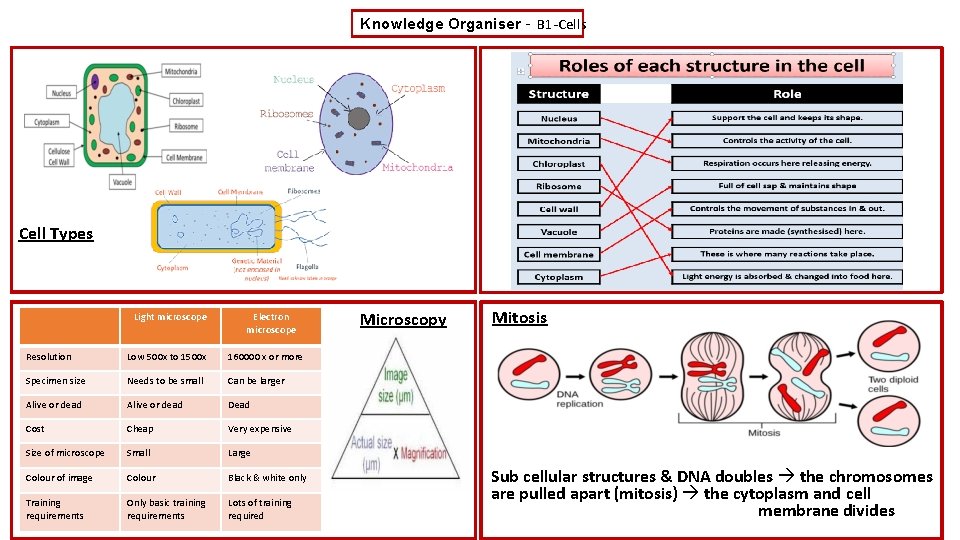
Knowledge Organiser – B 1 -Cells Cell Types Light microscope Electron microscope Resolution Low 500 x to 1500 x 160000 x or more Specimen size Needs to be small Can be larger Alive or dead Dead Cost Cheap Very expensive Size of microscope Small Large Colour of image Colour Black & white only Training requirements Only basic training requirements Lots of training required Microscopy Mitosis Sub cellular structures & DNA doubles the chromosomes are pulled apart (mitosis) the cytoplasm and cell membrane divides

Knowledge Organiser –B 1 -Cells Diffusion Stem cells are undifferentiated and so can become any cell type. They offer a potential cure for paralysis & diabetes as the faulty or damaged cells can be replaced with stem cells that have been made to differentiate into the required cell type. Stem cells come from adult bone marrow or embryos. In plants, the meristem tissue (highlighted in red) always behaves like stem cells Osmosis The movement of water molecules from an area of high water potential to an area of low water potential across a partially permeable membrane Cells that do lots of diffusion need a large surface area. So is the largest cube or smallest cube the best for diffusion? The blue circles represent oxygen molecules. They are moving from high concentration (outside the cell) to low concentration (inside the cell). Microscopy Active transport moves the solute (e. g. sugar) from lower to higher concentration (against the concentration gradient). This requires energy from respiration – so cells that carry out active transport tend to have a lot of mitochondria.
- Slides: 2