
Knowledge Organiser AngloSaxon and Norman England Key Topic
- Slides: 1
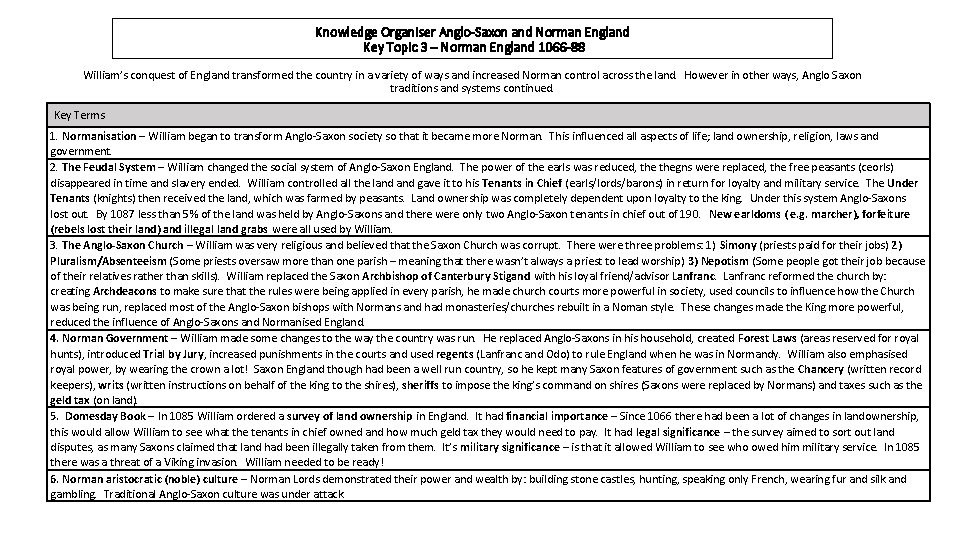
Knowledge Organiser Anglo-Saxon and Norman England Key Topic 3 – Norman England 1066 -88 William’s conquest of England transformed the country in a variety of ways and increased Norman control across the land. However in other ways, Anglo Saxon traditions and systems continued. Key Terms 1. Normanisation – William began to transform Anglo-Saxon society so that it became more Norman. This influenced all aspects of life; land ownership, religion, laws and government. 2. The Feudal System – William changed the social system of Anglo-Saxon England. The power of the earls was reduced, thegns were replaced, the free peasants (ceorls) disappeared in time and slavery ended. William controlled all the land gave it to his Tenants in Chief (earls/lords/barons) in return for loyalty and military service. The Under Tenants (knights) then received the land, which was farmed by peasants. Land ownership was completely dependent upon loyalty to the king. Under this system Anglo-Saxons lost out. By 1087 less than 5% of the land was held by Anglo-Saxons and there were only two Anglo-Saxon tenants in chief out of 190. New earldoms ( e. g. marcher), forfeiture (rebels lost their land) and illegal land grabs were all used by William. 3. The Anglo-Saxon Church – William was very religious and believed that the Saxon Church was corrupt. There were three problems: 1) Simony (priests paid for their jobs) 2) Pluralism/Absenteeism (Some priests oversaw more than one parish – meaning that there wasn’t always a priest to lead worship) 3) Nepotism (Some people got their job because of their relatives rather than skills). William replaced the Saxon Archbishop of Canterbury Stigand with his loyal friend/advisor Lanfranc reformed the church by: creating Archdeacons to make sure that the rules were being applied in every parish, he made church courts more powerful in society, used councils to influence how the Church was being run, replaced most of the Anglo-Saxon bishops with Normans and had monasteries/churches rebuilt in a Noman style. These changes made the King more powerful, reduced the influence of Anglo-Saxons and Normanised England. 4. Norman Government – William made some changes to the way the country was run. He replaced Anglo-Saxons in his household, created Forest Laws (areas reserved for royal hunts), introduced Trial by Jury, increased punishments in the courts and used regents (Lanfranc and Odo) to rule England when he was in Normandy. William also emphasised royal power, by wearing the crown a lot! Saxon England though had been a well run country, so he kept many Saxon features of government such as the Chancery (written record keepers), writs (written instructions on behalf of the king to the shires), sheriffs to impose the king’s command on shires (Saxons were replaced by Normans) and taxes such as the geld tax (on land). 5. Domesday Book – In 1085 William ordered a survey of land ownership in England. It had financial importance – Since 1066 there had been a lot of changes in landownership, this would allow William to see what the tenants in chief owned and how much geld tax they would need to pay. It had legal significance – the survey aimed to sort out land disputes, as many Saxons claimed that land had been illegally taken from them. It’s military significance – is that it allowed William to see who owed him military service. In 1085 there was a threat of a Viking invasion. William needed to be ready! 6. Norman aristocratic (noble) culture – Norman Lords demonstrated their power and wealth by: building stone castles, hunting, speaking only French, wearing fur and silk and gambling. Traditional Anglo-Saxon culture was under attack.