
Knowledge Organiser AC 1 1 Structure of the
- Slides: 1
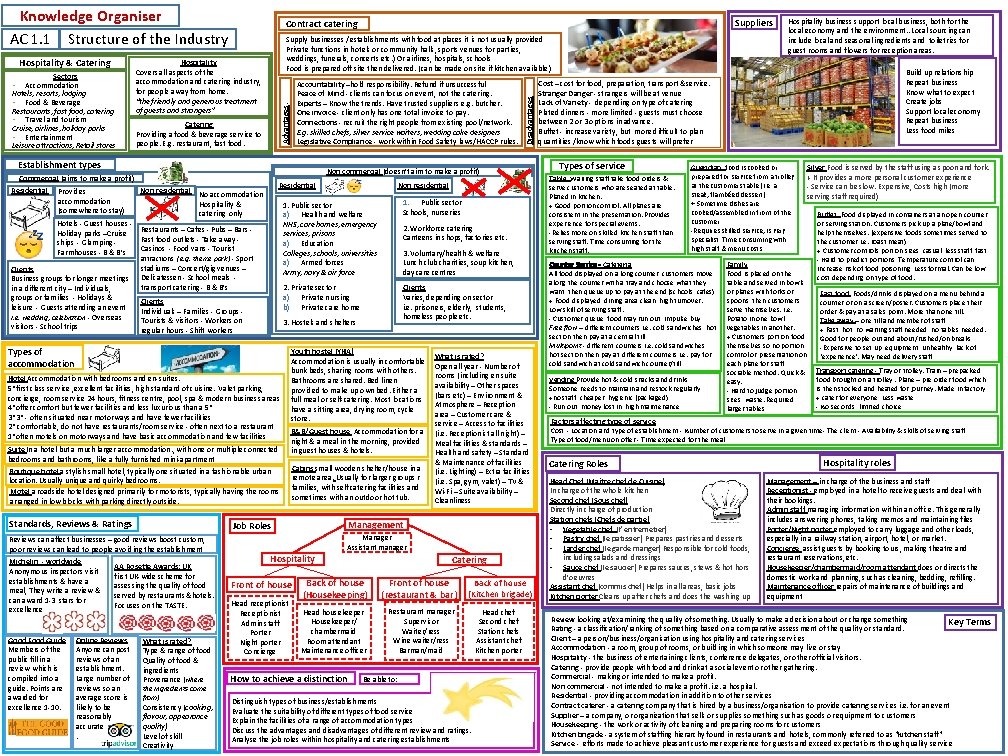
Knowledge Organiser AC 1. 1 Structure of the Industry Hospitality Covers all aspects of the accommodation and catering industry, for people away from home. “the friendly and generous treatment of guests and strangers” Accountability –hold responsibility. Refund if unsuccessful Peace of Mind - clients can focus on event, not the catering. Experts – Know the trends. Have trusted suppliers e. g. butcher. One invoice - client only has one total invoice to pay. Connections - recruit the right people from existing pool/network. E. g. skilled chefs, silver service waiters, wedding cake designers Legislative Compliance - work within Food Safety laws/HACCP rules. Catering Providing a food & beverage service to people. E. g. restaurant, fast food. Establishment types Non commercial (doesn’t aim to make a profit) Commercial (aims to make a profit) Residential Provides accommodation (somewhere to stay) Hotels - Guest houses Holiday parks –Cruise ships - Glamping Farmhouses - B & B’s Clients Business groups for longer meetings in a different city – Individuals, groups or families - Holidays & leisure - Guests attending an event i. e. wedding, celebration - Overseas visitors - School trips Non residential Restaurants – Cafes - Pubs – Bars Fast food outlets - Take away Casinos - Food vans - Tourist attractions (e. g. theme park) - Sport stadiums – Concert/gig venues – Delicatessen - School meals transport catering - B & B’s Clients Individuals – Families - Groups Tourists & visitors - Workers on regular hours - Shift workers 1. Public sector a) Health and welfare NHS, care homes, emergency services, prisons a) Education Colleges, schools, universities a) Armed forces Army, navy & air force 1. 2. Private sector a) Private nursing b) Private care home Clients Varies, depending on sector i. e. prisoners, elderly, students, homeless people etc. Suite In a hotel but a much larger accommodation. , with one or multiple connected bedrooms and bathrooms, like a fully furnished mini-apartment Boutique hotel a stylish small hotel, typically one situated in a fashionable urban location. Usually unique and quirky bedrooms. Motel a roadside hotel designed primarily for motorists, typically having the rooms arranged in low blocks with parking directly outside. Good Food Guide Members of the public fill in a review which is compiled into a guide. Points are awarded for excellence 1 -10. AA Rosette Awards: UK first UK-wide scheme for assessing the quality of food served by restaurants &hotels. Focuses on the TASTE. Online Reviews Anyone can post reviews of an establishment. Large number of reviews so an average score is likely to be reasonably accurate. What is rated? Type & range of food Quality of food & ingredients Provenance (where the ingredients come from) Consistency (cooking, flavour, appearance quality) Level of skill Creativity 2. Workforce catering Canteens in shops, factories etc. 3. Voluntary/health & welfare Lunch club charities, soup kitchen, day care centres Youth hostel (YHA) Accommodation is usually in comfortable bunk beds, sharing rooms with others. Bathrooms are shared. Bed linen provided to make up own bed. Either a full meal or self-catering. Most locations have a sitting area, drying room, cycle store. B&B/Guest house Accommodation for a night & a meal in the morning, provided in guest houses & hotels. Cabins small wooden shelter/house in a remote area. Usually for larger groups r families, with self catering facilities and sometimes with an outdoor hot tub. What is rated? Open all year - Number of rooms (including en suite availability – Other spaces (bars etc) – Environment & Atmosphere – Reception area – Customer care & service – Access to facilities (i. e. Receptionist all night) – Meal facilities & standards – Health and safety – Standard & Maintenance of facilities (i. e. Lighting) – Extra facilities (i. e. Spa, gym, valet) – TV & Wi-Fi – Suite availability – Cleanliness Management Job Roles Reviews can affect businesses – good reviews boost custom, poor reviews can lead to people avoiding the establishment Public sector Schools, nurseries 3. Hostels and shelters Hotel Accommodation with bedrooms and en-suites. 5*first class service , excellent facilities, high standard of cuisine. Valet parking, concierge, room service 24 hours, fitness centre, pool, spa & modern business areas 4*offer comfort but fewer facilities and less luxurious than a 5* 3*3* - often situated near motorways and have fewer facilities 2* comfortable, do not have restaurants/room service - often next to a restaurant 1*often motels on motorways and have basic accommodation and few facilities Standards, Reviews & Ratings Non residential Residential No accommodation Hospitality & catering only Types of accommodation Michelin - worldwide Anonymous inspectors visit establishments & have a meal, They write a review & can award 1 -3 stars for excellence. Disadvantages Sectors • Accommodation Hotels, resorts, lodging • Food & Beverage Restaurants, fast food, catering • Travel and tourism Cruise, airlines, holiday parks • Entertainment Leisure attractions, Retail stores Supply businesses /establishments with food at places it is not usually provided Private functions in hotels or community halls, sports venues for parties, weddings, funerals, concerts etc. ) Or airlines, hospitals, schools Food is prepared off site then delivered. (can be made on site if kitchen available) Advantages. Hospitality & Catering Suppliers Contract catering Manager Assistant manager Hospitality Front of house Head receptionist Receptionist Admin staff Porter Night porter Concierge Catering Back of house (Housekeeping) Front of house (restaurant & bar) Back of house (Kitchen brigade) Head housekeeper Housekeeper/ chambermaid Room attendant Maintenance officer Restaurant manager Supervisor Waiter/ress Wine waiter/ress Barman/maid Head chef Second chef Station chefs Assistant chef Kitchen porter How to achieve a distinction Be able to: Distinguish types of business/establishments Evaluate the suitability of different types of food service Explain the facilities of a range of accommodation types Discuss the advantages and disadvantages of different review and ratings. Analyse the job roles within hospitality and catering establishments Hospitality business support local business, both for the local economy and the environment. . Local sourcing can include local and seasonal ingredients and toiletries for guest rooms and flowers for reception areas. Build up relationship Repeat business Know what to expect Create jobs Support local economy Repeat business Less food miles Cost – cost for food, preparation, transport &service. Stranger Danger - strangers will be at venue Lack of Variety - depending on type of catering Plated dinners - more limited - guests must choose between 2 or 3 options in advance. Buffet - increase variety, but more difficult to plan quantities /know which foods guests will prefer Types of service Table: Waiting staff take food orders & serve customers who are seated at table. Plated in kitchen. + Good portion control. All plates are consistent in the presentation. Provides experience for special events. -Relies more on skilled kitchen staff than serving staff. Time consuming for the kitchen staff. Gueridian: food is cooked or prepared for service from a trolley at the customers table (i. e. a steak, flambéed dessert) + Sometime dishes are cooked/assembled in front of the customer. -Requires skilled service, is very specialist. Time consuming with high staff & menu costs. Counter Service - Cafeteria All food displayed on a long counter, customers move along the counter with a tray and choose what they want, then queue up to pay at the end (schools, cafes) + Food displayed, dining area clean, high turnover. Low skill of serving staff. - Customer queue, food may run out, impulse buy Free flow – different counters i. e. cold sandwiches, hot section then pay at a central till Multipoint - different counters i. e. cold sandwiches, hot section then pay at different counters i. e. pay for cold sandwich at cold sandwich counter/till Vending Provide hot & cold snacks and drinks Someone needs to maintain and restock regularly +no staff, cheaper, hygienic (packaged) - Run out, money lost in, high maintenance Silver Food is served by the staff using a spoon and fork. + It provides a more personal customer experience - Service can be slow. Expensive, Costs high (more serving staff required) Family Food is placed on the table and served in bowls or plates with forks or spoons, then customers serve themselves. i. e. Potato in one bowl, vegetables in another. + Customers portion food themselves so no portion control or presentation on each plate for staff, sociable method. Quick & easy. - Hard to judge portion sizes, waste. Required larger tables Buffet: Food displayed in containers at an open counter or serving station. Customers pick up a plate/bowl and help themselves. (expensive foods sometimes served to the customer i. e. roast meat) + Customer controls portion sizes, casual, less staff, fast - Hard to predict portions, Temperature control can increase risk of food poisoning, Less formal. Can be low cost depending on type of food. Fast food Foods/drinks displayed on a menu behind a counter or on a screen/poster. Customers place their order & pay at a sales point. More than one till. Take away – one till and member of staff + Fast, hot, no waiting staff needed, no tables needed. Good for people out and about/rushed/on breaks -Expensive to set up, equipment, unhealthy, lack of ‘experience’. May need delivery staff Transport catering - Tray or trolley. Train – prepacked food brought on a trolley. Plane – pre order food which is then stocked and heated for journey. Made in factory + cater for everyone, Less waste - No seconds, limited choice Factors affecting type of service Cost - Location and type of establishment - Number of customers to serve in a given time- The client - Availability & skills of serving staff Type of food/menu on offer - Time expected for the meal Catering Roles Head Chef (Maître chef de Cuisine) In charge of the whole kitchen Second chef (Sous chef) Directly in charge of production Station chefs (Chefs de partie) - Vegetable chef (l’ entremetier) - Pastry chef (le patissier) Prepares pastries and desserts - Larder chef (le garde manger) Responsible for cold foods, including salads and dressings - Sauce chef (le saucier) Prepares sauces, stews & hot hors d’oeuvres Assistant chef (commis chef) Helps in all areas, basic jobs Kitchen porter Cleans up after chefs and does the washing up Hospitality roles Management – in charge of the business and staff Receptionist - employed in a hotel to receive guests and deal with their bookings. Admin staff managing information within an office. This generally includes answering phones, taking memos and maintaining files Porter/Night porter employed to carry luggage and other loads, especially in a railway station, airport, hotel, or market. Concierge assist guests by booking tours, making theatre and restaurant reservations, etc. Housekeeper/chambermaid/room attendant does or directs the domestic work and planning, such as cleaning, bedding, refilling. Maintenance officer repairs of maintenance of buildings and equipment Review looking at/examining the quality of something. Usually to make a decision about or change something Key Terms Rating - a classification/ranking of something based on a comparative assessment of the quality or standard. Client – a person/business/organisation using hospitality and catering services Accommodation - a room, group of rooms, or building in which someone may live or stay Hospitality - the business of entertaining clients, conference delegates, or other official visitors. Catering - provide people with food and drink at a social event or other gathering. Commercial - making or intended to make a profit. Non commercial - not intended to make a profit. i. e. a hospital. Residential - providing accommodation in addition to other services Contract caterer - a catering company that is hired by a business/organisation to provide catering services i. e. for an event Supplier – a company, or organization that sells or supplies something such as goods or equipment to customers Housekeeping - the work or activity of cleaning and preparing rooms for customers Kitchen brigade - a system of staffing hierarchy found in restaurants and hotels, commonly referred to as "kitchen staff" Service - efforts made to achieve pleasant customer experience for guests and exceed expectations through quality service