
Knowledge Organiser A 1 Factors affecting Health Wellbeing
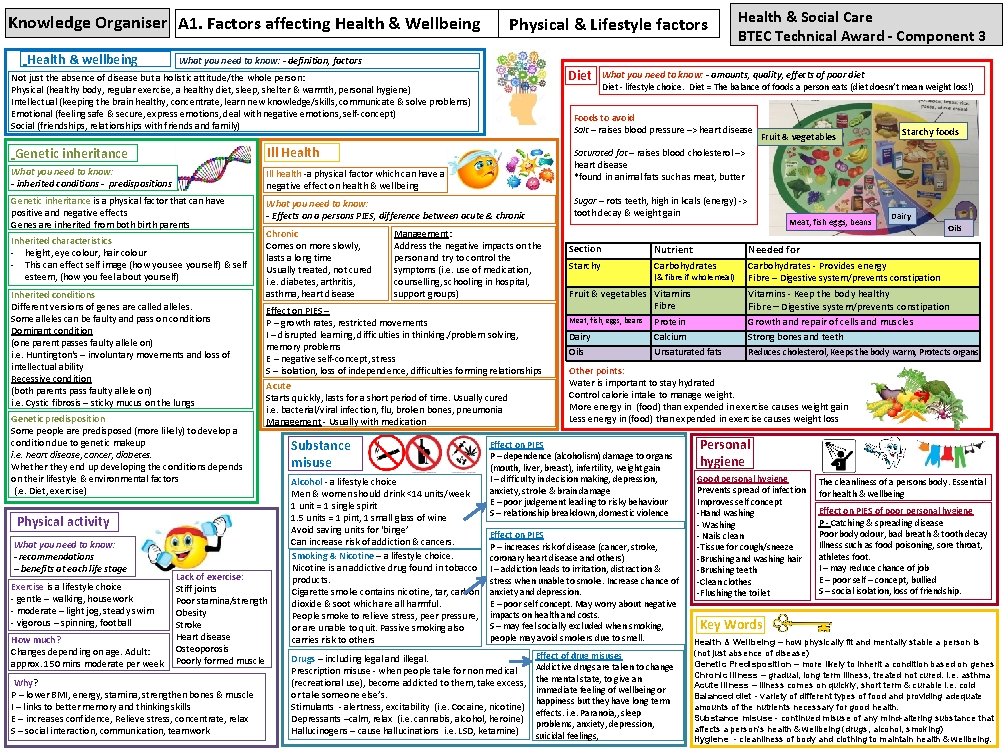
Knowledge Organiser A 1. Factors affecting Health & Wellbeing Health & wellbeing Physical & Lifestyle factors What you need to know: - definition, factors Diet Not just the absence of disease but a holistic attitude/the whole person: Physical (healthy body, regular exercise, a healthy diet, sleep, shelter & warmth, personal hygiene) Intellectual (keeping the brain healthy, concentrate, learn new knowledge/skills, communicate & solve problems) Emotional (feeling safe & secure, express emotions, deal with negative emotions, self-concept) Social (friendships, relationships with friends and family) Ill health -a physical factor which can have a negative effect on health & wellbeing Genetic inheritance is a physical factor that can have positive and negative effects Genes are inherited from both birth parents What you need to know: - Effects on a persons PIES, difference between acute & chronic Inherited characteristics - height, eye colour, hair colour - This can effect self image (how you see yourself) & self esteem, (how you feel about yourself) Inherited conditions Different versions of genes are called alleles. Some alleles can be faulty and pass on conditions Dominant condition (one parent passes faulty allele on) i. e. Huntington's – involuntary movements and loss of intellectual ability Recessive condition (both parents pass faulty allele on) i. e. Cystic fibrosis – sticky mucus on the lungs Genetic predisposition Some people are predisposed (more likely) to develop a condition due to genetic makeup i. e. heart disease, cancer, diabetes. Whether they end up developing the conditions depends on their lifestyle & environmental factors (. e. Diet, exercise) Effect on PIES – P – growth rates, restricted movements I – disrupted learning, difficulties in thinking. /problem solving, memory problems E – negative self-concept, stress S – isolation, loss of independence, difficulties forming relationships Acute Starts quickly, lasts for a short period of time. Usually cured i. e. bacterial/viral infection, flu, broken bones, pneumonia Management - Usually with medication Physical activity What you need to know: - recommendations – benefits at each life stage Exercise is a lifestyle choice - gentle – walking, housework - moderate – light jog, steady swim - vigorous – spinning, football How much? Changes depending on age. Adult: approx. 150 mins moderate per week Lack of exercise: Stiff joints Poor stamina/strength Obesity Stroke Heart disease Osteoporosis Poorly formed muscle Why? P – lower BMI, energy, stamina, strengthen bones & muscle I – links to better memory and thinking skills E – increases confidence, Relieve stress, concentrate, relax S – social interaction, communication, teamwork Alcohol - a lifestyle choice Men & women should drink <14 units/week 1 unit = 1 single spirit 1. 5 units = 1 pint, 1 small glass of wine Avoid saving units for ‘binge’ Can increase risk of addiction & cancers. Smoking & Nicotine – a lifestyle choice. Nicotine is an addictive drug found in tobacco products. Cigarette smoke contains nicotine, tar, carbon dioxide & soot which are all harmful. People smoke to relieve stress, peer pressure, or are unable to quit. Passive smoking also carries risk to others Fruit & vegetables Sugar – rots teeth, high in kcals (energy) -> tooth decay & weight gain Management: Address the negative impacts on the person and try to control the symptoms (i. e. use of medication, counselling, schooling in hospital, support groups) Substance misuse Diet - lifestyle choice. Diet = The balance of foods a person eats (diet doesn’t mean weight loss!) Starchy foods Saturated fat – raises blood cholesterol –> heart disease *found in animal fats such as meat, butter What you need to know: - inherited conditions - predispositions Chronic Comes on more slowly, lasts a long time Usually treated, not cured i. e. diabetes, arthritis, asthma, heart disease What you need to know: - amounts, quality, effects of poor diet Foods to avoid Salt – raises blood pressure –> heart disease Ill Health Genetic inheritance Health & Social Care BTEC Technical Award - Component 3 Section Starchy Nutrient Carbohydrates (& fibre if wholemeal) Fruit & vegetables Vitamins Fibre Meat, fish, eggs, beans Dairy Oils Protein Calcium Unsaturated fats Dairy Oils Needed for Carbohydrates - Provides energy Fibre – Digestive system/prevents constipation Vitamins - Keep the body healthy Fibre – Digestive system/prevents constipation Growth and repair of cells and muscles Strong bones and teeth Reduces cholesterol, Keeps the body warm, Protects organs Other points: Water is important to stay hydrated Control calorie intake to manage weight. More energy in (food) than expended in exercise causes weight gain Less energy in (food) than expended in exercise causes weight loss Effect on PIES P – dependence (alcoholism) damage to organs (mouth, liver, breast), infertility, weight gain I – difficulty in decision making, depression, anxiety, stroke & brain damage E – poor judgement leading to risky behaviour S – relationship breakdown, domestic violence Effect on PIES P – increases risk of disease (cancer, stroke, coronary heart disease and others) I – addiction leads to irritation, distraction & stress when unable to smoke. Increase chance of anxiety and depression. E – poor self concept. May worry about negative impacts on health and costs. S – may feel socially excluded when smoking, people may avoid smokers due to smell. Drugs – including legal and illegal. Prescription misuse - when people take for non medical (recreational use), become addicted to them, take excess, or take someone else’s. Stimulants - alertness, excitability (i. e. Cocaine, nicotine) Depressants –calm, relax (i. e. cannabis, alcohol, heroine) Hallucinogens – cause hallucinations i. e. LSD, ketamine) Meat, fish eggs, beans Effect of drug misuses Addictive drugs are taken to change the mental state, to give an immediate feeling of wellbeing or happiness but they have long term effects. i. e. Paranoia, , sleep problems, anxiety, depression, suicidal feelings, Personal hygiene Good personal hygiene Prevents spread of infection Improves self concept -Hand washing - Washing - Nails clean -Tissue for cough/sneeze -Brushing and washing hair -Brushing teeth -Clean clothes -Flushing the toilet The cleanliness of a persons body. Essential for health & wellbeing Effect on PIES of poor personal hygiene P - Catching & spreading disease Poor body odour, bad breath & tooth decay Illness such as food poisoning, sore throat, athletes foot. I – may reduce chance of job E – poor self – concept, bullied S – social isolation, loss of friendship. Key Words Health & Wellbeing – how physically fit and mentally stable a person is (not just absence of disease) Genetic Predisposition – more likely to inherit a condition based on genes Chronic illness – gradual, long term illness, treated not cured. i. e. asthma Acute illness – illness comes on quickly, short term & curable i. e. cold Balanced diet - variety of different types of food and providing adequate amounts of the nutrients necessary for good health. Substance misuse - continued misuse of any mind-altering substance that affects a person's health & wellbeing (drugs, alcohol, smoking) Hygiene - cleanliness of body and clothing to maintain health & wellbeing.
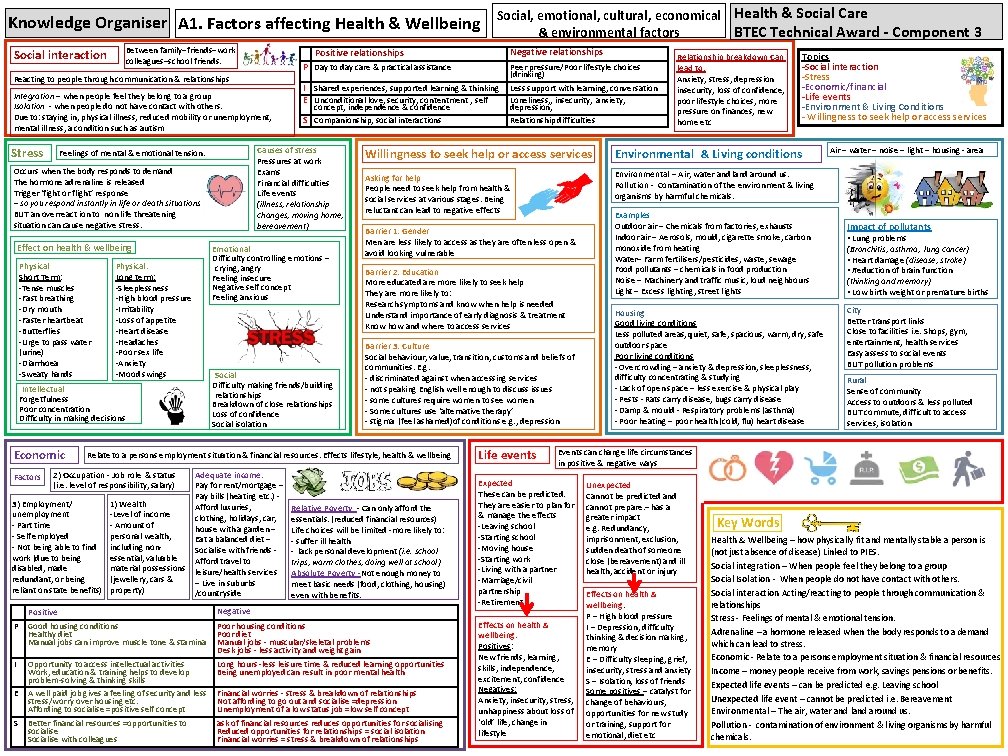
Knowledge Organiser A 1. Factors affecting Health & Wellbeing Between family–friends–work colleagues–school friends. Social interaction Integration – when people feel they belong to a group Isolation - when people do not have contact with others. Due to: staying in, physical illness, reduced mobility or unemployment, mental illness, a condition such as autism Occurs when the body responds to demand The hormone adrenaline is released Trigger ‘fight or flight’ response – so you respond instantly in life or death situations BUT an overreact ion to non life threatening situation cause negative stress. Effect on health & wellbeing Physical Short Term: -Tense muscles -Fast breathing -Dry mouth -Faster heartbeat -Butterflies -Urge to pass water (urine) -Diarrhoea -Sweaty hands Factors Peer pressure/Poor lifestyle choices (drinking) I Shared experiences, supported learning & thinking E Unconditional love, security, contentment , self Less support with learning, conversation Loneliness, , insecurity, anxiety, depression, Relationship difficulties concept, independence & confidence S Companionship, social interactions Emotional Difficulty controlling emotions – crying, angry Feeling insecure Negative self concept Feeling anxious Physical: Long term: -Sleeplessness -High blood pressure -Irritability -Loss of appetite -Heart disease -Headaches -Poor sex life -Anxiety -Mood swings Social Difficulty making friends/building relationships Breakdown of close relationships Loss of confidence Social isolation Intellectual Forgetfulness Poor concentration Difficulty in making decisions Economic P Day to day care & practical assistance Causes of stress Pressures at work Exams Financial difficulties Life events (illness, relationship changes, moving home, bereavement) Feelings of mental & emotional tension. 3) Employment/ unemployment - Part time - Self employed - Not being able to find work (due to being disabled, made redundant, or being reliant on state benefits) 1) Wealth -Level of income - Amount of personal wealth, including nonessential, valuable material possessions (jewellery, cars & property) Adequate income: Pay for rent/mortgage – Pay bills (heating etc. ) Afford luxuries, clothing, holidays, car, house with a garden – Eat a balanced diet – Socialise with friends Afford travel to leisure/health services – Live in suburbs /countryside Relationship breakdown Can lead to: Anxiety, stress, depression insecurity, loss of confidence, poor lifestyle choices, more pressure on finances, new home etc Topics -Social interaction -Stress -Economic/financial -Life events -Environment & Living Conditions - Willingness to seek help or access services Environmental & Living conditions Asking for help People need to seek help from health & social services at various stages. Being reluctant can lead to negative effects Environmental – Air, water and land around us. Pollution - Contamination of the environment & living organisms by harmful chemicals. Barrier 1: Gender Men are less likely to access as they are often less open & avoid looking vulnerable Barrier 2: Education More educated are more likely to seek help They are more likely to: Research symptoms and know when help is needed Understand importance of early diagnosis & treatment Know how and where to access services Barrier 3: Culture Social behaviour, value, transition, customs and beliefs of communities. E. g. - discriminated against when accessing services - not speaking English well enough to discuss issues - some cultures require women to see women - Some cultures use ‘alternative therapy’ - stigma (feel ashamed)of conditions e. g. , depression Relate to a persons employment situation & financial resources. Effects lifestyle, health & wellbeing 2) Occupation - Job role & status (i. e. level of responsibility, salary) Negative relationships Positive relationships Reacting to people through communication & relationships Stress Social, emotional, cultural, economical Health & Social Care & environmental factors BTEC Technical Award - Component 3 Relative Poverty - Can only afford the essentials. (reduced financial resources) Life choices will be limited -more likely to: - suffer ill health - lack personal development (i. e. school trips, warm clothes, doing well at school) Absolute Poverty -Not enough money to meet basic needs (food, clothing, housing) even with benefits. Positive Negative P Good housing conditions Healthy diet Manual jobs can improve muscle tone & stamina Poor housing conditions Poor diet Manual jobs - muscular/skeletal problems Desk jobs - less activity and weight gain I Opportunity to access intellectual activities Work, education & training helps to develop problem-solving & thinking skills Long hours -less leisure time & reduced learning opportunities Being unemployed can result in poor mental health E A well paid job gives a feeling of security and less stress/worry over housing etc. Affording to socialise =positive self concept Financial worries - stress & breakdown of relationships Not affording to go out and socialise =depression Unemployment of a low status job =low self concept S Better financial resources =opportunities to socialise Socialise with colleagues ask of financial resources reduces opportunities for socialising Reduced opportunities for relationships = social isolation Financial worries = stress & breakdown of relationships Life events Examples Outdoor air – Chemicals from factories, exhausts Indoor air – Aerosols, mould, cigarette smoke, carbon monoxide from heating Water– Farm fertilisers/pesticides, waste, sewage Food pollutants – chemicals in food production Noise – Machinery and traffic music, loud neighbours Light – Excess lighting, street lights Housing Good living conditions Less polluted areas, quiet, safe, spacious, warm, dry, safe outdoor space Poor living conditions - Overcrowding – anxiety & depression, sleeplessness, difficulty concentrating & studying - Lack of open space – less exercise & physical play - Pests - Rats carry disease, bugs carry disease - Damp & mould - Respiratory problems (asthma) - Poor heating – poor health (cold, flu) heart disease Air – water – noise – light – housing - area Impact of pollutants • Lung problems (Bronchitis, asthma, lung cancer) • Heart damage (disease, stroke) • Reduction of brain function (thinking and memory) • Low birth weight or premature births City Better transport links Close to facilities i. e. Shops, gym, entertainment, health services Easy assess to social events BUT pollution problems Rural Sense of community Access to outdoors & less polluted BUT commute, difficult to access services, isolation Events can change life circumstances in positive & negative ways Expected These can be predicted. They are easier to plan for & manage the effects -Leaving school -Starting school -Moving house -Starting work -Living with a partner -Marriage/civil partnership -Retirement Effects on health & wellbeing: Positives: New friends, learning, skills, independence, excitement, confidence Negatives: Anxiety, insecurity, stress, unhappiness about loss of ‘old’ life, change in lifestyle Unexpected Cannot be predicted and cannot prepare. – has a greater impact e. g. Redundancy, imprisonment, exclusion, sudden death of someone close (bereavement) and ill health, accident or injury Effects on health & wellbeing: P – High blood pressure I – Depression, difficulty thinking & decision making, memory E – Difficulty sleeping, grief, insecurity, stress and anxiety S – Isolation, loss of friends Some positives – catalyst for change of behaviours, opportunities for new study or training, support for emotional, diet etc Key Words Health & Wellbeing – how physically fit and mentally stable a person is (not just absence of disease) Linked to PIES. Social integration – When people feel they belong to a group Social Isolation - When people do not have contact with others. Social interaction Acting/reacting to people through communication & relationships Stress - Feelings of mental & emotional tension. Adrenaline – a hormone released when the body responds to a demand which can lead to stress. Economic - Relate to a persons employment situation & financial resources Income – money people receive from work, savings pensions or benefits. Expected life events – can be predicted e. g. Leaving school Unexpected life event – cannot be predicted i. e. Bereavement Environmental – The air, water and land around us. Pollution - contamination of environment & living organisms by harmful chemicals.
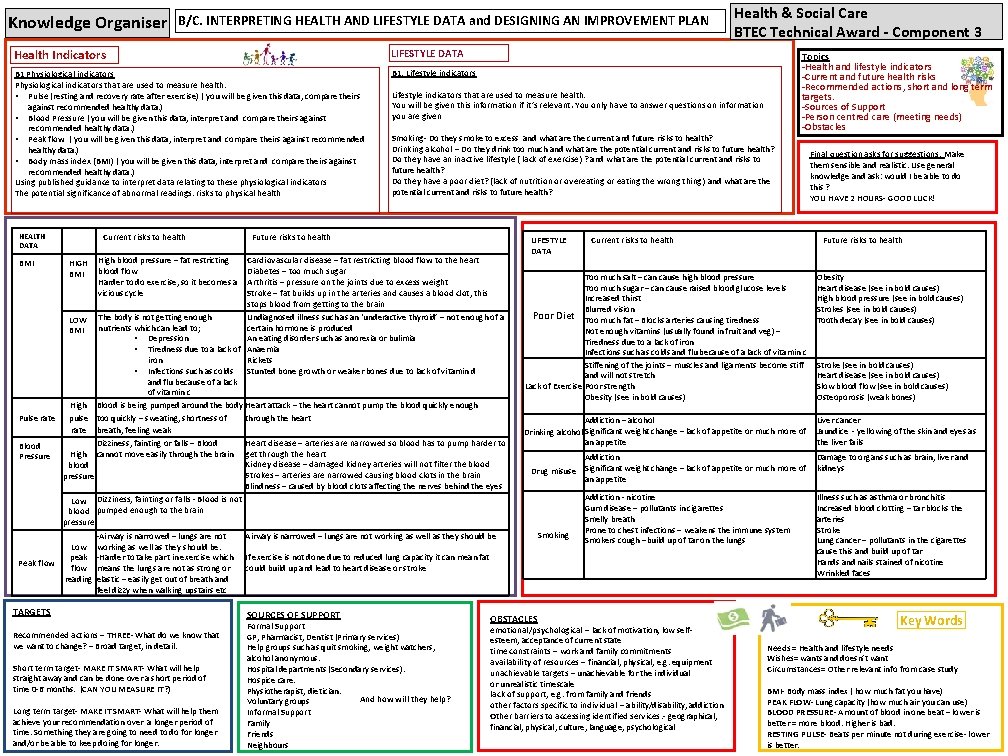
Knowledge Organiser B/C. INTERPRETING HEALTH AND LIFESTYLE DATA and DESIGNING AN IMPROVEMENT PLAN Health Indicators LIFESTYLE DATA B 1 Physiological indicators that are used to measure health: • Pulse (resting and recovery rate after exercise) ( you will be given this data, compare theirs against recommended healthy data. ) • Blood Pressure ( you will be given this data, interpret and compare theirs against recommended healthy data. ) • Peak flow ( you will be given this data, interpret and compare theirs against recommended healthy data. ) • Body mass index (BMI) ( you will be given this data, interpret and compare theirs against recommended healthy data. ) Using published guidance to interpret data relating to these physiological indicators The potential significance of abnormal readings: risks to physical health B 1: Lifestyle indicators Current risks to health HEALTH DATA Lifestyle indicators that are used to measure health: You will be given this information if it’s relevant. You only have to answer questions on information you are given Smoking- Do they smoke to excess and what are the current and future risks to health? Drinking alcohol – Do they drink too much and what are the potential current and risks to future health? Do they have an inactive lifestyle ( lack of exercise) ? and what are the potential current and risks to future health? Do they have a poor diet? (lack of nutrition or overeating or eating the wrong thing) and what are the potential current and risks to future health? Future risks to health Cardiovascular disease – fat restricting blood flow to the heart Diabetes – too much sugar Arthritis – pressure on the joints due to excess weight Stroke – fat builds up in the arteries and causes a blood clot, this stops blood from getting to the brain The body is not getting enough Undiagnosed illness such as an ‘underactive thyroid’ – not enough of a LOW nutrients which can lead to; certain hormone is produced BMI • Depression An eating disorder such as anorexia or bulimia • Tiredness due to a lack of Anaemia iron Rickets • Infections such as colds Stunted bone growth or weaker bones due to lack of vitamin d and flu because of a lack of vitamin c High Blood is being pumped around the body Heart attack – the heart cannot pump the blood quickly enough Pulse rate pulse too quickly – sweating, shortness of through the heart rate breath, feeling weak Dizziness, fainting or falls – Blood Heart disease – arteries are narrowed so blood has to pump harder to Blood High cannot move easily through the brain get through the heart Pressure Kidney disease – damaged kidney arteries will not filter the blood Strokes – arteries are narrowed causing blood clots in the brain pressure Blindness – caused by blood clots affecting the nerves behind the eyes Low Dizziness, fainting or falls - Blood is not blood pumped enough to the brain pressure BMI Peak flow HIGH BMI Low peak flow reading High blood pressure – fat restricting blood flow Harder to do exercise, so it becomes a vicious cycle -Airway is narrowed – lungs are not working as well as they should be. -Harder to take part in exercise which means the lungs are not as strong or elastic – easily get out of breath and feel dizzy when walking upstairs etc TARGETS Recommended actions – THREE- What do we know that we want to change? – Broad target, in detail. Short term target- MAKE IT SMART- What will help straight away and can be done over a short period of time 0 -6 months. (CAN YOU MEASURE IT? ) Long term target- MAKE IT SMART- What will help them achieve your recommendation over a longer period of time. Something they are going to need to do for longer and/or be able to keep doing for longer. LIFESTYLE DATA Current risks to health Final question asks for suggestions: Make them sensible and realistic. Use general knowledge and ask: would I be able to do this ? YOU HAVE 2 HOURS- GOOD LUCK! Future risks to health Obesity Heart disease (see in bold causes) High blood pressure (see in bold causes) Strokes (see in bold causes) Tooth decay (see in bold causes) Addiction – alcohol Drinking alcohol Significant weight change – lack of appetite or much more of an appetite Liver cancer Jaundice - yellowing of the skin and eyes as the liver fails Addiction Drug misuse Significant weight change – lack of appetite or much more of an appetite Smoking Addiction - nicotine Gum disease – pollutants in cigarettes Smelly breath Prone to chest infections – weakens the immune system Smokers cough –build up of tar on the lungs If exercise is not done due to reduced lung capacity it can mean fat could build up and lead to heart disease or stroke Formal Support GP, Pharmacist, Dentist (Primary services) Help groups such as quit smoking, weight watchers, alcohol anonymous. Hospital departments (Secondary services). Hospice care. Physiotherapist, dietician. And how will they help? Voluntary groups Informal Support Family Friends Neighbours Topics -Health and lifestyle indicators -Current and future health risks -Recommended actions, short and long term targets. -Sources of Support -Person centred care (meeting needs) -Obstacles Too much salt – can cause high blood pressure Too much sugar – can cause raised blood glucose levels Increased thirst Blurred vision Poor Diet Too much fat – Blocks arteries causing tiredness Not enough vitamins (usually found in fruit and veg) – Tiredness due to a lack of iron Infections such as colds and flu because of a lack of vitamin c Stiffening of the joints – muscles and ligaments become stiff and will not stretch Lack of Exercise Poor strength Obesity (see in bold causes) Airway is narrowed – lungs are not working as well as they should be SOURCES OF SUPPORT Health & Social Care BTEC Technical Award - Component 3 OBSTACLES emotional/psychological – lack of motivation, low selfesteem, acceptance of current state time constraints – work and family commitments availability of resources – financial, physical, e. g. equipment unachievable targets – unachievable for the individual or unrealistic timescale lack of support, e. g. from family and friends other factors specific to individual – ability/disability, addiction Other barriers to accessing identified services. - geographical, financial, physical, culture, language, psychological Stroke (see in bold causes) Heart disease (see in bold causes) Slow blood flow (see in bold causes) Osteoporosis (weak bones) Damage to organs such as brain, liver and kidneys Illness such as asthma or bronchitis Increased blood clotting – tar blocks the arteries Stroke Lung cancer – pollutants in the cigarettes cause this and build up of tar Hands and nails stained of nicotine Wrinkled faces Key Words Needs = Health and lifestyle needs Wishes= wants and doesn’t want Circumstances= Other relevant info from case study BMI- Body mass index ( how much fat you have) PEAK FLOW- Lung capacity (how much air you can use) BLOOD PRESSURE- Amount of blood in one beat – lower is better = more blood. Higher is bad. RESTING PULSE- Beats per minute not during exercise- lower is better.
- Slides: 3