
Knowledge of the alphabetic code Skills of segmentation
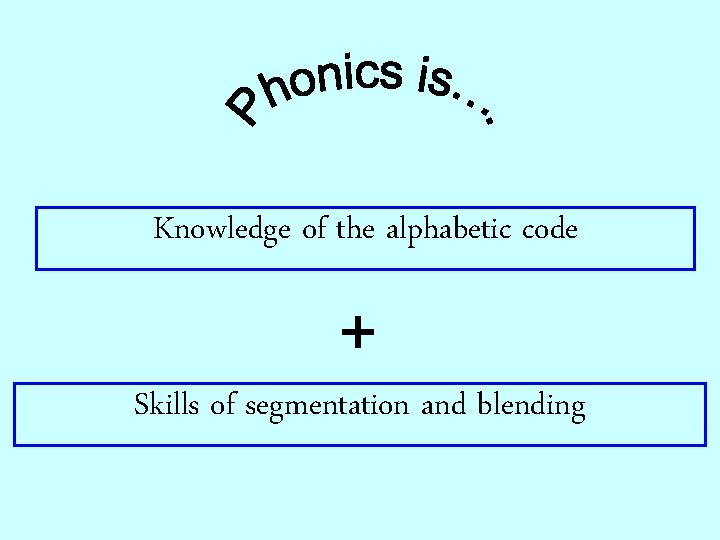
Knowledge of the alphabetic code + Skills of segmentation and blending
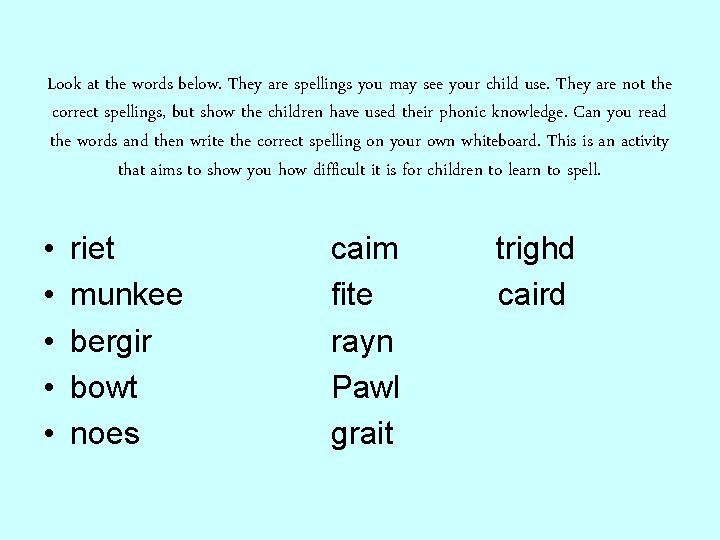
Look at the words below. They are spellings you may see your child use. They are not the correct spellings, but show the children have used their phonic knowledge. Can you read the words and then write the correct spelling on your own whiteboard. This is an activity that aims to show you how difficult it is for children to learn to spell. • • • riet munkee bergir bowt noes caim fite rayn Pawl grait trighd caird
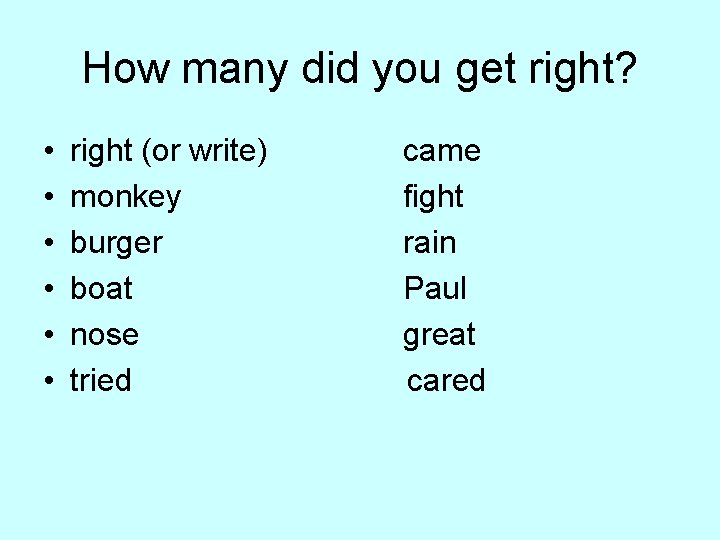
How many did you get right? • • • right (or write) monkey burger boat nose tried came fight rain Paul great cared
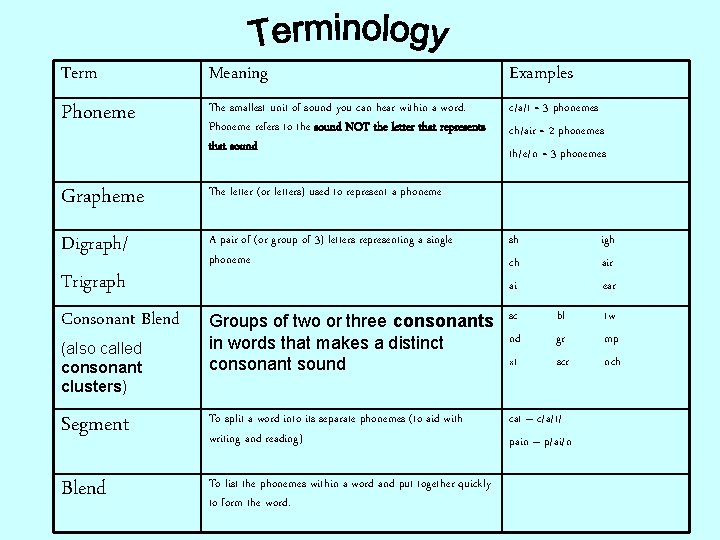
Term Meaning Examples Phoneme The smallest unit of sound you can hear within a word. Phoneme refers to the sound NOT the letter that represents that sound c/a/t = 3 phonemes ch/air = 2 phonemes th/e/n = 3 phonemes Grapheme The letter (or letters) used to represent a phoneme Digraph/ Trigraph A pair of (or group of 3) letters representing a single phoneme Consonant Blend Groups of two or three consonants sc nd in words that makes a distinct xt consonant sound Segment To split a word into its separate phonemes (to aid with writing and reading) Blend To list the phonemes within a word and put together quickly to form the word. (also called consonant clusters) sh ch ai igh air ear bl gr scr cat – c/a/t/ pain – p/ai/n tw mp nch
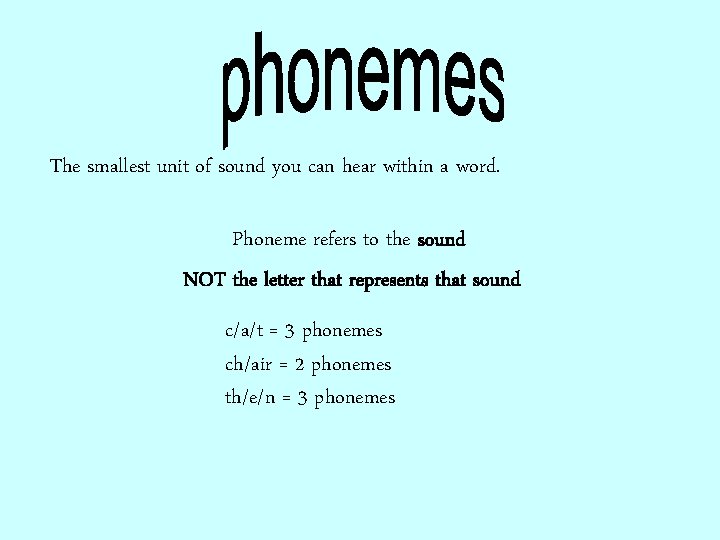
The smallest unit of sound you can hear within a word. Phoneme refers to the sound NOT the letter that represents that sound c/a/t = 3 phonemes ch/air = 2 phonemes th/e/n = 3 phonemes
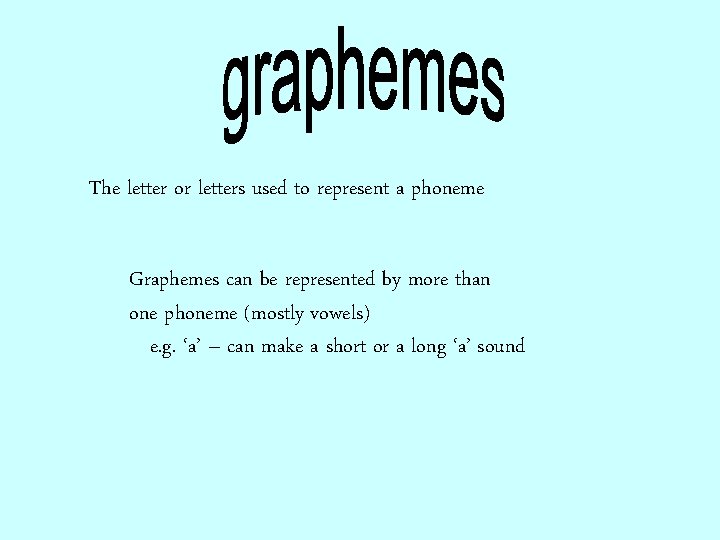
The letter or letters used to represent a phoneme Graphemes can be represented by more than one phoneme (mostly vowels) e. g. ‘a’ – can make a short or a long ‘a’ sound
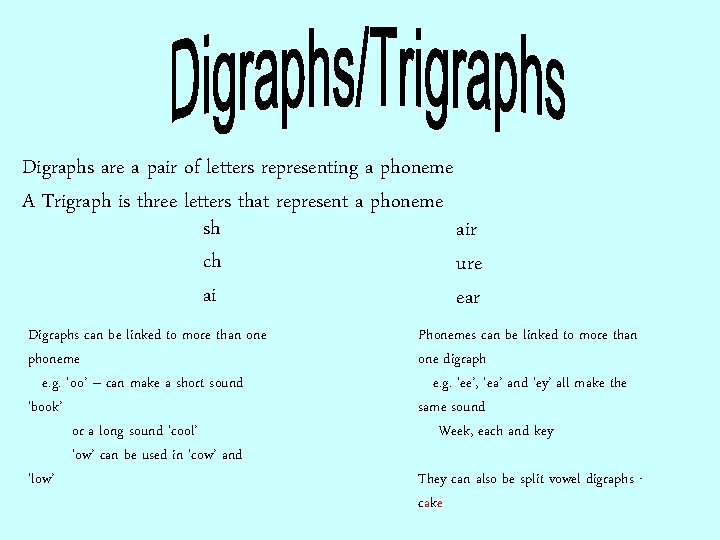
Digraphs are a pair of letters representing a phoneme A Trigraph is three letters that represent a phoneme sh air ch ure ai ear Digraphs can be linked to more than one phoneme e. g. ‘oo’ – can make a short sound ‘book’ or a long sound ‘cool’ ‘ow’ can be used in ‘cow’ and ‘low’ Phonemes can be linked to more than one digraph e. g. ‘ee’, ‘ea’ and ‘ey’ all make the same sound Week, each and key They can also be split vowel digraphs cake
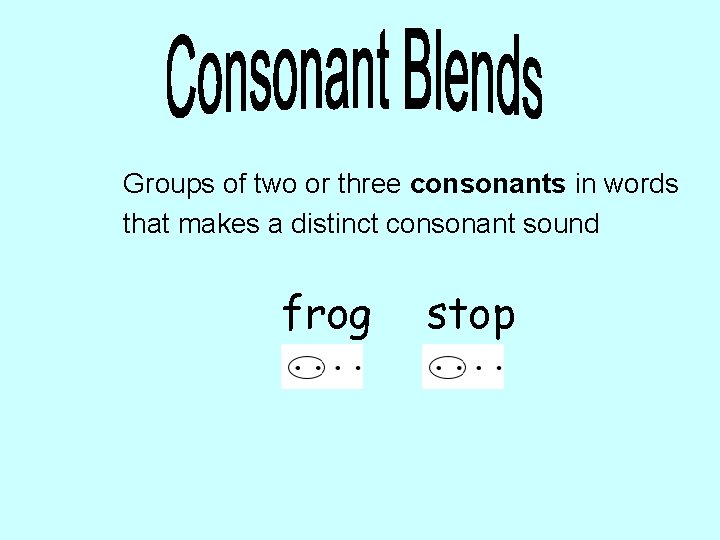
Groups of two or three consonants in words that makes a distinct consonant sound frog stop
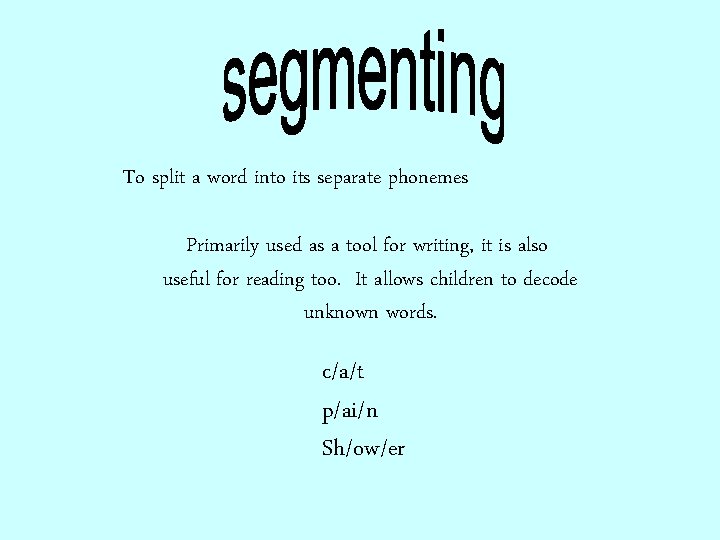
To split a word into its separate phonemes Primarily used as a tool for writing, it is also useful for reading too. It allows children to decode unknown words. c/a/t p/ai/n Sh/ow/er
To list the phonemes within a word and put together quickly to form the word. Taught as a strategy for reading unknown words
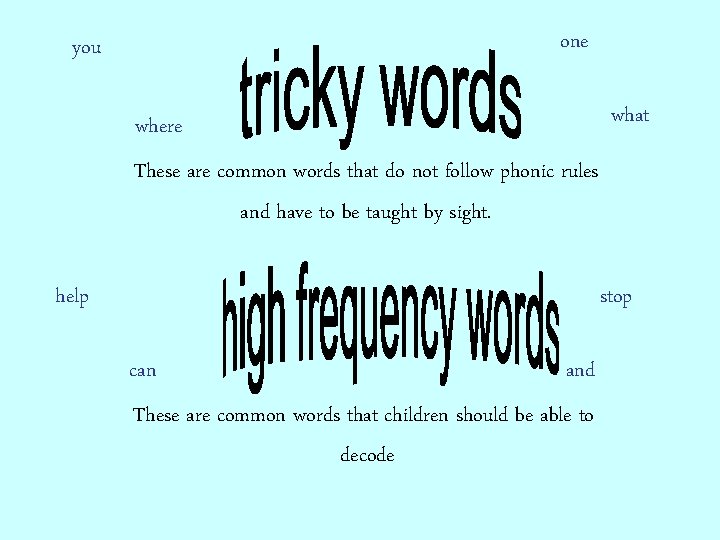
one you what where These are common words that do not follow phonic rules and have to be taught by sight. help stop can and These are common words that children should be able to decode
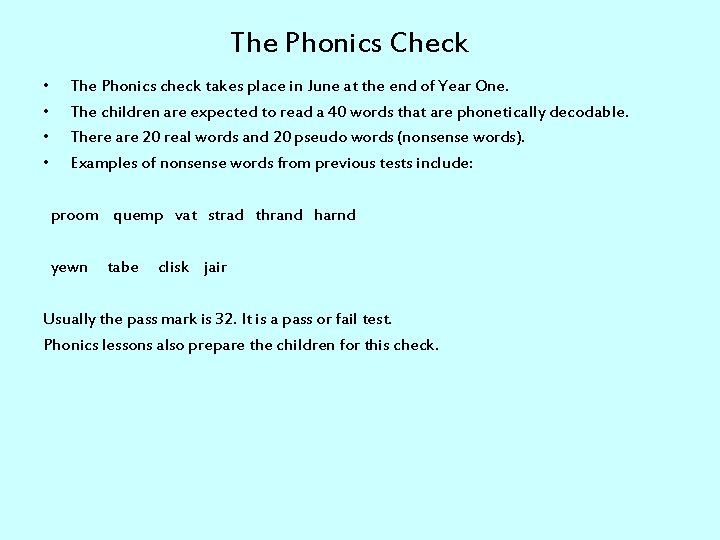
The Phonics Check • • The Phonics check takes place in June at the end of Year One. The children are expected to read a 40 words that are phonetically decodable. There are 20 real words and 20 pseudo words (nonsense words). Examples of nonsense words from previous tests include: proom quemp vat strad thrand harnd yewn tabe clisk jair Usually the pass mark is 32. It is a pass or fail test. Phonics lessons also prepare the children for this check.
Reading How to help your children at home • School would like you to hear your child read four times a week. • Encourage them to segment any unknown, decodable words. • Highlight any digraphs or trigraphs in unknown words. • Encourage them to blend the phonemes back together. • With longer 2 syllable words, encourage them to split the word to help blend. • Practise reading the tricky words.
Reading is not just about word reading. Children are expected to be able to understand discuss what they have read. • • This includes: Being able to retell the story Identify and use punctuation e. g. speech marks, exclamation marks, question marks and full stops. Retrieving information from the text (fiction and non-fiction). Sequencing the events of the story. Discussing their favourite parts and why. Predicting what might happen next. Inference – reading between the lines e. g. how is the character feeling? Why do you think something has happened and finding a hidden meaning in the story.
Any questions?
- Slides: 15