
Knowledge Nugget 2 Community Foundation Operations The Basics
Knowledge Nugget #2: Community Foundation Operations – The Basics 10/27/2021 1
Community Foundation Operations – The Basics Community Foundation Operations Endowed And Nonpermanent Funds Fund Types Supporting Organizations Community Foundation Affiliates 10/27/2021 2
My Contact Information David Bennett ◦ Cell: 260 -804 -5617 ◦ Email: cfrtinstitute@gmail. com ◦ Website: www. cfrti. com 10/27/2021 3
Community Foundations in a Nutshell A community foundation: 1. Receives charitable gifts from donors – Either into a newlycreated charitable fund, or the gift is added to an existing fund 2. Invests those gifts – To generate investment returns to be used to support charitable purposes 3. Awards grants and scholarships – To support worthwhile charitable activities, or help a student receive an education 10/27/2021 4
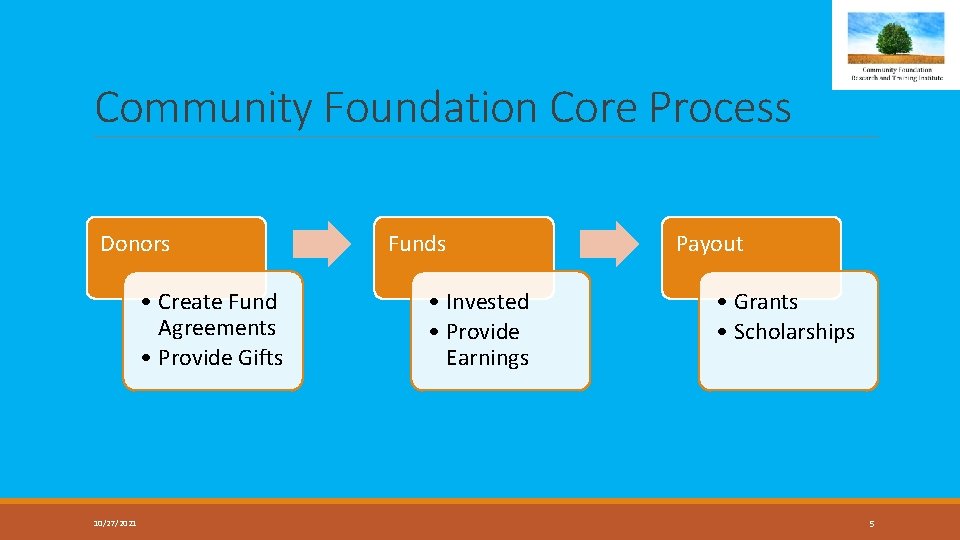
Community Foundation Core Process Donors • Create Fund Agreements • Provide Gifts 10/27/2021 Funds • Invested • Provide Earnings Payout • Grants • Scholarships 5
A community foundation … ØIs a 501 -c-3 charitable organization, just like a school, a homeless shelter, or your local arts museum. ØThat means gifts to community foundations can be charitable deductions for the donor. ØIt also means that a community foundation’s activities must be charitable, as defined by IRS regulations. 10/27/2021 6
Endowed vs. Nonpermanent Community foundation funds are usually one of two types: ◦ Endowed/Permanent fund - A fund which is invested and only a portion of the fund is available to spend annually ◦ Pass-through/Non-Permanent Fund – Any amount in the fund can be awarded as a grant or a scholarship 10/27/2021 7

Fund Types 10/27/2021 8
Funds at Community Foundations All of the assets at a community foundation are held in some type of fund. The funds are created by donors who want to make a gift for a particular charitable purpose. Community foundations might also create a fund for their own budget – this is sometimes called their “Operating Fund”. There might also be internal funds relating to their own operations – perhaps a contingency fund (to use as backup cash) or a capital fund (to save for future capital expenditures). In this section, however, we will only discuss funds set up by donors to achieve a specified charitable purpose. 10/27/2021 9
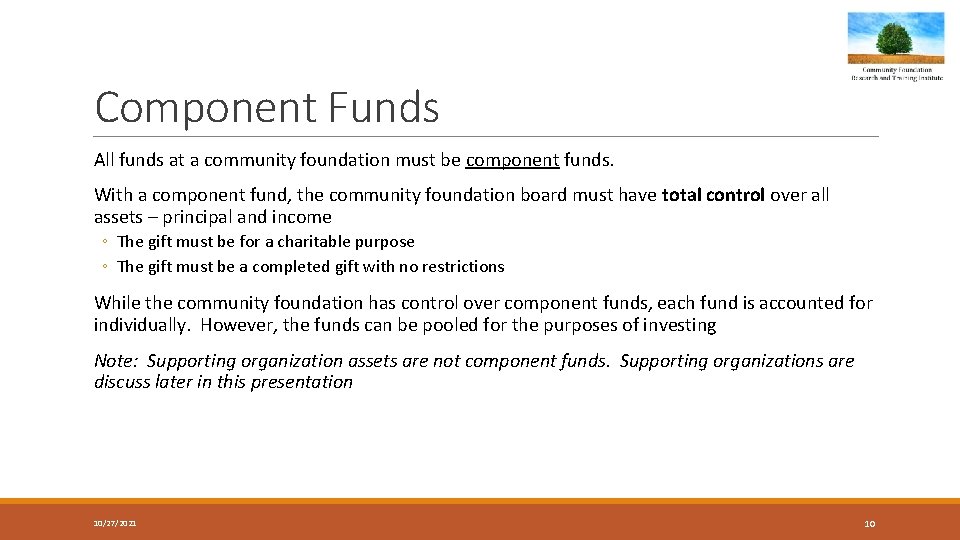
Component Funds All funds at a community foundation must be component funds. With a component fund, the community foundation board must have total control over all assets – principal and income ◦ The gift must be for a charitable purpose ◦ The gift must be a completed gift with no restrictions While the community foundation has control over component funds, each fund is accounted for individually. However, the funds can be pooled for the purposes of investing Note: Supporting organization assets are not component funds. Supporting organizations are discuss later in this presentation 10/27/2021 10
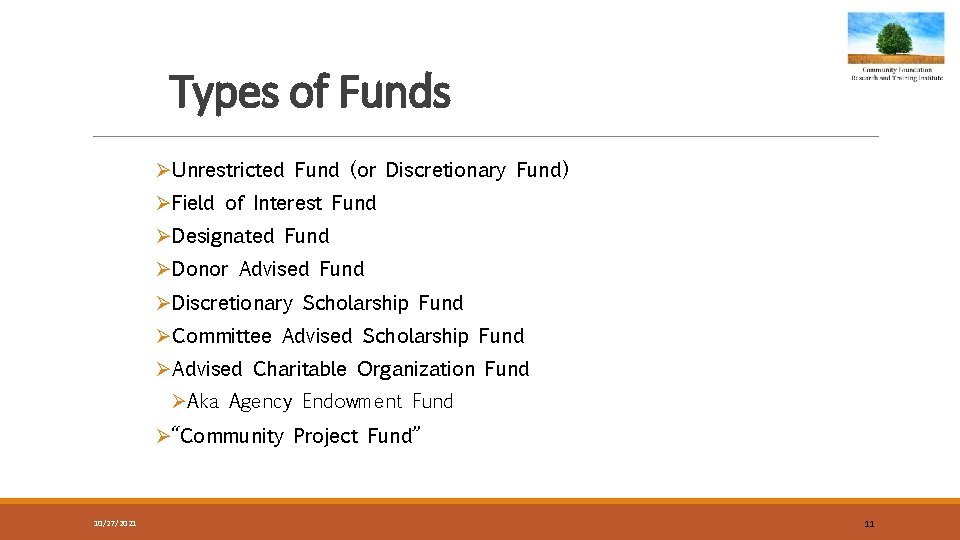
Types of Funds ØUnrestricted Fund (or Discretionary Fund) ØField of Interest Fund ØDesignated Fund ØDonor Advised Fund ØDiscretionary Scholarship Fund ØCommittee Advised Scholarship Fund ØAdvised Charitable Organization Fund ØAka Agency Endowment Fund Ø“Community Project Fund” 10/27/2021 11
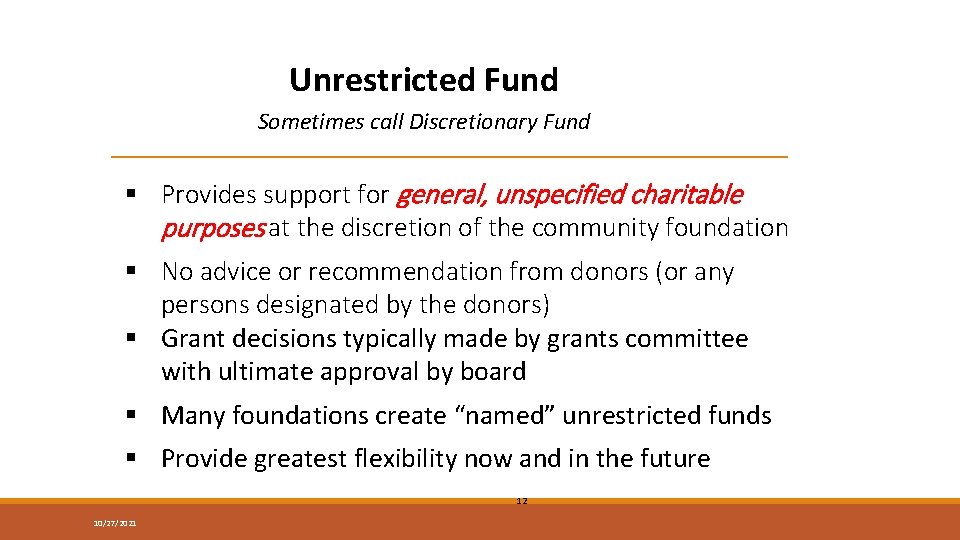
Unrestricted Fund Sometimes call Discretionary Fund § Provides support for general, unspecified charitable purposes at the discretion of the community foundation § No advice or recommendation from donors (or any persons designated by the donors) § Grant decisions typically made by grants committee with ultimate approval by board § Many foundations create “named” unrestricted funds § Provide greatest flexibility now and in the future 12 10/27/2021
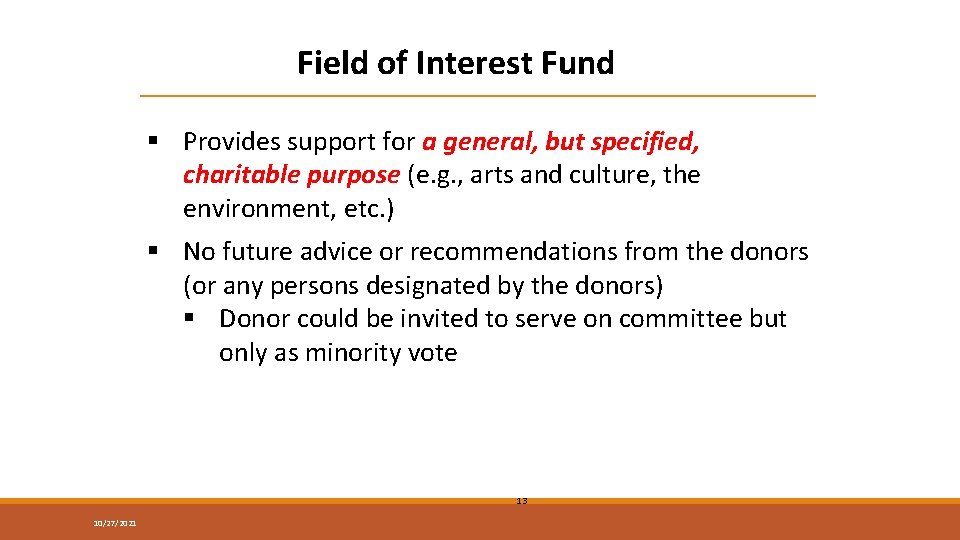
Field of Interest Fund § Provides support for a general, but specified, charitable purpose (e. g. , arts and culture, the environment, etc. ) § No future advice or recommendations from the donors (or any persons designated by the donors) § Donor could be invited to serve on committee but only as minority vote 13 10/27/2021
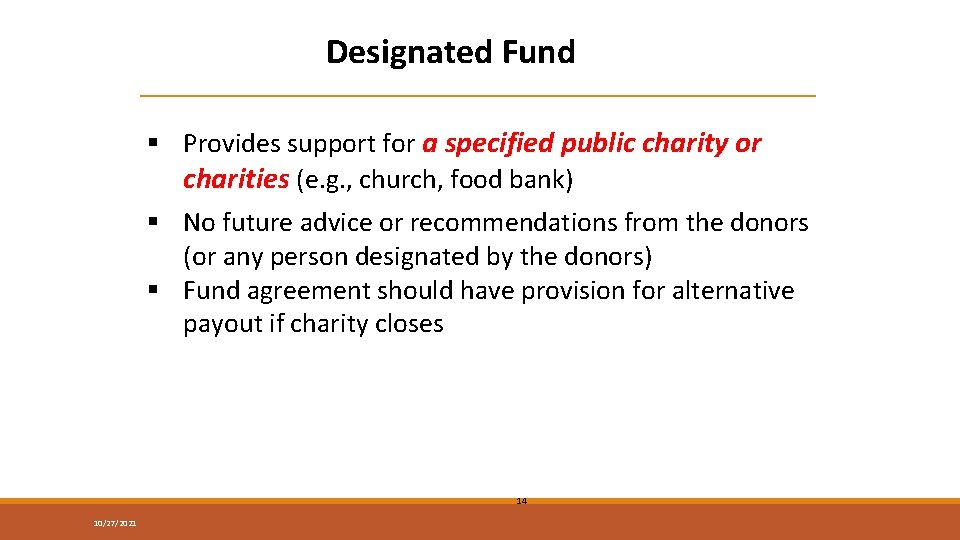
Designated Fund § Provides support for a specified public charity or charities (e. g. , church, food bank) § No future advice or recommendations from the donors (or any person designated by the donors) § Fund agreement should have provision for alternative payout if charity closes 14 10/27/2021
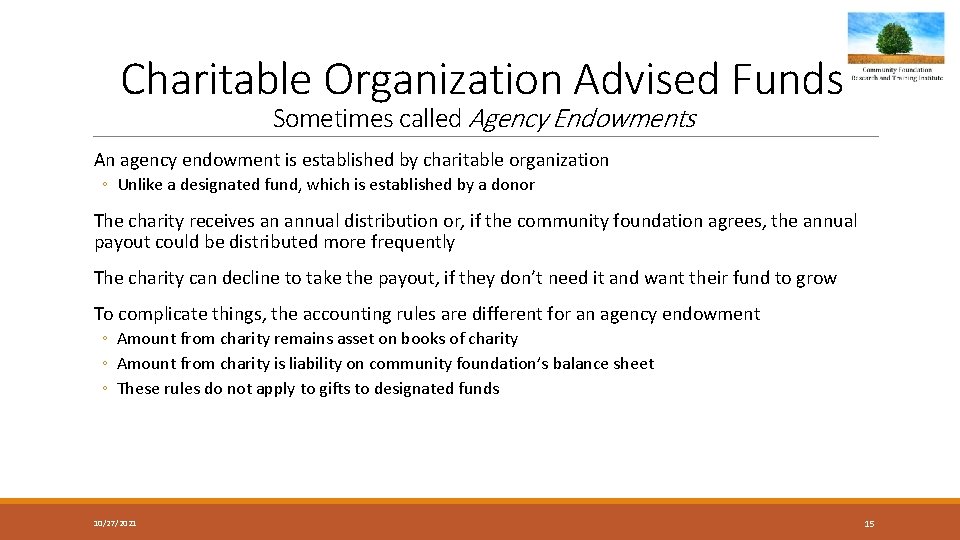
Charitable Organization Advised Funds Sometimes called Agency Endowments An agency endowment is established by charitable organization ◦ Unlike a designated fund, which is established by a donor The charity receives an annual distribution or, if the community foundation agrees, the annual payout could be distributed more frequently The charity can decline to take the payout, if they don’t need it and want their fund to grow To complicate things, the accounting rules are different for an agency endowment ◦ Amount from charity remains asset on books of charity ◦ Amount from charity is liability on community foundation’s balance sheet ◦ These rules do not apply to gifts to designated funds 10/27/2021 15
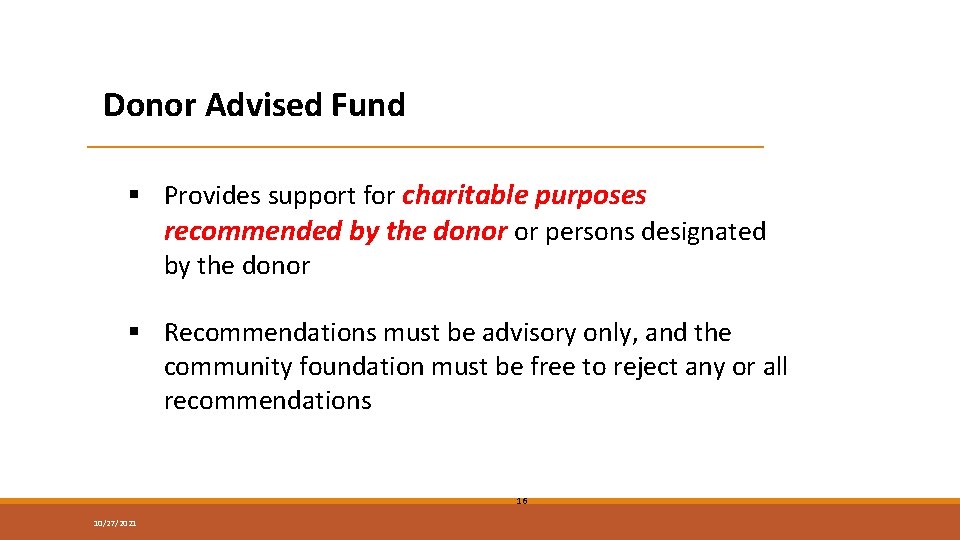
Donor Advised Fund § Provides support for charitable purposes recommended by the donor or persons designated by the donor § Recommendations must be advisory only, and the community foundation must be free to reject any or all recommendations 16 10/27/2021
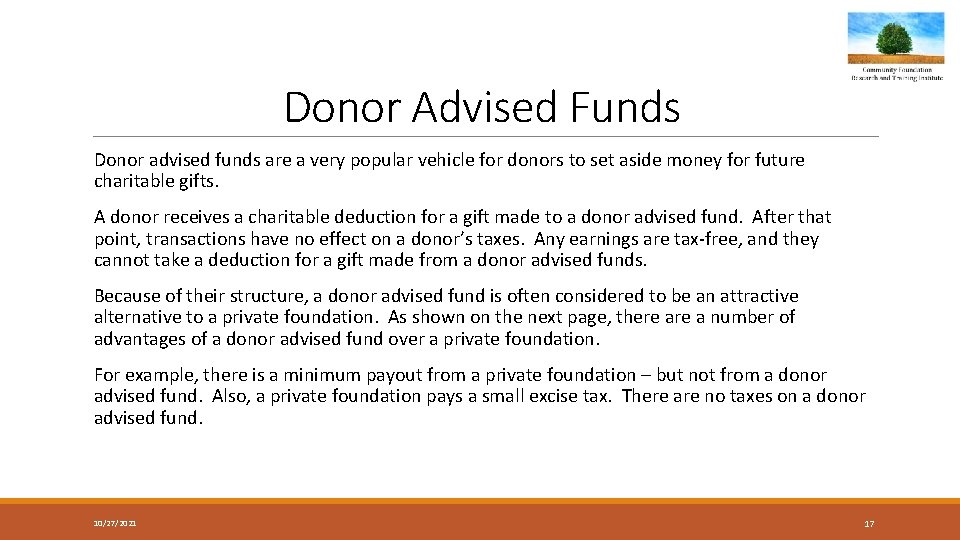
Donor Advised Funds Donor advised funds are a very popular vehicle for donors to set aside money for future charitable gifts. A donor receives a charitable deduction for a gift made to a donor advised fund. After that point, transactions have no effect on a donor’s taxes. Any earnings are tax-free, and they cannot take a deduction for a gift made from a donor advised funds. Because of their structure, a donor advised fund is often considered to be an attractive alternative to a private foundation. As shown on the next page, there a number of advantages of a donor advised fund over a private foundation. For example, there is a minimum payout from a private foundation – but not from a donor advised fund. Also, a private foundation pays a small excise tax. There are no taxes on a donor advised fund. 10/27/2021 17
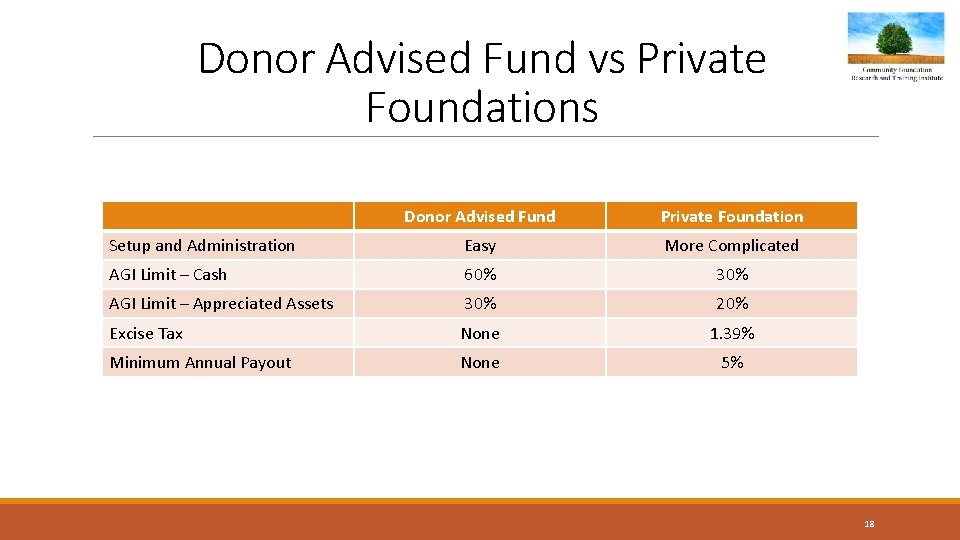
Donor Advised Fund vs Private Foundations Donor Advised Fund Private Foundation Setup and Administration Easy More Complicated AGI Limit – Cash 60% 30% AGI Limit – Appreciated Assets 30% 20% Excise Tax None 1. 39% Minimum Annual Payout None 5% 18
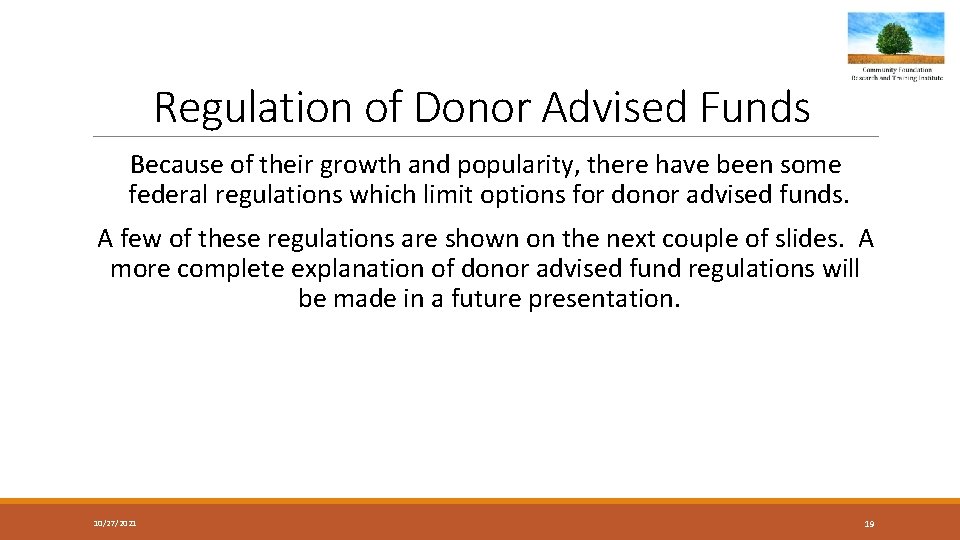
Regulation of Donor Advised Funds Because of their growth and popularity, there have been some federal regulations which limit options for donor advised funds. A few of these regulations are shown on the next couple of slides. A more complete explanation of donor advised fund regulations will be made in a future presentation. 10/27/2021 19
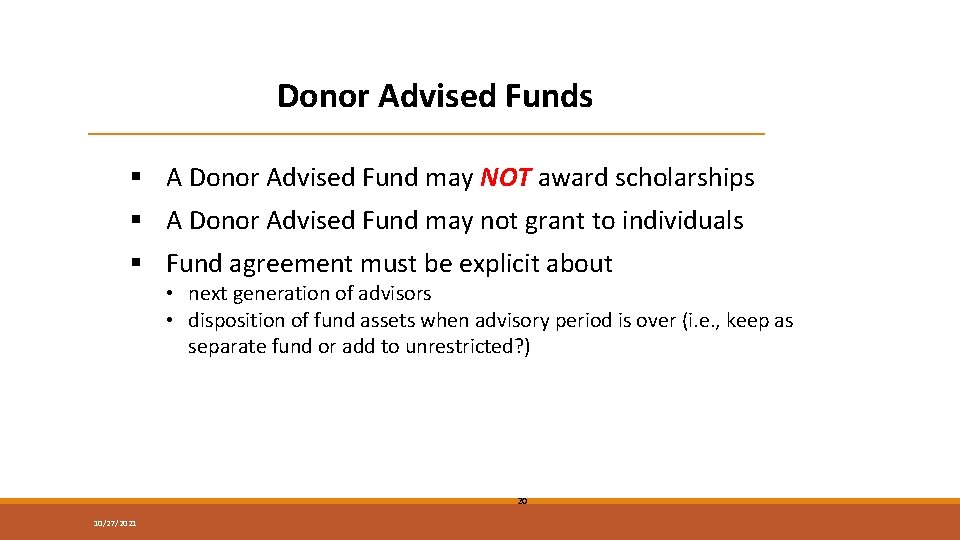
Donor Advised Funds § A Donor Advised Fund may NOT award scholarships § A Donor Advised Fund may not grant to individuals § Fund agreement must be explicit about • next generation of advisors • disposition of fund assets when advisory period is over (i. e. , keep as separate fund or add to unrestricted? ) 20 10/27/2021
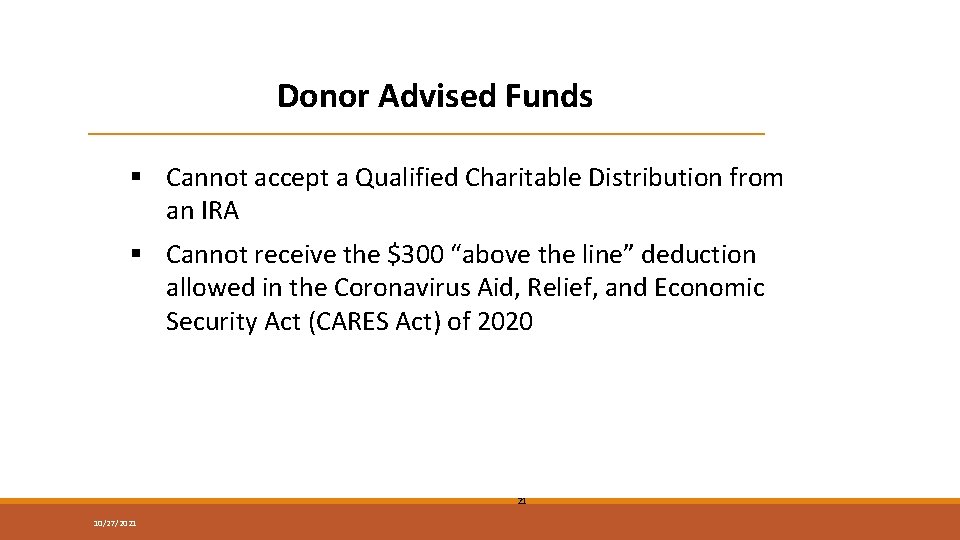
Donor Advised Funds § Cannot accept a Qualified Charitable Distribution from an IRA § Cannot receive the $300 “above the line” deduction allowed in the Coronavirus Aid, Relief, and Economic Security Act (CARES Act) of 2020 21 10/27/2021
Donor Advised Funds and Pledges § A donor can fulfill a pledge through a donor advised fund if the following apply: • The sponsoring organization makes no reference to the pledge when making the DAF distribution • Donor receives no other benefit, directly or indirectly, that is more than incidental; and • Donor does not claim a charitable contribution deduction for the DAF distribution (even if the charity erroneously sends the Donor a written acknowledgment). IRS Notice 2017 -73 (December 4, 2017) 22 10/27/2021
Scholarship Funds A scholarship fund is generally one of two types: 1. Advised Scholarship Fund 2. Discretionary Scholarship Fund With an advised scholarship fund, a committee is put together to read the applications and select the recipients. As will be described in a future presentation, the donor cannot control the selection process. With a discretionary scholarship fund, the money is awarded to an educational institution, and that school determines the scholarship recipient. 10/27/2021 23
Scholarship Funds ØAll scholarships must have two elements: ØQualified charitable class ØUnbiased selection process ØEvery member of the committee must be appointed by the community foundation (not by the donor) ØScholarship grants must be awarded according to objective and nondiscriminatory procedures, approved in advance by the board of directors ØAccording to the Pension Protection Act of 2006, the donor and his/her designees may not control or constitute a majority of the committee 10/27/2021 24
How Do You Determine What Type of Fund to Create? On the next page is a chart that can be used to determine what type of fund a donor wants to create. By answering the questions, you can trace along the path to determine the correct fund 10/27/2021 25
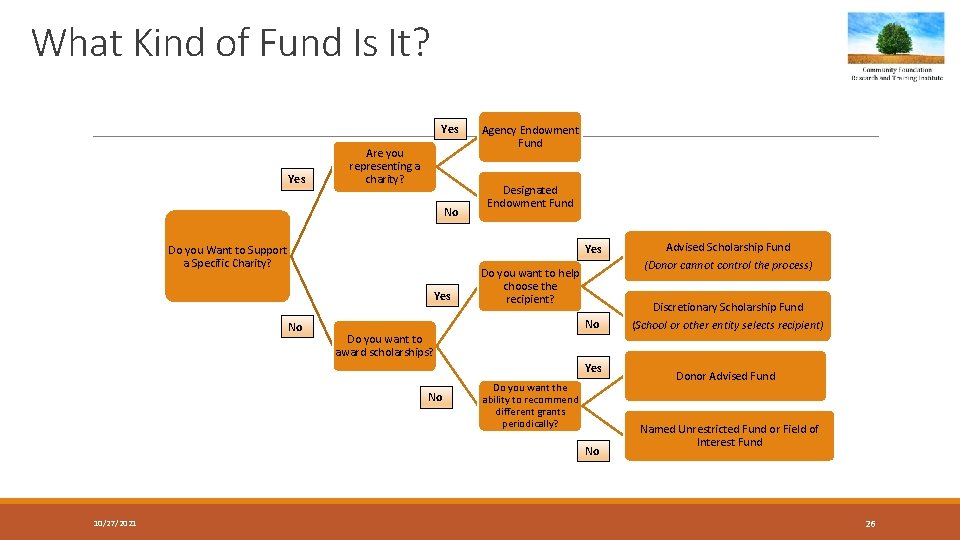
What Kind of Fund Is It? Yes Are you representing a charity? No Agency Endowment Fund Designated Endowment Fund Yes Do you Want to Support a Specific Charity? Yes No Do you want to help choose the recipient? No Do you want to award scholarships? Yes No Do you want the ability to recommend different grants periodically? No 10/27/2021 Advised Scholarship Fund (Donor cannot control the process) Discretionary Scholarship Fund (School or other entity selects recipient) Donor Advised Fund Named Unrestricted Fund or Field of Interest Fund 26
Community Project Funds Some community foundations allow the creation of “community project funds”. These are funds which are created for a particular local charitable project. If your community foundation offers these types of funds, special consideration should be given to developing very clear policies and procedures. It is a good idea to have your legal council review these policies and procedures before you offer these services. 10/27/2021 27
Community Project Funds § A group of individuals determine a solution to a community need § The group does not have 501(c)(3) status § The project can use the community foundation for donors to make charitable gifts 28 10/27/2021
Community Project Funds § § Community Foundations need a foundation policy about when you engage in these efforts § You need a written operating agreement about roles and responsibilities § You need to know the time frame and your exit plan ACCEPTING THESE FUNDS MEANS THE PROJECT IS A COMMUNITY FOUNDATION PROJECT § Staffing issues § Liability issues 29 10/27/2021
Supporting Organizations 10/27/2021 30
What is a Supporting Organization? A supporting organization is a charity that carries out its exempt purposes by supporting other exempt organizations, usually other public charities. A community foundation can create a supporting organization by filing the proper forms with your state, and then applying for the proper exempt status. Supporting organizations are separate corporations from a community foundation, and must file their own Form 990. It is common, however, for the financial activity of all supporting organizations to be consolidated into a single financial audit for the community foundation. 10/27/2021 31

Large Gifts from Donors As will be described in a future seminar, a community foundation must annually pass a financial test known as the Public Support Test. A community foundation that does not pass the Public Support Test risks being reclassified as a private foundation. A large gift from a single donor can put a community foundation at risk of failing the public support test. As an alternative, a community foundation can create a supporting organization (usually type I) and have the donor’s gift go to the supporting organization. The reason? A supporting organization is not subject to the public support test. 10/27/2021 32

Supporting Organization § Separate legal entity with its own 501(c)(3) designation from the IRS; § Does not need to meet public support test independently because it “supports” a public charity § Used for: • Large donor funds ($1 million +); more independence on grants and investments • Hold real estate; limit liability • Prevent “tipping” into private foundation status due to large grant 33 10/27/2021

Different Types of Supporting Organizations ØType I–a supporting organization that is under direct control of the supported organization ØType II–a supporting organization that is under common control with the supported organization (also known as "brother/sister" organizations) ØType III–a supporting organization that is not necessarily related to the supported organization. Ø Therefore, in addition to a notification requirement, Type III supporting organizations must pass separate responsiveness and integral part tests. ØThis type supplies so much of the revenue for a charity that the supported charity is “responsive” and an “integral part” of the charity. 10/27/2021 34
Disclosure on Form 990 Every supporting organization must indicate on its Form 990 which type of supporting organization it is and which organization it supports. This disclosure provision added by Pension Protection Act of 2006 10/27/2021 35
Affiliate Organizations 10/27/2021 36
Affiliate Foundations One model used to deliver community foundation services across the country is through the use of affiliates. In this model, there is a “parent” organization, which provides back-office services such as the processing of financial transactions. Different areas in the geographic footprint of the community foundations are served by affiliates. The affiliates are usually not separate corporations. They are overseen by advisory board members, who make decisions on local services. Legal control of affiliates remains with the board of directors of the parent organization. 10/27/2021 37
Hybrid/Affiliate Structure A parent organization sets up affiliate funds serving multiple communities Those communities select how services are provided This allows the affiliates to offer a wide range of products to suit the needs of their donors ◦ Parent organization provides back office support Two examples shown on the next page are the Community Foundation of the Ozarks and the Community Foundation of Greater Des Moines 38
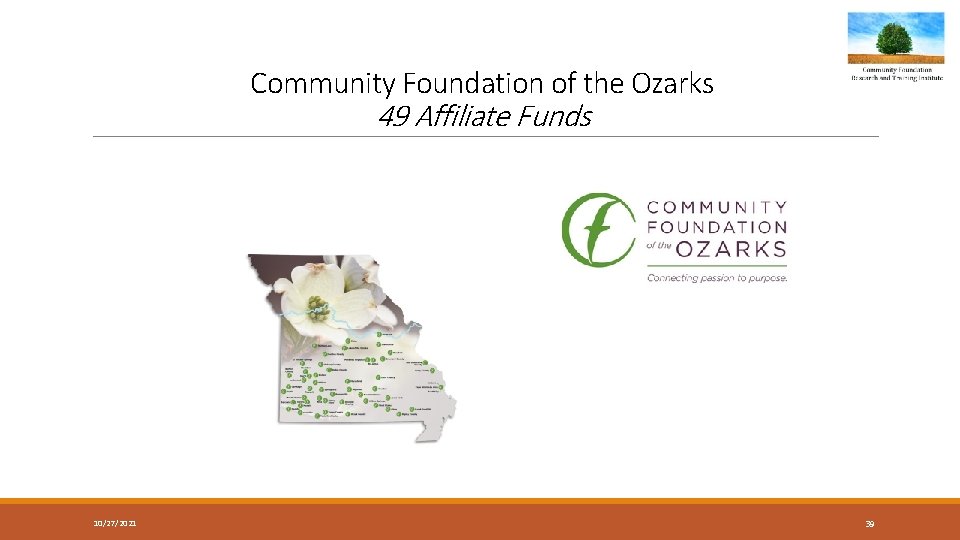
Community Foundation of the Ozarks 49 Affiliate Funds 10/27/2021 39
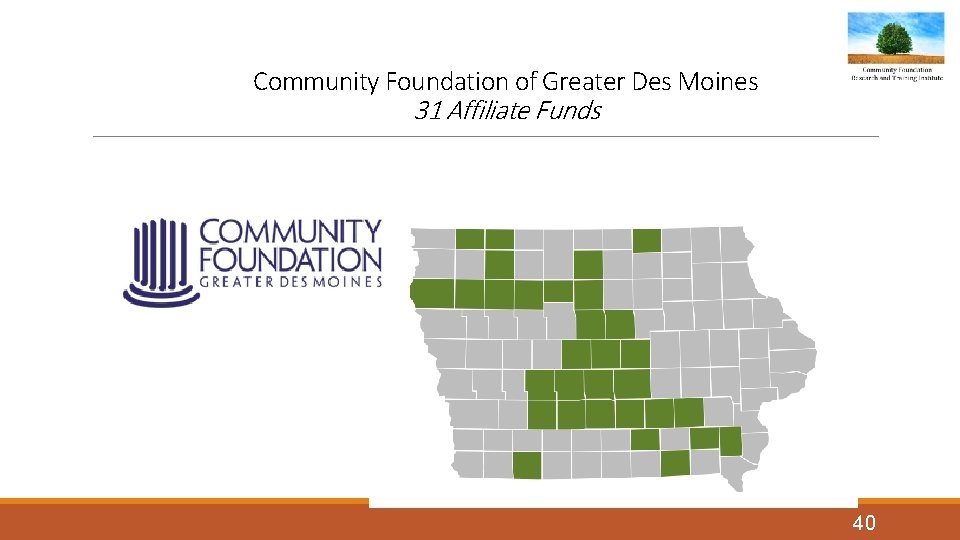
Community Foundation of Greater Des Moines 31 Affiliate Funds 40
My Contact Information That’s it for Knowledge Nugget #2. If you want to test what you learned, there’s a short quiz located elsewhere on this website. If you have any questions or comments, please contact me using this information David Bennett ◦ Cell: 260 -804 -5617 ◦ Email: cfrtinstitute@gmail. com ◦ Website: www. cfrti. com Keep up the good work … what you are doing for your community is so important. 10/27/2021 41
- Slides: 41