
Knowledge Model Construction Process model guidelines Knowledge elicitation
- Slides: 61
Knowledge Model Construction Process model & guidelines Knowledge elicitation techniques Knowledge-model construction
Process & Product n n so far: focus on knowledge model as product bottleneck for inexperienced knowledge modelers ä n solution: process model ä ä n n as prescriptive as possible process elements: stage, activity, guideline, technique but: modeling is constructive activity ä n how to undertake the process of model construction. no single correct solution nor an optimal path support through a number of guidelines that have proven to work well in practice. knowledge modeling is specialized form of requirements specification ä general software engineering principles apply Knowledge-model construction 2
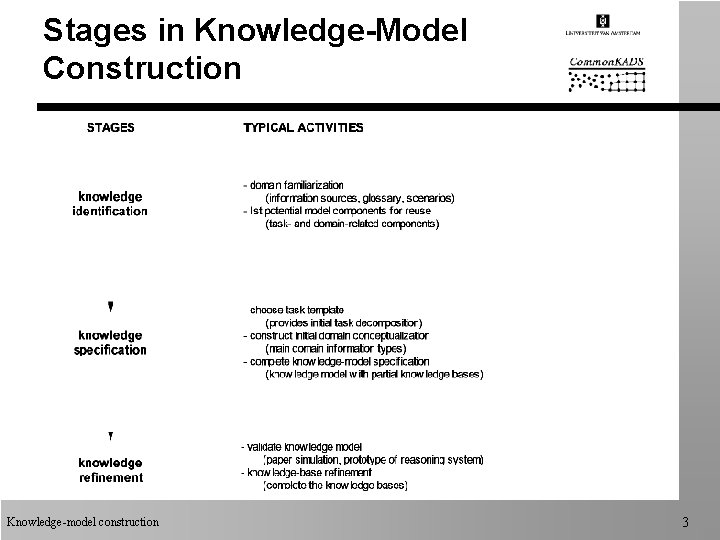
Stages in Knowledge-Model Construction Knowledge-model construction 3
Stage 1: Knowledge identification n goal ä ä n survey the knowledge items prepare them for specification input ä ä ä knowledge-intensive task selected main knowledge items identified. application task classified – assessment, configuration, combination of task types n activities ä ä explore and structure the information sources study the nature of the task in more detail Knowledge-model construction 4
Exploring information sources n Factors ä Nature of the sources – well-understood? , theoretical basis? ä Diversity of the sources – no single information source (e. g. textbook or manual) – diverse sources may be conflicting – multiple experts is a risk factor. n Techniques ä ä n text marking in key information sources some structured interviews to clarify perceived holes in domain problem: ä find balance between learning about the domain without becoming a full Knowledge-model construction 5
Guidelines n n Talk to people in the organization who have to talk to experts but are not experts themselves Avoid diving into detailed, complicated theories unless the usefulness is proven Construct a few typical scenarios which you understand at a global level Never spend too much time on this activity. Two person weeks should be maximum. Knowledge-model construction 6
Exploring the housing domain n Reading the two-weekly magazine in detail ä n Reading the original report of the local government for setting up the house assignment procedure ä n organizational goal of transparent procedure makes life easy identification of detailed information about handling urgent cases Short interviews/conversations ä ä staff member of organization two applicants (the “customers”) Knowledge-model construction 7
Results exploration n Tangible ä ä n Listing of domain knowledge sources, including a short characterization. Summaries of selected key texts. Glossary/lexicon Description of scenarios developed. Intangible ä your own understanding of the domain – most important result Knowledge-model construction 8
List potential components n n goal: pave way for reusing components two angles on reuse: ä Task dimension – check task type assigned in Task Model – build a list of task templates ä Domain dimension – type of the domain: e. g. technical domain – look for standardized descriptions AAT for art objects ontology libraries, reference models, product model libraries Knowledge-model construction 9
Available components for the “housing” application n Task dimension: assessment templates ä ä n CK book: single template assessment library of Valente and Loeckenhoff (1994) Domain dimension ä ä ä data model of the applicant database data model of the residence database CK-book: generic domain schema Knowledge-model construction 10
Stage 2: Knowledge specification n goal: complete specification of knowledge except for contents of domain models ä n domain models need only to contain example instances activities ä ä ä Choose a task template. Construct an initial domain conceptualization. Specify the three knowledge categories Knowledge-model construction 11
Choose task template n baseline: strong preference for a knowledge model based on an existing application. ä n efficient, quality assurance selection criteria: features of application task ä ä nature of the output: fault category, plan nature of the inputs: kind of data available nature of the system: artifact, biological system constraints posed by the task environment: – required certainty, costs of observations. Knowledge-model construction 12
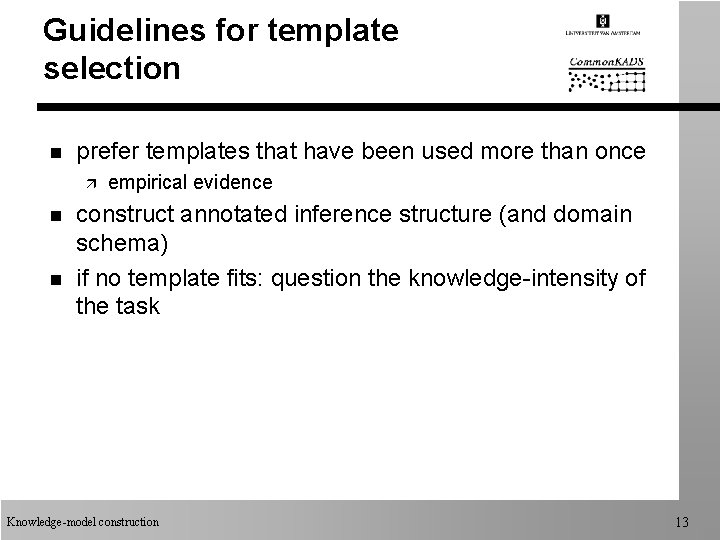
Guidelines for template selection n prefer templates that have been used more than once ä n n empirical evidence construct annotated inference structure (and domain schema) if no template fits: question the knowledge-intensity of the task Knowledge-model construction 13
Annotated inference structure “housing” application Knowledge-model construction 14
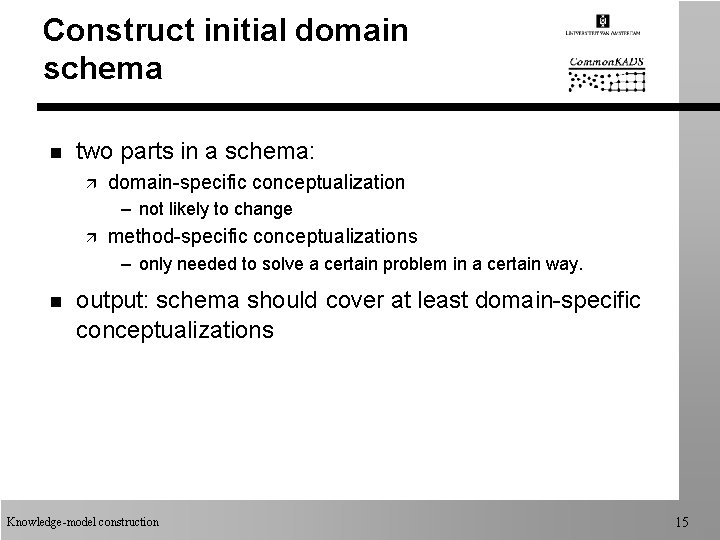
Construct initial domain schema n two parts in a schema: ä domain-specific conceptualization – not likely to change ä method-specific conceptualizations – only needed to solve a certain problem in a certain way. n output: schema should cover at least domain-specific conceptualizations Knowledge-model construction 15
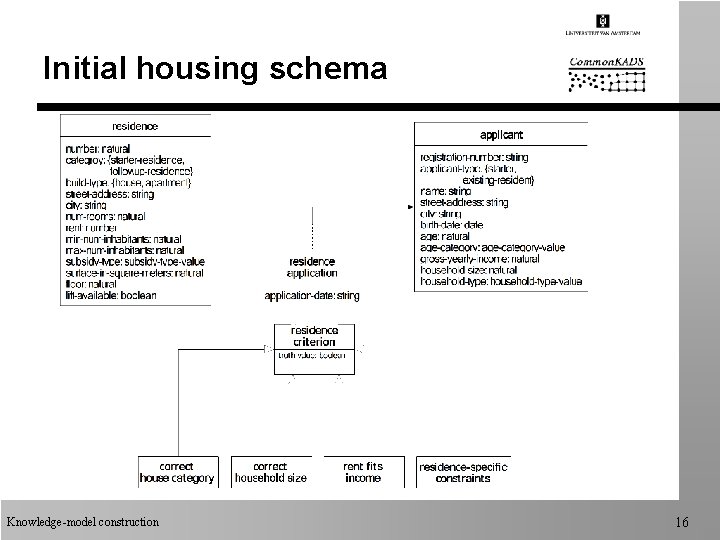
Initial housing schema Knowledge-model construction 16
Guidelines n use as much as possible existing data models: ä ä n limit use of the knowledge-modeling language to concepts, subtypes and relations ä ä n concentrate on "data" similar to building initial class model If no existing data models can be found, use standard SE techniques for finding concepts and relations ä n useful to use at least the same terminology basic constructs makes future cooperation/exchange easier use “pruning” method Constructing the initial domain conceptualization should be done in parallel with the choice of the task template ä otherwise: fake it Knowledge-model construction 17
Complete model specification n Route 1: Middle-out ä ä ä n Start with the inference knowledge Preferred approach Precondition: task template provides good approximation of inference structure. Route 2: Middle-in ä ä ä Start in parallel with task decomposition and domain modeling More time-consuming Needed if task template is too coarse-grained Knowledge-model construction 18
Middle-in and Middle-out Knowledge-model construction 19
Guidelines n n inference structure is detailed enough, if the explanation it provides is sufficiently detailed inference structure is detailed enough if it is easy to find for each inference a single type of domain knowledge that can act as a static role for this inference Knowledge-model construction 20
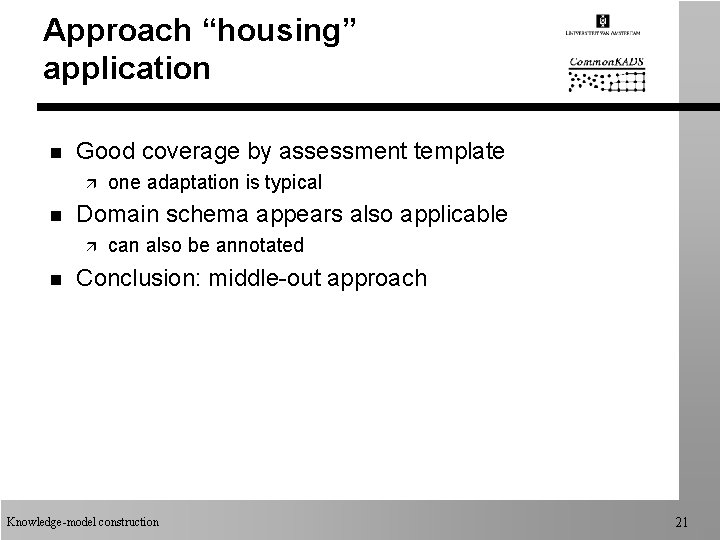
Approach “housing” application n Good coverage by assessment template ä n Domain schema appears also applicable ä n one adaptation is typical can also be annotated Conclusion: middle-out approach Knowledge-model construction 21
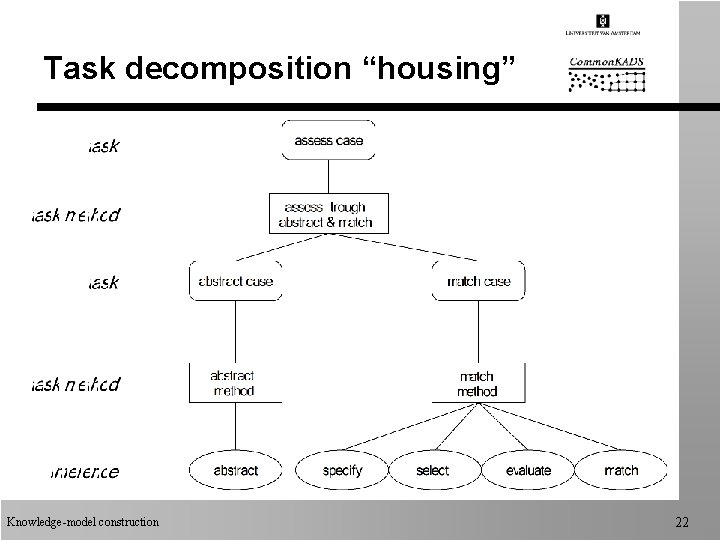
Task decomposition “housing” Knowledge-model construction 22
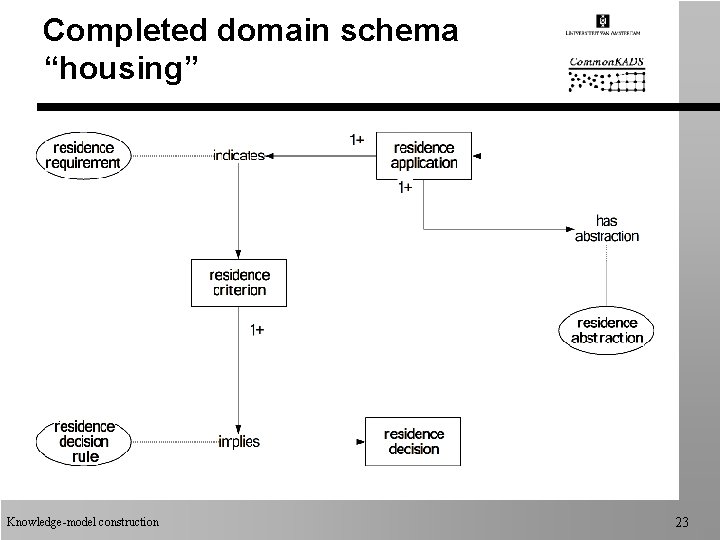
Completed domain schema “housing” Knowledge-model construction 23
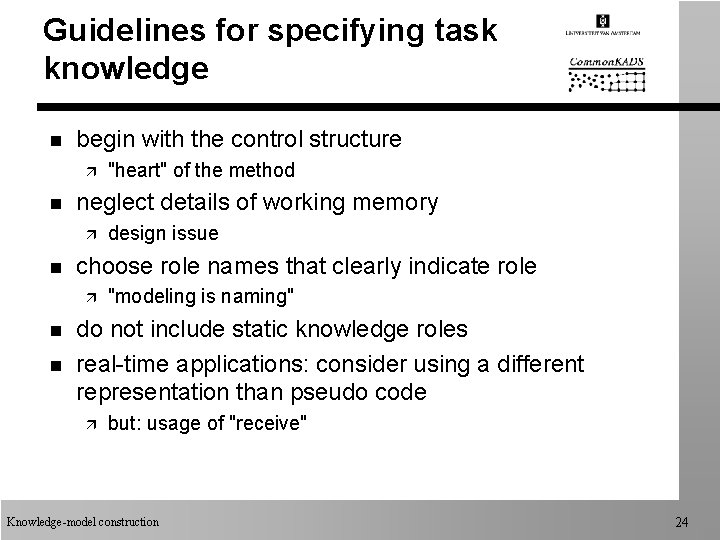
Guidelines for specifying task knowledge n begin with the control structure ä n neglect details of working memory ä n n design issue choose role names that clearly indicate role ä n "heart" of the method "modeling is naming" do not include static knowledge roles real-time applications: consider using a different representation than pseudo code ä but: usage of "receive" Knowledge-model construction 24
Guidelines for specifying inference knowledge n n Start with the graphical representation Choose names of roles carefully ä ä n dynamic character hypothesis, initial data, finding Use as much as possible a standard set of inferences ä see catalog of inferences in the book Knowledge-model construction 25
Guidelines for specifying domain knowledge n domain-knowledge type used as static role not required to have exactly the “right’” representation ä ä n design issue; key point: knowledge is available. scope of domain knowledge is typically broader than what is covered by inferences ä requirements of communication, explanation Knowledge-model construction 26
Stage 3: Knowledge Refinement n n Validate knowledge model Fill contents of knowledge bases Knowledge-model construction 27
Fill contents of knowledge bases n schema contains two kinds of domain types: ä ä n n information types that have instances that are part of a case knowledge types that have instances that are part of a domain model goal of this task: find (all) instances of the latter type case instances are only needed for a scenario Knowledge-model construction 28
Guidelines for filling contents n n n filling acts as a validation test of the schema usually not possible to define full, correct knowledge base in the first cycle knowledge bases need to be maintained ä n knowledge changes over time techniques: ä incorporate editing facilities for KB updating, trace transcripts, structured interview, automated learning, map from existing knowledge bases Knowledge-model construction 29
Validate knowledge model n n internally and externally verification = internal validation ä n “is the model right? ” validation = validation against user requirements ä "is it the right model? " Knowledge-model construction 30
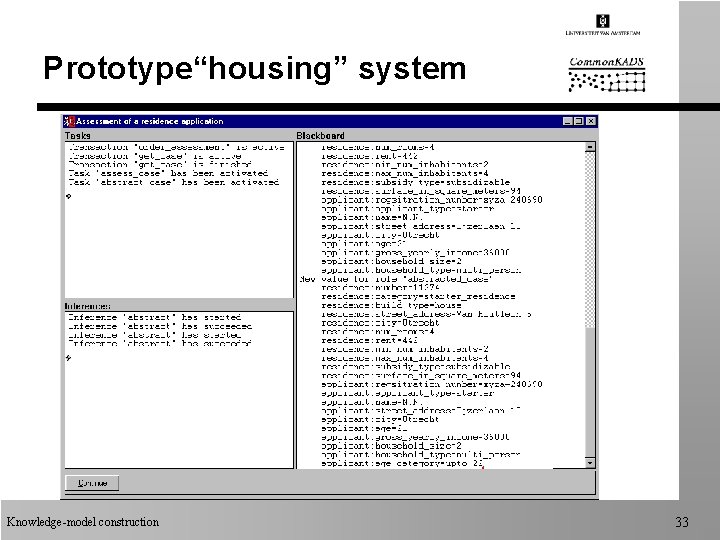
Validation techniques n Internal ä ä n structured walk-troughs software tools for checking the syntax and find missing parts External ä ä usually more difficult and/or more comprehensive. main technique: simulation – paper-based simulation – prototype system Knowledge-model construction 31
Paper-based simulation Knowledge-model construction 32
Prototype“housing” system Knowledge-model construction 33
Maintenance n n n CK view: not different from development model development is a cyclic process models act as information repositories ä n continuously updated but: makes requirements for support tools stronger ä transformation tools Knowledge-model construction 34
Domain Documentation Document (KM-1) n n n Knowledge model specification list of all information sources used. list of model components that we considered for reuse. scenarios for solving the application problem. results of the simulations undertaken during validation Elicitation material (appendices) Knowledge-model construction 35
Summary process n Knowledge identification ä n Knowledge specification ä ä n detailed knowledge analysis supported by reference models Knowledge refinement ä ä n familiarization with the application domain completing the knowledge model validating the knowledge model Feedback loops may be required ä ä ä simulation in third stage may lead to changes in specification Knowledge bases may require looking for additional knowledge sources. general rule: feedback loops occur less frequently, if the application problem is well-understood and similar problems have been tackled Knowledge-model construction 36
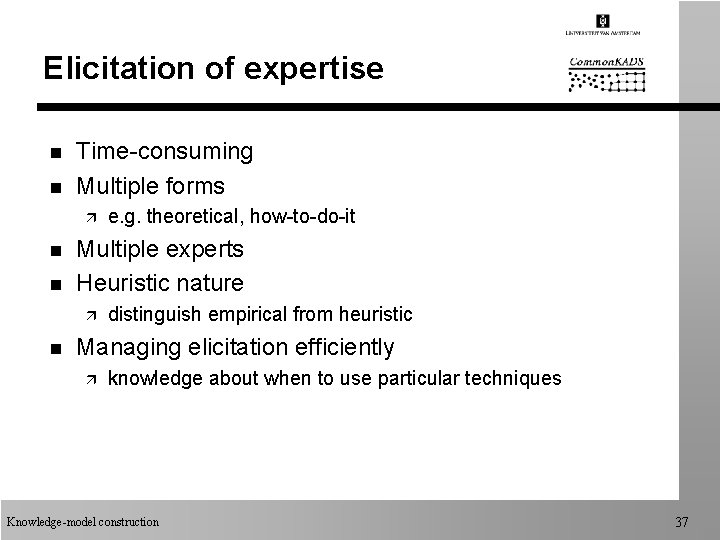
Elicitation of expertise n n Time-consuming Multiple forms ä n n Multiple experts Heuristic nature ä n e. g. theoretical, how-to-do-it distinguish empirical from heuristic Managing elicitation efficiently ä knowledge about when to use particular techniques Knowledge-model construction 37
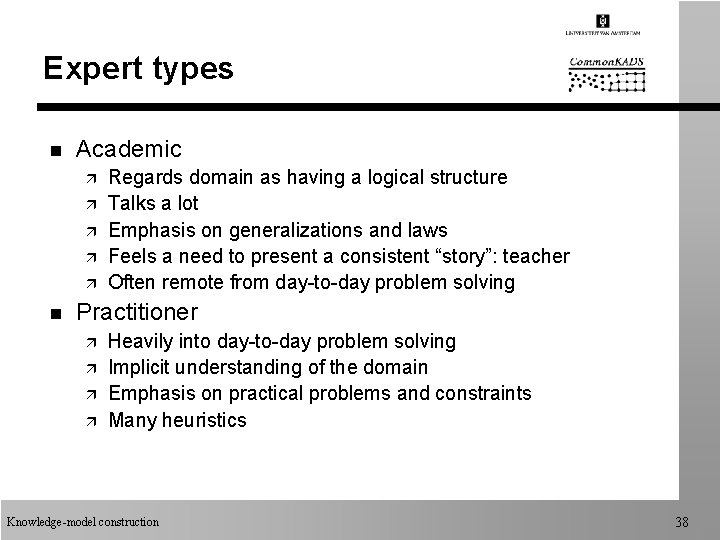
Expert types n Academic ä ä ä n Regards domain as having a logical structure Talks a lot Emphasis on generalizations and laws Feels a need to present a consistent “story”: teacher Often remote from day-to-day problem solving Practitioner ä ä Heavily into day-to-day problem solving Implicit understanding of the domain Emphasis on practical problems and constraints Many heuristics Knowledge-model construction 38
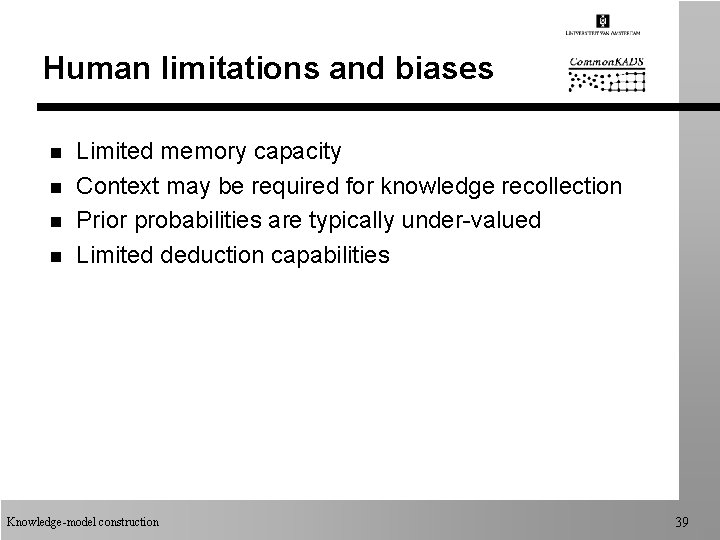
Human limitations and biases n n Limited memory capacity Context may be required for knowledge recollection Prior probabilities are typically under-valued Limited deduction capabilities Knowledge-model construction 39
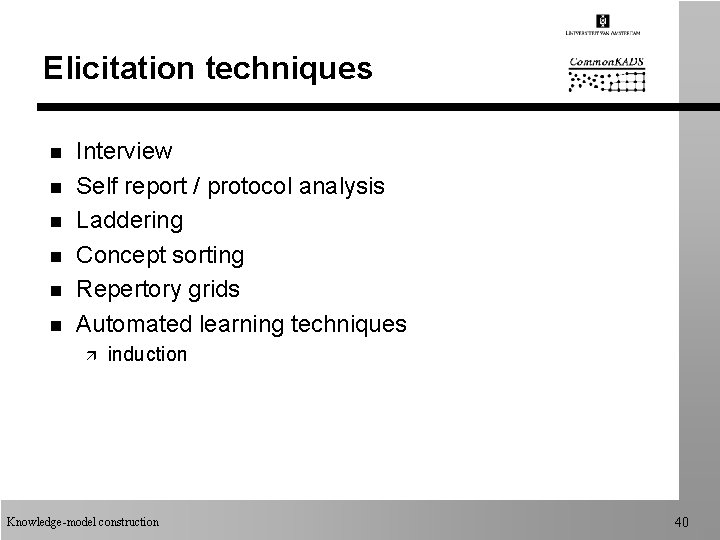
Elicitation techniques n n n Interview Self report / protocol analysis Laddering Concept sorting Repertory grids Automated learning techniques ä induction Knowledge-model construction 40
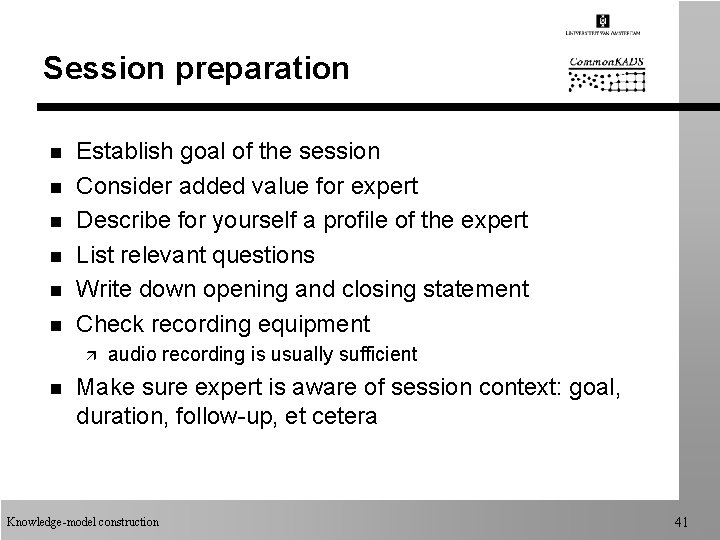
Session preparation n n n Establish goal of the session Consider added value for expert Describe for yourself a profile of the expert List relevant questions Write down opening and closing statement Check recording equipment ä n audio recording is usually sufficient Make sure expert is aware of session context: goal, duration, follow-up, et cetera Knowledge-model construction 41
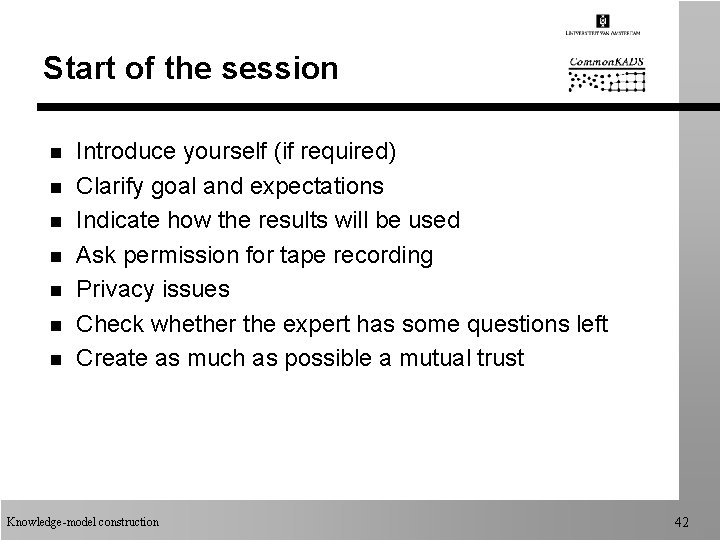
Start of the session n n n Introduce yourself (if required) Clarify goal and expectations Indicate how the results will be used Ask permission for tape recording Privacy issues Check whether the expert has some questions left Create as much as possible a mutual trust Knowledge-model construction 42
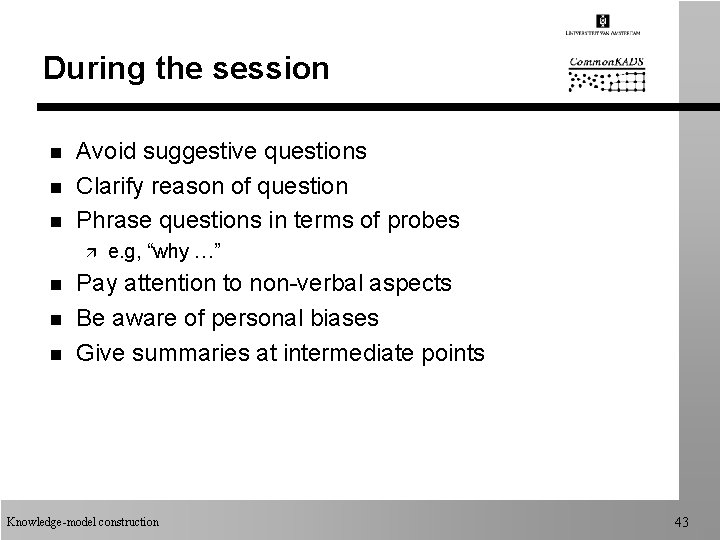
During the session n Avoid suggestive questions Clarify reason of question Phrase questions in terms of probes ä n n n e. g, “why …” Pay attention to non-verbal aspects Be aware of personal biases Give summaries at intermediate points Knowledge-model construction 43
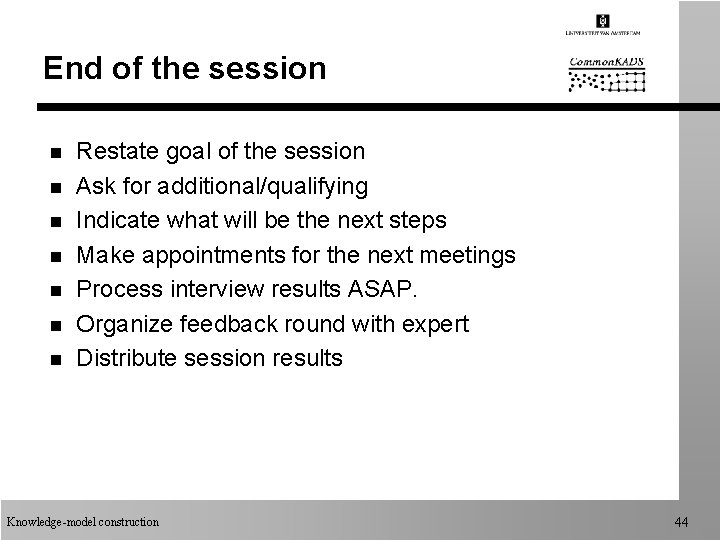
End of the session n n n Restate goal of the session Ask for additional/qualifying Indicate what will be the next steps Make appointments for the next meetings Process interview results ASAP. Organize feedback round with expert Distribute session results Knowledge-model construction 44
Unstructured interview n n n No detailed agenda Few constraints Delivers diverse, incomplete data Used in early stages: feasibility study, knowledge identification Useful to establish a common basis with expert ä s/he can talk freely Knowledge-model construction 45
Structured interview n n Knowledge engineer plans and directs the session Takes form of provider-elicitor dialogue Delivers more focused expertise data Often used for “filling in the gaps” in the knowledge base ä n n knowledge refinement phase Also useful at end of knowledge identification or start of knowledge specification Always create a transcript Knowledge-model construction 46
Interview structure for domainknowledge elicitation n Identify a particular sub-task ä n n n should be relatively small task, e. g. an inference Ask expert to identify “rules” used in this task Take each rule, and ask when it is useful and when not Use fixed set of probes: ä ä ä “Why would you do that? ” “How would you do that? ” “When would you do that? ” “What alternatives are there for this action? ” “What if …? ” “Can you tell me more about. . ? ” Knowledge-model construction 47
Interview pitfalls n n Experts can only produce what they can verbalize Experts seek to justify actions in any way they can ä n “spurious justification” Therefore: supplement with techniques that observe expertise “in action” ä e. g. self report Knowledge-model construction 48
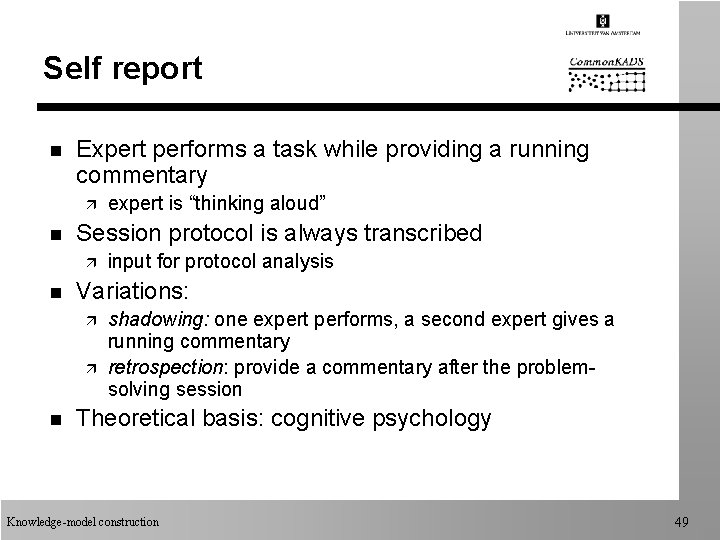
Self report n Expert performs a task while providing a running commentary ä n Session protocol is always transcribed ä n input for protocol analysis Variations: ä ä n expert is “thinking aloud” shadowing: one expert performs, a second expert gives a running commentary retrospection: provide a commentary after the problemsolving session Theoretical basis: cognitive psychology Knowledge-model construction 49
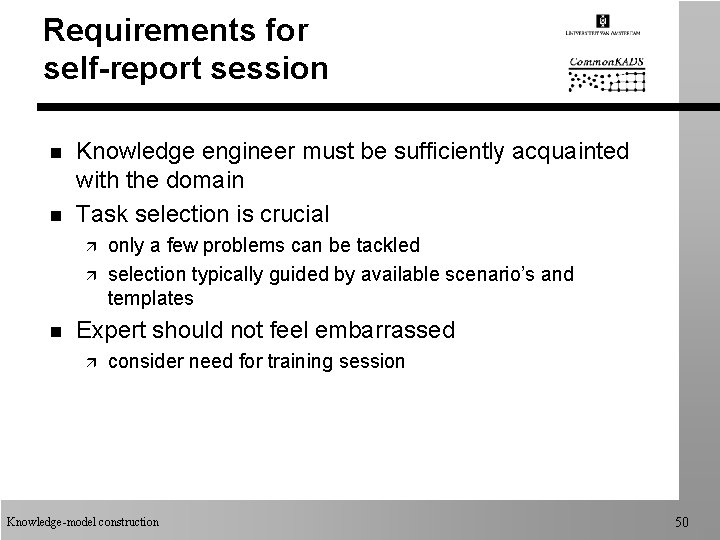
Requirements for self-report session n n Knowledge engineer must be sufficiently acquainted with the domain Task selection is crucial ä ä n only a few problems can be tackled selection typically guided by available scenario’s and templates Expert should not feel embarrassed ä consider need for training session Knowledge-model construction 50
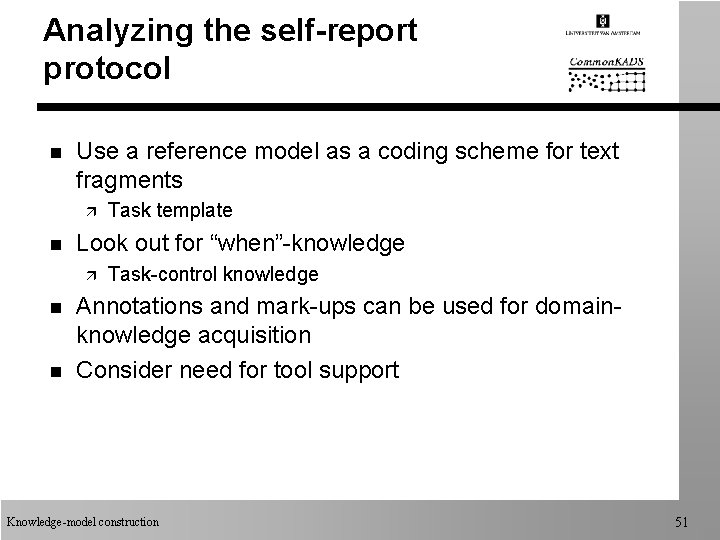
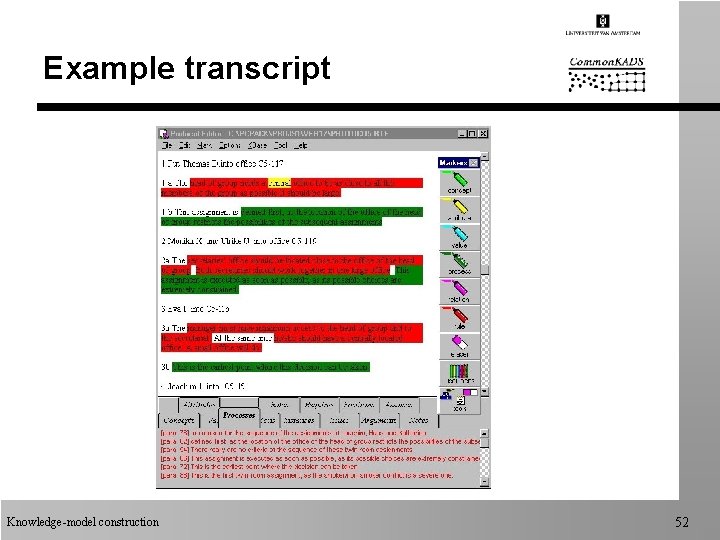
Analyzing the self-report protocol n Use a reference model as a coding scheme for text fragments ä n Look out for “when”-knowledge ä n n Task template Task-control knowledge Annotations and mark-ups can be used for domainknowledge acquisition Consider need for tool support Knowledge-model construction 51
Example transcript Knowledge-model construction 52
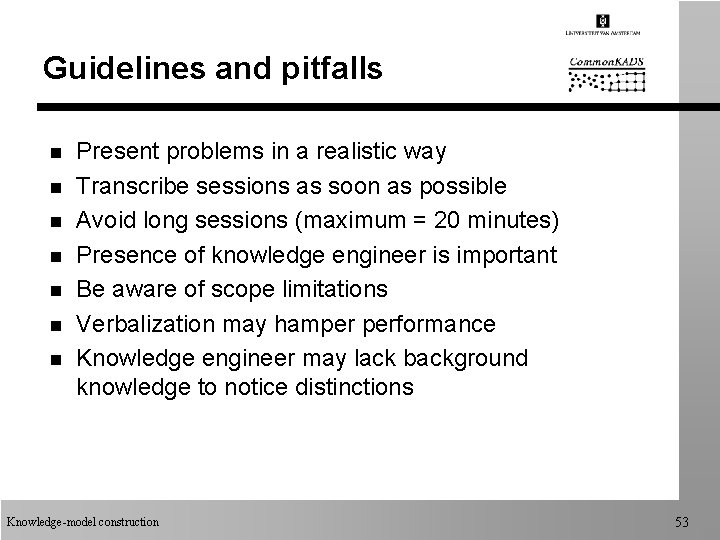
Guidelines and pitfalls n n n n Present problems in a realistic way Transcribe sessions as soon as possible Avoid long sessions (maximum = 20 minutes) Presence of knowledge engineer is important Be aware of scope limitations Verbalization may hamper performance Knowledge engineer may lack background knowledge to notice distinctions Knowledge-model construction 53
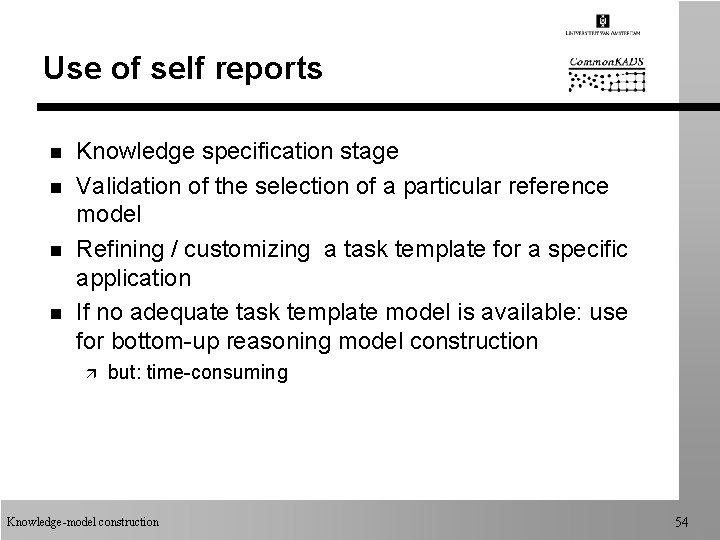
Use of self reports n n Knowledge specification stage Validation of the selection of a particular reference model Refining / customizing a task template for a specific application If no adequate task template model is available: use for bottom-up reasoning model construction ä but: time-consuming Knowledge-model construction 54
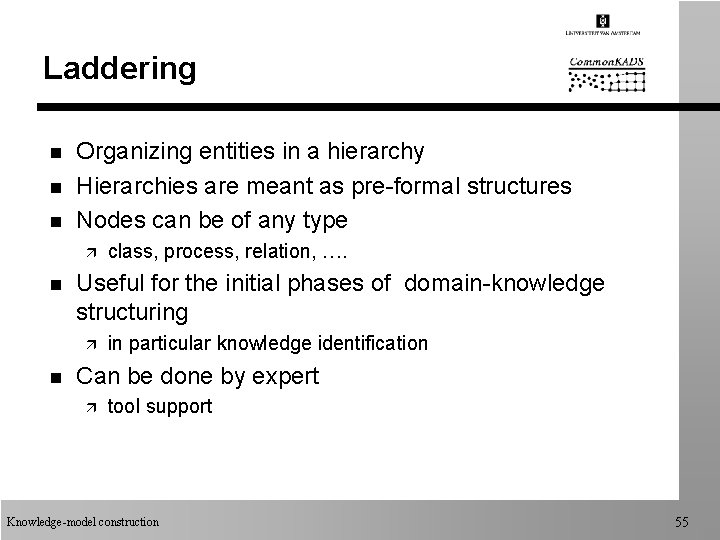
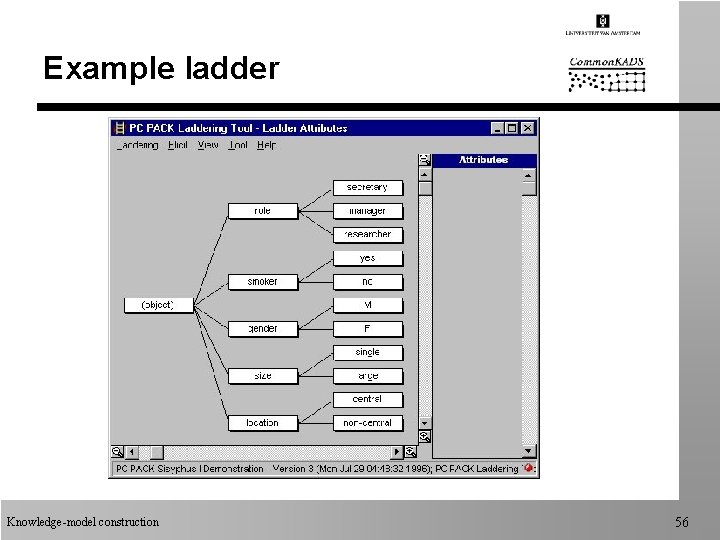
Laddering n n n Organizing entities in a hierarchy Hierarchies are meant as pre-formal structures Nodes can be of any type ä n Useful for the initial phases of domain-knowledge structuring ä n class, process, relation, …. in particular knowledge identification Can be done by expert ä tool support Knowledge-model construction 55
Example ladder Knowledge-model construction 56
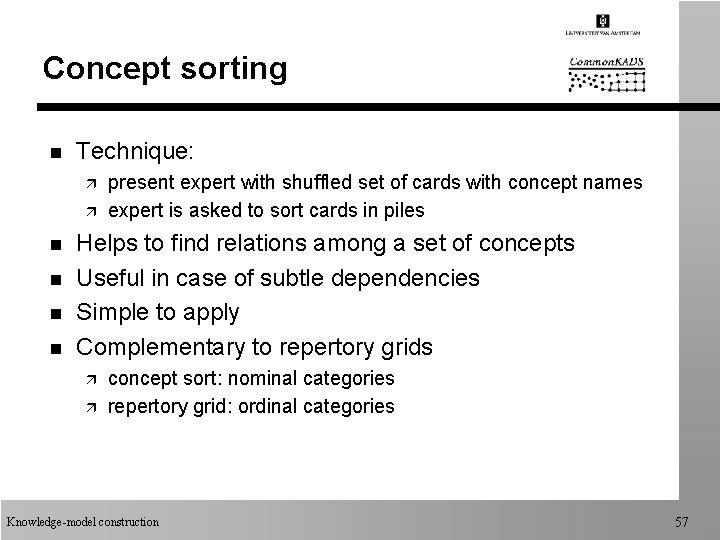
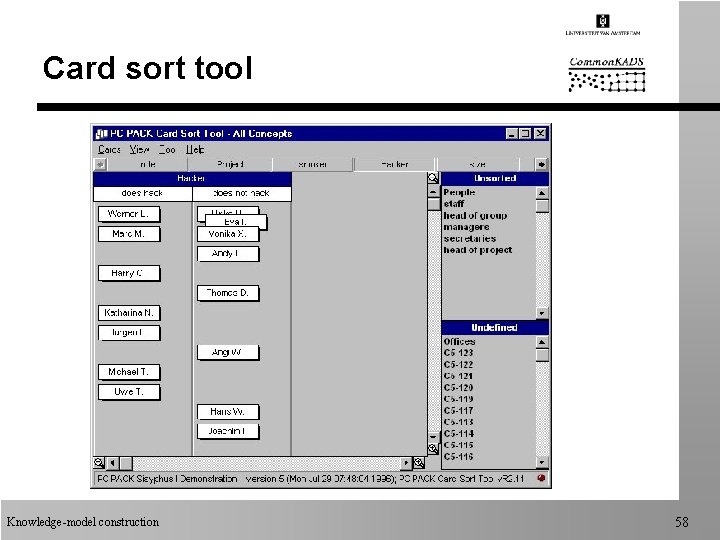
Concept sorting n Technique: ä ä n n present expert with shuffled set of cards with concept names expert is asked to sort cards in piles Helps to find relations among a set of concepts Useful in case of subtle dependencies Simple to apply Complementary to repertory grids ä ä concept sort: nominal categories repertory grid: ordinal categories Knowledge-model construction 57
Card sort tool Knowledge-model construction 58
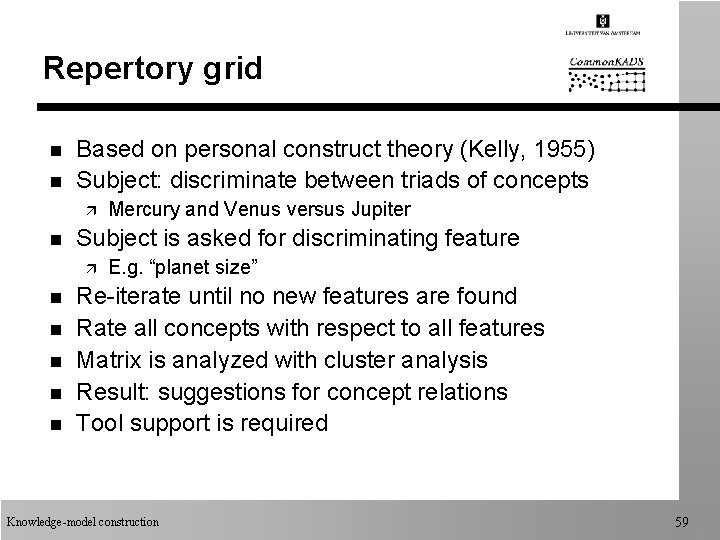
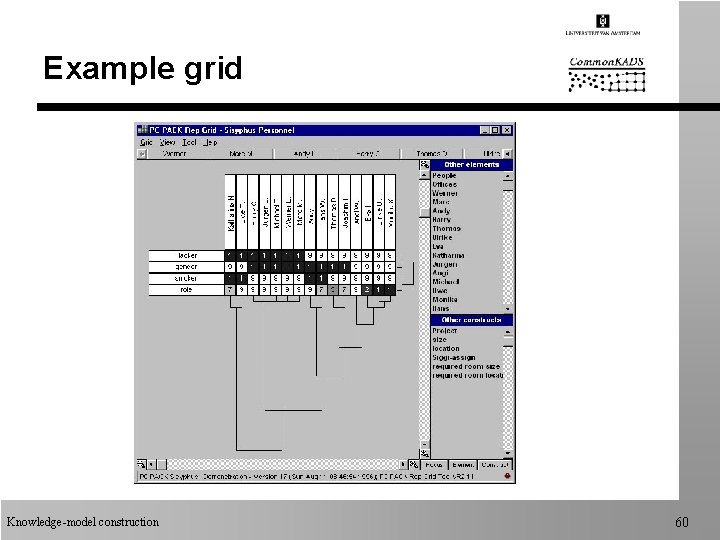
Repertory grid n n Based on personal construct theory (Kelly, 1955) Subject: discriminate between triads of concepts ä n Subject is asked for discriminating feature ä n n n Mercury and Venus versus Jupiter E. g. “planet size” Re-iterate until no new features are found Rate all concepts with respect to all features Matrix is analyzed with cluster analysis Result: suggestions for concept relations Tool support is required Knowledge-model construction 59
Example grid Knowledge-model construction 60
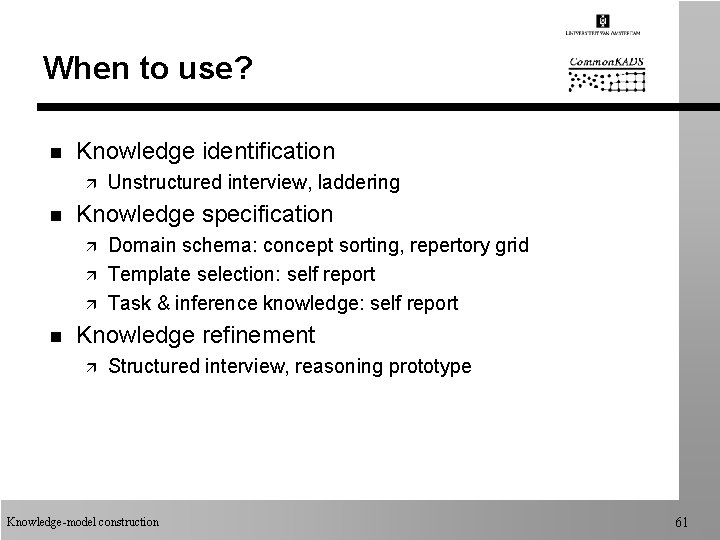
When to use? n Knowledge identification ä n Knowledge specification ä ä ä n Unstructured interview, laddering Domain schema: concept sorting, repertory grid Template selection: self report Task & inference knowledge: self report Knowledge refinement ä Structured interview, reasoning prototype Knowledge-model construction 61