
Knowledge Mobilization In Education Ben Levin Amanda Cooper

Knowledge Mobilization In Education Ben Levin & Amanda Cooper CSSE 2009

KNOWLEDGE MOBILIZATION (KM) Multiple Definitions By Sector GETTING THE MOVING RIGHT KNOWLEDGE INFORMATION INTO ACTIVE TO THE RIGHT SERVICE FOR PEOPLE IN THE RIGHT FORMAT BROADEST AT THE RIGHT POSSIBLE TIME SO AS TO COMMON INFLUENCE GOOD DECISION(SSHRC) MAKING THE PROCESS COLLABORATIVE FROM THE PROBLEMCREATION SOLVING OF BETWEEN EVIDENCE RESEARCHERS AND TO ITS DECISION MAKERS ULTIMATE THAT HAPPENS IMPACT THROUGH LINKAGE AND EXCHANGE (Knowledge Exchange, Translation, CHSRF) CIHR)
There is Growing Momentum Globally • Increasing public and media interest • Increasing government support ▫ Rhetorically (stated commitment) ▫ Resources (research centers, projects) • Increasing academic activity ▫ Journals, centres, conferences • Increasing presence of knowledge brokers • National and international
Learning More About Key Issues • Multiple forms of ‘use’ • Multiple forms of communication ▫ Importance of person to person • Role of third parties • Institutional infrastructure
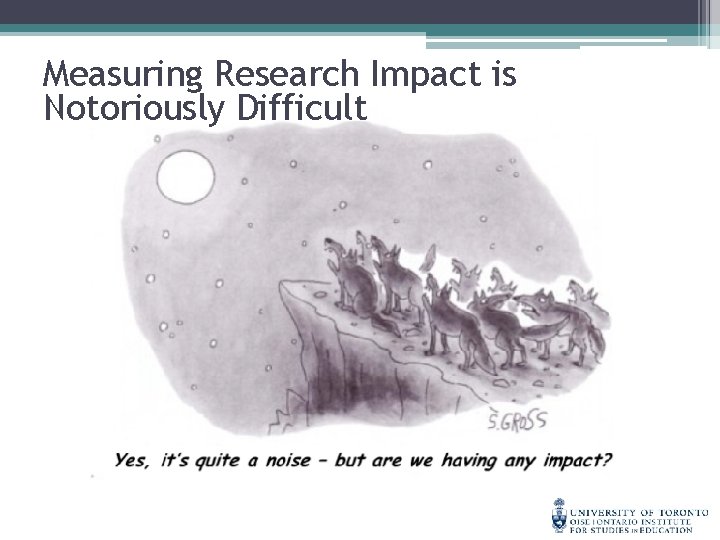
Measuring Research Impact is Notoriously Difficult
Measuring KM & Research Use • Research is used in varying ways: ▫ Conceptual (influences ideas, thinking) ▫ Symbolic (justifies stance or decision) ▫ Instrumental (processes, decisions, policy, practice) • Measuring KM is difficult: 1. How much research use is actually occurring (baseline for change)? 2. What are the access points where research can leverage educational improvement?
Some Canadian Evidence • Landry et al – researchers’ efforts to communicate • Amara et al – agencies’ use of research • Belkhodja et al – research use in health
Use of Social Science Research • Survey of 1229 Canadian social science scholars ▫ Half of social science researchers report efforts to communicate with professionals ▫ Varies across disciplines; professional fields have more ▫ Researcher effort matters more than context (Landry, Amara & Lamari, 2001)
Research Use in Government Agencies • 833 survey responses from government officials ▫ Reported use Conceptual (22% of respondents) Symbolic (16%) Concrete Action (12%) ▫ Some policy domains (including education) have consitently higher use ▫ Managers who have graduate degrees do more (Amara, Ouimet, & Landry, 2004)
Organizational Determinants of Research Use in Health • 928 survey responses (ministries, regional authorities, hospitals) ▫ Variables: absorptive capacity, organizational culture, adaptation efforts, learning ▫ Most important factors are linkage mechanisms & research experience, followed by unit size and research relevance for users ▫ Adaptation efforts did not impact research use (Belkhodja, Amara, Landry & Ouimet, 2007)
Research Supporting Practice in Education (RSPE) • Group of graduate students and faculty • Organized program of research and learning ▫ ▫ ▫ Empirical studies Resource for definitions, studies, bibliography Wiki to develop shared approach International e-list discussion Tools for analyzing website use www. oise. utoronto. ca/rspe
RSPE Empirical Studies • Research Use in Secondary Schools (CEA) • Research Use in Faculties of Education (SSHRC) • Website Analysis of KM Efforts (CRC) • Use of Web-based Research Material (CRC)
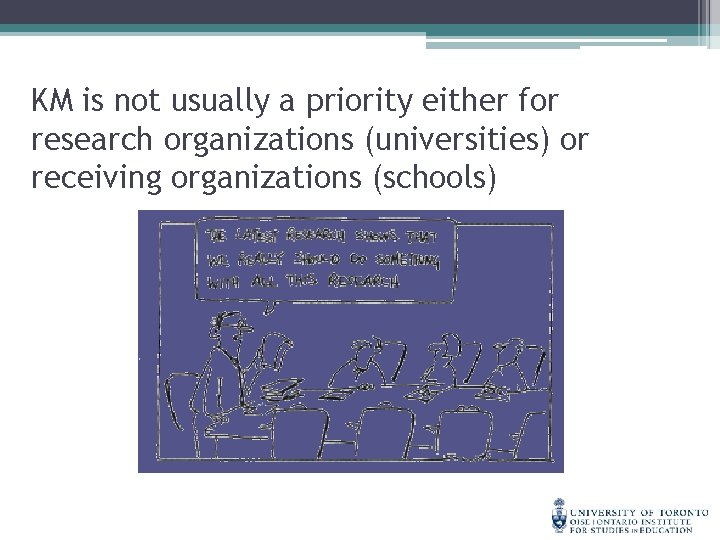
KM is not usually a priority either for research organizations (universities) or receiving organizations (schools)
Next Steps • Support development of KM as a field ▫ More empirical work on KM efforts and take-up ▫ Better tools to assess KM and use ▫ More work on role of third parties • Engage education partners in KM work ▫ Joint projects in various areas • Build networks across disciplines and settings
Thank You www. oise. utoronto. ca/rspe blevin@oise. utoronto. ca acooper@oise. utoronto. ca
- Slides: 15