
Knowledge Management Leveraging NGO Resources Albert Simard Presented
Knowledge Management: Leveraging NGO Resources Albert Simard Presented to Workshop on Diplomacy and Negotiation Washington DC September 18, 2 -13
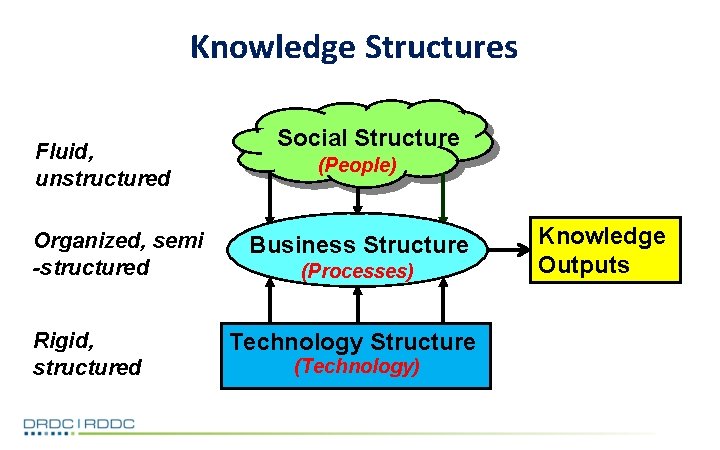
Knowledge Structures Fluid, unstructured Organized, semi -structured Rigid, structured Social Structure (People) Business Structure (Processes) Technology Structure (Technology) Knowledge Outputs
Outline Knowledge Management Social Interaction Knowledge Work
Some Definitions Knowledge: Understanding cause-and-effect relationships that help to explain and predict physical, biological, or social phenomena. Knowledge Management: Develop and implement a knowledge infrastructure to support creating, managing, and using knowledge. Knowledge Work: People creating, managing, or using knowledge to produce products or deliver services that achieve organizational goals. 3
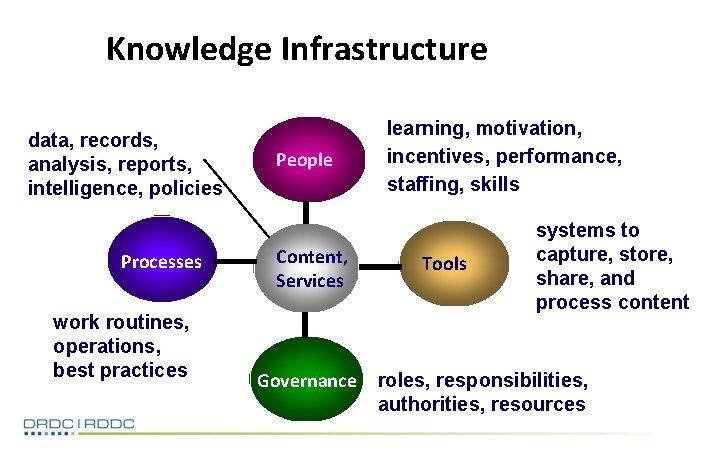
Knowledge Infrastructure data, records, analysis, reports, intelligence, policies Processes work routines, operations, best practices People Content, Services Governance learning, motivation, incentives, performance, staffing, skills Tools systems to capture, store, share, and process content roles, responsibilities, authorities, resources
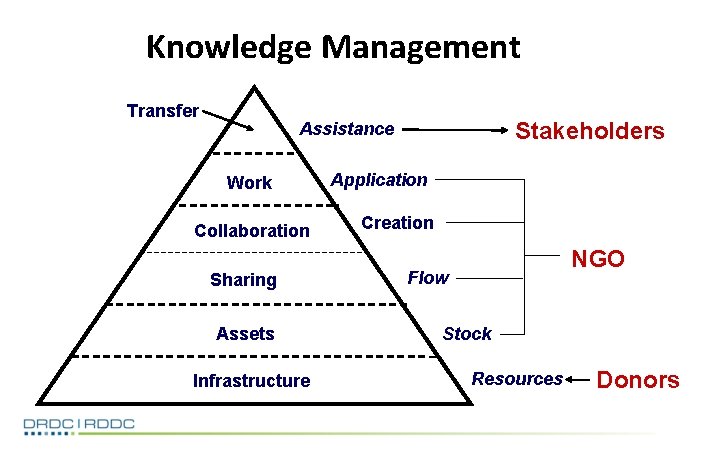
Knowledge Management Transfer Stakeholders Assistance Work Collaboration Sharing Assets Infrastructure Application Creation NGO Flow Stock Resources Donors
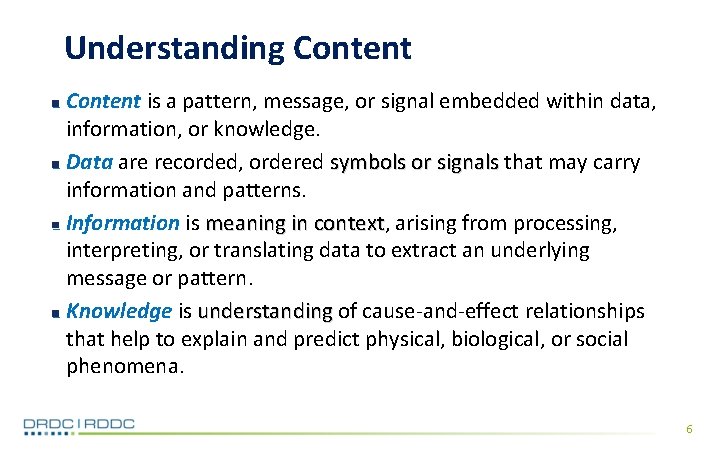
Understanding Content is a pattern, message, or signal embedded within data, information, or knowledge. Data are recorded, ordered symbols or signals that may carry information and patterns. Information is meaning in context, context arising from processing, interpreting, or translating data to extract an underlying message or pattern. Knowledge is understanding of cause-and-effect relationships that help to explain and predict physical, biological, or social phenomena. 6
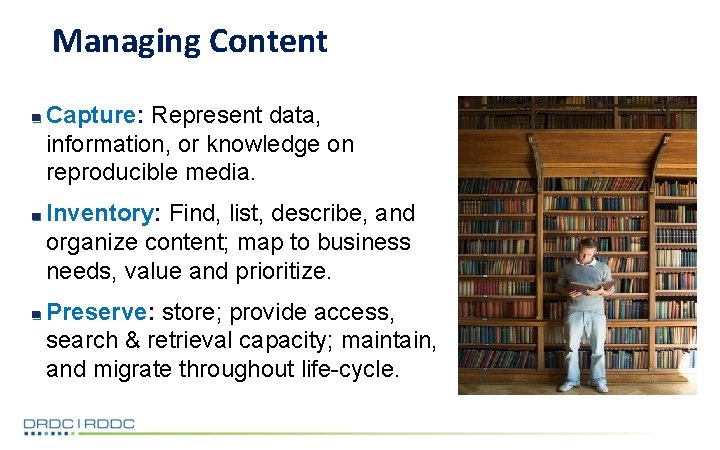
Managing Content Capture: Represent data, information, or knowledge on reproducible media. Inventory: Find, list, describe, and organize content; map to business needs, value and prioritize. Preserve: store; provide access, search & retrieval capacity; maintain, and migrate throughout life-cycle.
Storing Content Information technology Network infrastructure Database, data management Information library, information management Knowledge repository, knowledge management Interfaces for entry, retrieval, & administration
Retrieving Content Access to content Browser interface Search engine Extraction tools Manipulation tools Assembly tools Retrieval system
Outline Knowledge Management Social Interaction Knowledge Work
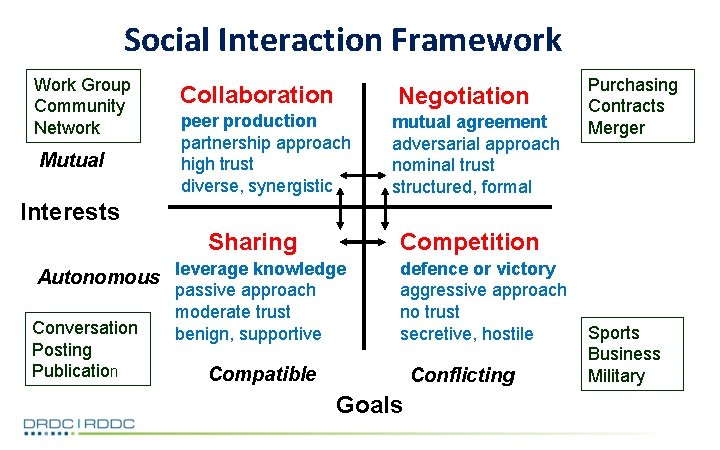
Social Interaction Framework Work Group Community Network Mutual Collaboration Negotiation peer production partnership approach high trust diverse, synergistic mutual agreement adversarial approach nominal trust structured, formal Purchasing Contracts Merger Interests Sharing Competition Autonomous leverage knowledge Conversation Posting Publication passive approach moderate trust benign, supportive defence or victory aggressive approach no trust secretive, hostile Compatible Conflicting Goals Sports Business Military
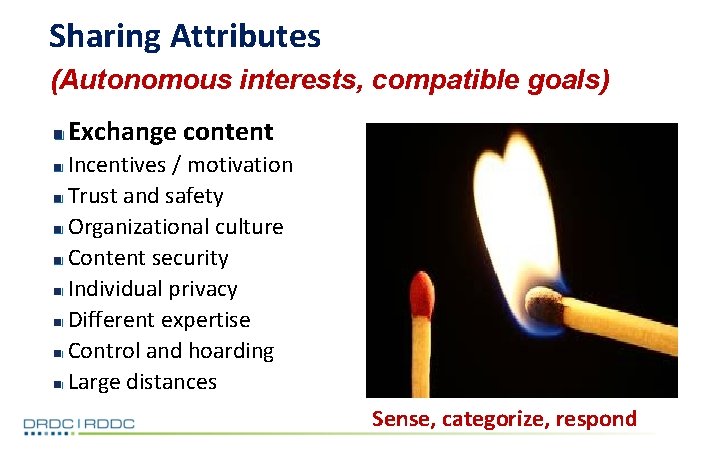
Sharing Attributes (Autonomous interests, compatible goals) Exchange content Incentives / motivation Trust and safety Organizational culture Content security Individual privacy Different expertise Control and hoarding Large distances Sense, categorize, respond
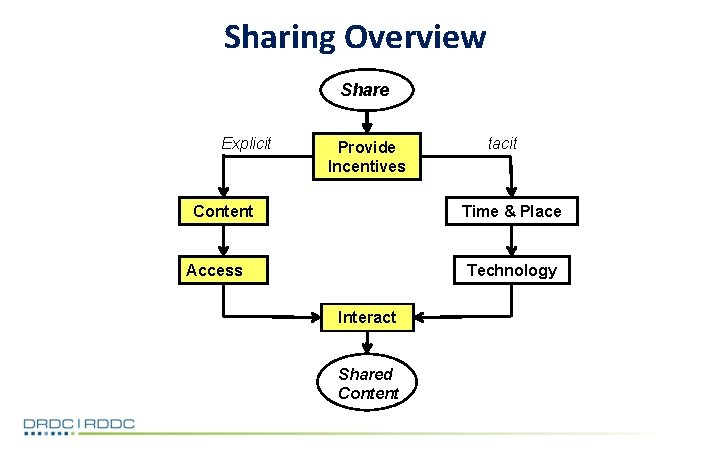
Sharing Overview Share Explicit Provide Incentives Content tacit Time & Place Access Technology Interact Shared Content
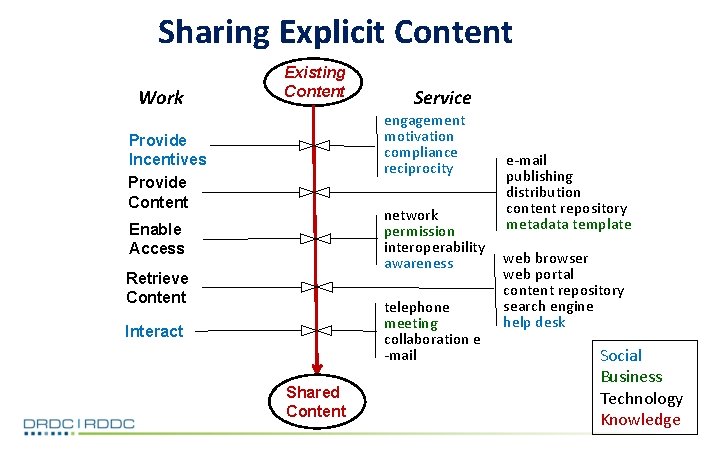
Sharing Explicit Content Work Existing Content Service engagement motivation compliance reciprocity Provide Incentives Provide Content network permission interoperability awareness Enable Access Retrieve Content telephone meeting collaboration e -mail Interact Shared Content e-mail publishing distribution content repository metadata template web browser web portal content repository search engine help desk Social Business Technology Knowledge
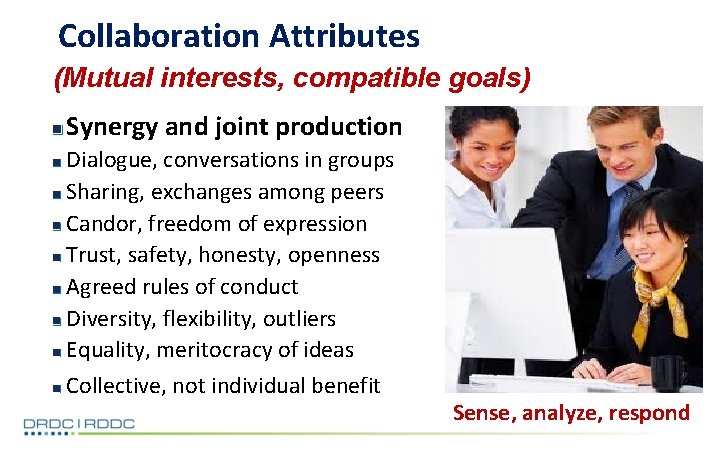
Collaboration Attributes (Mutual interests, compatible goals) Synergy and joint production Dialogue, conversations in groups Sharing, exchanges among peers Candor, freedom of expression Trust, safety, honesty, openness Agreed rules of conduct Diversity, flexibility, outliers Equality, meritocracy of ideas Collective, not individual benefit Sense, analyze, respond
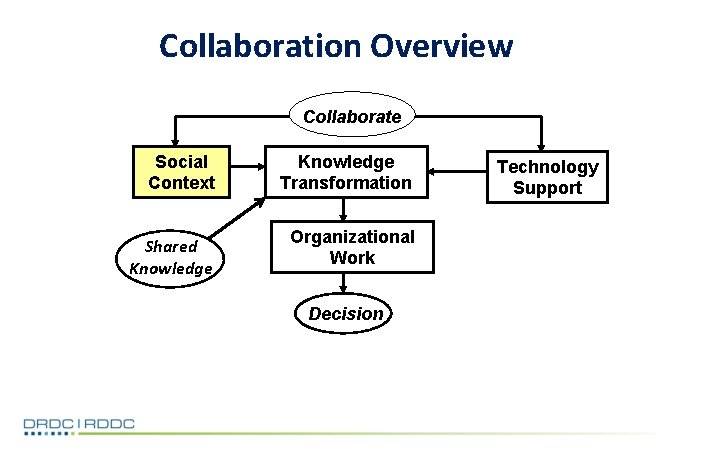
Collaboration Overview Collaborate Social Context Knowledge Transformation Shared Knowledge Organizational Work Decision Technology Support
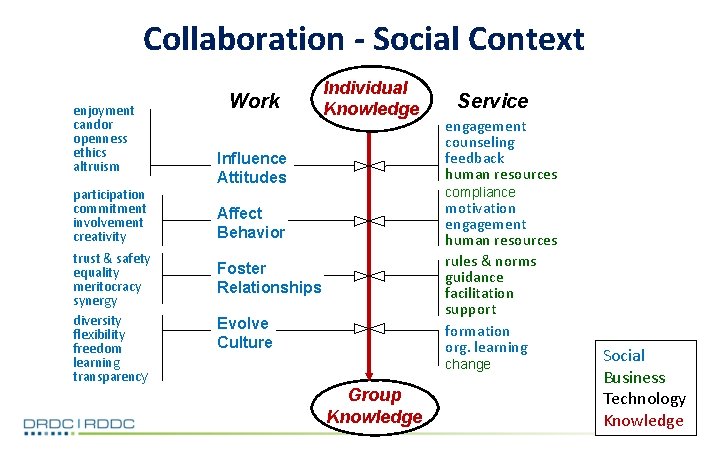
Collaboration - Social Context enjoyment candor openness ethics altruism participation commitment involvement creativity trust & safety equality meritocracy synergy diversity flexibility freedom learning transparency Work Individual Knowledge Influence Attitudes Service engagement counseling feedback human resources compliance motivation engagement human resources rules & norms guidance facilitation support formation org. learning Affect Behavior Foster Relationships Evolve Culture change Group Knowledge Social Business Technology Knowledge
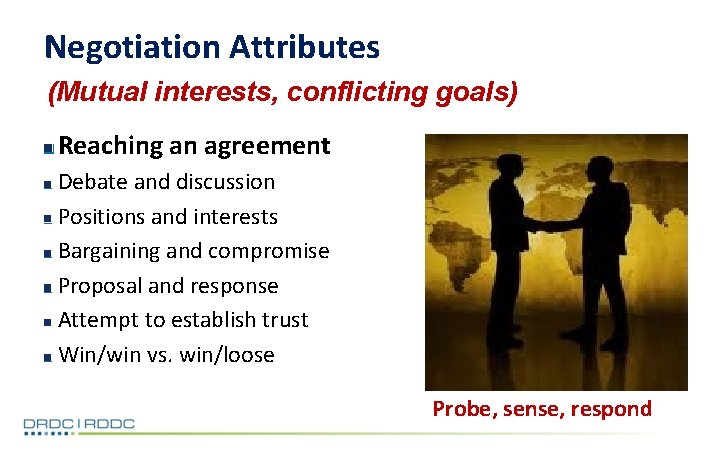
Negotiation Attributes (Mutual interests, conflicting goals) Reaching an agreement Debate and discussion Positions and interests Bargaining and compromise Proposal and response Attempt to establish trust Win/win vs. win/loose Probe, sense, respond
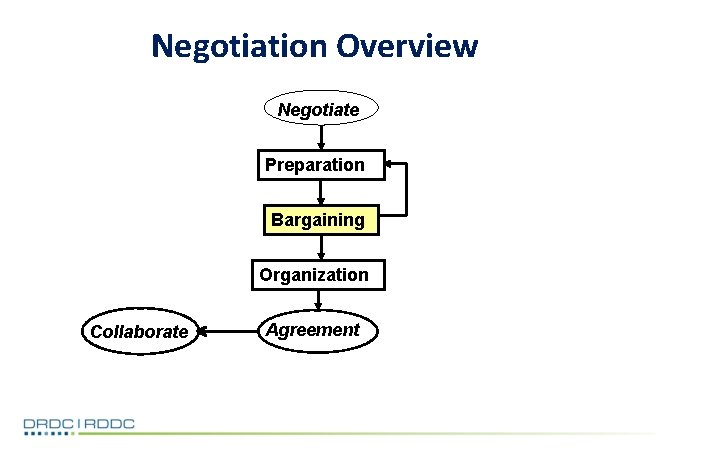
Negotiation Overview Negotiate Preparation Bargaining Organization Collaborate Agreement
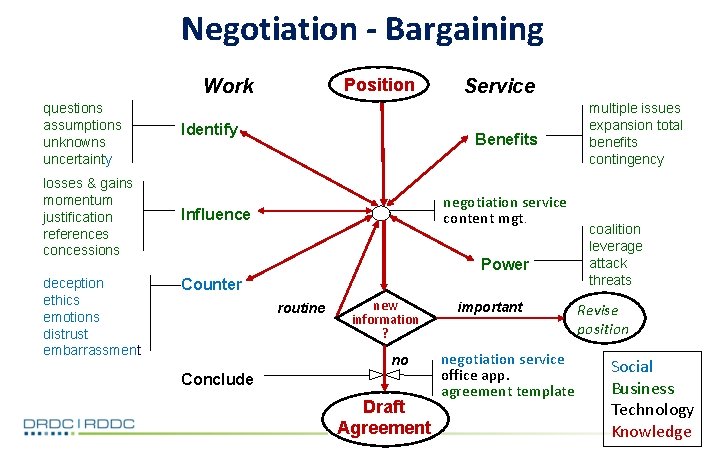
Negotiation - Bargaining Position Work questions assumptions unknowns uncertainty losses & gains momentum justification references concessions deception ethics emotions distrust embarrassment Identify Service Benefits negotiation service content mgt. Influence Power Counter routine new information ? no Conclude Draft Agreement important negotiation service office app. agreement template multiple issues expansion total benefits contingency coalition leverage attack threats Revise position Social Business Technology Knowledge
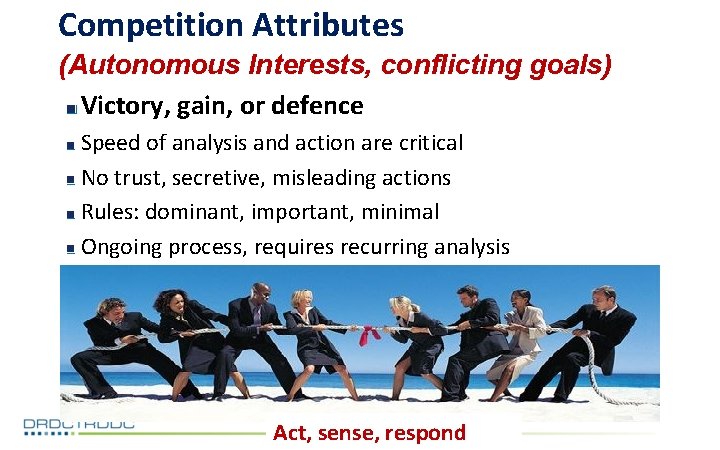
Competition Attributes (Autonomous Interests, conflicting goals) Victory, gain, or defence Speed of analysis and action are critical No trust, secretive, misleading actions Rules: dominant, important, minimal Ongoing process, requires recurring analysis Act, sense, respond
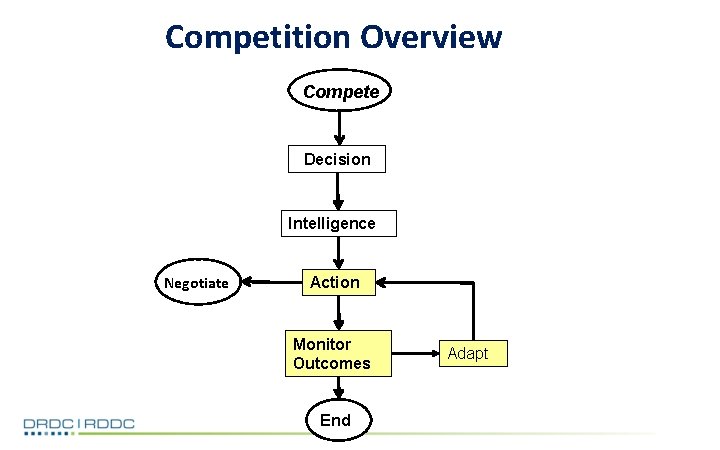
Competition Overview Compete Decision Intelligence Negotiate Action Monitor Outcomes End Adapt
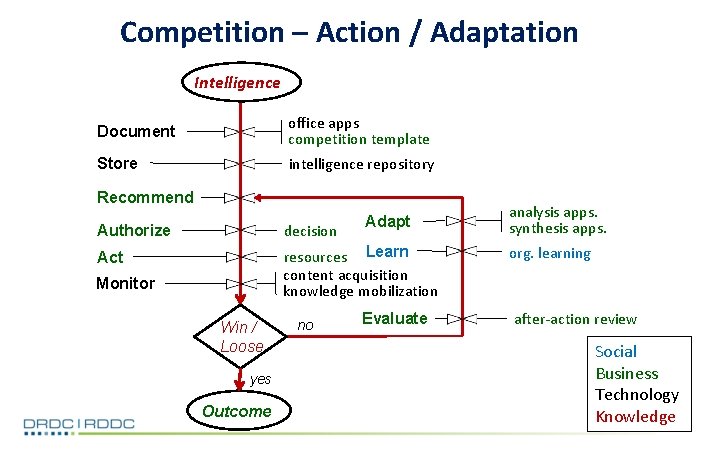
Competition – Action / Adaptation Intelligence Document office apps competition template Store intelligence repository Recommend Adapt Authorize decision Act resources Learn content acquisition knowledge mobilization Monitor Win / Loose yes Outcome no Evaluate analysis apps. synthesis apps. org. learning after-action review Social Business Technology Knowledge
Outline Knowledge Management Social Interaction Knowledge Work
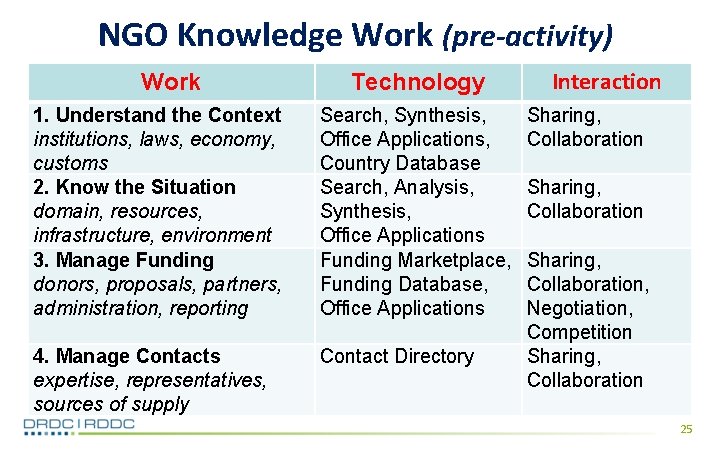
NGO Knowledge Work (pre-activity) Work Technology 1. Understand the Context institutions, laws, economy, customs 2. Know the Situation domain, resources, infrastructure, environment 3. Manage Funding donors, proposals, partners, administration, reporting Search, Synthesis, Office Applications, Country Database Search, Analysis, Synthesis, Office Applications Funding Marketplace, Funding Database, Office Applications 4. Manage Contacts expertise, representatives, sources of supply Contact Directory Interaction Sharing, Collaboration, Negotiation, Competition Sharing, Collaboration 25
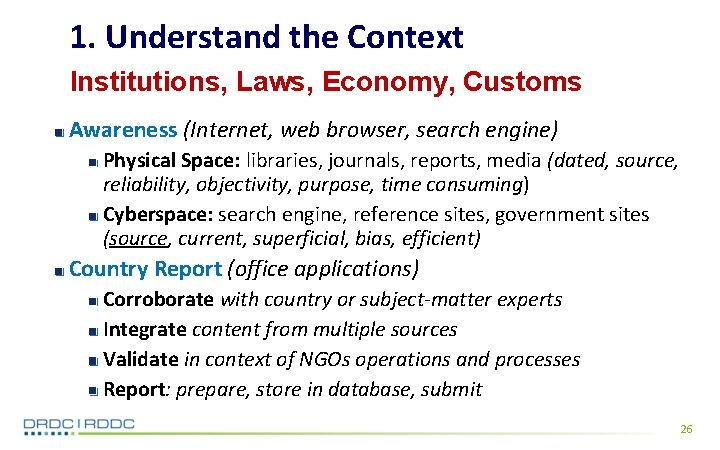
1. Understand the Context Institutions, Laws, Economy, Customs Awareness (Internet, web browser, search engine) Physical Space: libraries, journals, reports, media (dated, source, reliability, objectivity, purpose, time consuming) Cyberspace: search engine, reference sites, government sites (source, current, superficial, bias, efficient) Country Report (office applications) Corroborate with country or subject-matter experts Integrate content from multiple sources Validate in context of NGOs operations and processes Report: prepare, store in database, submit 26
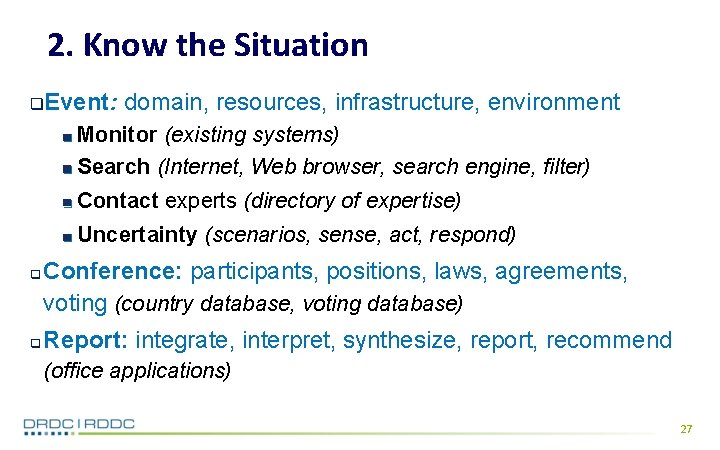
2. Know the Situation q. Event: domain, resources, infrastructure, environment Monitor (existing systems) Search (Internet, Web browser, search engine, filter) Contact experts (directory of expertise) Uncertainty (scenarios, sense, act, respond) q q Conference: participants, positions, laws, agreements, voting (country database, voting database) Report: integrate, interpret, synthesize, report, recommend (office applications) 27
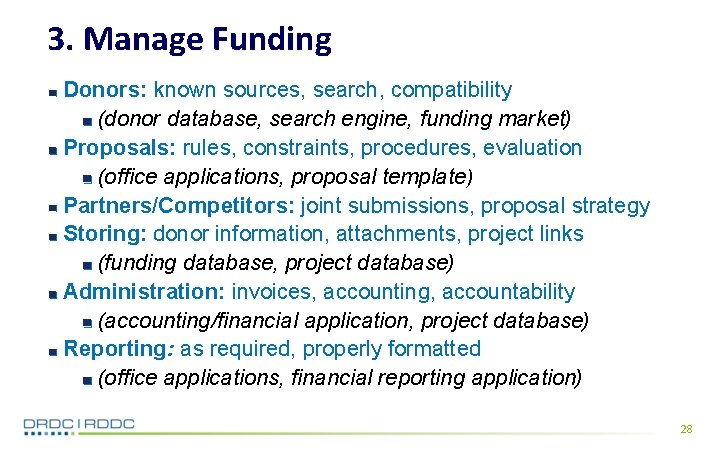
3. Manage Funding Donors: known sources, search, compatibility (donor database, search engine, funding market) Proposals: rules, constraints, procedures, evaluation (office applications, proposal template) Partners/Competitors: joint submissions, proposal strategy Storing: donor information, attachments, project links (funding database, project database) Administration: invoices, accounting, accountability (accounting/financial application, project database) Reporting: as required, properly formatted (office applications, financial reporting application) 28
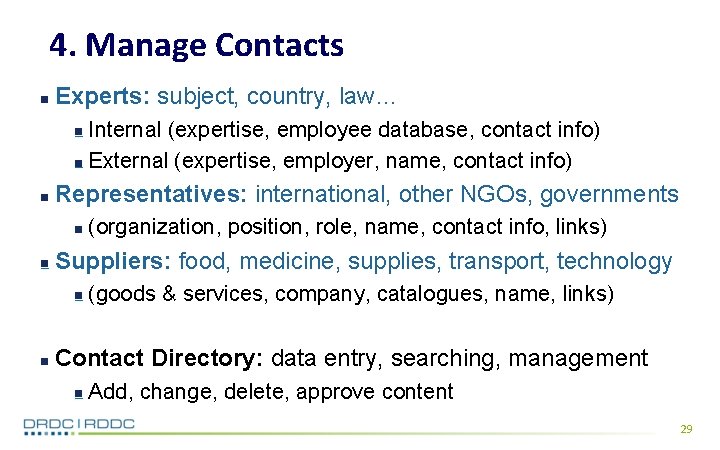
4. Manage Contacts Experts: subject, country, law… Internal (expertise, employee database, contact info) External (expertise, employer, name, contact info) Representatives: international, other NGOs, governments (organization, position, role, name, contact info, links) Suppliers: food, medicine, supplies, transport, technology (goods & services, company, catalogues, name, links) Contact Directory: data entry, searching, management Add, change, delete, approve content 29
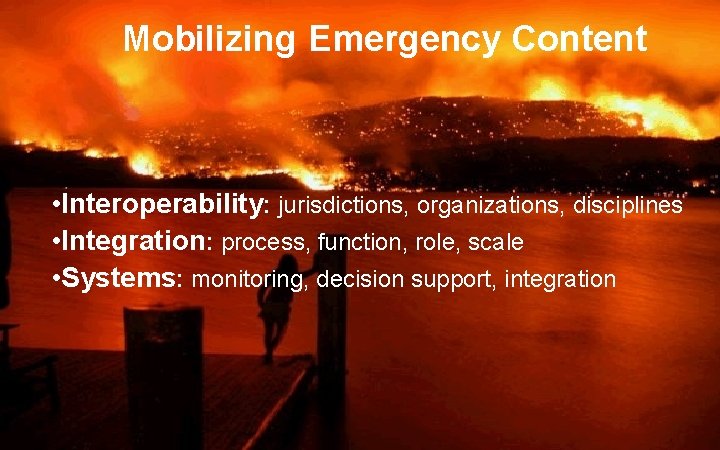
Mobilizing Emergency Content • Interoperability: jurisdictions, organizations, disciplines • Integration: process, function, role, scale • Systems: monitoring, decision support, integration
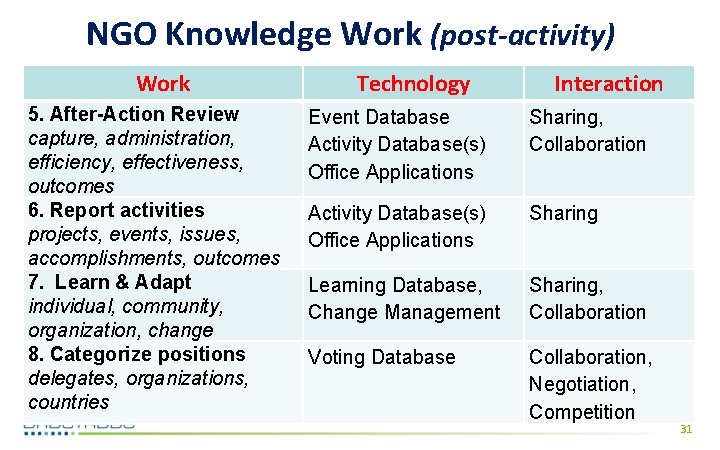
NGO Knowledge Work (post-activity) Work 5. After-Action Review capture, administration, efficiency, effectiveness, outcomes 6. Report activities projects, events, issues, accomplishments, outcomes 7. Learn & Adapt individual, community, organization, change 8. Categorize positions delegates, organizations, countries Technology Interaction Event Database Activity Database(s) Office Applications Sharing, Collaboration Activity Database(s) Office Applications Sharing Learning Database, Change Management Sharing, Collaboration Voting Database Collaboration, Negotiation, Competition 31
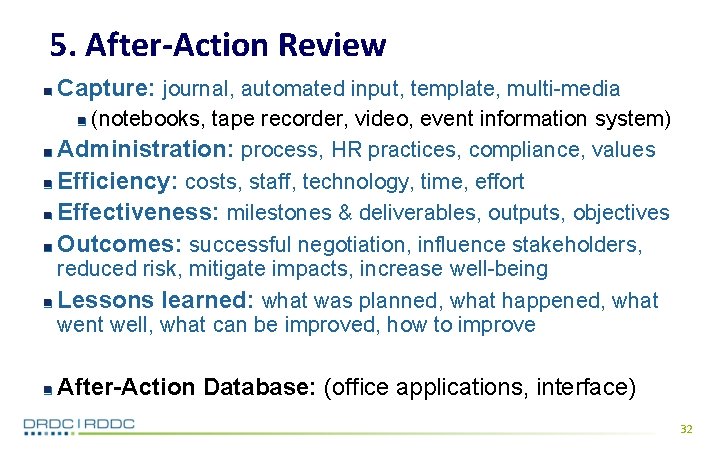
5. After-Action Review Capture: journal, automated input, template, multi-media (notebooks, tape recorder, video, event information system) Administration: process, HR practices, compliance, values Efficiency: costs, staff, technology, time, effort Effectiveness: milestones & deliverables, outputs, objectives Outcomes: successful negotiation, influence stakeholders, reduced risk, mitigate impacts, increase well-being Lessons learned: what was planned, what happened, what went well, what can be improved, how to improve After-Action Database: (office applications, interface) 32
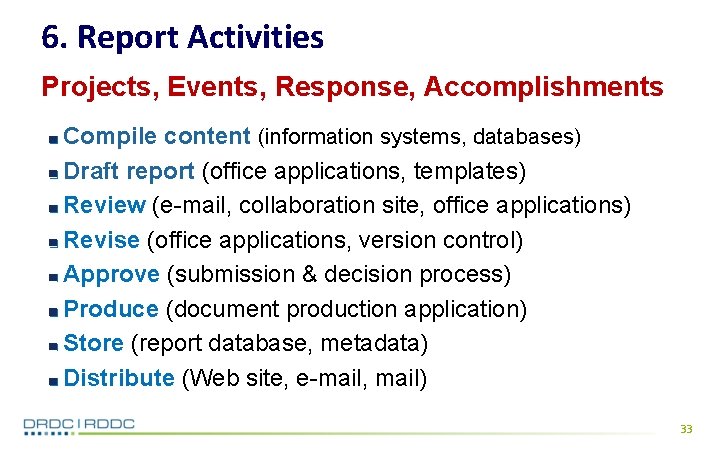
6. Report Activities Projects, Events, Response, Accomplishments Compile content (information systems, databases) Draft report (office applications, templates) Review (e-mail, collaboration site, office applications) Revise (office applications, version control) Approve (submission & decision process) Produce (document production application) Store (report database, metadata) Distribute (Web site, e-mail, mail) 33
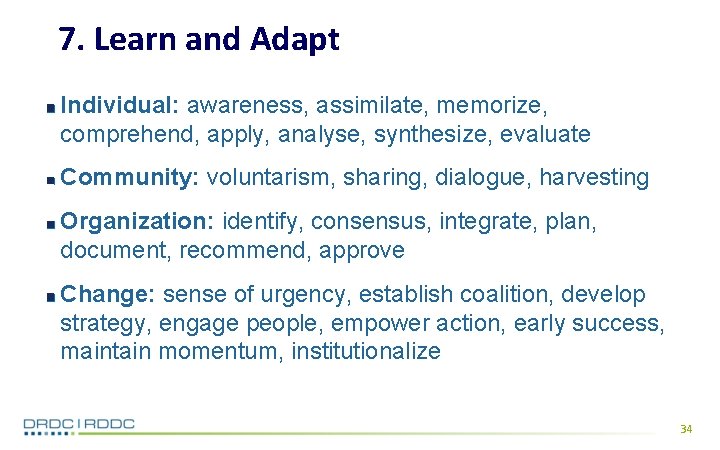
7. Learn and Adapt Individual: awareness, assimilate, memorize, comprehend, apply, analyse, synthesize, evaluate Community: voluntarism, sharing, dialogue, harvesting Organization: identify, consensus, integrate, plan, document, recommend, approve Change: sense of urgency, establish coalition, develop strategy, engage people, empower action, early success, maintain momentum, institutionalize 34
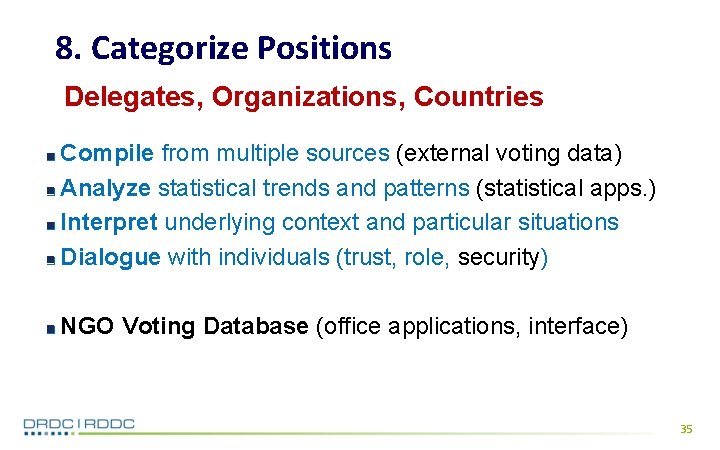
8. Categorize Positions Delegates, Organizations, Countries Compile from multiple sources (external voting data) Analyze statistical trends and patterns (statistical apps. ) Interpret underlying context and particular situations Dialogue with individuals (trust, role, security) NGO Voting Database (office applications, interface) 35
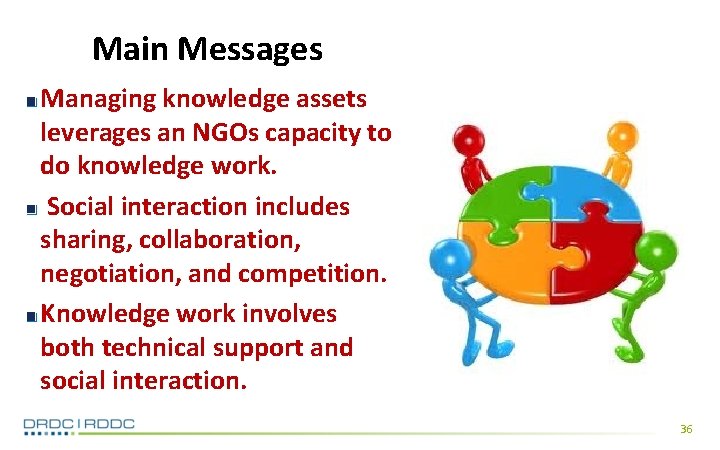
Main Messages Managing knowledge assets leverages an NGOs capacity to do knowledge work. Social interaction includes sharing, collaboration, negotiation, and competition. Knowledge work involves both technical support and social interaction. 36
E-Mail: albert. simard@drdc-rddc. gc. ca Presentations: http: //www. slideshare. net/albertsimard/slideshows http: //www. slideshare. net/Al. Simard/slideshows Knowledge Services: A Synthesis of Best Practices http: //cradpdf. drdc-rddc. gc. ca/PDFS/unc 121/p 536618_A 1 b. pdf
- Slides: 38