
KNOWLEDGE MANAGEMENT KM Session 8 Understanding KM Understanding
![One Perspective of KM “KM [Knowledge Management] involves blending a company’s internal and external](https://slidetodoc.com/presentation_image_h2/a2741888e8456db89aae061c7e0e1138/image-3.jpg "One Perspective of KM “KM [Knowledge Management] involves blending a company’s internal and external")

- Slides: 13
KNOWLEDGE MANAGEMENT (KM) Session # 8
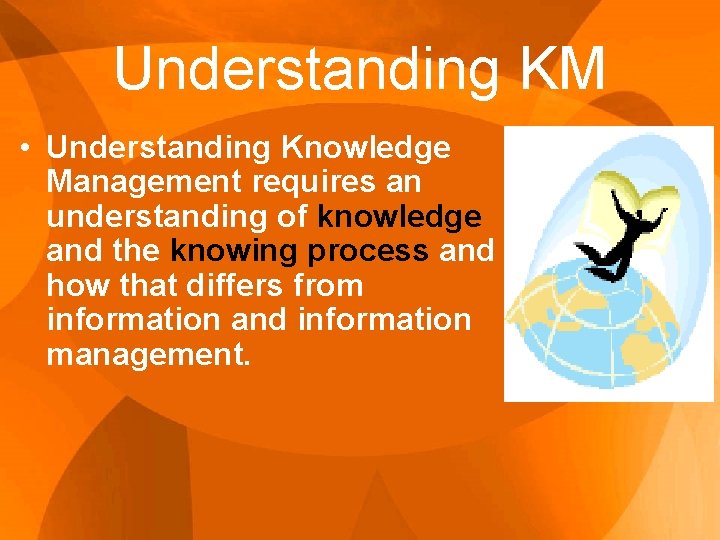
Understanding KM • Understanding Knowledge Management requires an understanding of knowledge and the knowing process and how that differs from information and information management.
One Perspective of KM “KM [Knowledge Management] involves blending a company’s internal and external information and turning it into actionable knowledge via a technology platform. ”
What is Knowledge Management? Knowledge holds the key to …… Competitive advantage, Better customer care, Increased return-on-investment, Faster time-to-market Enhanced performance, and Innovation.
What is Knowledge Management? • Knowledge management (KM) may simply be defined as doing what is needed to get the most out of knowledge resources.
What is Knowledge Management? • KM focuses on organizing and making available important knowledge, wherever and whenever it is needed to gain advantage in the global market.
What is Knowledge Management? KM helps to…. 1. Enhance decision making 2. Build bridge between islands of K 3. Helps to identify new islands of K
What is Knowledge Management? KM helps to…. 4. Leverage K already created 5. Simulate innovation thinking 6. Prepare next generation of K Workers
Value of KM ! Value of KM depends not on Knowledge or on ICT, But on the Use of Knowledge by an Organization’s members!
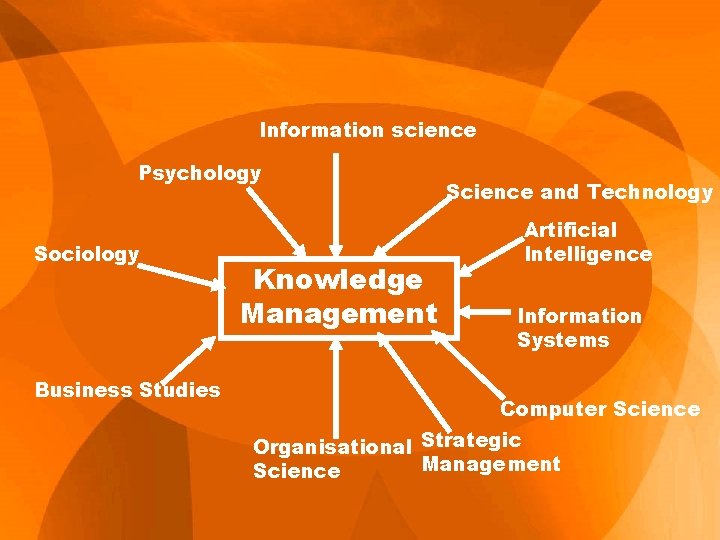
Information science Psychology Sociology Business Studies Knowledge Management Science and Technology Artificial Intelligence Information Systems Computer Science Organisational Strategic Management Science
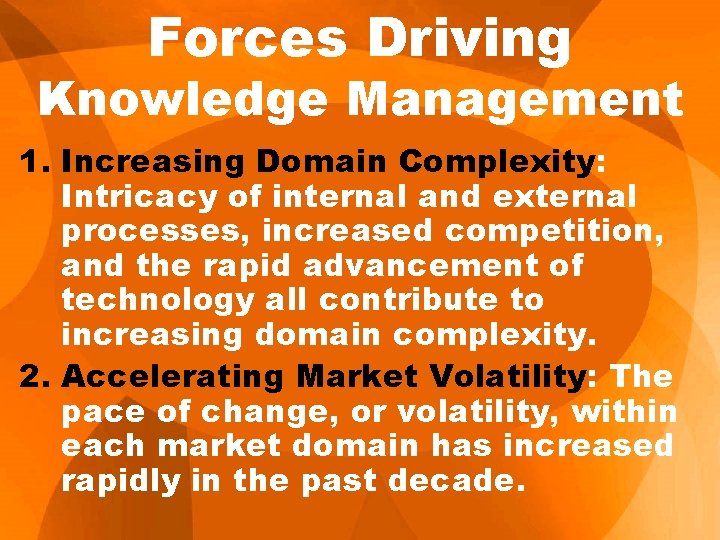
Forces Driving Knowledge Management 1. Increasing Domain Complexity: Intricacy of internal and external processes, increased competition, and the rapid advancement of technology all contribute to increasing domain complexity. 2. Accelerating Market Volatility: The pace of change, or volatility, within each market domain has increased rapidly in the past decade.
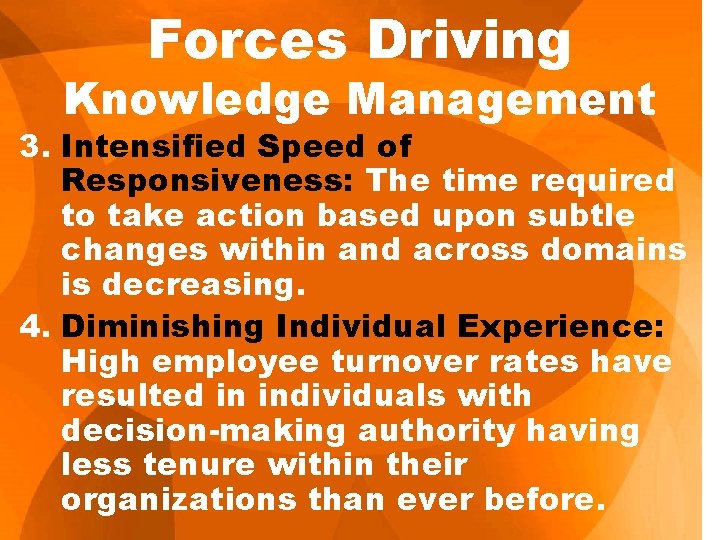
Forces Driving Knowledge Management 3. Intensified Speed of Responsiveness: The time required to take action based upon subtle changes within and across domains is decreasing. 4. Diminishing Individual Experience: High employee turnover rates have resulted in individuals with decision-making authority having less tenure within their organizations than ever before.
So, what does this mean? Faced with increased complexity, market volatility and accelerated responsiveness, Today’s younger manager feels less adequate to make the difficult decisions faced each day.