
KNOWLEDGE MANAGEMENT KM Session 35 KNOWLEDGE MANAGEMENT SYSTEMS


- Slides: 17
KNOWLEDGE MANAGEMENT (KM) Session # 35
KNOWLEDGE MANAGEMENT SYSTEMS; LIFE CYCLE APPROACH
Why Organizations Launch KM Programs ?
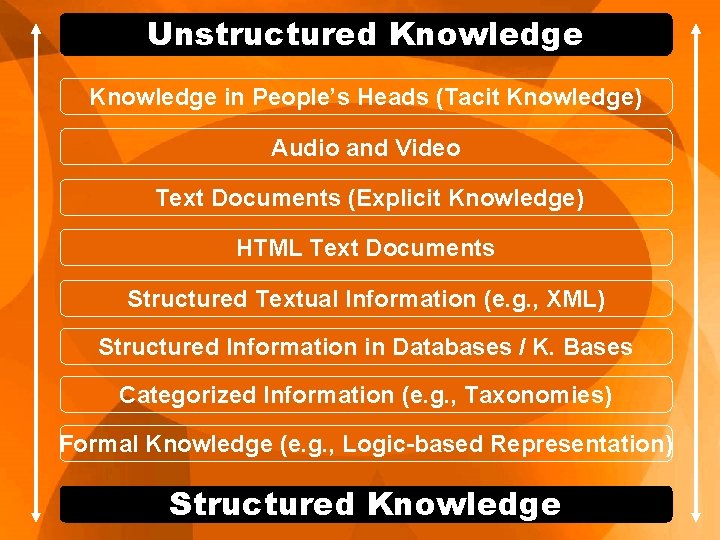
Unstructured Knowledge in People’s Heads (Tacit Knowledge) Audio and Video Text Documents (Explicit Knowledge) HTML Text Documents Structured Textual Information (e. g. , XML) Structured Information in Databases / K. Bases Categorized Information (e. g. , Taxonomies) Formal Knowledge (e. g. , Logic-based Representation) Structured Knowledge
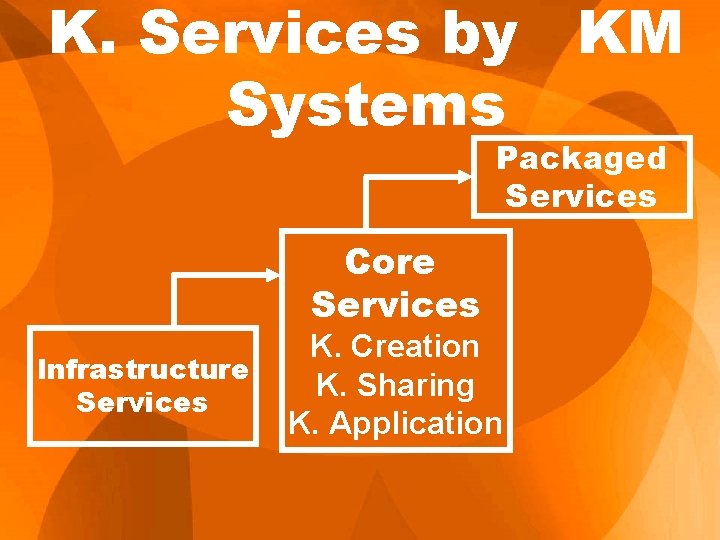
K. Services by KM Systems Packaged Services Core Services Infrastructure Services K. Creation K. Sharing K. Application
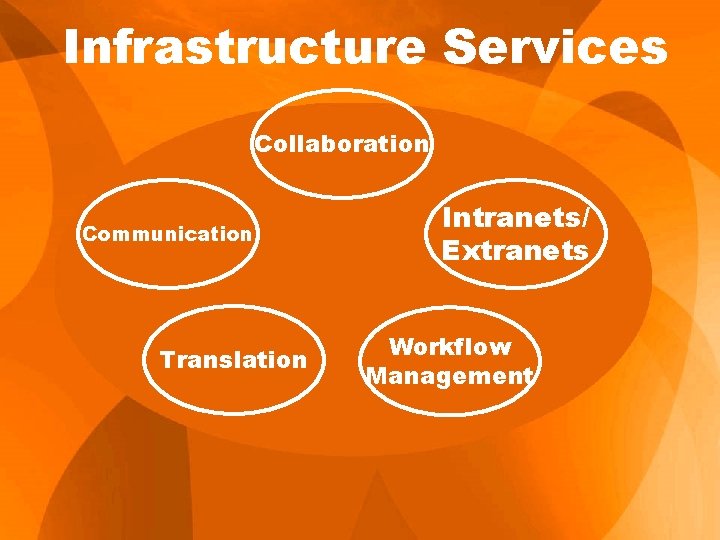
Infrastructure Services Collaboration Communication Translation Intranets/ Extranets Workflow Management
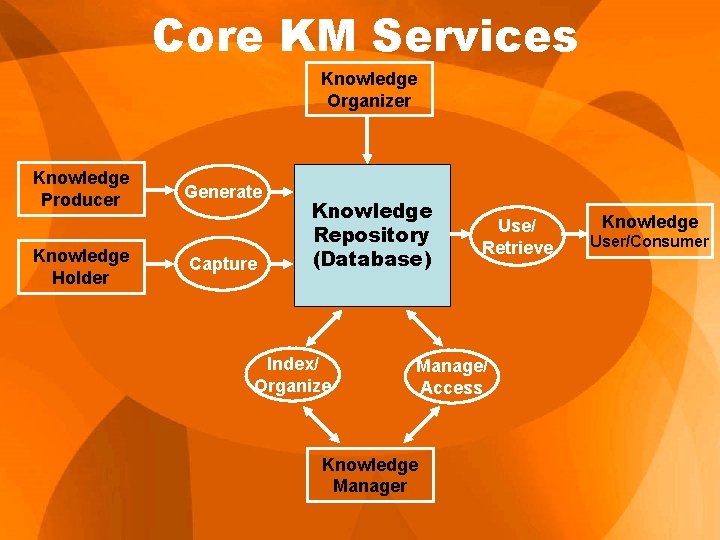
Core KM Services Knowledge Organizer Knowledge Producer Knowledge Holder Generate Capture Knowledge Repository (Database) Index/ Organize Use/ Retrieve Manage/ Access Knowledge Manager Knowledge User/Consumer
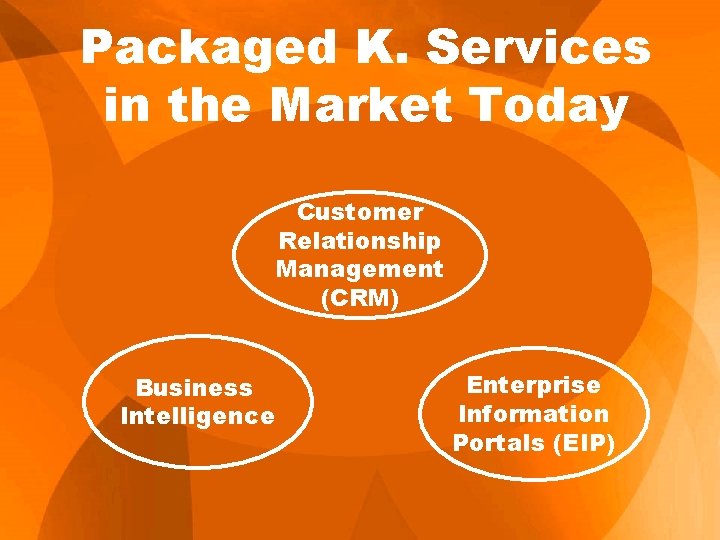
Packaged K. Services in the Market Today Customer Relationship Management (CRM) Business Intelligence Enterprise Information Portals (EIP)
CHALLENGES IN BUILDING KM SYSTEMS • Culture — Getting people to share knowledge • Knowledge Evaluation — Assessing the worth of knowledge across the firm • Knowledge Processing — Documenting how decisions are reached • Knowledge Implementation — Organizing knowledge and integrating it with the processing strategy for final deployment
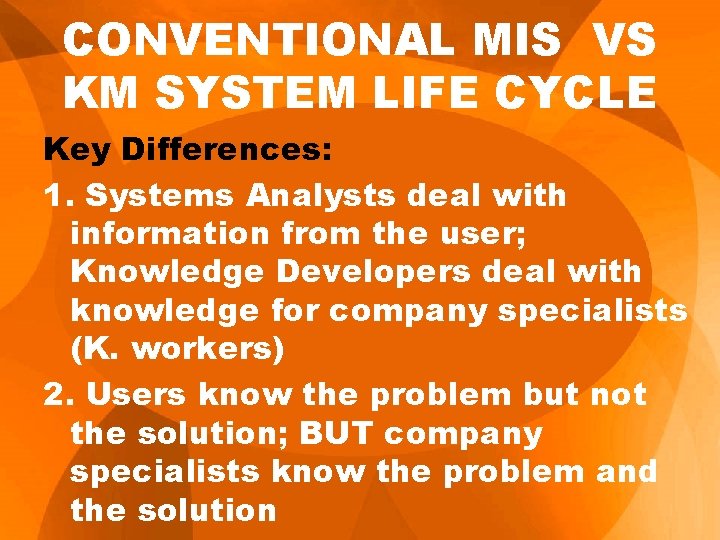
CONVENTIONAL MIS VS KM SYSTEM LIFE CYCLE Key Differences: 1. Systems Analysts deal with information from the user; Knowledge Developers deal with knowledge for company specialists (K. workers) 2. Users know the problem but not the solution; BUT company specialists know the problem and the solution
CONVENTIONAL MIS VS KM SYSTEM LIFE CYCLE 3. System Development is primarily Sequential; KMSLC is Incremental and Interactive. 4. Info System Testing normally at end of cycle; KM System Testing evolves from beginning of the cycle.
Conventional Vs KM System Life Cycle 5. Conventional system life cycle is Process-Driven “Specify then Build”; KMSLC is Result-Oriented “Start Slow and Grow” 6. Conventional system life cycle does NOT support Rapid Prototyping; KMSLC does
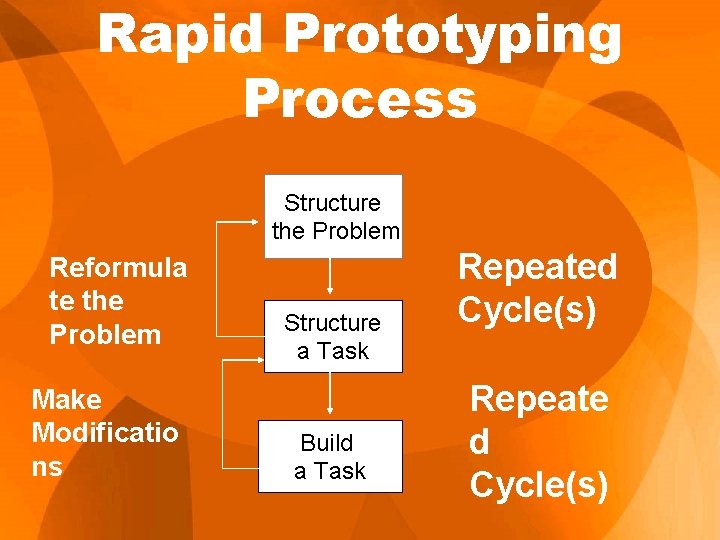
Rapid Prototyping Process Structure the Problem Reformula te the Problem Make Modificatio ns Structure a Task Build a Task Repeated Cycle(s) Repeate d Cycle(s)
Conventional Vs KM System Life Cycle Key Similarities: 1. Both begin with a problem and end with a solution. 2. Both begin with information gathering or capture.
Conventional Vs KM System Life Cycle 3. Testing is essentially the same to make sure the system is right and it is the right system 4. Both developers must choose the appropriate tool(s) for designing their respective systems
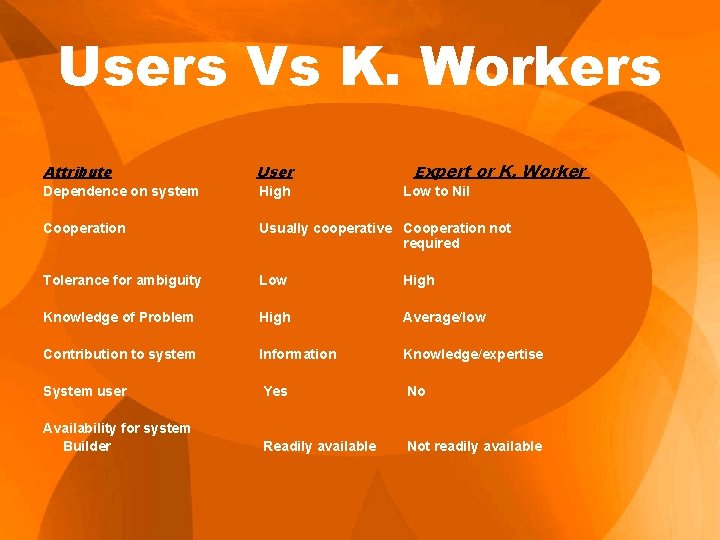
Users Vs K. Workers Expert or K. Worker Attribute User Dependence on system High Cooperation Usually cooperative Cooperation not required Tolerance for ambiguity Low High Knowledge of Problem High Average/low Contribution to system Information Knowledge/expertise System user Yes No Availability for system Builder Readily available Not readily available Low to Nil
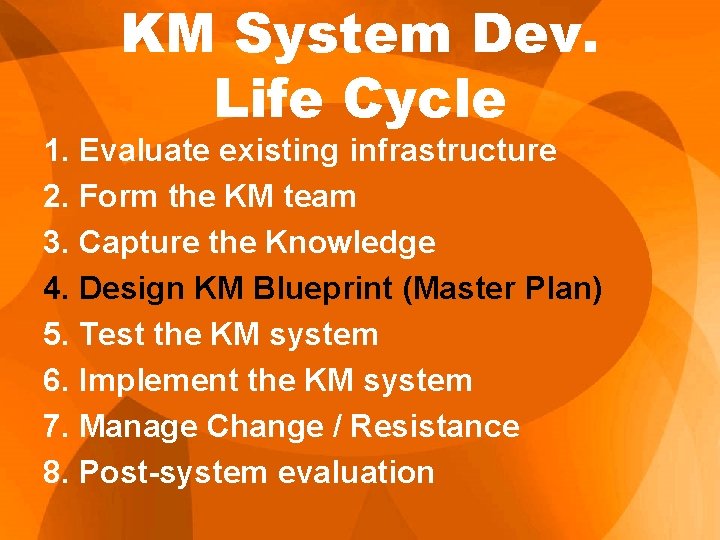
KM System Dev. Life Cycle 1. Evaluate existing infrastructure 2. Form the KM team 3. Capture the Knowledge 4. Design KM Blueprint (Master Plan) 5. Test the KM system 6. Implement the KM system 7. Manage Change / Resistance 8. Post-system evaluation