
Knowledge Management in Theory and Practice Lecture 13
- Slides: 36
Knowledge Management in Theory and Practice Lecture 13: The KM Team Textbook: Knowledge Management in Theory and Practice. Third Edition. MIT Press All rights reserved. No part of this book may be reproduced in any form by any electronic or mechanical means (including photocopying, recording, or information storage and retrieval) without permission in writing from the publisher.
Overview w The KM Team n n n Roles and Responsibilities in KM Critical Skills Job Titles and Potential Employers w The KM Profession n The Ethics of KM 2
KM Dream Team w Would together possess the following knowledge, skills and attributes: n n n n Communication Leadership Expertise in KM methodologies, processes, tools Negotiation skills Strategic planning skills Knowledge of the organization Holistic approach (systems view) Intuitive risk taker 3
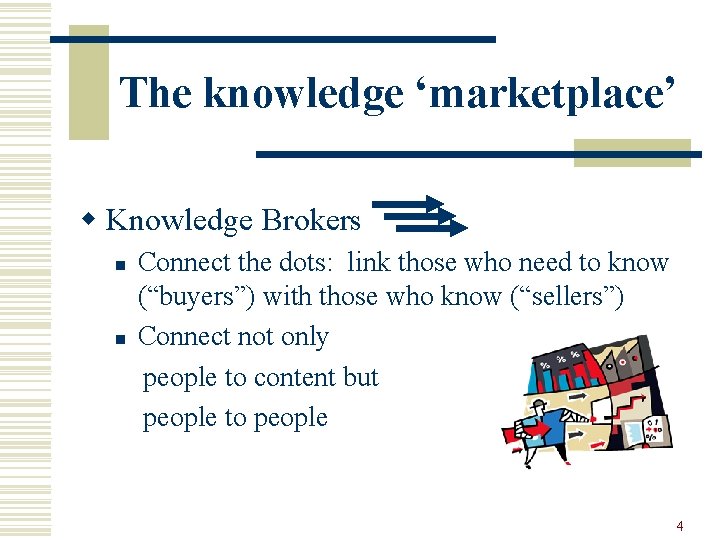
The knowledge ‘marketplace’ w Knowledge Brokers n n Connect the dots: link those who need to know (“buyers”) with those who know (“sellers”) Connect not only people to content but people to people 4
Skills, Attitudes, Work Habits… w TFPL – is a British company specialized in recruitment, consulting, training, and research n Library and information management n Knowledge management n Record management n Web management w Publish a skills map for KM – available on my. Courses 5
TFPL – 7 Critical KM Skills 1. 2. 3. 4. 5. 6. 7. Time management Learning techniques Information seeking techniques Advocacy and inquiry skills Networking skills Facilitation skills IT skills TFPL Skills Map 2000 6
TFPL – 6 critical dimensions 1. 2. 3. 4. 5. 6. Business and strategy Management Learning Communication Information-literacy Technology-literacy 7
Key KM Abilities w w w Able to learn efficiently and effectively – curiosity Initiative – doesn’t wait for instructions Collaboration – team player Able to connect the dots – “see the big picture” Humility – able to admit and learn from mistakes Able to think and act fast TFPL Skills Map 2000 8
Specific capabilities w w w Understands the business Communication Technology Understands key KM concepts Management, strategic planning Information management Leadership Change management Content organization Human resource management Project management 9
Major KM Roles w Chief Knowledge Officer (CKO) w Chief Learning Officer (CLO) w KM champion/leader w Knowledge manager w Knowledge navigator w Information architect w w w w Knowledge synthesizer Content editors Web developers Mentors, coaches HR roles Knowledge publishers Help desk activities 10
KM Responsibilities Designing information systems n n Designing, evaluating, or choosing information content, Database structures, Indexing and knowledge representation, Interfaces, networking, technology 11
KM Responsibilities… Managing information systems n n n maintaining the integrity, quality, currency of the data updating, modifying, improving the system operating the system Information resources management n managing organizational information resources to support organizational missions and for competitive advantage 12
KM Responsibilities… Training n n n Coaching, mentoring Community of practice start-up and lifecycle training support Feeding back lessons learned, best practices into training content 13
KM Responsibilities… Information agencies n n Acting as information consultants or guides for clients: advising, training, guiding on information, information sources, information use Acting as an agent on behalf of the client: gathering, evaluating, analyzing, synthesizing, summarizing information for a clients 14
KM Responsibilities… w Competitive intelligence w Customer relations for information systems/technology n n n acting as intermediaries between clients and information system designers translating client needs into functional specifications sales 15
KM Responsibilities… w Designing and producing information services and products n n publications, databases, information systems multimedia products w Stories from storytelling workshops w Knowledge journalist 16
KM Responsibilities… w Organizational information & KM policy analysts n n n Designing corporate, organizational information & KM policies access, quality control Maintaining proprietary information and KM Mapping corporate intellectual assets 17
KM Responsibilities… w Government KM policy analysts n n Formulating government policies at all levels regarding such issues as the KM infrastructure, access to and use of government information, intellectual property, privacy; Public/ private roles in knowledge creation, dissemination and use, government acquisition of information and information technology 18
Potential KM Employers Organizations concerned primarily with information content. w w w w Publishers Database creators and providers The press/mass media New media companies (e. g. , multimedia developers) Information collectors (e. g. , Reuters) Data service companies (e. g. , Mead) Value-added providers (e. g. , Standard and Poors) Disciplinary societies (e. g. , American Chemical Society, Canadian Mining & Metallurgical Society) 19
Potential KM Employers… Organizations concerned primarily with information & knowledge delivery. w w Telecommunications and cable companies Database vendors e. g. DIALOG Networks, service providers (e. g. , BARNET, ANS) Big Six Consulting Companies (PWC, E&Y…. ) 20
Potential KM Employers… Organizations concerned primarily with information technology. w w w The software industry Computer hardware companies and systems integrators, especially to develop criteria for hardware and software and optimize systems for customers Instructional technology development 21
Potential KM Employers… Organizations concerned primarily with information organization, access and preservation. w w w Libraries (e. g. , college/university libraries, public libraries, corporate libraries, school libraries, research libraries, other special purpose libraries such as hospital libraries) Museums Archives Data centers Hospitals and other medical organizations 22
Potential KM Employers… Information functions in organizations that are not primarily information organizations: w Design and management of information systems, paper and computer-based, for organizations of all kinds and sizes including banks, manufacturing, insurance. n n Internal information External information 23
Potential KM Employers… B. Application of information technology evaluation, selection, applications design - software industry, hardware, system integrators C. Research and information-gathering, synthesis, and evaluation - libraries, competitive intelligence units. D. Records Management, Document Management 24
Potential KM Employers… w Government n n Governmental agencies engaged in information production and distribution (e. g. , Bureau of Labor Statistics, Department of Commerce, National Center for Education Statistics, NTIS, ERIC, US Geological Survey, NIH, Bureau of the Census, Patent and Trademark Office, United Nations, World Bank, foreign governments. ) Canadian: Stats Can, Industry Canada, Health Canada, Environment Canada, DFO, DND…. 25
Potential KM Employers… B. Governmental agencies involved in information regulation n e. g. , Industry Canada regarding telecommunications regulation) C. Governmental agencies involved in information technology assessment, development and policy. D. Information resources management to help agencies accomplish their missions n e. g. , recent GAO report criticized Dept of Energy for inadequate information resources management which impeded its operations 26
Potential KM Employers… E. Intelligence community n e. g. CIA, CSIS, NSA, RCMP F. Agencies involved in policy formulation/decisionmaking: as consumers of information n n e. g. food and drug administration (US) CFIA (Canada)…. H. Law firms, medical practices, pharmaceutical companies – almost every type of organization! 27
Potential KM Employers… Other academic and research organizations: A. Large scientific enterprises n e. g. , Human Genome project, Mission to Planet Earth). B. Design and management of discipline-specific information systems. 28
Potential KM Employers… Specifically for Ph. Ds n n n Academic departments. Information industry firms for R&D. Government agencies. 29
Traditionally…. w Knowledge is kept in a ‘safe’ n Only ‘important people’ had the key w Possessing knowledge meant having power n Sharing knowledge meant losing your job! 30
The Challenge: w Evolve the role of the KM professionals such that they can: n n Improve the decision-making process Encourage innovation Enable the creation and sharing of valuable knowledge Provide access to knowledge l l internal and external knowledge Explicit and tacit knowledge w Increase ability to document and use knowledge 31
Non-traditionally…. The KSO Knowledge Support Office (e. g. Mc. Kinsey) w Identifies important knowledge resources within and outside of the organization w Ensures findability (efficient retrieval via catalog, index, thesaurus) w Maintains the ‘knowledge bank’ w Provides a one-stop shop for all knowledge needs w Knows who the experts are w Provides advice (recommends sources to consult, quality, usefulness etc) 32
KM Code of Ethics w Valuing human beings is the core of ethics in any environment w Ethics is considered simple whereas it is not w Boundaries can help members of an organization stay on the correct side of organizational policy and can help clarify ethical issues n n n Landmarks Fences DMZs (Demilitarized zones) 33
The Ethics of KM /2 w Landmark = high-level ethical guideline n n Often built upon the company’s culture E. g. value the demonstration of social responsibility among their employees Promote recycling, donating to local charities, paying employees to work on community events Often can be conveyed through good stories 34
The Ethics of KM /3 w Fences = explicit boundary that shows exactly where an important ethical line lies n n n E. g. official company policies on ethics They should be ubiquitous Policies define the fence and the procedures define operating within the limits of the ethical fence 35
The Ethics of KM /4 w DMZs = active compliance monitoring n n E. g. monitoring of software licenses Define exactly where the ethical line is Prevent employees from crossing the ethical line Monitors and reports any violations 36